When her children were small, evenings were busy and full.
Dinner on the table before exhaustion set in.
Baths and stories,
boys in their blanket sleepers,
clean and snuggly,
clamoring for stories and lullabies.
Years went by. Swim meets and soccer practice,
boy scouts and music lessons.
Dinner later and later.
Rushing seemed their only speed.
Then one of those boys left for college. Fewer games to cheer at,
mountains of laundry eroded to foothills.
Soon enough, both boys were gone.
Now she is greeted by a fluffy orange cat,
purring and happy to see her.
The house is quite.
Nowhere to rush to.
At times,
the silence of her empty house
made her feel
superfluous.
But most of the time, she welcomes the peace at day’s end.
In the kitchen, no longer rushed,
she finds pleasure chopping onions,
slicing carrots,
keeping time with the dripping rain.
Thank you to Stacey, Tara, Dana, Betsy, Anna, and Beth for this space for teachers and others to share their stories each day during the month of March and on Tuesdays throughout the year. Be sure to visit Two Writing Teachers to read more Slice of Life posts.
My role as literacy specialist encompasses three main responsibilities. I work with teachers to develop and refine curriculum and instruction, conduct model lessons in classrooms, and work with tier 3 readers in grades K-3. I love everything about my job, but the best part by far is working with tier 3 students. They work hard and will try their best, even if I’ve overshot what I think they can accomplish. I am in awe of them.
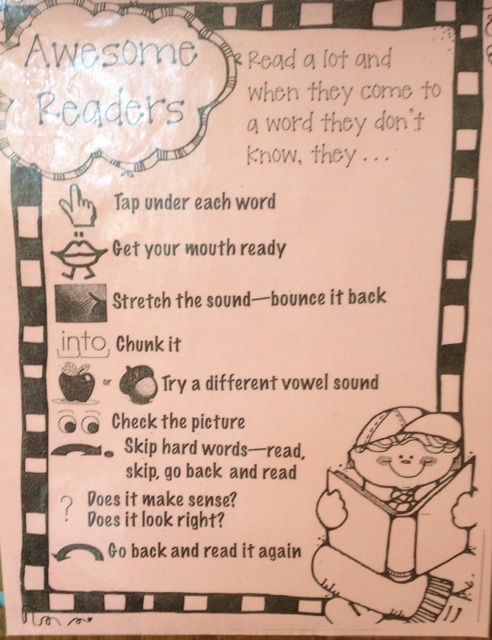
On Monday, one of my first grade students had a breakthrough moment. She has been struggling with learning short vowel sounds, so we’ve been practicing them. A lot. The word work portion of our session involved a mixed short vowel sort. She was doing a great job stretching out each sound, then blending them back into the whole word.
Then she came to the word “snug.” She covered up the -ug chunk, read sn, covered up the sn and read -ug. Then, with the confidence of a Hollywood star, she read “snug.” Hurrah! But she wasn’t finished. She turned to the “Awesome Readers…” chart right next toher, pointed to the “Chunk it” strategy, and proceeded to explain to me what she had just done and why it was better than stretching out each sound in the word!
To say that I was thrilled is an understatement. These kind of spontaneous metacognitive moments don’t happen every day. I praised her for using the strategy and the chart. I told her how proud I was of her for working so hard and for thinking about the strategies I’ve been teaching her. She was beaming!
I was never a cheerleader, but sometimes I feel like one as I work with my students. Of course I teach and model strategies for decoding and comprehension, but I also encourage students when they’re frustrated. I coach them through the hard parts. I celebrate their successes.
In her book Mindset: The New Psychology of Success, (Random House, 2007), Carol Dweck tells us “the view you adopt for yourself profoundly affects the way you lead your life.” In other words, my celebration and acknowledgement of my students’ hard work may be more important than the decoding skills they’re learning. For it is through this acknowledgement and celebration that they begin to see themselves as capable and confident. They begin to see themselves as readers.
Thank you to Stacey, Tara, Dana, Betsy, Anna, and Beth for this space for teachers and others to share their stories each day during the month of March and on Tuesdays throughout the year. Be sure to visit Two Writing Teachers to read more Slice of Life posts.
It’s been a busy weekend, filled with family, errands, cooking, and chores. And, in Connecticut at least, the sun was shining and the temperature climbed into the thirties! I actually went outside for a short walk. The birds were also happy with the weather, and one inspired this haiku:
From his frosty perch
a crimson cardinal chirps
welcoming the dawn.
By LASZLO ILYES, via Wikimedia CommonsThank you to Stacey, Tara, Dana, Betsy, Anna, and Beth for this space for teachers and others to share their stories each day during the month of March and on Tuesdays throughout the year. Be sure to visit Two Writing Teachers to read more Slice of Life posts.
“The writer should never be ashamed of staring. There is nothing that does not require his attention.”
~ Flannery O’Connor ~
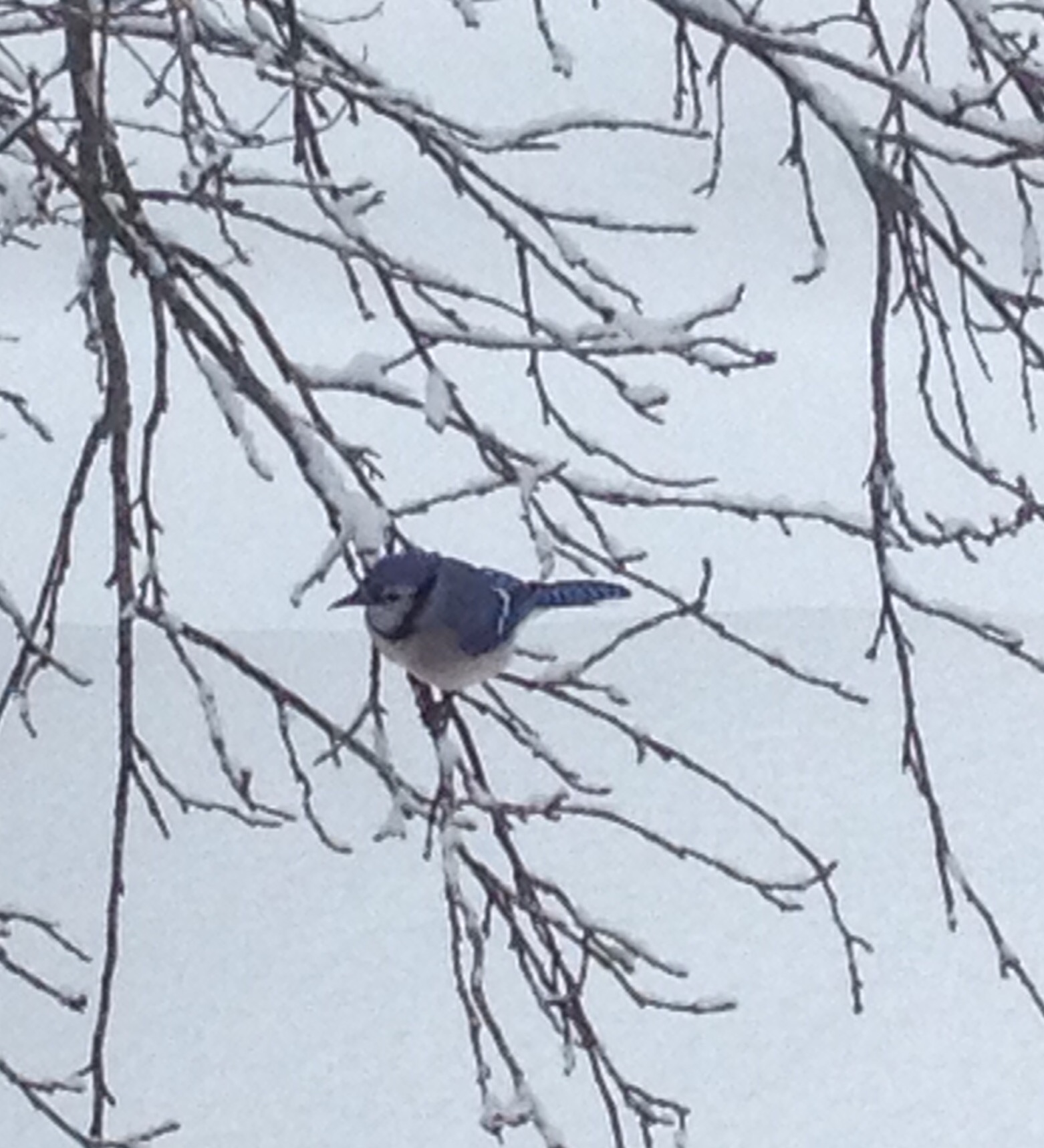
Like this blue jay and everyone else in the northeast, I’ve stared at plenty of snow this winter. So how hard could it be to come up with a poem for Carol Varsalona’s “Winter Whisperings” gallery? I had jottings about winter everywhere, a false start to a poem here, a line that definitely should be abandoned there. Nothing was coming together.
Taking a cue from Kate Messner, I decided to try to capture the many different moods of snow into one “Sometimes” poem.
“Sometimes Snow…”
Sometimes snow whispers itself into the world, falling gently to the ground,
muffling every sound.
Sometimes snow ROARS through the air,
the north wind sculpting it
into undulating drifts.
Sometimes snow settles on tree branches,
offering itself to
thirsty blue jays.
Sometimes snow is blue in the moon’s glow,
catching stark shadows,
crisp as X-rays.
But then, come March, snow begins to
melt.
At first just a trickle,
then a torrent,
filling brooks and
streams and rivers,
washing away
our winter weariness,
Be sure to visit Robyn Campbell for the Poetry Friday Round Up, and thank you to Stacey, Tara, Dana, Betsy, Anna, and Beth for this space for teachers and others to share their stories each day during the month of March and on Tuesdays throughout the year. Don’t forget to visit Two Writing Teachers to read more Slice of Life posts.
Have you ever ridden in the rumble seat of a 1930 Ford Model A? For a ten year old, almost nothing is more exhilarating.
When I was a kid, our neighbor owned a tree farm. Neat rows of shrubs, pine, willow, and birch trees stretched for a quarter mile from the edge of his yard, creating a miniature forest in the midst of miles of cow pastures. Narrow lanes lined the perimeter of the nursery, and one or two paths cut through the center, allowing easy access to all the trees.
Uncle Jack, as everyone called him, was my best friend’s uncle. He and his mother lived in a ranch house close to the road, built there I’m sure so there would be more room for trees. Because Lisa’s grandmother lived there, she and her brother Johnny spent a lot of time there. Because this was right next door, I spent a lot of time there, too.
Most of the time, we played all sorts of typical kid games. But on certain days, beautiful sunny days that were clear and warm, we went out in the Model A. Uncle Jack’s 1930 Ford Model A was stored in the back of the garage under a musty brown tarp. Johnny, who was two years older, loved to drive this car around the nursery and Lisa and I loved to ride with him.
Sadly, I don’t have a photo of Uncle Jack’s car. This is the closest copyright-free image I could find. By GPS 56 from New Zealand (1930 Ford Model A Roadster) [CC BY 2.0 (http://creativecommons.org/licenses/by/2.0)%5D, via Wikimedia Commons
The blue paint was faded, and the seats were hard and cracked, but we didn’t care. To us, this old car was a chariot that whisked us away to adventure. As soon as the car was out of the garage, Lisa and I scrambled up into the tiny seat that appeared like magic from where the trunk should have been. Then we were off along the the pathways between the trees.
I’m sure we never went more than 20 or 30 miles per hour, and maybe we didn’t even go that fast. Of course the lanes were rutted and uneven. But bouncing over the bumps was part of the thrill. And what a thrill it was to be riding along with the wind in our hair, the sun on our faces, and not a care in the world.
It’s almost unimaginable to me now that we were allowed this kind of freedom, to be driven around by a twelve or thirteen year old! Yet we never had a mishap of any kind and no one ever got hurt.
Soon enough, we outgrew the Model A and our afternoon drives. We were off on adventures beyond the boundaries of the nursery. But we carried away fond memories of those joyous days, cruising along those tree-lined lanes.
Thank you to Stacey, Tara, Dana, Betsy, Anna, and Beth for this space for teachers and others to share their stories each day during the month of March and on Tuesdays throughout the year. Be sure to visit Two Writing Teachers to read more Slice of Life posts.
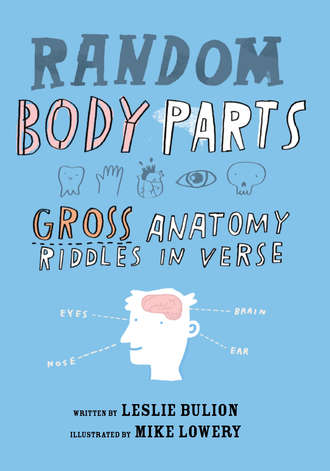
Today is an exciting day here at Reading to the Core! I’m so happy to welcome poet Leslie Bulion to talk about her third collection of nonfiction poetry, Random Body Parts: Gross Anatomy Riddles in Verse (Peachtree, 2015). Leslie is also the author of At the Sea Floor Cafe: Odd Ocean Critter Poems and Hey There, Stink Bug!, as well as four books of fiction. You can read about all of Leslie’s work on her website.
The words “gross” and “riddles” in the title of this collection will automatically lure readers who wouldn’t ordinarily pick up poetry. In the opening poem, Leslie invites readers to “Riddle Me This:”
“Of course you have a body,
But do you have a clue,
Where all the body parts you’ve got are found
And what they do?”
Leslie delivers on her promise of grossness. In “Lunchtime,” kids will learn which body part has “Mucus [oozing] from deep inside” and which makes “gobs of mucus disgusty.” (“The Gatekeeper”) Leslie’s poems are full of humor, and allusions to Shakespeare’s plays are woven into every poem. Side notes include the kinds of fascinating facts kids love. For example, didyou know your kidneys are the size of a gerbil?
Mike Lowery’s appealing illustrations blend cartoon-like drawings with photos and antique anatomical prints. Leslie included a glossary, as well as notes about the poetic forms used and the Shakespearean references. There is also a list of resources for further investigation.
Without further ado, welcome, Leslie!
Thanks so much for inviting me to your blog, Catherine!
Photo by Jen Schulten
I’m always interested to learn where authors get their ideas. What made you decide to write a poetry collection about anatomy?
A week of summer entomology camp for grown-ups sparked my science poetry journey as I thought about pairing two wonderful things that come in small packages: hundreds of millions of years of evolution packed into a critter the size of a beetle, and a poem’s elegant arrangement of words and ideas. From HEY THERE, STINK BUG, the next obvious stop for me was AT THE SEA FLOOR CAFE: ODD OCEAN CRITTER POEMS, since I have a graduate background in oceanography. I always mine my subjects for their full grossness potential, so moving on to body parts was–well–a no-brainer.
One aspect I love about the collection is that each poem contains an allusion to one Shakespeare. Why?
In my collections, I am always working from what I call my “big idea.” In RANDOM BODY PARTS, the big idea is riddles, since the subject matter is fairly familiar. I am carefully selective about the forms of poetry I use for each individual subject. One obvious place to start this collection was with a sonnet about the heart. I chose Shakespeare’s Sonnet #18 as my mentor text. Fun! I decided to keep playing with Shakespeare’s words and moved on to “Grumble, grumble, roil and rumble” inspired by the witches’ speech in Macbeth. Shakespeare’s rich words and phrases are part of our English lexicon and will be enjoyed over and over again during the lifetime of any reader–it’s never too early to start sampling the banquet!
Can you describe the process you used to research these poems?
I read GRAY’S ANATOMY and other reference books, used many excellent online sources, and my favorite: I watched the UC Berkeley online “General Human Anatomy” lectures given by the inimitable Dr. Marian Diamond (here’s a link to a NYTimes article about the class http://www.nytimes.com/2010/04/18/education/edlife/18anatomy-t.html?_r=0 ). Back to school! YAY! I reread Shakespeare, and read many recent reference books about Shakespeare’s language, and combed through lists of quotations, revisiting the original sources when something caught my eye.
I became a dedicated list-maker: lists of disembodied parts, lists of favorite Shakespeare lines, phrases and his wealth of invented words, lists of poetic forms I wanted to include. Then I played the match game. Some of the Shakespeare references are more obscure than others–the process was a challenge!
What advice can you give to teachers and students who are inspired to use Random Body parts as a mentor text and write their own collection of nonfiction poems?
In all of my collections, I try to include a range of poetic forms. Some forms are simpler and some are more complex. They all use some sense of rhyme and/or rhythm, and those aspects touch on math and music as well as language. This may seem counter-intuitive, but paring a body of science research down to a coherent and elegantly brief poem is a wonderful way for students to seek and demonstrate an integrated understanding of their subject matter. Rather than listing “facts,” I suggest finding the juicy nugget of story you’d like to communicate about your particular subject. What is the most interesting thing you’ve learned in your research? What was surprising? What connections have you made? Those are the ideas that give science poems their shape. I love the readers’ theater possibilities with poetry, and especially with poems for two (or more) voices. Also, writing and solving riddles taps all kinds of other skills, and provides many classroom possibilities for learning fun. On the illustration side of things, I think the book’s multi-layered design and Mike Lowery’s illustrations provide endless mentor art possibilities–so accessible, fun, and visually literate!
Who are your poetic influences? Favorite poets?
There are so many wonderful poets writing now that I’m going to limit my answer to the poets who set me on this path from my childhood (thought I didn’t know it at the time): A.A. Milne and Theodor Geisel, aka Dr. Seuss.
You say on your blog that even though you wrote poetry when you were younger, you didn’t always want to be a writer. What finally helped you decide to become a writer?
My friend Pam told me to. That’s the real answer. She is a writer and editor and has been my friend since I was 12. Well into adulthood I wrote her a long letter about making choices as a parent, and she asked me to write for the magazine PARENTS. Somewhere along the way I told her a story about something that happened to one of my daughters and she said, “That would make a good children’s story.” I’ve never looked back since.
Leslie, thank you so much for taking the time to answer my questions! I know teachers will be happy to include this collection in their health/anatomy units.
It is absolutely my pleasure, Catherine. I am so excited to add this new collection to my body of work!
Thank you to Stacey, Tara, Dana, Betsy, Anna, and Beth for this space for teachers and others to share their stories each day during the month of March and on Tuesdays throughout the year. Be sure to visit Two Writing Teachers to read more Slice of Life posts.
Today I’m also joining Alyson Beecher of Kit Lit Frenzy and other bloggers who feature nonfiction picture books each Wednesday. Thank you, Alyson, for this round up of terrific new nonfiction!
The word challenge is a appropriate on so many levels for this Slice of Life Challenge! How do I make the time to write everyday? How to read all the terrific posts being shared? How do I come up with an idea of what to write about Every. Single. Day.
It’s not that I don’t have ideas. It’s that they don’t always cooperate, or I don’t have the time I need to develop them. So what to do on those days?
A few months ago, I received an intriguing postcard advertising Rip the Page! Adventures in Creative Writing (Roost Books, 2010) by Karen Benke. The jacket copy goes on to say that the book “Includes wordplay, open-ended writing experiments, encouragement from writers and poets, and enough blank pages to let your words roam…” I ordered it immediately.
To say that this book is full of inspiration is an understatement. I could open up to any random page and have a topic to write about in under a minute. Today’s slice is courtesy “Favorite Words,” a page with sixty random words. Benke describes this as “a list of some of my favorite words to snack on.” I chose the word “honeysuckle,” which unleashed this:
By Aftabbanoori (Own work) [CC BY-SA 3.0 (http://creativecommons.org/licenses/by-sa/3.0)%5D, via Wikimedia CommonsThe potential of this book for classroom use is endless. I can’t wait to see what my students come up with based on their favorite words!
Thank you to Stacey, Tara, Dana, Betsy, Anna, and Beth for this space for teachers and others to share their stories each day during the month of March and on Tuesdays throughout the year. Be sure to visit Two Writing Teachers to read more Slice of Life posts.
“The miracle is this: The more we share, the more we have.”
~ Leonard Nimoy ~
Last week, I shared Jacqueline Woodson’s heart-breaking Each Kindness (Nancy Paulsen Books, 2012) with a fourth-grade class to begin a series of lessons on theme. As I read these words, “This is what kindness does, Ms. Albert said. Each little thing we do goes out, like a ripple, into the world,” the image sending Slice of Life posts out into the world came into my mind. There’s an important difference, though. When you share a Slice of Life post, the ripples of kindness return to you in wonderful and surprising ways.
I wrote my first March Slice of Life Challenge post without much forethought to what a month of blogging EVERY DAY would entail. I certainly didn’t have a plan. I know that I NEVER anticipated the way my posts would ripple back to me.
Through this warm, supportive community, I’ve made so many friends I’m afraid if I start to mention you all, I’ll forget someone. When I was NCTE’s national convention last November, I don’t think there was a single session when I didn’t sit with a friend made through Slice of Life or blogging. The truth is, the kindness sent out by this community is overwhelming. Thank you to all of you who have influenced me and helped me grow as a teacher, writer, and human being.
Bruce Coville wrote in his poem, “Ripples” that
“Words and gestures ripple outward,
What shores they reach we cannot name.”
I can’t wait to see where this year’s ripples take us. Happy Slicing, everyone!
Thank you to Stacey, Tara, Dana, Betsy, Anna, and Beth for this space for teachers and others to share their stories each day during the month of March and on Tuesdays throughout the year. Be sure to visit Two Writing Teachers to read more Slice of Life posts.
At the beginning of the month, Michelle Barnes shared a terrific interview with David Elliot on her blog, Today’s Little Ditty. David challenged readers to write a “letter poem to a bird, animal, or other object of our choice.” I have been thinking about this challenge all month, but couldn’t decide what or whom to write to until today when a friend shared a link to this video on Facebook.
I was hooked. After watching the video several times, scrolling through the other photos posted on this site, and, as David suggested, doing some research, I drafted this letter poem to Mr. and Mrs. Eagle.
Dear Mr. and Mrs. Eagle,
The world has snatched the privacy of your tree-top aerie;
While on a clutch of eggs you brood,
to our TV screens we’re glued.
We marvel at your fortitude, braving wind and snow in solitude,
to tend your unborn chicks with care
one hundred feet up in the air.
Taking turns to hunt and fish, you bring your mate a tasty dish.
Now it’s your shift on the nest;
roll those eggs, then get some rest.
We’ll be watching all month long, waiting to hear your newborns’ song.
Thank you, Michelle and David, for this challenge! Please be sure to visit Michelle’s blog to read more letter poems, and don’t forget to visit Heidi Mordhorst at My Juicy Little Universe for the Poetry Friday Round Up.
My colleagues and I have been busy teaching and revising informational writing units of study. We’ve been concerned, though, about having enough good mentor texts for our Kindergarten through second grade students to emulate. A traditional five-paragraph essay is NOT our goal, yet an organizational structure is needed so they don’t write pages and pages of random facts. This week I found two informational texts with unique structures that will be inspiring mentor texts for young writers.
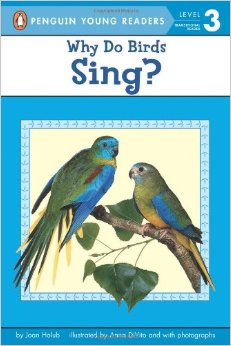
Why Do Birds Sing? (Penguin Young Readers, 2004) by Joan Holub and illustrated by Anna DiVito is a question-and-answer book. Holub anticipates any question kids might have about birds, then responds with brief, informative answers. DiVito’s cartoon-like illustrations are paired with color photos that provide close up views of many familiar species.
This book is a terrific mentor text. Children have many questions about subjects they’re interested in, and this question-and-answer structure is a perfect way for them to organize their research findings. Text features in Why Do Birds Sing? are limited to photographs and labels, but the photos have been thoughtfully chosen to illustrate and/or support the information being presented.
Holub and DiVito have also teamed up to create Why Do Dogs Bark?, Why Do Cats Meow?, and others that answer these urgent questions that all kids ask.
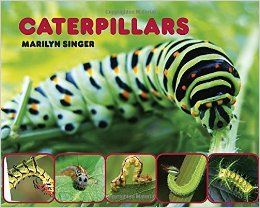
Caterpillars, by Marilyn Singer (EarlyLight Books, 2011) is a fact-filled book lavishly illustrated with close-up color photographs of both familiar and unfamiliar caterpillars. What I really love about this book, though, is its unique structure. Poet Singer (who was recently awarded the National Council of Teachers of English Award for Excellence in Poetry for Children) begins the book with a poem introducing caterpillars. Here is the first stanza:
Caterpillars smooth,
Caterpillars hairy.
Munching in a giant bunch,
Lunching solitary.
The poem is followed by a page devoted to elaborating each line, providing young readers with all sorts of interesting facts. Each page is also filled with gorgeous color photographs showing examples of the species or behavior described in the text. There is also a quiz, a matching game (caterpillar-to-moth/butterfly), glossary, resource list, index, and more.
Caterpillars, which was named a National Science Teachers Association Outstanding Trade Book for Science in 2012, is listed by the publisher as being appropriate for K-2 students. But I think older students would also enjoy Singer’s informative, accessible writing style and have fun creating their own poem to organize their informational writing.
Both of these books are excellent mentors for a whole class book on a single topic, or for individuals writing about a topic of their choice. Best of all, they are engaging nonfiction texts that can be enjoyed as read-alouds or as independent reading by all elementary age students.
Don’t forget to visit Jen at Teach Mentor Texts and Kellee at Unleashing Readers to find out what other people have been reading lately. Thanks, Jen and Kellee, for hosting!


![By LASZLO ILYES from Cleveland, Ohio, USA (♂ Cardinal Uploaded by Snowmanradio) [CC BY 2.0 (http://creativecommons.org/licenses/by/2.0)], via Wikimedia Commons](https://readingtothecore.com/wp-content/uploads/2015/03/cardinalis_cardinalis_-cleveland_ohio_usa_-male-8.jpg)
![Sadly, I don't have a photo of Uncle Jack's car. This is the closest copyright-free image I could find. By GPS 56 from New Zealand (1930 Ford Model A Roadster) [CC BY 2.0 (http://creativecommons.org/licenses/by/2.0)], via Wikimedia Commons](https://readingtothecore.com/wp-content/uploads/2015/03/1930_ford_model_a_roadster_11164444945.jpg)

![By Aftabbanoori (Own work) [CC BY-SA 3.0 (http://creativecommons.org/licenses/by-sa/3.0)], via Wikimedia Commons](https://readingtothecore.com/wp-content/uploads/2015/03/honeysuckle-2.jpg)