
What can I say? Friday came and went in a blur, just like the red-bellied woodpecker who inspired this poem!
flashing his red cap,
forest archeologist
drills for hidden grubs
© Catherine Flynn, 2017
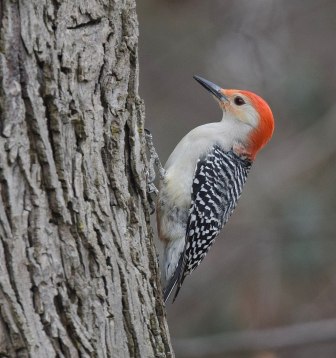
What can I say? Friday came and went in a blur, just like the red-bellied woodpecker who inspired this poem!
flashing his red cap,
forest archeologist
drills for hidden grubs
© Catherine Flynn, 2017
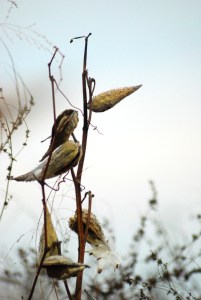
dried milkweed pods
catch winter’s first whispers
with alien ears
© Catherine Flynn, 2017
Please be sure to visit Lisa at Steps and Staircases for the Poetry Friday Roundup.
Years ago, when my kids were busy teenagers playing sports, taking music lessons, and all the rest, I heard a report about the danger of velocitization. The idea is that driving too fast on the highway distorts your sense of speed, which can make you drive even faster. The story pointed out the related danger of continuing to drive fast once you were off the highway.
For some reason, I felt like my whole life was velocitized this week. It was an awful feeling.
What better antidote to this feeling than reading poetry? A member of my book club suggested we read a book of poetry, so our selection this month is Sailing Alone Around the Room, by Billy Collins. I read this book years ago, but I’m savoring each poem as I read them again (and again).
“The Brooklyn Museum of Art” is one of my favorites. It has reminded me to put on the brakes and let “birdsong…[halt] me in my tracks”.
“The Brooklyn Museum of Art”
by Billy Collins
I will now step over the soft velvet rope
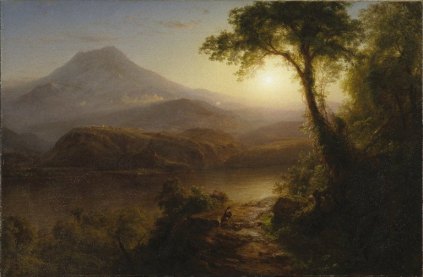
and walk directly into this massive Hudson River
painting and pick my way along the Palisades
with this stick I snapped off a dead tree.
I will skirt the smoky, nestled towns
and seek the path that leads always outward
until I become lost, without a hope
of ever finding the way back to the museum.
I will stand on the bluffs in nineteenth-century clothes,
a dwarf among rock, hills, and flowing water,
and I will fish from the banks in a straw hat
which will feel like a brush stroke on my head.
And I will hide in the green covers of forests
so no appreciator of Frederick Edwin Church,
leaning over the soft velvet rope,
will spot my tiny figure moving in the stillness
and cry out, pointing for others to see,
and be thought mad and led away to a cell
where there is no vaulting landscape to explore,
none of this birdsong that halts me in my tracks,
and no wide curving of this river that draws
my steps toward the misty vanishing point.
Please be sure to visit Linda Baie at Teacher Dance for the Poetry Friday Roundup.
Today is NCTE’s National Day on Writing. This year’s theme is #Why I Write. As I thought about how to respond to this, I realized there isn’t just one reason. There are as many reasons as stars in the sky. I write to remember the moon winking at me in the morning as I stand at my kitchen sink. I write to feel the warmth of my grandmother’s hand in mine once more, and the sweet smell of her kitchen when she baked pies. I could go on and on. Or maybe there is only one reason: love. I write because I love watching people and the world around me and trying to capture the beauty of it all in words.
This poem was inspired by a lone ladybug crawling along my porch railing last weekend. As I watched, I realized it’s just about time for the invasion of the ladybugs.
As red as ripe berries,
a horde of ladybugs
swarm every room,
crawling on walls,
buzzing over chairs,
scuttling into corners
where walls meet ceiling
nestling into beams of warm October sun,
punctuating autumn’s golden days,
declaring summer’s end.
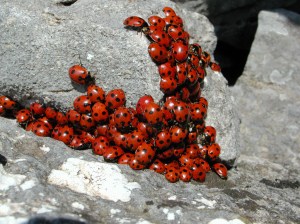
© Catherine Flynn, 2017
Please be sure to visit Leigh Ann Eck at A Day in the Life for the Poetry Friday Roundup.
Last week I shared the section of Walt Whitman’s Song of Myself that includes this line:
“…you shall possess the good of the earth and sun…”
As I read and reread this poem, a Golden Shovel started to form in my mind.
Please be sure to visit the talented and lovely Irene Latham at Live Your Poem for the Poetry Friday Roundup.
“Our task must be to free ourselves by widening our circles of compassion
to embrace all living creatures and the whole of nature in its beauty.”
~ Albert Einstein ~
I recently finished reading The Invention of Nature: Alexander Humboldt’s New World, by Andrea Wulf. At 400 pages, this book isn’t a quick read, but it’s worthwhile and enlightening. Born in 1769, “Humboldt gave us our concept of nature itself.” In this amazing book, Wulf describes Humboldt’s life and work as well as his influence on Charles Darwin, Henry David Thoreau, and John Muir, and countless other scientists, artists, and writers. In fact, Wulf writes, “Humboldt’s views have become so self-evident that we have largely forgotten the man behind them.”
A “sense of wonder for the natural world” lay at the heart of Humboldt’s work and writings, and is also found in the work of his followers. The importance of sharing and nurturing this wonder feels more urgent today than ever.
With Wulf’s words about Humboldt still swirling in my brain, it felt like serendipity when I came across these much-loved lines from Walt Whitman’s Song of Myself:
Stop this day and night with me and you shall possess the
origin of all poems,
You shall possess the good of the earth and sun—there are
millions of suns left,
You shall no longer take things at second or third hand,
nor look through the eyes of the dead, nor feed on the
specters in books,
You shall not look through my eyes either, nor take things
from me,
You shall listen to all sides and filter them from yourself.
Here’s to listening to the world from all sides and learning the lessons nature is desperately trying to teach us.
Please be sure to visit Violet Nesdoly for the Poetry Friday Roundup.
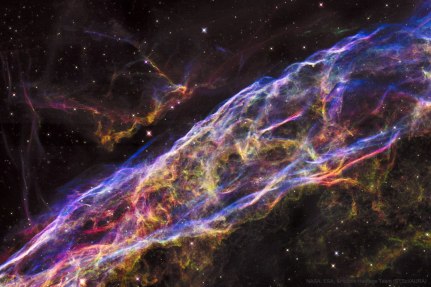
I was two years old when John F. Kennedy declared “we chose to go to the moon…and do other things not because they are easy, but because they are hard.” Space exploration was woven into the background of my childhood, and it has always captivated me. So I was paying close attention last week as the Cassini spacecraft met its fiery end in Saturn’s butterscotch clouds. Cassini and its mission to explore Saturn, its rings, and moons seemed like a worthy subject for Michelle Barnes’s September ditty challenge from Carole Boston Weatherford.
It soon became clear, though, that writing an abecedarian about Saturn and the Cassini mission would be hard! It threatened to become a list of some of Saturn’s 53 named moons. Not giving up, I expanded my focus to include the whole universe and came up with this draft.
Astral bodies:
comets,
dwarf planets with
eccentric orbits,
frozen moons,
glowing stars,
haloes of hydrogen and helium
illuminating
jet black space,
kindling wonder,
launching dreams to
mine the mysteries of
nebulous interstellar dust, the
Oort cloud,
pulsing quasars, and
rotating
spiral galaxies
tumbling through the
universe, emitting
visible and invisible
wavelengths of light and
X-rays,
yielding amazement and awe, our
zeal for discovery never-ending.
© Catherine Flynn, 2017
Please be sure to head over to Amy Ludwig Vanderwater’s Poem Farm for the Poetry Friday Roundup!
This picture, taken at the Highlights Foundation last year, popped up in my Facebook feed this morning:
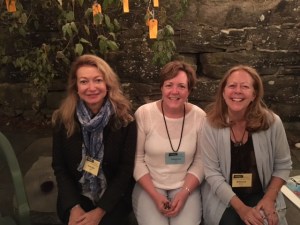
What a magical few days I had there, spending time with Rebecca, Georgia and so many other Poetry Friday friends! It made me realize how far I’ve drifted from my poetry practice and how much I miss it. In “What to Remember When Waking,” David Whyte asks “What shape waits in the seed of you/to grow and spread its branches/against a future sky?” I love the endless possibilities contained in this question. With renewed resolve, I can’t wait to find out.
“What to Remember When Waking”
by David Whyte
In that first hardly noticed moment in which you wake,
coming back to this life from the other
more secret, moveable and frighteningly honest world
where everything began,
there is a small opening into the new day
which closes the moment you begin your plans.
What you can plan is too small for you to live.
What you can live wholeheartedly will make plans enough
for the vitality hidden in your sleep.
To be human is to become visible
while carrying what is hidden as a gift to others.
To remember the other world in this world
is to live in your true inheritance.
You are not a troubled guest on this earth,
you are not an accident amidst other accidents
you were invited from another and greater night
than the one from which you have just emerged.
Now, looking through the slanting light of the morning window
toward the mountain presence of everything that can be
what urgency calls you to your one love?
What shape waits in the seed of you
to grow and spread its branches
against a future sky?
Read the rest of the poem here.
Please be sure to visit Michelle Heidenrich Barnes at Today’s Little Ditty for the Poetry Friday Roundup.
This week I’ve been reading poemcrazy: freeing your life with words (1996) by Susan Goldmsith Wooldridge. I found this book as I was scrolling though my Twitter feed a few weeks ago. If you aren’t familiar with it, go find it now. You won’t be sorry.
Sometimes writing poems does drive me crazy, but this book makes you fall-in-love crazy about poetry. Wooldridge is a cheerful, enthusiastic teacher. In the first section of the book, “Following Words”, she urges us to collect words and “create a wordpool.” “The great thing about collecting words,” she writes, “is they’re free; you can borrow them, trade them in or toss them out.” Each short chapter is followed by suggestions for practice. This draft grew out of those suggestions.
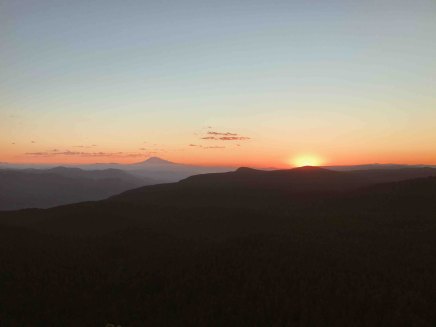
The canary sun
sets the sky aglow,
whispering pink
at the edge of day
like a conch,
whispering
the memory
of ocean waves.
Please be sure to visit Matt Forrest Esenwine at Radio, Rhythm, & Rhyme for the Poetry Friday Roundup. And to all my friends around the country who are facing hurricanes or fires, please stay safe!
This fall I’m teaching a six-week exploratory course on gardening to 4th and 5th graders. Six weeks isn’t much time, but we’ve already suspended an avocado pit in water, planted oregano, and brainstormed a list of questions we want to answer. Later today we’ll be planting potatoes and next week we’re starting herb gardens.
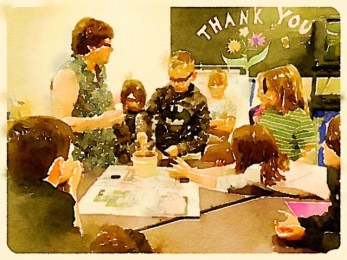
In addition to all these seeds sprouting, I’d like some writing to blossom during our course. A “things to do” list poem is a form we can collaborate on, and lends itself nicely to a short time frame. Here is a poem I drafted to use as a model.
Things to do if you’re a seed…
nestle into rich, warm soil
soak up plenty of water
swell like a sponge
split your coat
plunge thirsty roots deep into the earth
poke an eager stem into the air
sprout feathery leaves
drink up the sun’s shimmering rays
then grow…
© Catherine Flynn, 2017
Please be sure to visit Kathryn Apel for the Poetry Friday Roundup.

