I spent much of the evening working on a writing project that I hope to tell you about one day. After playing with one four-line stanza for the better part of an hour, it was time to step away. My brain was too muddled to make any more progress on this day. Then I realized I hadn’t written anything for Poetry Friday! I searched my recent jottings and found the bare bones of this poem hiding in my notebook. Since this is what I’d been doing all evening, it seemed appropriate to polish it up a bit and share it today.
Find a word write it down play with its meaning listen to its sound.
Pick another do the same string them together make it a game.
Soon you will have a new work of art a story or poem straight from your heart.
Please be sure to visit Michelle Heidenrich Barnes at Today’s Little Ditty for the Poetry Friday Roundup. Also, a big thank you to Stacey, Betsy, Beth, Kathleen, Deb, Melanie, and Lanny for creating this community and providing this space for teachers and others to share their stories every day in March and each Tuesday throughout the year. Be sure to visit Two Writing Teachers to read more Slice of Life posts.
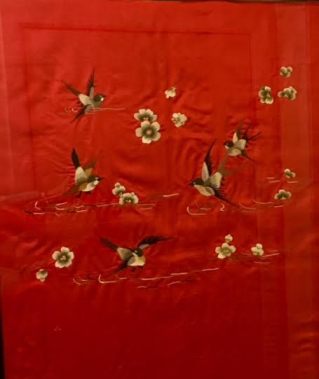
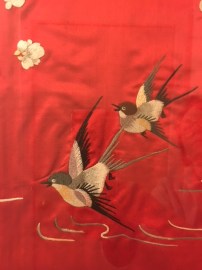
Have you ever had the experience of passing an object on a daily basis and not really seeing it? We get so wrapped up in our busyness that we fail to notice the beauty present all around us. This is certainly true of this silk embroidery. It was given to my husband’s grandfather, an Army major, when he served in Southeast Asia during World War II. (I’m embarrassed to admit I don’t know exactly where or by whom.) When our son, the first son of a first son, was born, Rodney’s grandparents gave it to us. It’s been hanging in our upstairs hallway ever since, but I never really stop to LOOK at it.
When Laura Shovan announced that her February Poetry Project would be ekphrastic poetry inspired by art in participant’s homes, I knew I wanted to share this embroidery. These playful birds and delicate petals deserve a poem. (Or a dozen or more!)
Playful swallows swoop
among dancing white blossoms
chittering, chirping
iridescent acrobats
tumbling on a spring breeze
Don’t forget to visit Renée LaTulippe at No Water River for the Poetry Friday Roundup. Also, thank you to Stacey, Betsy, Beth, Kathleen, Deb, Melanie, and Lanny for creating this community and providing this space for teachers and others to share their stories every day in March and each Tuesday throughout the year. Be sure to visit Two Writing Teachers to read more Slice of Life posts.
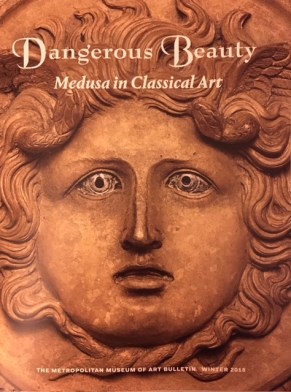
Every month I look forward the Ditty Challenge that Michelle Heidenrich Barnes shares on her blog. In February, to celebrate their new book, Last Laughs: Prehistoric Epitaphs (Charlesbridge, 2017), J. Patrick Lewis and Jane Yolen challenged Michelle’s readers to write an epitaph poem. All month I’ve been at a loss for a topic. Then, yesterday, inspiration arrived in the mail:
“An Epitaph for Medusa”
With slithering, serpentine hair
and a cold, penetrating stare,
you turned men into statues of stone, so most mortals left you alone.
But while you slumbered in bed, Perseus chopped of your head. Now, instead of resting in Elysian’s field, you’re entombed on Athena’s bronze shield.
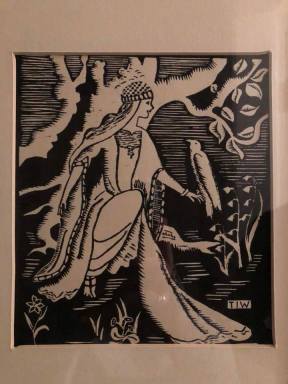
Like many Poetry Friday friends, I’m participating in Laura Shovan‘s 6th Annual February Daily Poem Project. This year’s theme is ekphrasis. Each day, a group member posts a photo of a work of art in his or her home. The variety of works shared during the past week alone has been astounding. I haven’t been able to keep up and write a poem every day, but I’m trying. This daily writing is stretching my poetry muscles in different ways and has yielded many surprises. Almost accidentally, I’ve also been playing with new and different forms. Last week, I shared an abecedarian. This week, Heather Meloche shared a block print created by her grandmother, Thelma Wilson Brain.
Troubadours and courtly love immediately came to mind, so I decide to tried my had at a lai. In The Essential Poet’s Glossary, Edward Hirsch writes that “in Old French Poetry, a lai is a short lyrical or narrative poem…usually written in octosyllabic verse.” Sticking to a strict syllable count and rhyme scheme was quite a challenge. I tried not to sacrifice sense while maintaining both, but don’t think I completely succeeded. In any case, this draft was fun to write, and brought back many fond memories of a favorite English professor who specialized in the lais of Marie de France.
The Maiden and the Dove
When troubadours in days of old Sang songs of maids with hair of gold, Sweet lady Jane traversed a wood To where the sacred hazel stood. Beneath its boughs she met a dove Who trilled the promise of true love. “Gather rosebuds of red and white. Present them to a gallant knight. For you he will forego all strife, Preferring an idyllic life.”
No damsel in distress was she, Jane soon was down upon one knee. “Dear dove, thank you for these wise words But taking such advice from birds Seems like a foolish plan to make And sure would bring me much heartache. Don’t fill my head with fluff and froth. I’ll only ever pledge my troth To one who’s loyal and steadfast, Whose bravery is unsurpassed. On such a man I will bestow My tender love, then all will know.”
To her word, gracious Jane was true, Tales of her love and kindness grew, Throughout the land her story was told, By troubadours in days of old.
The first few lines of this poem, inspired by the first prompt of Laura Shovan’s 6th Annual February Daily Poem Project, came to me in alphabetical order. I’ve been working on an abecedarian for my WIP, so I decided to go with my instinct and get some practice with the form.
an ancient poetic form guided by alphabetical order. Generally each line or stanza begins with the first letter of the alphabet and is followed by the successive letter, until the final letter is reached.
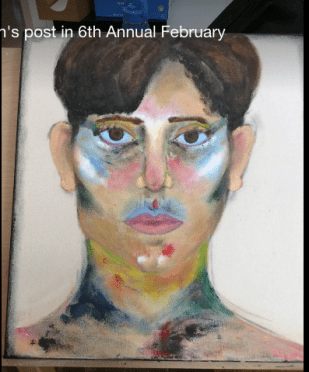
Unfinished self-portrait by Jay Shovan
To me, the pain in this painting is palpable, but Jay’s eyes are strong and steady. It felt necessary to acknowledge a possible source of what look like bruises (Real? Metaphorical? Does it matter?), yet see into the fulfilling future those piercing eyes are looking toward.
A Bully’s words, Calculated for maximum Damage, Echo through my brain Forever, Grow softer, but never fully Heal. I want to scream, “Who are you to Judge me? Because I Know Lurking behind your Malicious mask is a Neglected soul. On my neck, this Patchwork Quilt of colors will fade, Recede from sight and I will Stitch my soul back Together Until Vibrant White sails unfurl. I’ll become a Xebec,* sail to far away shores, leaving Your taunts behind, reaching my Zenith despite you.
* “a small, three-masted ship with overhanging bow and stern, once common in the Mediterranean.” (Webster’s New World Dictionary)
Don’t forget to visit Donna Smith at Mainely Write for the Poetry Friday Roundup. Also, please stop by my friend and critique group partner Linda Mitchell’s blog, A Word Edgewise. Linda invited me to answer a few questions about poetry and writing. It was revealing process to reflect on Linda’s questions, and I thank her for the opportunity. As usually happens, when I read my responses, I realized I neglected to mention all my poetry mentors, especially Laura Purdie Salas and Mary Lee Hahn. Forgive my addled brain!
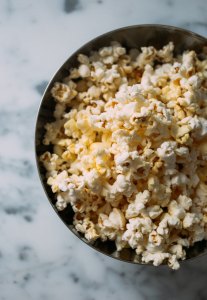
Did you know today is National Popcorn Day? It is also one of those days when I was at a bit of a loss about what to share for Poetry Friday. So I casually Googled “popcorn poems.” Maya Angelou’s “I Love the Look of Words” was one of the results. The title sounded vaguely familiar, and as I started reading it, I realized this poem is one I shared with my third graders for many years.
Angelou’s poem is a celebration of words and ideas, bouncing around in our brains like popcorn. I’m sorry this poem lay tucked away in my memory for so long. I’m happy National Popcorn Day brought it back up to the surface.
“I Love the Look of Words”
Popcorn leaps, popping from the floor of a hot black skillet and into my mouth. Black words leap, snapping from the white page. Rushing into my eyes. Sliding into my brain which gobbles them the way my tongue and teeth chomp the buttered popcorn.
When I have stopped reading, ideas from the words stay stuck in my mind, like the sweet smell of butter perfuming my fingers long after the popcorn is finished.
I love the book and the look of words the weight of ideas that popped into my mind I love the tracks of new thinking in my mind.
by Maya Angelou
Photo by Charles Deluvio via Unsplash
Grab a bowl of popcorn and visit Kay McGriff at A Journey Through The Pages for the feast of poetry served in the PF Roundup.
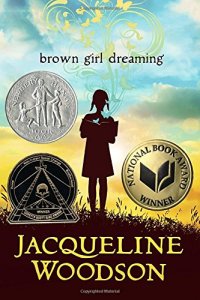
“I believe in one day and someday and this perfect moment called Now.” Jacqueline Woodson
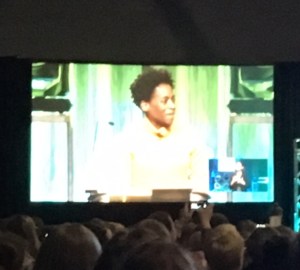
I was lucky enough to be in the audience at NCTE’s Annual Convention last November when Jacqueline Woodson read this passage from Brown Girl Dreaming, her award-winning memoir in verse. Woodson’s work has always had a place in my classroom, and I am thrilled that she has been named the next National Ambassador for Young People’s Literature. This role will allow her to travel around the country sharing her message that “books can drive change and instill hope in young readers.” She summed up her vision as ambassador as “Reading = Hope x Change.” You can hear Woodson talk more about this vision in this NPR interview.
During her speech at NCTE, students from around the country asked questions via pre-recorded video. One student wondered why Woodson chose to write Brown Girl Dreaming and her recent novel Another Brooklyn in verse. Woodson’s brilliant response? “I wrote it in verse because that’s how memory comes to us.”
In “on paper,” from Brown Girl Dreaming, Woodson shares this memory:
Woodson reminded the teachers at NCTE that “everybody has a story, and everyone has a right to tell that story. Encourage students to tell their stories.” It’s clear that Woodson’s work springs from her own story, her own memories. But her writing also shines with her love for her fellow humans. She urged her NCTE audience to remember that “community is so important. We need to know who we are going to walk through the world with.” I am happy I’m walking through the world with Jacqueline Woodson.
Please be sure to visit Jan Godown Annino at Bookseedstudio for the Poetry Friday Roundup.
Happy New Year! Welcome to the first Poetry Friday Roundup of 2018! If you’re new to Poetry Friday, you can learn more from Renée LaTulippe at No Water River.
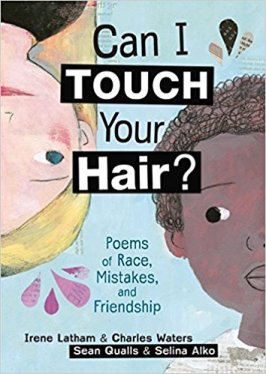
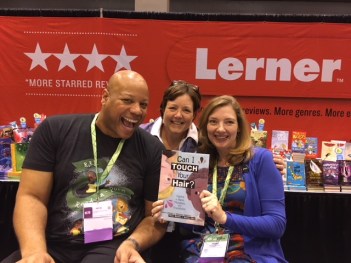
Today I’m proud to feature a brave and beautiful new book by two dear poetry friends, Irene Latham and Charles Waters, Can I Touch Your Hair? Poems of Race, Mistakes, and Friendship, published by Carolrhoda Books on January 1, 2018. With starred reviews from Kirkus and Publisher’s Weekly, this book deserves a place in every classroom. (A Teacher’s Guide is available here.)
Assigned to work together on a poetry project, Irene and Charles are ambivalent. Irene articulates this with the frank honesty of childhood: “Charles is black/and I am white.”
Overcoming their misgivings, they find common ground in the everyday worries of all kids, and begin by writing about shoes and hair. These subjects soon give way to more serious topics such as saying the wrong thing, racial tensions, police brutality, and fear of others because they look different.
They walk the tightrope of adolescent friendships when Irene’s request to join “the black girls/ play[ing] freeze dance” and Charles’s friends “play me dirty.” The poems reveal an unfolding friendship, which Sean Qualls and Selina Alko capture in their sensitive illustrations as heart-shaped flourishes erupting from their pens, mouths, and minds.
Throughout the collection, Irene and Charles make their alter egos come alive by honestly revealing pieces of vulnerability, as when Charles realizes he’s “a few shades too dark/to be allowed to call [a new classmate] by his nickname.” This is balanced by their courage to face fear and shame, as Irene does in “Apology.” When an African-American classmate’s family tree is “draped in chains,” she realizes that the words “I’m sorry…are so small/ for something/so big.”
Both poets use figurative language to bring a depth of feeling and wisdom that amplifies the emotional impact of their writing. We feel the “fury rising inside” Charles, as if he’s “a tidal wave about to crash on land,” as well as the joy they each feel as they “stand in line, cradling our books like newborn kittens,” as they wait to meet author Nikki Grimes.
With Charles and Irene at NCTE in St. Louis last November.
Irene and Charles generously allowed me to share two of their poems with you today. Thank you so much!
“The Poem Project”
When our teacher says, Pick your partner, my body freezes
like a ship in ice.
I want Patty Jean,
but Madison
has already looped
arms with her.
Within seconds,
you-never-know-what-
he’s-going-to-say-Charles
is the only one left.
How many poems?
someone asks. About what? Do they have to be true?
Mrs. Vandenberg
holds up her hand. Write about anything! It’s not black and white.
Mrs. Vandenberg wants us to write poems?
Finally, an easy project. Words fly off my pen
onto the paper, like writing is my superpower.
The rest of the time, my words are a curse. I open my mouth,
and people run away. Now I’m stuck with Irene?
She hardly says anything. Plus she’s white.
Her stringy, dishwater blond hair waves
back and forth as she stutter-steps toward me.
My stomach bottoms out. “Hello,” I say. “Hi,” she says.
I surprise myself by smiling at her–she smells like
a mix of perfume and soap. We stare at our sneakers
before I ask, “So, what do you want to
write about?” She shrugs. I say, “How about our shoes, hair?
Then we can write about school and church?”
She takes a deep breath. “Okay.”
I match it. “Let’s start there.”
In an interview with Megan Labrise on the podcast Fully Booked by Kirkus Reviews (starting at 32:40), Charles and Irene share the origin of Can I Touch Your Hair, as well as their hopes for their book. Irene states their wish is that “it will make it easier to have these really difficult conversations about race” and as we “talk about it, listen to each other, [we’ll] realize that we’re all human people, we have more in common than we have separate, different, and that the different parts are beautiful.” Because, as Irene and Charles so wisely point out in the book’s final poem, “Dear Mrs. Vandenberg”: “We are so much more than black and white!”
And now for the Roundup! Please join today’s celebration of poetry by sharing your link.
I was unsure about the final line of my haiku and undecided about sharing a post today, but after I stumbled upon this treasure from Maria Papova at Brain Pickings, my indecision was gone. I hope you enjoy this poetic celebration of “great scientists and scientific discoveries, and a protest against the silencing of science and the defunding of the arts.”
Here is one of my favorites from a stellar line up of poets.
WE ARE LISTENING
by Diane Ackerman
I.
As our metal eyes wake to absolute night, where whispers fly from the beginning of time, we cup our ears to the heavens. We are listening
on the volcanic lips of Flagstaff and in the fields beyond Boston in a great array that blooms like coral from the desert floor, on highwire webs patrolled by computer spiders in Puerto Rico.
We are listening for a sound beyond us, beyond sound,
searching for a lighthouse in the breakwaters of our uncertainty, an electronic murmur a bright, fragile I am.
When Mary Lee Hahn invited us all to join her in writing a daily haiku during the month of December, I wasn’t sure I had the energy. The past year has been challenging in so many ways and I have often found it difficult to put my worries and frustrations aside and just write. But, like Mary Lee, I needed to find a way to “focus on moments and slows me down to a more livable pace.”
Writing a haiku each day has helped me shift into low gear and find the poetry in what Natalie Babbitt calls “those commonplace marvels which [the world] spreads so carelessly before us everyday.” For me, many of these marvels have arrived on the wings of birds, so it seems appropriate to end the year with a mini-collection of haiku inspired by my feathered friends.
By Shahnoor Habib Munmun via Wikimedia Commons
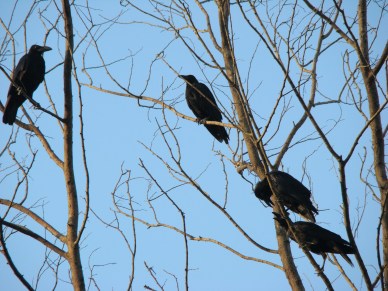
a quartet of crows:
onyx adornments in oak’s
leafless crown
tracks in fresh snow: thank you notes from the birds
withered brown apple summer’s forgotten bounty blue jay’s surprise treat
like an eagle’s tail plumes of white clouds fan out over distant hills
Wishing you all a joyous holiday season. I’m looking forward to seeing you all in 2018! Please be sure to visit Buffy Silverman at Buffy’s Blog for the Poetry Friday Roundup.