Happy Friday, everyone! I hope you all had a wonderful holiday filled with family, friends, feasting, and love. Somehow, I managed to keep up with Mary Lee Hahn’s #haikuforhope. Here are my offerings for the week.
brief December days bookended by darkness long for sun’s bright shine
feathers ruffled against a cold, steady rain swans glide onward
snowflakes flit and float scattering fairy dust over the world
dawn’s golden light filtered by gathering clouds still holds promise
swollen stream rushes babbling its timeless tune: joy to the world
silent stars swirl, our dazzling partner in an endless cosmic dance
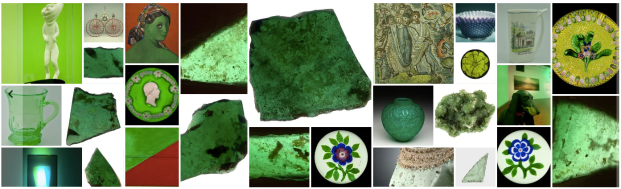
Last night I was at a total loss about what to share today. For some reason, I remembered this post by Irene Latham about using Google Arts & Culture as a source for images for her annual Artspeak! poetry project. When I opened the site, these stunning images greeted me.
These are all pieces of glass, but this image in particular reminded me of malachite.
Stained glass fragment, 13th century, via The Metropolitan Museum of Art
I wanted to confirm what I thought I knew about this stunning green mineral, so I Googled it and this image popped up.
Which led to this poem:
He pressed a polished malachite heart into my hand; whispered, “to match your eyes,” then hurried off to Mrs. King’s calculus class.
No one noticed as I sprouted gossamer wings and floated into
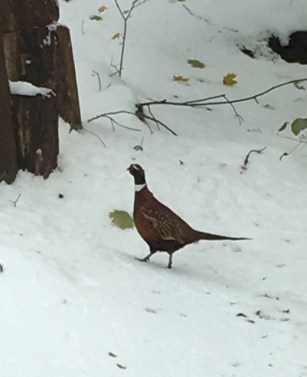
Two surprises arrived last week: an early snow storm and a ring-necked pheasant. We have never seen a pheasant in our yard, so his presence was quite thrilling. His sudden appearance was explained when I found out that a local landowner had stocked his property with 100 birds. This is a common practice in our area, and these gorgeous birds may have wandered onto our property in the past, but I was too busy to notice.
dressed for dinner
a pheasant feasts on seeds
scattered on snow
I hope you all had a joyous Thanksgiving feast. I am forever grateful for this generous, nurturing community of poets. Thank you for all your friendship and support! Please be sure to visit Irene Latham, one of the kindest people I know, at Live Your Poem, for the Poetry Friday Roundup!
I didn’t get much writing done in October. I probably won’t get much writing done in November, either. But I keep plugging away. Slow and steady, right? Today’s poem is my response to Michelle Heidenrich Barnes‘s October(!) ditty challenge from Calef Brown. He asked us to “Write a poem or a story about two anthropomorphized objects.”
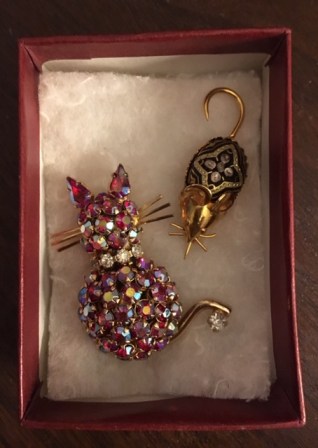
I thought about this for days, but kept coming up empty. Then, on Halloween, it finally came to me. I have a drawer full of pins to match almost every book and subject from the third grade curriculum I taught for many years. I don’t wear them too much any more, but I have a cat pin I often wear on Halloween. Bingo! Finally, several drafts later, here is my still-needs-work-but-it’s-come-a-long-way draft.
Forever Friends?
Trapped inside a box of baubles, An enamel mouse and rhinestone cat Grew restless and began to squabble On their cushiony, cottony mat.
“If I had legs, I’d crouch and pounce, Then grab your shimmering tail. You’d be completely trounced,” that feline loudly railed.
“If I had legs, I’d dart and dash, Evading your golden claws, zipping past you in a flash,” the wee brave mouse guffawed.
“If only we could reach the rim,” bemoaned the paralyzed pair. “We’d be free to stretch our limbs, and breathe in pure fresh air.
“This lid won’t budge; we’re out of luck. Why don’t we make amends? No lark for us. We’re truly stuck. Let’s bury our grudge and be friends.”
“It’s amazing what you can see when you just sit quietly and look.” Jacqueline Kelly, The Evolution of Calpurnia Tate
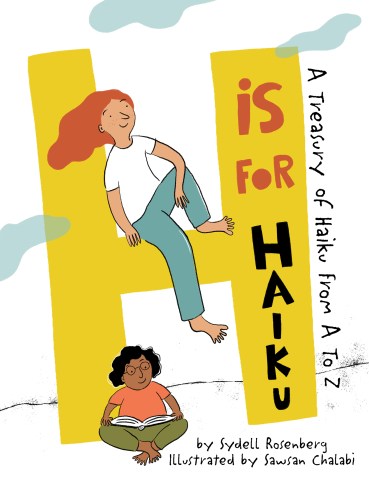
Looking closely and seeing familiar objects in new and unique ways is the essence of poetry. H is For Haiku is a joyful collection of haiku by Sydell Rosenberg, a poet and New York City public school teacher who passed away in 1996, that celebrates everyday life 17 syllables at a time. Rosenberg’s daughter, Amy Losak, has lovingly gathered 26 poems to fulfill her mother’s dream of publishing a book of haiku for children. (Read more about this journey here.)
I love that this collection begins with the word adventure, for that’s exactly what H is For Haiku is. Readers step into a world where children’s daily lives and dreams spill across the page, just as the universe seems to be pouring out of a cat’s tail in the first poem. What child hasn’t thought of monsters when they see lobsters in a tank or wondered about turtles perched on a rock?
Rosenberg’s haiku are also full of the joy of language. Young readers may not know what a jaunt is, but they will to go on one with a “wide-eyed doll” after reading the poem for the letter C. The subject of each poem does not necessarily begin with the letter the poem represents. This inventiveness shows children how playful language can be. After reading “a squirrel sweeps up sunbeams/with her transparent tail,” who won’t be inspired to notice the world in new way?
This collection is spirited, inventive, and fun. Sawsan Chalabi’s whimsical illustrations fill H is For Haiku with a diverse cast of expressive characters that perfectly complement the tone of Rosenberg’s poems. After reading H is For Haiku, children of all ages will pay closer attention as they go about their day, always on the lookout for the poetry hiding in unexpected corners of their world.
Honoring Syd’s life,
crafted with her daughter’s love: H is For Haiku
Thank you, Amy Losak, for giving us the gift of your mother’s poetry.
Please be sure to visit Michelle Heidenrich Barnes at Today’s Little Ditty for the Poetry Friday Roundup.
For the past week or so, I have been attempting to write a sonnet. It is not going well. I have counted syllables, tapped stresses, and written lists of rhyming words. I have read sonnets. I have read about writing sonnets. This has not helped. But I am not giving up.
Among the many sonnets I’ve read, I found this little gem, which seems to be lacking a few characteristics of a sonnet, in the Poetry Foundation’s sonnet collection.
“Talking About the Day”
by Jim Daniels
Each night after reading three books to my two children–
we each picked one–to unwind them into dreamland,
I’d turn off the light and sit between their beds
in the wide junk-shop rocker I’d reupholstered blue,
still feeling the close-reading warmth of their bodies beside me,
and ask them to talk about the day–we did this,
we did that, sometimes leading somewhere, sometimes
not, but always ending up at the happy ending of now.
Now, in still darkness, listening to their breath slow and ease
into sleep’s regular rhythm.
Over the summer, all our students in grades five through eight read Restart, by Gordon Korman. The kids loved the book, and have had some amazing discussions about its characters and themes. Earlier this week, as a culminating event, we had a Skype visit with Mr. Korman, who entertained us with stories and writing advice. Before our visit, the kids came up with many insightful questions. Their thoughtful wonderings inspired this poem. (Which was also inspired by Naomi Shihab Nye‘s ditty challenge for September on Michelle Heidenrich Barnes’s blog, Today’s Little Ditty.)
To the Author Of My Favorite Book:
What made you write this story? What gave you this idea? How did you find the just-right words to show the way I feel? Did you peek inside my diary, or spy on me each day?
Were you ever lonely? Were you ever blue? Did someone ever write a book that felt like a friend to you?
Do you think I can be happy like the girl inside your book? You made her come alive, you gave me a new friend. Please write more of her story so our friendship never ends.
Like many of you, and hundreds of thousands of educators around the country, I’ve been busy preparing for the start of school next week. The buzz of anticipation at meeting new students, sharing new books, and embarking on our learning journey never fades. Unfortunately, there are always aspects of our teaching lives that we have no control over and don’t always agree with. What we can control, though, is our response to the situation.
I’ve always admired people who remain calm in every situation because I occasionally go to DEFCON 1 in an instant. I know this is not always appropriate or even warranted. It’s usually also never helpful. This is something I’m working on. I will carry the last line of this poem by the very wise and wonderful W.S. Merwin into the new year to help me.
“Beginners”
by W.S. Merwin
As though it had always been forbidden to remember
each of us grew up
knowing nothing about the beginning
but in time there came from that forgetting
names representing a truth of their own
and we went on repeating them
until they too began not to be remembered
they became part of the forgetting
later came stories like the days themselves
there seemed to be no end to them
and we told what we could remember of them




 Reading to the Core