I was two years old when John F. Kennedy declared “we chose to go to the moon…and do other things not because they are easy, but because they are hard.” Space exploration was woven into the background of my childhood, and it has always captivated me. So I was paying close attention last week as the Cassini spacecraft met its fiery end in Saturn’s butterscotch clouds. Cassini and its mission to explore Saturn, its rings, and moons seemed like a worthy subject for Michelle Barnes’s September ditty challenge from Carole Boston Weatherford.
It soon became clear, though, that writing an abecedarian about Saturn and the Cassini mission would be hard! It threatened to become a list of some of Saturn’s 53 named moons. Not giving up, I expanded my focus to include the whole universe and came up with this draft.
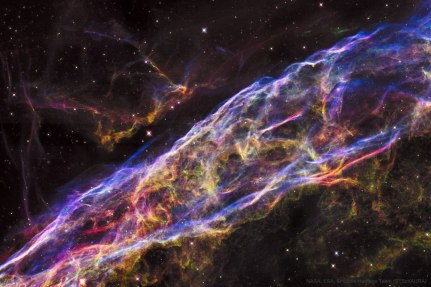
Astral bodies: comets, dwarf planets with eccentric orbits, frozen moons, glowing stars, haloes of hydrogen and helium illuminating jet black space, kindling wonder, launching dreams to mine the mysteries of nebulous interstellar dust, the Oort cloud, pulsing quasars, and rotating spiral galaxies tumbling through the universe, emitting visible and invisible wavelengths of light and X-rays, yielding amazement and awe, our zeal for discovery never-ending.
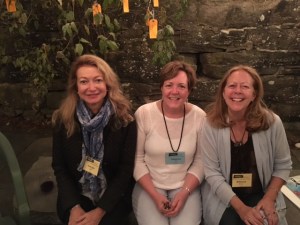
This picture, taken at the Highlights Foundation last year, popped up in my Facebook feed this morning:
What a magical few days I had there, spending time with Rebecca, Georgia and so many other Poetry Friday friends! It made me realize how far I’ve drifted from my poetry practice and how much I miss it. In “What to Remember When Waking,” David Whyte asks “What shape waits in the seed of you/to grow and spread its branches/against a future sky?” I love the endless possibilities contained in this question. With renewed resolve, I can’t wait to find out.
“What to Remember When Waking”
by David Whyte
In that first hardly noticed moment in which you wake,
coming back to this life from the other
more secret, moveable and frighteningly honest world
where everything began,
there is a small opening into the new day
which closes the moment you begin your plans.
What you can plan is too small for you to live.
What you can live wholeheartedly will make plans enough
for the vitality hidden in your sleep.
To be human is to become visible
while carrying what is hidden as a gift to others.
To remember the other world in this world
is to live in your true inheritance.
You are not a troubled guest on this earth,
you are not an accident amidst other accidents
you were invited from another and greater night
than the one from which you have just emerged.
Now, looking through the slanting light of the morning window
toward the mountain presence of everything that can be
what urgency calls you to your one love?
What shape waits in the seed of you
to grow and spread its branches
against a future sky?
This week I’ve been reading poemcrazy: freeing your life with words (1996) by Susan Goldmsith Wooldridge. I found this book as I was scrolling though my Twitter feed a few weeks ago. If you aren’t familiar with it, go find it now. You won’t be sorry.
Sometimes writing poems does drive me crazy, but this book makes you fall-in-love crazy about poetry. Wooldridge is a cheerful, enthusiastic teacher. In the first section of the book, “Following Words”, she urges us to collect words and “create a wordpool.” “The great thing about collecting words,” she writes, “is they’re free; you can borrow them, trade them in or toss them out.” Each short chapter is followed by suggestions for practice. This draft grew out of those suggestions.
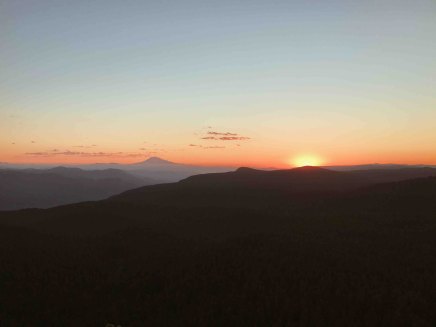
The canary sun sets the sky aglow, whispering pink at the edge of day like a conch, whispering the memory of ocean waves.
Photo by adrian via Unsplash
Please be sure to visit Matt Forrest Esenwine at Radio, Rhythm, & Rhyme for the Poetry Friday Roundup. And to all my friends around the country who are facing hurricanes or fires, please stay safe!
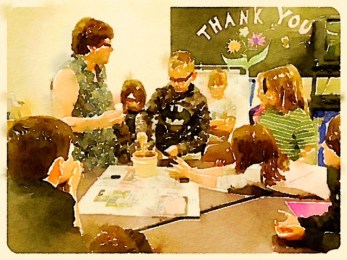
This fall I’m teaching a six-week exploratory course on gardening to 4th and 5th graders. Six weeks isn’t much time, but we’ve already suspended an avocado pit in water, planted oregano, and brainstormed a list of questions we want to answer. Later today we’ll be planting potatoes and next week we’re starting herb gardens.
Planting oregano (Thank you, Keri Snowden, for the photo!)
In addition to all these seeds sprouting, I’d like some writing to blossom during our course. A “things to do” list poem is a form we can collaborate on, and lends itself nicely to a short time frame. Here is a poem I drafted to use as a model.
Things to do if you’re a seed…
nestle into rich, warm soil soak up plenty of water swell like a sponge split your coat plunge thirsty roots deep into the earth poke an eager stem into the air sprout feathery leaves drink up the sun’s shimmering rays
Yesterday was National Root Beer Float Day. I love that there is a National day for almost everything, and I was especially happy to have an excuse to make a root beer float. When we were little, my sister and I spent a lot of time with our grandmother, especially during the summer. Her house was surrounded by shady maple trees that kept us cool, but on sweltering afternoons, nothing beat the heat like a root beer float.
Grandma had tall pink plastic tumblers that were reserved for these warm-weather treats. Joanie and I got them from the cupboard while Grandma took the ice cream from the freezer and the cans of root beer from the fridge. She scooped two precise balls of Sealtest vanilla into each cup. Then she slowly poured in the root beer, trying to prevent streams of bubbly foam from erupting over the rim.
We sat together at the kitchen table and sipped as the icebergs of softening ice cream dissolved into crystal-coated blobs. We laughed at the foamy mustaches on our upper lips. Grandma never threw anything away, so we used long-handled, red plastic spoons from Carvel’s to scoop out the last remnants of the ice cream from the bottom of the cup, savoring the creamy blend of sweet and sharp flavors, the perfect antidote for a hot summer day.
Those plastic tumblers are long gone, and I don’t think Sealtest Ice Cream is even made anymore, but that didn’t stop me from savoring a root beer float yesterday. It was just as delicious as I remembered.
Thank you also to Stacey, Betsy, Beth, Kathleen, Deb, Melanie, and Lanny for creating this community and providing this space for teachers and others to share their stories each Tuesday. Be sure to visit Two Writing Teachers to read more Slice of Life posts.
My week has been filled with birds. (If you’re a frequent reader, you might be asking yourself, “What else is new?”) At the beginning of the week, I made may way to a new Audubon Center near my home for an early morning bird walk. Then I finished Mozart’s Starling (which I wrote about here). I really loved this book. Haupt ends by deftly weaving the threads of her starling Carmen, Mozart, and artists of every stripe into a reflection on the nature of creativity. “And what is this wild summons?” Haupt asks. “To listen with changed ears and sing back what we hear.”
Inspired by these words, here is a tanka filled with the sounds from my week.
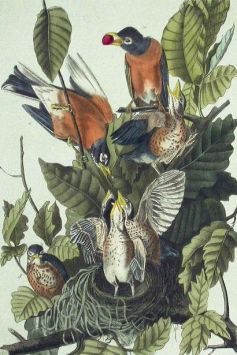
As the last stars fade, robins and cardinals sense dawn’s approaching warmth. Trills and cheeps float from treetops chasing away night’s shadows.
How often do we go down rabbit holes in search of one thing, only to come out on the other side with something else altogether? Maybe not as often as we should.
This week I’m reading Lyanda Lynn Haupt’s captivating book, Mozart’s Starling. (Little, Brown, 2017). At one point, she quotes French poet Paul Éluard: “There is another world, but it is in this one.” This idea launches Haupt into a rumination on wonder. Did you know the root of “wonder” is an Old English word, wundrian that means “to be affected by one’s own astonishment”? Isn’t that lovely? Haupt ends this brief passage with this: “For us, the song of the world so often rises in places we had not thought to look.” These are the words of a poet.
Curious about her, I discovered that Haupt “is a naturalist, eco-philosopher, and speaker whose writing is at the forefront of the movement to connect people with nature in their everyday lives.”
But no poetry.
Back to Paul Éluard. The Poetry Foundation has two of Éluard’s poems, but neither of them really appealed to me. What did catch me eye was the poem of the day by Linda Pastan. Pastan is a favorite, so I clicked on the link to find this:
Even before I finished reading, I could feel my own poem taking shape. The ideas in this poem had been floating around my brain for the last month or so, but hadn’t settled on a form.
Thank you for following me down the rabbit hole! Please be sure to visit my friend and critique group partner, Linda Mitchell, at A Word Edgewise for the Poetry Friday Roundup.
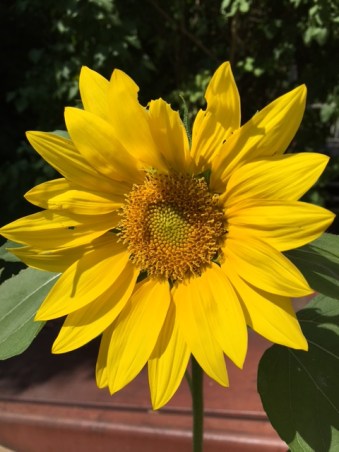
We haven’t filled our bird feeders for months because we don’t want bears wandering through our yard, but that doesn’t mean they aren’t still bringing us beauty and inspiration. I found this lovely visitor tucked into a corner that doesn’t get mowed. What better form than a Fibonacci for a poem about a sunflower?
A
dropped
seed, long
forgotten,
grows summer surprise:
one blossoming, buttery sun.
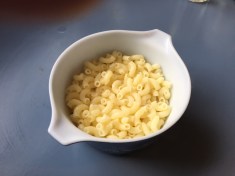
Happy National Macaroni and Cheese Day! Last week, Tabatha Yeatts, today’s PF Roundup hostess, suggested we celebrate this delectable dish in verse. Coincidentally, I had just read Rita Dove’s prompt, “Your Mother’s Kitchen” in The Practice of Poetry. Dove directs writers to include “the oven… and also something green.” My draft deviates from the instructions slightly by not including “something dead,” and not having a female relation “walk into the kitchen during the course of the poem.” My sister doesn’t like to cook and wouldn’t have been anywhere near the kitchen while my mother was cooking!
Healing Hands
My mother’s hands were healing hands. After standing all day helping doctors stitch broken bodies back together, she came home to tend and mend us.
When she was seven, my sister suffered from chronic strep. Soft and smooth on her raw throat, my mother’s macaroni and cheese was all she’d eat.
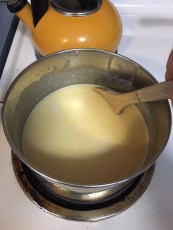
In the kitchen, my mother gathered milk, butter, and cheese. Velveeta was the cheese of choice. She took the foil-wrapped brick from its bright yellow box, diced it into chunks.
Standing in front of the avocado green stove, she whisked the mornay sauce, stirred until the liquid was smooth and golden, then poured it over steaming macaroni waiting in a pyrex dish. Into the oven it went, where it transformed into a creamy, bubbling concoction.
To this day, whenever I see a box of Velveeta, I can taste the macaroni and cheese my mother used to make with her healing hands.
One frustration I often have after attending workshops or conferences during the school year is that when I get back to school, I’m immediately caught up in day-to-day demands. This leaves little time to process and implement what I’ve learned. Presenters always advise to “pick one strategy or activity” to weave into your practice, but this too can be a challenge. So I’ve loved having some uninterrupted time to process my learning from the four days I spent at the Yale Center for British Art, which I wrote briefly about here.
As I reread my notes, some overarching ideas stood out:
possibility
observing
thinking
understanding
skill development
I created a document with five columns, sorting my notes according to these ideas. I quickly realized that I was “tackling complexity” by “putting the pieces together, rather than taking them apart, [which allowed me] to see connections, relationships and patterns of interactions.” (p. 4) It was deeply satisfying to see these relationships emerge.
Vicki’s underlying argument is that, in our rush to scaffold our students for success, we have deprived our students of opportunities to engage in critical thinking. They need many opportunities to engage in “productive struggle…the process of thinking, making sense and persevering in the face of not knowing exactly how to proceed” (p.13).
Visual literacy teaches children that, as Linda Friedlaender, Senior Curator of Education at YCBA, pointed out“images have an underlying narrative.” They automatically provide an accessible text that allow students to engage in productive struggle. Images allow students to think “for themselves, with a minimum of scaffolding.” (Vinton, p. 27). Reading images develops the same skills readers need when they read any text, including vocabulary, identifying key details, precise word choice, observation, and formulating and defending a thesis. (What Vicki and Dorothy refer to as “first-draft” thinking). Importantly, visual literacy makes abstract comprehension skills more concrete.
By incorporating visual literacy into our regular literacy routines, we create opportunities for students “to wonder, generate questions, and form hypotheses, then to test out those hypotheses, using reasoning and logic, to arrive at a final judgment or claim” (Vinton, p. 37).
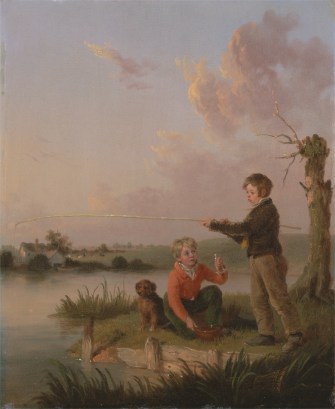
Give it a try. What do you see in this painting? Images such as “The Young Anglers,” by Edmund Bristow, offer students a chance to orient themselves to the narrative of the image, just as readers have to orient themselves when reading written text.
Edmund Bristow, 1787–1876, British, The Young Anglers, ca. 1845, Oil on panel, Yale Center for British Art, Paul Mellon Collection
After observing and gathering information, students share their thoughts. Just as with a piece of writing, students’ ideas have to be grounded in the details of the painting. Again, the process of reading a painting parallels and supports what we do when we read a book. If someone says they think the dog above belongs to the two boys, they have to share the exact detail from the painting that makes them think that. This is a critical step. As Vicki states, “the more opportunities students have to talk about their thinking, the more likely they are to transfer that thinking from one text to the next” (p. 77). This is true for images as well as written texts, and will also transfer from images to written texts.
Once students have developed an understanding of the narrative of the painting, the response options are limitless. Students can sketch or draw their response, write about their thinking, or (ideally), both. And, just as writing deepens our understanding of a text we’ve read, sketching deepens our understanding of visual images by drawing us ever deeper into the fine details.
The possibilities incorporating visual literacy into our classrooms are endless, and I’m excited to get back to school and working with students to build their thinking skills. In the meantime, I’m going to finish reading Vicki’s book and continue gathering images that will “give [students] a chance to build up the muscle to deal with the problems texts like this pose” (p. 79).