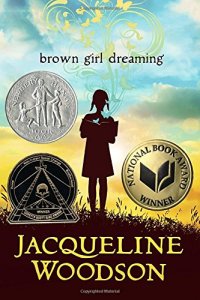
“I believe in one day and someday and this perfect moment called Now.” Jacqueline Woodson
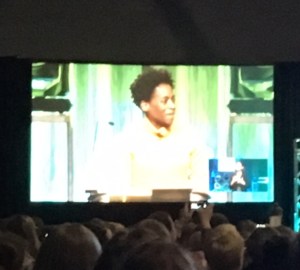
I was lucky enough to be in the audience at NCTE’s Annual Convention last November when Jacqueline Woodson read this passage from Brown Girl Dreaming, her award-winning memoir in verse. Woodson’s work has always had a place in my classroom, and I am thrilled that she has been named the next National Ambassador for Young People’s Literature. This role will allow her to travel around the country sharing her message that “books can drive change and instill hope in young readers.” She summed up her vision as ambassador as “Reading = Hope x Change.” You can hear Woodson talk more about this vision in this NPR interview.
During her speech at NCTE, students from around the country asked questions via pre-recorded video. One student wondered why Woodson chose to write Brown Girl Dreaming and her recent novel Another Brooklyn in verse. Woodson’s brilliant response? “I wrote it in verse because that’s how memory comes to us.”
In “on paper,” from Brown Girl Dreaming, Woodson shares this memory:
Woodson reminded the teachers at NCTE that “everybody has a story, and everyone has a right to tell that story. Encourage students to tell their stories.” It’s clear that Woodson’s work springs from her own story, her own memories. But her writing also shines with her love for her fellow humans. She urged her NCTE audience to remember that “community is so important. We need to know who we are going to walk through the world with.” I am happy I’m walking through the world with Jacqueline Woodson.
Please be sure to visit Jan Godown Annino at Bookseedstudio for the Poetry Friday Roundup.
Happy New Year! Welcome to the first Poetry Friday Roundup of 2018! If you’re new to Poetry Friday, you can learn more from Renée LaTulippe at No Water River.
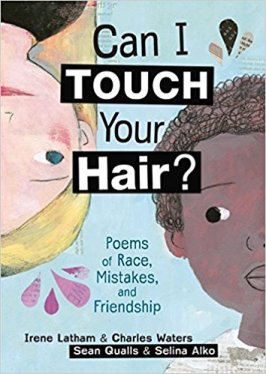
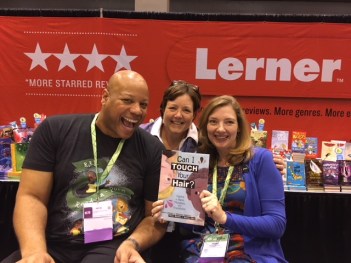
Today I’m proud to feature a brave and beautiful new book by two dear poetry friends, Irene Latham and Charles Waters, Can I Touch Your Hair? Poems of Race, Mistakes, and Friendship, published by Carolrhoda Books on January 1, 2018. With starred reviews from Kirkus and Publisher’s Weekly, this book deserves a place in every classroom. (A Teacher’s Guide is available here.)
Assigned to work together on a poetry project, Irene and Charles are ambivalent. Irene articulates this with the frank honesty of childhood: “Charles is black/and I am white.”
Overcoming their misgivings, they find common ground in the everyday worries of all kids, and begin by writing about shoes and hair. These subjects soon give way to more serious topics such as saying the wrong thing, racial tensions, police brutality, and fear of others because they look different.
They walk the tightrope of adolescent friendships when Irene’s request to join “the black girls/ play[ing] freeze dance” and Charles’s friends “play me dirty.” The poems reveal an unfolding friendship, which Sean Qualls and Selina Alko capture in their sensitive illustrations as heart-shaped flourishes erupting from their pens, mouths, and minds.
Throughout the collection, Irene and Charles make their alter egos come alive by honestly revealing pieces of vulnerability, as when Charles realizes he’s “a few shades too dark/to be allowed to call [a new classmate] by his nickname.” This is balanced by their courage to face fear and shame, as Irene does in “Apology.” When an African-American classmate’s family tree is “draped in chains,” she realizes that the words “I’m sorry…are so small/ for something/so big.”
Both poets use figurative language to bring a depth of feeling and wisdom that amplifies the emotional impact of their writing. We feel the “fury rising inside” Charles, as if he’s “a tidal wave about to crash on land,” as well as the joy they each feel as they “stand in line, cradling our books like newborn kittens,” as they wait to meet author Nikki Grimes.
With Charles and Irene at NCTE in St. Louis last November.
Irene and Charles generously allowed me to share two of their poems with you today. Thank you so much!
“The Poem Project”
When our teacher says, Pick your partner, my body freezes
like a ship in ice.
I want Patty Jean,
but Madison
has already looped
arms with her.
Within seconds,
you-never-know-what-
he’s-going-to-say-Charles
is the only one left.
How many poems?
someone asks. About what? Do they have to be true?
Mrs. Vandenberg
holds up her hand. Write about anything! It’s not black and white.
Mrs. Vandenberg wants us to write poems?
Finally, an easy project. Words fly off my pen
onto the paper, like writing is my superpower.
The rest of the time, my words are a curse. I open my mouth,
and people run away. Now I’m stuck with Irene?
She hardly says anything. Plus she’s white.
Her stringy, dishwater blond hair waves
back and forth as she stutter-steps toward me.
My stomach bottoms out. “Hello,” I say. “Hi,” she says.
I surprise myself by smiling at her–she smells like
a mix of perfume and soap. We stare at our sneakers
before I ask, “So, what do you want to
write about?” She shrugs. I say, “How about our shoes, hair?
Then we can write about school and church?”
She takes a deep breath. “Okay.”
I match it. “Let’s start there.”
In an interview with Megan Labrise on the podcast Fully Booked by Kirkus Reviews (starting at 32:40), Charles and Irene share the origin of Can I Touch Your Hair, as well as their hopes for their book. Irene states their wish is that “it will make it easier to have these really difficult conversations about race” and as we “talk about it, listen to each other, [we’ll] realize that we’re all human people, we have more in common than we have separate, different, and that the different parts are beautiful.” Because, as Irene and Charles so wisely point out in the book’s final poem, “Dear Mrs. Vandenberg”: “We are so much more than black and white!”
And now for the Roundup! Please join today’s celebration of poetry by sharing your link.
When Mary Lee Hahn invited us all to join her in writing a daily haiku during the month of December, I wasn’t sure I had the energy. The past year has been challenging in so many ways and I have often found it difficult to put my worries and frustrations aside and just write. But, like Mary Lee, I needed to find a way to “focus on moments and slows me down to a more livable pace.”
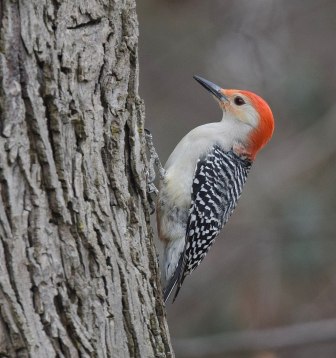
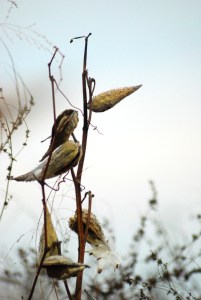
Writing a haiku each day has helped me shift into low gear and find the poetry in what Natalie Babbitt calls “those commonplace marvels which [the world] spreads so carelessly before us everyday.” For me, many of these marvels have arrived on the wings of birds, so it seems appropriate to end the year with a mini-collection of haiku inspired by my feathered friends.
By Shahnoor Habib Munmun via Wikimedia Commons
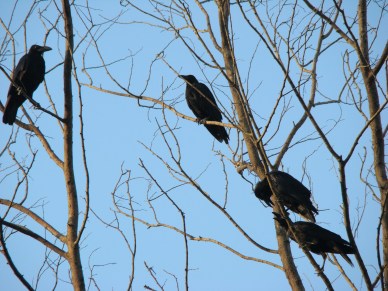
a quartet of crows:
onyx adornments in oak’s
leafless crown
tracks in fresh snow: thank you notes from the birds
withered brown apple summer’s forgotten bounty blue jay’s surprise treat
like an eagle’s tail plumes of white clouds fan out over distant hills
Wishing you all a joyous holiday season. I’m looking forward to seeing you all in 2018! Please be sure to visit Buffy Silverman at Buffy’s Blog for the Poetry Friday Roundup.
“You were made and set her to give voice to this, your own astonishment.”
~ Annie Dillard ~
When I took my dog outside one morning not long ago, I gasped when I looked up. The moon was a glowing, golden egg hanging in the western sky. Just to the south, his sword raised for eternity, his quarry just out of reach, Orion stood tall. A scattering of fainter stars dotted the sky around him. It was an astonishing sight.
It occurred to me how rare the word astonish has become. In fact, Merriam-Websterranks it in the bottom 50% of words. This is a shame, and a fate this word doesn’t deserve. Defined as “to strike with sudden and usually great wonder or surprise,” astonish arrived in our vocabulary from the Middle English words astonen or astonien. These, in turn, are derived from the Anglo-French word estoner, “to stun,” which comes from the Latin ex- + tonare, “to thunder.” An obsolete meaning is “to strike with sudden fear.” I prefer our modern definition,
And although Mary Oliver instructs us to “Pay attention. Be astonished. Tell about it,” modern life throws so many distractions at us, it’s easy to forget even these simple steps.
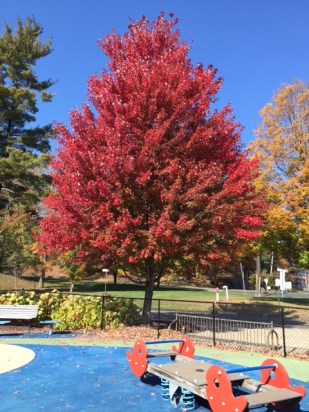
Each day as I come and go to my classroom, I pass a wall of windows that looks out over the playground. At the far end is a maple tree whose leaves turn the most gorgeous red I’ve ever seen. I’ve always felt a kinship with that tree, that I was the only one who appreciated its beauty. Yesterday, two teachers were standing by the windows deep in conversation about a student. They paused and said hello as I walked by. With Mary Oliver’s words in my mind, after returning their greeting, I pointed out the flaming red leaves of the tree. One of the teachers hadn’t ever noticed the tree’s beauty and thanked me for pointing it out to her.
I want my students to be astonished by the world around them. I want them to notice the wooly bear scurrying off toward his winter hiding spot. I want them to astonish themselves, like one of my first grade students. After reading a sentence perfectly, he looked up at me and exclaimed, “I read that!” He was truly astonished that he had such power within himself.
Writing also gives us access to that power. My writing practice has been in the doldrums lately, for all the reasons you already know. But I miss writing about small astonishments I see each day. This rather scattered slice is a first step in returning to this practice. One of the profound lessons of writing each day is that those small astonishments lead to larger insights and discoveries. And like Orion, always on the hunt, I don’t ever want to stop searching for those bigger insights about who I am and my place in the world.
Thank you also to Stacey, Betsy, Beth, Kathleen, Deb, Melanie, and Lanny for creating this community and providing this space for teachers and others to share their stories each Tuesday. Be sure to visit Two Writing Teachers to read more Slice of Life posts.
Today is NCTE’s National Day on Writing. This year’s theme is #Why I Write. As I thought about how to respond to this, I realized there isn’t just one reason. There are as many reasons as stars in the sky.I write to remember the moon winking at me in the morning as I stand at my kitchen sink. I write to feel the warmth of my grandmother’s hand in mine once more, and the sweet smell of her kitchen when she baked pies. I could go on and on. Or maybe there is only one reason: love. I write because I love watching people and the world around me and trying to capture the beauty of it all in words.
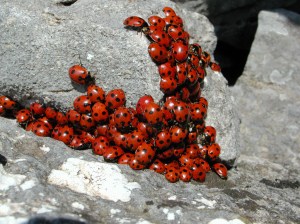
This poem was inspired by a lone ladybug crawling along my porch railing last weekend. As I watched, I realized it’s just about time for the invasion of the ladybugs.
As red as ripe berries, a horde of ladybugs swarm every room, crawling on walls, buzzing over chairs, scuttling into corners where walls meet ceiling nestling into beams of warm October sun, punctuating autumn’s golden days, declaring summer’s end.
I was two years old when John F. Kennedy declared “we chose to go to the moon…and do other things not because they are easy, but because they are hard.” Space exploration was woven into the background of my childhood, and it has always captivated me. So I was paying close attention last week as the Cassini spacecraft met its fiery end in Saturn’s butterscotch clouds. Cassini and its mission to explore Saturn, its rings, and moons seemed like a worthy subject for Michelle Barnes’s September ditty challenge from Carole Boston Weatherford.
It soon became clear, though, that writing an abecedarian about Saturn and the Cassini mission would be hard! It threatened to become a list of some of Saturn’s 53 named moons. Not giving up, I expanded my focus to include the whole universe and came up with this draft.
Astral bodies: comets, dwarf planets with eccentric orbits, frozen moons, glowing stars, haloes of hydrogen and helium illuminating jet black space, kindling wonder, launching dreams to mine the mysteries of nebulous interstellar dust, the Oort cloud, pulsing quasars, and rotating spiral galaxies tumbling through the universe, emitting visible and invisible wavelengths of light and X-rays, yielding amazement and awe, our zeal for discovery never-ending.
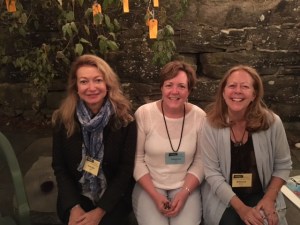
This picture, taken at the Highlights Foundation last year, popped up in my Facebook feed this morning:
What a magical few days I had there, spending time with Rebecca, Georgia and so many other Poetry Friday friends! It made me realize how far I’ve drifted from my poetry practice and how much I miss it. In “What to Remember When Waking,” David Whyte asks “What shape waits in the seed of you/to grow and spread its branches/against a future sky?” I love the endless possibilities contained in this question. With renewed resolve, I can’t wait to find out.
“What to Remember When Waking”
by David Whyte
In that first hardly noticed moment in which you wake,
coming back to this life from the other
more secret, moveable and frighteningly honest world
where everything began,
there is a small opening into the new day
which closes the moment you begin your plans.
What you can plan is too small for you to live.
What you can live wholeheartedly will make plans enough
for the vitality hidden in your sleep.
To be human is to become visible
while carrying what is hidden as a gift to others.
To remember the other world in this world
is to live in your true inheritance.
You are not a troubled guest on this earth,
you are not an accident amidst other accidents
you were invited from another and greater night
than the one from which you have just emerged.
Now, looking through the slanting light of the morning window
toward the mountain presence of everything that can be
what urgency calls you to your one love?
What shape waits in the seed of you
to grow and spread its branches
against a future sky?