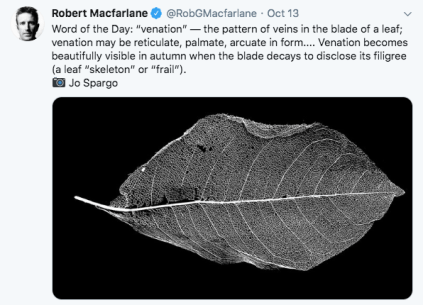
Kudos to everyone who have been keeping up with the Poemtober/Inktober words! Your poems have all been impressive. My efforts haven’t been too successful. Last weekend, though, the word ash bumped into this tweet from Robert Macfarlane, author of The Lost Words.
Ash + venation = this draft
When leaves are burned and turn to ash
their venation disappears
just like the whorls on your fingertips
have disappeared from the world.
Fingertips that will never again
crimp a pie crust,
knit a sweater,
stroke the hair of a sobbing girl.
But your heart,
now turned to ash,
still beats
in the hearts
of those you loved.
A friend alerted me the first “Kidlit Fall Writing Frenzy” over at Kaitlyn Leann Sanchez’s blog, Math is Everywhere. As this is a theme at school this year, I was curious. This is an ambitious project. There are thirteen images to inspire any type of writing, “whatever suits your fancy for any kidlit age: board book through young adult.” The only limit is a maximum length of 200 words.
Many of the images are lovely autumn scenes, others lean distinctly toward a Halloween theme. There were several that intrigued me, but this is the image that I ended up writing about.
Even though it wasn’t a requirement, I wanted to stick with “Math is Everywhere,” so I wrote a fib poem. (I added a second stanza that counts back down to one syllable.)
Sweet Treats
Sweet loot: worms of spun sugar, dyed confetti hues, fill my sack for just a moment,
then wiggle through the white stalactites and stalagmites
standing guard in the cave of my mouth, inching toward a hollow hungry pit: Treats!
“It is not joy that makes us grateful;
it is gratitude that makes us joyful.”
~ David Steindl-Rast ~
Welcome to the Poetry Friday Roundup! I’m happy you stopped by! If you want to know more about what the Roundup is all about, read Renée LaTullipe‘s description here.
I’ve been thinking a lot about gratitude recently. The world is worrisome place at the moment and I long for saner heads to prevail. And yet, there is much to be grateful for. For instance, this welcoming community. My writing has improved a thousand-fold because of all of you. I’m especially thankful for my extraordinary critique group partners Heidi Mordhorst, Linda Mitchell, Margaret Simon, and Molly Hogan. They nudge and nourish my work with smart, insightful suggestions. We have all grown because of, in the words of Maria Papova, “this enormously vitalizing virtuous cycle of mutual respect and admiration that is available to all who choose to welcome and celebrate one another’s kinship of spirit.”
It is with this spirit of kinship in mind that I share “Let’s Remake the World With Words” by Gregory Orr.
Let’s remake the world with words.
Not frivolously, nor
To hide from what we fear,
But with a purpose.
Let’s,
As Wordsworth said, remove
“The dust of custom” so things
Shine again, each object arrayed
In its robe of original light.
As I was reading about gratitude this week, I found the wisdom of David Steindl-Rast particularly helpful. Brother David acknowledges that “we cannot be grateful for violence, for war, for oppression, for exploitation.” Rather, “we can … open our hearts, our hearts for the opportunities, for the opportunities also to help others, to make others happy, because nothing makes us more happy than when all of us are happy.”
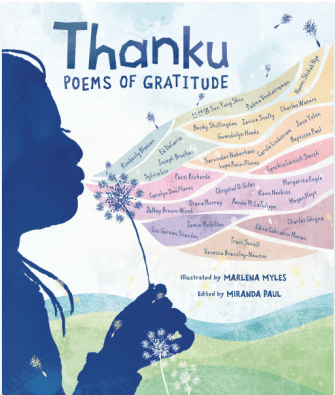
In case you need one more dose of thankfulness, don’t miss Miranda Paul’s new anthology, Thanku: Poems of Gratitude (Millbrook, 2019), which includes poems by many Poetry Friday regulars. Leave your link or comment below before Wednesday, October 16th to be entered in a drawing for a copy of this lovely book.
It’s the first Friday of the month, so it time for another Sunday Night Swaggers Challenge. This month, Margaret Simon challenged us to write zenos. Invented by J. Patrick Lewis, a zeno is a ten line form with a 8-4-2-1-4-2-1-4-2-1 syllable sequence an abcdefdghd rhyme scheme. Learn more about Pat and this form here. After a few false starts, I went for a walk to clear my head. As often happens, this poem was waiting for me.
Swirling, twirling like autumn leaves,
summer songbirds
flock, take
flight
toward steamy,
breezy
light
kaleidoscope
whirling
bright.
To say that I feel bombarded and overwhelmed by the news of the past week is an understatement. But then I read poems like this, selected and shared by our brilliant Young People’s Poet Laureate, Naomi Shihab Nye, in the New York Times Magazine, and I feel a little more hopeful. Because I believe this is true:
“…they are the true dwelling of the holy, these
fleeting temples we make together…”
“Small Kindnesses”
by Danusha Laméris
I’ve been thinking about the way, when you walk
down a crowded aisle, people pull in their legs
to let you by. Or how strangers still say “bless you”
when someone sneezes, a leftover
from the Bubonic plague. “Don’t die,” we are saying.
And sometimes, when you spill lemons
from your grocery bag, someone else will help you
pick them up. Mostly, we don’t want to harm each other.
Inspired by the Poetry Sisters, my critique group decided to set monthly challenges for one another. After much debate, we christened ourselves the Sunday Night Swaggers and premiered in August with a challenge from Heidi to write definitos, a form she invented.
“Suzanne had an assortment of mystery packed into tiny boxes: metal boxes, cardboard boxes, long boxes, jewelry boxes, cloth boxes, wooden boxes, soap boxes and small boxes. We had two questions to guide our group talk:
Who was the owner of the box? How did what is inside the box transform him or her?”
I tried this activity with teachers at my school and it sparked many interesting conversations and inspired some amazing writing. My challenge this month was more open-ended: write a poem inspired by a box.
Since I first read Lee Ann’s post, I’ve accumulated quite a collection of boxes, with lots of help from my friend Colette, who is always on the lookout for cool stuff. I shared a photo of my boxes with my writing partners, but also encouraged everyone to pick their own box if they wanted.
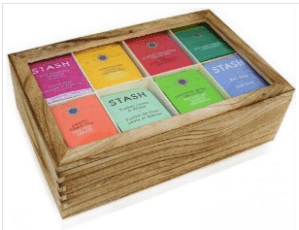
So which box did I choose? Not the one I thought I would. As you may know, we’ve been renovating our house (for way too long) and I’ve been sorting through closets and cabinets. One day after I posed this challenge, I found an assortment of tea similar to this:
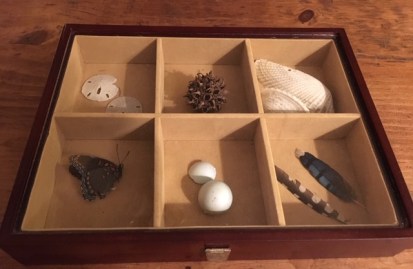
My mind immediately started racing, and my box has now been transformed into a mini cabinet of curiosities. (Read more about them here.)
Now that I had an idea, all I had to do was write the poem, right? Yeah, not so much. The start of school and an ongoing medical issue with my husband (nothing too serious, but stressful and frustrating) kept distracting me from writing this poem.
My Cabinet of Curiosities
This box is full of treasure I found scattered on the ground:
A fallen feather Fragment of forgotten flight Now grounded.
An empty marvel Seashell or angel wing Who’s to say?
A butterfly Orange, brown, and blue Resting her wings
A baby hawk’s Snow-blue mottled egg Expertly unzipped.
Gum tree seed pod, barbed, brown orb An earth-bound star
Coins from the sea Not silver or gold Priceless.
Baubles, relics, rarities, Each one holds a memory carried in my heart.
“Write a poem inspired by song lyrics…Pick a Beatles song (or, if you’re not a Beatles fan, a song by your favorite band), write down as many words from the song as you can, then compose a poem that uses at least three words from your list. Don’t tell us the song that inspired your poem—see if we can guess!”
I am a huge Beatles fan, so lyrics started flowing through my mind immediately. So many tunes were tumbling around in my head, I quickly realized it would be really hard to pick a song! Another challenge that was soon apparent is that many Beatles songs are long on repetition, meaning that word choice could be limited. Then, one afternoon in the grocery store, a Beatles song began. Bingo! This was the song to use.
Repetition isn’t a technique I use often enough, so I took my inspiration a step further and used a repeating line throughout this draft.
“Our Yard”
Our yard is teeming with life. Each evening, deer wander through, Happy to forage on grass And golden apples that have fallen, A ring of sweets under the tree.
Our yard is teeming with life. Each evening, a band of crickets And other insects Sing their summer song.
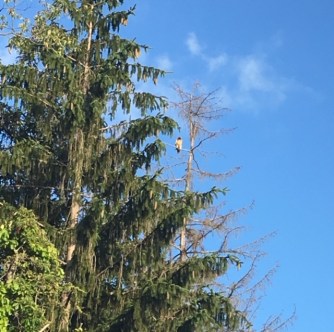
Each evening, a hawk perches high in the pine tree, waiting to spot a mouse Running home to his burrow.
I count eight words from the song I chose. Can you guess what it is?
The hawk on the lookout for supper.
An update: The Beatles song that inspired this poem is Ob-La-Di Ob-La-Da. The words from the song are: band, life, ring, sing, home, yard, happy, and golden. Thank you to Jesse and Michelle for this fun challenge!
Please be sure to visit Kathryn Apel at her blog for the Poetry Friday Roundup!
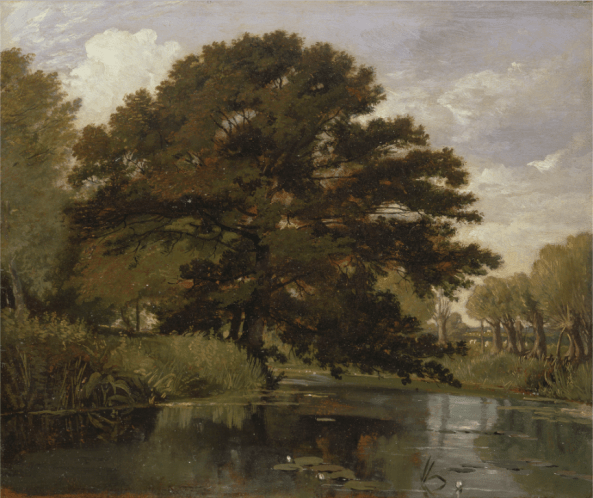
Last week, my friend Molly Hogan wrote about stealing the title of a poem to write her own poem. This idea was intriguing to me and I filed it away for another day. Then, as I was thinking about a poem for this week’s tree-themed Poetry Friday Roundup at Christie Wyman‘s lovely blog, Wondering and Wandering, I came across an ad for this course: “The Art of Painting Trees.” How could I resist stealing that title? I couldn’t.
The Art of Painting Trees
When I was little,
drawing trees was simple:
two curved lines
with a brown crayon
topped by a puffy
green cumulus cloud.
Little did I know
a whole world
lay hidden beneath
those shifting shades of green.
Little did I imagine
the texture of bark,
sculpted by wind
and weather,
invaded by beetles
and birds,
where they crawled
and hummed
and thrived.
Techniques learned,
skills improved,
but what looked easy
was not so simple:
It takes a lifetime
to learn
the art of painting trees.
“Never lose your curiosity about everything
in the universe– it can take you to places you never thought possible!”
~ Sue Hendrickson ~
Thank you to Cathy Mere and Mandy Robek for creating and curating this celebration of picture books. Please be sure to visit Cathy’s blog, Reflect and Refine to read all the lists contributed to this labor of love. It is teachers like them, and others in this community, who will keep the gift of stories alive for years to come.
Coming up with a theme for this year’s PB 10 for 10 celebration was difficult. There were several new picture books that I loved, but at first I didn’t see an obvious connection between them. As I read and reread, though, patterns began to emerge. A path presented itself, and I followed. Each book I’ve chosen to share this year involves a journey or exploration. Some of these journeys cross the globe, others plumb the soul, some do both. All enlarge our imagination.
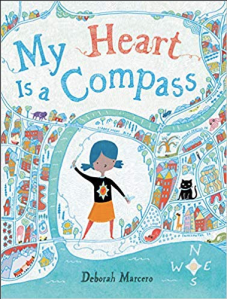
My Heart Is a Compass, written and illustrated by Deborah Marcero (Little, Brown, 2018), was my starting point this year. I have always loved maps, so this book appealed to me immediately. Maps show us the way, help us know we’re not alone and we don’t always have to rely on our own wits to help us find the path. In one way or another, these books may help readers find their way–even if it’s encouragement that sometimes we have to create our own paths and that’s okay, maybe even essential. They also help us understand that wherever we are on our path, someone else has been in a similar spot before, maybe are in a similar spot right now. How we respond and react to the spot we’re in is what matters. Getting love and giving love makes the journey so much easier.
Rose is on a quest: “Her heart was set on discovering something that had never been found…” Marcero’s rich language and evocative illustrations carry us along on this journey. Rose’s flights of imagination are distinguished from “real life” by use of a gorgeous blue that reminds me of cyanotypes. Her maps are worth poring over; a scientifically correct sky map is also filled with fancy–including “big dreams,” “empty thoughts,” and “first lines of poems” as well as a “brainstorm.” Close observers will recognize features of Rose’s journey covering the floor of her room before she embarks on her travels. This book will inspire readers to explore their own inner worlds. It is also a perfect choice to pair with Georgia Heard’s Heart Maps, (Heinemann, 2017).
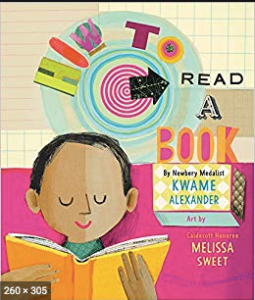
How to Read a Book, by Kwame Alexander with illustrations by Melissa Sweet (Harper, 2019) is a love letter to the joys of reading. Alexander encourages readers not to rush: “Your eyes need time to taste. Your soul needs room to bloom.” This is advice we all should heed. Sweet’s illustrations of “watercolor, gouache, mixed media, handmade and vintage papers, found objects including old book covers, and a paint can lid” (and at least one map) add layers of meaning and wonder that will keep readers coming back to this book again and again. A Teacher’s Guide is available here.
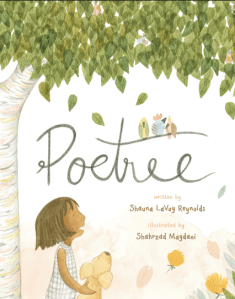
Poetree, by Shauna LaVoy Reynolds, illustrated by Shahrzad Maydani (New York: Dial Books for Young Readers, 2019) stars a dreamer and poet named Sylvia. The book begins with Sylvia writing a poem about spring. She “…tied her poem to a birch tree…hoping that it didn’t count as littering if it made the world more splendid.” Poetry brings two children together and helps them move past the misunderstanding at the center of the story. Reynolds sneaks in sly humor adult readers will appreciate: characters are named Sylvia and Walt, a dog named Shel, and a teacher, Ms. Oliver. There is also a nod to Joyce Kilmer: “I never thought that I would see/such lovely poems from a tree…” Maydani’s graphite pencil and watercolor illustrations of soft greens and yellows (is that Amy Krouse Rosenthal‘s yellow umbrella?) add to the overall gentleness and love of this book.
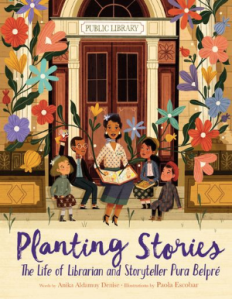
Planting Stories: The Life of Librarian and Storyteller Pura Belpré, by Anika Aldamuy Denise, illustrated by Paola Escobar; (Harper, 2019) is a lovely biography of Pura Belpré, the first Latina librarian in New York City. When Belpré first traveled to New York, “words travel[ed] with her” and libraries were “ripe for planting seed of the cuentos she carrie[d].” This metaphor of a garden of stories is carried throughout the book and is echoed in Escobars gorgeous digital illustrations. The words she brought from Puerto Rico took root and “grew shoots into the open air of possibility, (emphasis mine) have become a lush landscape…” Her legacy is honored through the Pura Belpré Award. A select bibliography is included, as well as suggestions for further reading and a brief description of Pura Belpre’s own stories. A teaching guide is available here.
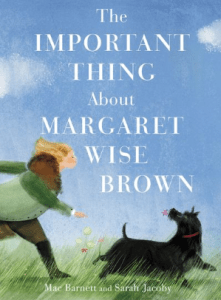
The Important Thing About Margaret Wise Brown, by Mac Barnett and illustrated by Sarah Jacoby (New York: Blazer + Bray, 2019) is, like its subject, an unconventional biography. Barnett gets to the heart of the matter quickly, though: “The important thing about Margaret Wise Brown is that she wrote books.” (p. 2) The truth is that Margaret Wise Brown had something to say and she didn’t let anyone stop her from saying it. The information Barnett includes underscores the fact that writers are real people. He includes possible origins of her stories: ”When Margaret Wise Brown was six or seven and she lived in a house next to the woods, she kept many pets.” (p. 7) Barnett asks thought-provoking questions, including “Isn’t it important that children’s books contain the things children think of and the things children do, even if those things seem strange?” These expand the range of who will appreciate this book. He also highlights important truths: “…in real lives and good stories the patterns are hard to see, because the truth is never made of straight lines” and “She believed children deserve important books.” (emphasis mine). Jacoby “used watercolor, Nupastel, and Photoshop magic to create the illustrations for this book” that give them a dreaminess we want to step into. Read and interview with Mac Barnett and Sarah Jacoby about the creation of this book here.
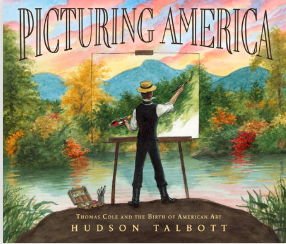
Picturing America: Thomas Cole and the Birth of American Art, by Hudson Talbott (Nancy Paulsen Books/Penguin Random House, 2018) takes us on another journey of discovery. Like many immigrants, when Thomas Cole and his family arrived in the US in 1818, they didn’t have much. Through hard work and sacrifice, Thomas discovered that “he had something to say and he was on his way to find it.” This book not only provides a brief introduction to the birth of the Hudson River School of painting, it helps children understand we all have something to say. Finding out what that something is and how best to express it is the journey of our life, it’s what gives our life meaning. Over the course of his life, Cole realized “he simply wanted to show what it meant to be human.”
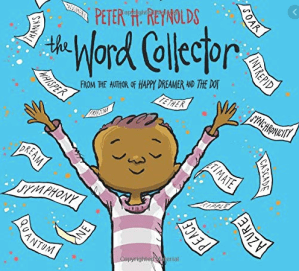
In The Word Collector (Orchard Books, 2018), Peter H. Reynolds extolls the joy and power of words. We learn about Jerome and his passion for words: “Words he heard…words he saw…words he read.” Jerome uses his words in poems and songs, and ultimately, shares all his words. After all, isn’t that words are for? This book will inspire word collectors of all ages. Resources are available here.
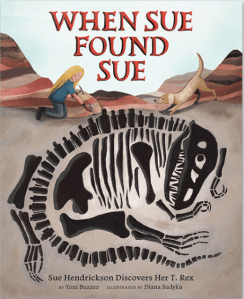
When Sue Found Sue: Sue Hendrickson Discovers Her T. Rex, by Toni Buzzeo, illustrated by Diana Sudyka. (New York: Abrams Books for Young Readers, 2019) This biography is a celebration of curiosity, exploration of the natural world, and following your dreams. “Sue Hendrickson was born to find things.” Buzzeo tells the story of how Sue’s whole life lead to the moment in 1990 when she discovered “the world’s largest, most complete, best preserved, Tyrannosaurus rex fossil discovered so far.” Named in honor of her discoverer, “Sue” is now on display in Chicago’s Field Museum. A Teacher’s Guide is available here.
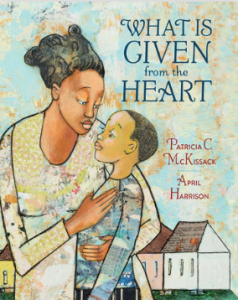
What is Given from the Heart, by Patricia C. McKissack, illustrated by April Harrison (New York: Schwartz & Wade Books, 2019) is the “final, magnificent picture book from three-time Coretta Scott King Award winner and Newbery Honor author Patricia McKissack.” James Otis and his mother have had “a rough few months.” When a neighbor’s home is destroyed by fire, James Otis’s church rallies to help them. But he can’t imagine how he and his mother can help when they “aine got nothing ourselves.” After much searching and consideration, James Otis finds exactly the right gift for his neighbor. Harrison’s mixed media illustrations add depth to the emotions of James Otis, his mother, and their neighbors.
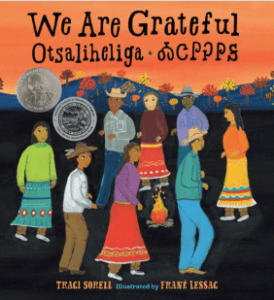
We Are Grateful: Otsaliheliga, by Traci Sorell, illustrated by Frané Lessac. (Charlesbridge, 2018) This book honors the Cherokee Nation’s tradition of otsaliheliga, an expression of gratitude that “is a reminder to celebrate our blessings and reflect on struggles–daily, throughout the year, and across the seasons.” A loving depiction of Cherokee culture, this is exactly the book we need right now: a reminder to be grateful for our family, our friends, and the many gifts of the earth.
I am grateful for these books, their creators and the publishers who bring them into the world and make it a more beautiful place.
Note: I am editing my original post to include concerns about Home Is a Window. My original post included this paragraph about this book:
Home is a Window, by Stephanie Parsley Ledyard with illustrations by Chris Sasaki (New York: Near Porter Books/Holiday House, 2019) is an ode to the comfort of what is familiar: a favorite blanket or chair, a daily routine, a color. It also celebrates the fact that home isn’t necessarily a physical place; rather, it’s a feeling you have because of “the people gathered near.” This creative, comforting book is a perfect launching point for students to create their own definitions of home.
Cathy Mere also included this book on her list, but removed it after a reader raised “some concerns over the images in the text.” Cathy shared this link to CrazyQuiltEdi explaining her concerns about the images of several characters.




 .
. 
 .
. 
 Reading to the Core