“Write a poem inspired by song lyrics…Pick a Beatles song (or, if you’re not a Beatles fan, a song by your favorite band), write down as many words from the song as you can, then compose a poem that uses at least three words from your list. Don’t tell us the song that inspired your poem—see if we can guess!”
I am a huge Beatles fan, so lyrics started flowing through my mind immediately. So many tunes were tumbling around in my head, I quickly realized it would be really hard to pick a song! Another challenge that was soon apparent is that many Beatles songs are long on repetition, meaning that word choice could be limited. Then, one afternoon in the grocery store, a Beatles song began. Bingo! This was the song to use.
Repetition isn’t a technique I use often enough, so I took my inspiration a step further and used a repeating line throughout this draft.
“Our Yard”
Our yard is teeming with life. Each evening, deer wander through, Happy to forage on grass And golden apples that have fallen, A ring of sweets under the tree.
Our yard is teeming with life. Each evening, a band of crickets And other insects Sing their summer song.
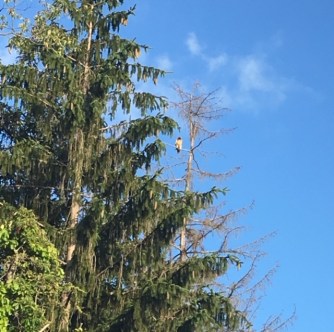
Each evening, a hawk perches high in the pine tree, waiting to spot a mouse Running home to his burrow.
I count eight words from the song I chose. Can you guess what it is?
The hawk on the lookout for supper.
An update: The Beatles song that inspired this poem is Ob-La-Di Ob-La-Da. The words from the song are: band, life, ring, sing, home, yard, happy, and golden. Thank you to Jesse and Michelle for this fun challenge!
Please be sure to visit Kathryn Apel at her blog for the Poetry Friday Roundup!

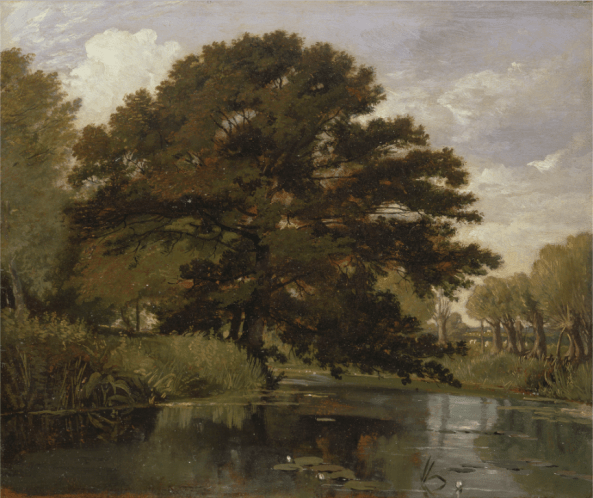
Last week, my friend Molly Hogan wrote about stealing the title of a poem to write her own poem. This idea was intriguing to me and I filed it away for another day. Then, as I was thinking about a poem for this week’s tree-themed Poetry Friday Roundup at Christie Wyman‘s lovely blog, Wondering and Wandering, I came across an ad for this course: “The Art of Painting Trees.” How could I resist stealing that title? I couldn’t.
The Art of Painting Trees
When I was little,
drawing trees was simple:
two curved lines
with a brown crayon
topped by a puffy
green cumulus cloud.
Little did I know
a whole world
lay hidden beneath
those shifting shades of green.
Little did I imagine
the texture of bark,
sculpted by wind
and weather,
invaded by beetles
and birds,
where they crawled
and hummed
and thrived.
Techniques learned,
skills improved,
but what looked easy
was not so simple:
It takes a lifetime
to learn
the art of painting trees.
“Never lose your curiosity about everything
in the universe– it can take you to places you never thought possible!”
~ Sue Hendrickson ~
Thank you to Cathy Mere and Mandy Robek for creating and curating this celebration of picture books. Please be sure to visit Cathy’s blog, Reflect and Refine to read all the lists contributed to this labor of love. It is teachers like them, and others in this community, who will keep the gift of stories alive for years to come.
Coming up with a theme for this year’s PB 10 for 10 celebration was difficult. There were several new picture books that I loved, but at first I didn’t see an obvious connection between them. As I read and reread, though, patterns began to emerge. A path presented itself, and I followed. Each book I’ve chosen to share this year involves a journey or exploration. Some of these journeys cross the globe, others plumb the soul, some do both. All enlarge our imagination.
My Heart Is a Compass, written and illustrated by Deborah Marcero (Little, Brown, 2018), was my starting point this year. I have always loved maps, so this book appealed to me immediately. Maps show us the way, help us know we’re not alone and we don’t always have to rely on our own wits to help us find the path. In one way or another, these books may help readers find their way–even if it’s encouragement that sometimes we have to create our own paths and that’s okay, maybe even essential. They also help us understand that wherever we are on our path, someone else has been in a similar spot before, maybe are in a similar spot right now. How we respond and react to the spot we’re in is what matters. Getting love and giving love makes the journey so much easier.
Rose is on a quest: “Her heart was set on discovering something that had never been found…” Marcero’s rich language and evocative illustrations carry us along on this journey. Rose’s flights of imagination are distinguished from “real life” by use of a gorgeous blue that reminds me of cyanotypes. Her maps are worth poring over; a scientifically correct sky map is also filled with fancy–including “big dreams,” “empty thoughts,” and “first lines of poems” as well as a “brainstorm.” Close observers will recognize features of Rose’s journey covering the floor of her room before she embarks on her travels. This book will inspire readers to explore their own inner worlds. It is also a perfect choice to pair with Georgia Heard’s Heart Maps, (Heinemann, 2017).
How to Read a Book, by Kwame Alexander with illustrations by Melissa Sweet (Harper, 2019) is a love letter to the joys of reading. Alexander encourages readers not to rush: “Your eyes need time to taste. Your soul needs room to bloom.” This is advice we all should heed. Sweet’s illustrations of “watercolor, gouache, mixed media, handmade and vintage papers, found objects including old book covers, and a paint can lid” (and at least one map) add layers of meaning and wonder that will keep readers coming back to this book again and again. A Teacher’s Guide is available here.
Poetree, by Shauna LaVoy Reynolds, illustrated by Shahrzad Maydani (New York: Dial Books for Young Readers, 2019) stars a dreamer and poet named Sylvia. The book begins with Sylvia writing a poem about spring. She “…tied her poem to a birch tree…hoping that it didn’t count as littering if it made the world more splendid.” Poetry brings two children together and helps them move past the misunderstanding at the center of the story. Reynolds sneaks in sly humor adult readers will appreciate: characters are named Sylvia and Walt, a dog named Shel, and a teacher, Ms. Oliver. There is also a nod to Joyce Kilmer: “I never thought that I would see/such lovely poems from a tree…” Maydani’s graphite pencil and watercolor illustrations of soft greens and yellows (is that Amy Krouse Rosenthal‘s yellow umbrella?) add to the overall gentleness and love of this book.
Planting Stories: The Life of Librarian and Storyteller Pura Belpré, by Anika Aldamuy Denise, illustrated by Paola Escobar; (Harper, 2019) is a lovely biography of Pura Belpré, the first Latina librarian in New York City. When Belpré first traveled to New York, “words travel[ed] with her” and libraries were “ripe for planting seed of the cuentos she carrie[d].” This metaphor of a garden of stories is carried throughout the book and is echoed in Escobars gorgeous digital illustrations. The words she brought from Puerto Rico took root and “grew shoots into the open air of possibility, (emphasis mine) have become a lush landscape…” Her legacy is honored through the Pura Belpré Award. A select bibliography is included, as well as suggestions for further reading and a brief description of Pura Belpre’s own stories. A teaching guide is available here.
The Important Thing About Margaret Wise Brown, by Mac Barnett and illustrated by Sarah Jacoby (New York: Blazer + Bray, 2019) is, like its subject, an unconventional biography. Barnett gets to the heart of the matter quickly, though: “The important thing about Margaret Wise Brown is that she wrote books.” (p. 2) The truth is that Margaret Wise Brown had something to say and she didn’t let anyone stop her from saying it. The information Barnett includes underscores the fact that writers are real people. He includes possible origins of her stories: ”When Margaret Wise Brown was six or seven and she lived in a house next to the woods, she kept many pets.” (p. 7) Barnett asks thought-provoking questions, including “Isn’t it important that children’s books contain the things children think of and the things children do, even if those things seem strange?” These expand the range of who will appreciate this book. He also highlights important truths: “…in real lives and good stories the patterns are hard to see, because the truth is never made of straight lines” and “She believed children deserve important books.” (emphasis mine). Jacoby “used watercolor, Nupastel, and Photoshop magic to create the illustrations for this book” that give them a dreaminess we want to step into. Read and interview with Mac Barnett and Sarah Jacoby about the creation of this book here.
Picturing America: Thomas Cole and the Birth of American Art, by Hudson Talbott (Nancy Paulsen Books/Penguin Random House, 2018) takes us on another journey of discovery. Like many immigrants, when Thomas Cole and his family arrived in the US in 1818, they didn’t have much. Through hard work and sacrifice, Thomas discovered that “he had something to say and he was on his way to find it.” This book not only provides a brief introduction to the birth of the Hudson River School of painting, it helps children understand we all have something to say. Finding out what that something is and how best to express it is the journey of our life, it’s what gives our life meaning. Over the course of his life, Cole realized “he simply wanted to show what it meant to be human.”
In The Word Collector (Orchard Books, 2018), Peter H. Reynolds extolls the joy and power of words. We learn about Jerome and his passion for words: “Words he heard…words he saw…words he read.” Jerome uses his words in poems and songs, and ultimately, shares all his words. After all, isn’t that words are for? This book will inspire word collectors of all ages. Resources are available here.
When Sue Found Sue: Sue Hendrickson Discovers Her T. Rex, by Toni Buzzeo, illustrated by Diana Sudyka. (New York: Abrams Books for Young Readers, 2019) This biography is a celebration of curiosity, exploration of the natural world, and following your dreams. “Sue Hendrickson was born to find things.” Buzzeo tells the story of how Sue’s whole life lead to the moment in 1990 when she discovered “the world’s largest, most complete, best preserved, Tyrannosaurus rex fossil discovered so far.” Named in honor of her discoverer, “Sue” is now on display in Chicago’s Field Museum. A Teacher’s Guide is available here.
What is Given from the Heart, by Patricia C. McKissack, illustrated by April Harrison (New York: Schwartz & Wade Books, 2019) is the “final, magnificent picture book from three-time Coretta Scott King Award winner and Newbery Honor author Patricia McKissack.” James Otis and his mother have had “a rough few months.” When a neighbor’s home is destroyed by fire, James Otis’s church rallies to help them. But he can’t imagine how he and his mother can help when they “aine got nothing ourselves.” After much searching and consideration, James Otis finds exactly the right gift for his neighbor. Harrison’s mixed media illustrations add depth to the emotions of James Otis, his mother, and their neighbors.
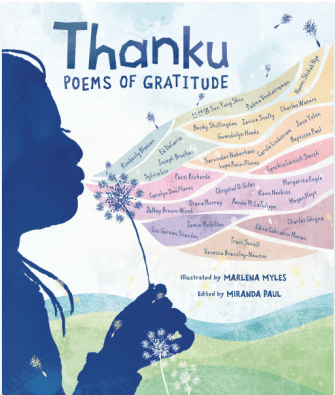
We Are Grateful: Otsaliheliga, by Traci Sorell, illustrated by Frané Lessac. (Charlesbridge, 2018) This book honors the Cherokee Nation’s tradition of otsaliheliga, an expression of gratitude that “is a reminder to celebrate our blessings and reflect on struggles–daily, throughout the year, and across the seasons.” A loving depiction of Cherokee culture, this is exactly the book we need right now: a reminder to be grateful for our family, our friends, and the many gifts of the earth.
I am grateful for these books, their creators and the publishers who bring them into the world and make it a more beautiful place.
Note: I am editing my original post to include concerns about Home Is a Window. My original post included this paragraph about this book:
Home is a Window, by Stephanie Parsley Ledyard with illustrations by Chris Sasaki (New York: Near Porter Books/Holiday House, 2019) is an ode to the comfort of what is familiar: a favorite blanket or chair, a daily routine, a color. It also celebrates the fact that home isn’t necessarily a physical place; rather, it’s a feeling you have because of “the people gathered near.” This creative, comforting book is a perfect launching point for students to create their own definitions of home.
Cathy Mere also included this book on her list, but removed it after a reader raised “some concerns over the images in the text.” Cathy shared this link to CrazyQuiltEdi explaining her concerns about the images of several characters.
“Poetry and I fit together.
I can’t imagine being without it…
It is food and drink, it is all seasons,
it is the stuff of all existence.”
~ Lee Bennett Hopkins ~
The death of Lee Bennett Hopkins yesterday leaves a gaping hole at the heart of the children’s poetry community. Lee was a visionary. His books, both his own and the countless anthologies he edited, are treasures. Although I never met him in person, Lee has had an enormous influence on both my teaching and my writing and his work will continue to inspire students and poets for years to come.
Coincidentally, Been to Yesterdays, Lee’s 1995 autobiographical poetry collection, was on my desk this morning. After reading the sad news, I reread many of my favorites from this book, including this one. Lee did indeed make this world a whole lot brighter.
To
make
this world
a whole lot
brighter
when
I
grow up
I’ll
be
a writer.
I’ll
write about
some things
I know–
how to bunt how to throw…
a Christmas wish a butter dish…
a teddy bear an empty chair…
the love I have inside
to
share…
Yes.
To
make
this world
a whole lot
brighter,
when
I
grow up
I’ll be
a
writer.
by Lee Bennett Hopkins
Please be sure to visit my friend and critique group partner, Molly Hogan, at Nix the Comfort Zone for the Poetry Friday Roundup.
What is a definito, you ask? Created by our brilliant Poetry Friday host, Heidi Mordhorst, a definito is
“…a free verse poem of 8-12 lines (aimed at readers 8-12 years old) that highlights wordplay as it demonstrates the meaning of a less common word, which always ends the poem.”
Heidi is a member of my fabulous critique group, The Sunday Poetry Swaggers, and she challenged us to join her this week in writing definitos. This was definitely a challenge for me! I had no trouble coming up with word possibilities, but once I’d settled on haste, well, let’s just say this poem was NOT written in haste!
HASTE
Scurry, hurry Rush, rush, rush All the world’s a blur.
Hustle, bustle, Race, race, race Leave them in the dust.
Dash, dash, dash At tip-top pace, Not a minute to waste: haste
Other Poetry Friday friends have written definitos today, too. Visit Mary Lee Hahn @ A Year of Reading and Laura Purdie Salas @ Writing the World for Children to read more. After reading all these definitos, you’ll want to write a few yourself!
“Every atom belonging to me as good belongs to you.”
~ Walt Whitman ~
I’ve been avoiding the news recently. The headlines are overwhelming and depressing. I feel helpless to make any meaningful contribution to changing the tenor of our times. But the world is full of antidotes to this feeling of helplessness. This week, I found several on a trek into New York City, where I was fortunate to visit two celebrations of the bicentennial of Walt Whitman’s birth.
The New York Public Library has an intimate gallery where treasures from the library’s collection are exhibited. Walt Whitman: America’s Poet is currently on view. Original copies of Whitman’s work are on display, as well as works that influenced him and books by poets from around the world who have been inspired by him. One of the most powerful pieces in the exhibit is a video by filmmaker Jennifer Crandall. Her project, Whitman, Alabama, is the result of spending two years traveling throughout Alabama, meeting and engaging with people from all walks of life. Crandall filmed these folks reading from Whitman’s great work, Leaves of Grass. The resulting film reminds us that we have much more in common than not, and our strength comes from what we share. Here is a sample.
“Song of Myself”
Verse 16
by Walt Whitman
I am of old and young, of the foolish as much as the wise,
Regardless of others, ever regardful of others,
Maternal as well as paternal, a child as well as a man,
Stuff’d with the stuff that is coarse and stuff’d with the stuff that is fine,
One of the Nation of many nations, the smallest the same and the largest the same,
Leaving this exhibit, we walked down 5th Avenue, among people from “many nations,” to The Morgan Library and Museum. Here, Walt Whitman: Bard of Democracy is on view. This show traces Whitman’s life and explores the influence of his early life in Brooklyn as well as his experiences as a nurse during the Civil War, among others, on his development as a poet.
Taken together, these shows gave me hope that our country can withstand and overcome the onslaughts we’re currently facing.
Please be sure to visit my good friend and critique group partner, Margaret Simon, at Reflections on the Teche for the Poetry Friday Roundup.
When school ended in June, I had a difficult time getting back into a writing routine. I searched through some of my favorite resources looking for an idea that would jump start my writing. This prompt, from Laurel Snyder in The Creativity Project, edited by Colby Sharp, appealed to me:
“You can create anything you want, anything at all! The only catch is that you need to mention:
A type of fruit
An animal
Something musical
Some sort of machine
A historical figure
Now, go crazy, but be sure to include them all.”
Here is what I created:
July 20, 1969
She sat in front of the TV cross-legged on the living room rug still wearing her shorts covered in drips from watermelon she’d eaten at the neighbor’s picnic celebrating Apollo 11’s moon landing.
It was long past her bedtime. Everyone had gone home to watch this historic event in their own living rooms, on their own TVs.
Suddenly, Neil Armstrong’s voice crackled across a quarter million miles of space. She was so nervous it was hard to sit still. She hugged her cat close.
A ghostly image appeared on the screen. There he was! Coming down the ladder as easily as if he were climbing out of her fort in the maple tree out back.
She cheered, startling Luna, who was named for the moon because of her smoky gray fur. She began to sing a song she’d heard at the picnic, “Good morning, starshine,” hoping her voice would calm the cat.
But then she laughed out loud. Maybe by now it was morning, and a star was shining and it was so bright she could see men walking on the moon.
My friend and critique group partner, Linda Mitchell, was in the “spotlight” at Michelle Heidenrich Barnes’s blog, Today’s Little Ditty, last week. Linda challenged Poetry Friday friends to “create a ‘found haiku’ from “an interesting article.” This challenge appealed to me immediately and I found two article in last weekend’s New York Times that had potential. The first article is “Kids Need a Digital Detox: A Ball,” by Nellie Bowles.
digital detox:
playing with blocks and painting
live fully present
Perfect advice, don’t you think?
The next article, “Letter of Recommendation: Dinghy Rowing,” by Heidi Julavits, made me want to go buy a dinghy. It was a joy to read and reread this exquisite piece of writing, finding just the right lines for this haiku.
Full confession: I did have to rearrange some phrases slightly to meet the 5-7-5 syllable count in both haiku.
Thank you, Linda and Michelle, for this fun challenge!
Please be sure to visit Jone MacCulloch at Deo Writer for the Poetry Friday Roundup.
Today would have been my father’s 82nd birthday. He died almost twenty years ago from a sudden heart attack. Dad joined the Air Force after high school, although he always said he wanted to go into the Navy. I think he dreamed of being a naval pilot, but the closest he came to that dream was building Sikorsky helicopters during the height of the Vietnam war.
My father wasn’t a “reader,” although he knew a lot about history and did read nonfiction about World War II. Reading poetry definitely wasn’t on his list of favorite activities. But when he died, my sister found this poem, which we agree he would have loved, to read at his funeral.
“High Flight”
by John Magee
Oh! I have slipped the surly bonds of earth
And danced the skies on laughter-silvered wings;
Sunward I’ve climbed, and joined the tumbling mirth
Of sun-split clouds – and done a hundred things
You have not dreamed of – wheeled and soared and swung
High in the sunlit silence. Hov’ring there,
I’ve chased the shouting wind along, and flung
My eager craft through footless halls of air.
Up, up the long, delirious, burning blue
I’ve topped the wind-swept heights with easy grace
Where never lark, or even eagle flew –
And, while with silent lifting mind I’ve trod
The high untrespassed sanctity of space,
Put out my hand and touched the face of God.
My father, proudly marching in our town’s Fireman’s parade, c. 1970
To pray you open your whole self
To sky, to earth, to sun, to moon
To one whole voice that is you.
And know there is more
That you can’t see, can’t hear,
Can’t know except in moments
Steadily growing, and in languages
That aren’t always sound but other
Circles of motion.
Loadmaster (David R. Tribble)This image was made by Loadmaster (David R. Tribble)Email the author: David R. TribbleAlso see my personal gallery at Google Photos [CC BY-SA 4.0 (https://creativecommons.org/licenses/by-sa/4.0)%5D via Wikimedia CommonsCoincidentally, yesterday was American Eagle Day. This day commemorates the adoption of the Great Seal of the United States and its iconic bald eagle by the Second Continental Congress on June 20, 1782.
Please be sure to visit my friend Linda Mitchell at A Word Edgewise for the Poetry Friday Roundup!