Last week, I spent two days working with middle school teachers on curriculum revisions. We got a lot accomplished and had some very productive discussions. But on Monday, one teacher commented about how sorry she was that she couldn’t do any creative writing anymore. This surprised me, because in my mind, creative writing and narrative writing go hand-in-hand.
When I asked her why she felt this way, she had difficulty explaining. “It’s just not the same. We just don’t have time.” She went on to explain a project that she had done in the past, but skipped this year. In previous years, she had displayed an assortment of pictures she’d gathered from magazines. Each kid chose one that intrigued him or her, then wrote a story to go along with the picture. The finished story was shared with the class, and the students had to guess which photo inspired the story.
This really upset me. This is exactly the kind of writing kids should be doing more of, not less! So the next morning, I rounded up a collection of post cards from art museums and clippings from magazines and newspapers. These were laid out on the table when the teachers arrived. The teacher laughed when she saw them because she knew exactly what I was thinking.
Everyone chose a picture and wrote for ten minutes, telling the story they imagined their picture contained. We each got right to work and stayed completely engaged with our writing the entire time. In fact, I think everyone could have kept writing.
We shared, complimenting specific writing moves others had tried. The variety of techniques was impressive, considering the size of our small group.
After this, I read the CCSS narrative writing standards for grade 8. Our work touched on them all except “Provide a conclusion that follows from and reflects on the narrated experiences or events,” and that was because we had only worked for a short time. I pointed out that we now had writing that could also be used to address the language and vocabulary standards.
My colleague still didn’t seem convinced. “This will take too long,” she said.
“This only took about 15 minutes,” I said.
“Why don’t you start class with this? You know, do it as a warm up,” another teacher suggested.
“They don’t have to finish it, it doesn’t have to become a polished piece,” added a third teacher.
Those were the words she needed to hear. The words that helped her realize that any writing time is better than no writing time. Her students could return to these pieces if they choose to, or not.
Coincidentally, Vicki Vinton had just written a lovely tribute to Maxine Greene, “a champion of the imagination and the arts in education,” on her blog To Make a Prairie. In it she, shared these wise words of Greene’s:
“Opening ourselves to encounters with the arts awakens us, prepares us for deeper living because our imagination is at work, and with imagination, a possibility of our transformation.”
I shared these words with my colleagues when we finished our writing. Everyone agreed that their imagination had been sparked in some unexpected way, and that this was an activity they would turn to again and again. The possibilities are endless.
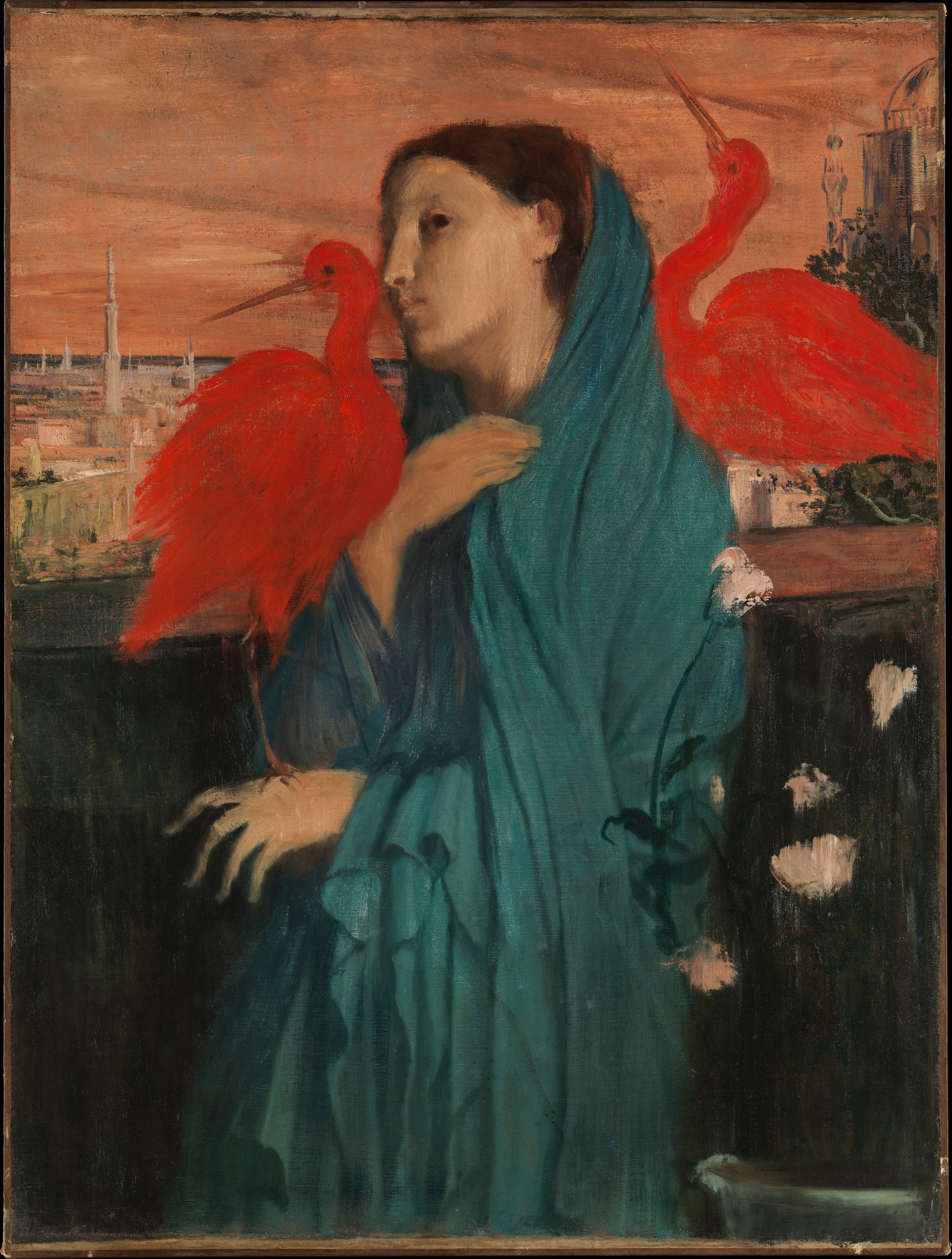
Metropolitan Museum of Art
This is the painting I chose to write about. I want to know why this woman looks so wistful, and I want to know more about the birds by her side. Whatever the answers turn out to be, I know my life will be richer because I opened myself to these questions.
Please be sure to visit the Two Writing Teachers blog to read more Slices of Life. (This is my first attempt to post by phone. My apologies for any errors.)