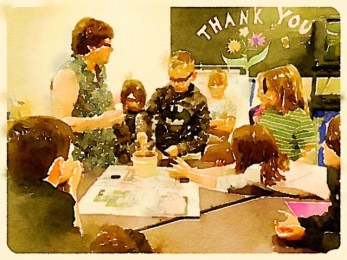
This fall I’m teaching a six-week exploratory course on gardening to 4th and 5th graders. Six weeks isn’t much time, but we’ve already suspended an avocado pit in water, planted oregano, and brainstormed a list of questions we want to answer. Later today we’ll be planting potatoes and next week we’re starting herb gardens.
Planting oregano (Thank you, Keri Snowden, for the photo!)
In addition to all these seeds sprouting, I’d like some writing to blossom during our course. A “things to do” list poem is a form we can collaborate on, and lends itself nicely to a short time frame. Here is a poem I drafted to use as a model.
Things to do if you’re a seed…
nestle into rich, warm soil soak up plenty of water swell like a sponge split your coat plunge thirsty roots deep into the earth poke an eager stem into the air sprout feathery leaves drink up the sun’s shimmering rays
“In music, in poetry, and in life, the rest, the pause, the slow movements are essential to comprehending the whole.” ~ Maryanne Wolf ~
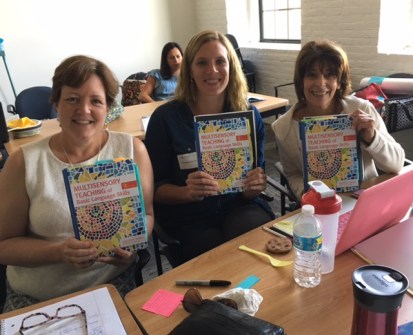
This past week, I attended a training institute on Structured Literacy Instruction. Although I may have grumbled a bit about the ninety minute drive, now that I’ve had time to rest and pause, I’ve realized the time spent learning with and from colleagues from across the state was both rewarding and enriching. I’ll be sifting through my notes and the presentation slides for weeks to come.
One of the requirements of the institute was to prepare a presentation on a chapter from Multisensory Teaching of Basic Language Skills, 3rd Edition, edited by Judith R. Birsh. At over 700 pages, this book is no light read, literally and figuratively! But, it is an important resource for all teachers. My group chose to present the chapter on vocabulary. We all know the impact of a deep vocabulary on reading comprehension, but some of the statistics shared were astounding. In 2006, Stahl & Nagy stated that “knowing individual word meanings is thought to account for as much as 50% of the variance in reading comprehension.”
Semantic relationships was discussed at length. Again, this is a topic that I know about and use with my students, but it was helpful to read again about the importance of developing our students’ “word consciousness,” or their “interest and awareness of words.” (Birsh, 339).
Poetry, of course, is ideal for developing all of these skills and more. As I was looking for a poem to share in our presentation to model these ideas, I stumbled across “School,” by David J. Langton. In the end, we chose Thunder Cake, by Patricia Polacco, but Langton’s poem is rich with possibility.
“School”
by David J. Langton
I was sent home the first day
with a note: Danny needs a ruler.
My father nodded, nothing seemed so apt.
School is for rules, countries need rulers,
graphs need graphing, the world is straight ahead.
“Education is the most powerful weapon which you can use to change the world.” ~ Nelson Mandela ~
“1905” by Marilyn Nelson
Looking out of the front page, a wild-haired, gentle-eyed young German man stands before a blackboard of incomprehensible equations. Meanwhile, back in the quotidian, Carver takes the school to the poor.
He outfits an open truck with shelves for his jars of canned fruit and compost, bins for his croker sacks of seeds. He travels roads barely discernible on the county map, teaching former field-slaves how to weave ditch weeds into pretty table place mats, how to keep their sweet potatoes from rotting before winter hunger sets in, how to make preacher-pleasing mock fried chicken without slaughtering a laying hen. He notes patches of wild chicory the farmers could collect to free themselves from their taste for high-priced imported caffeine.
He and his student assistants bump along shoulder to shoulder in the high cab, a braided scale of laughter trailing above their raised dust.
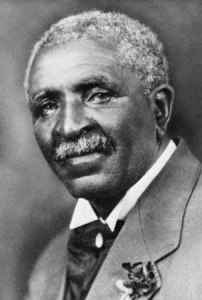
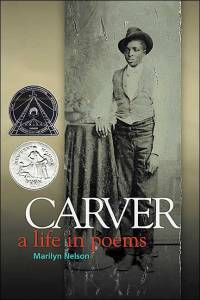
This poem is from Marilyn Nelson’s outstanding Carver: A Life in Poems. George Washington Carver, this poem, and the entire collection are a much-needed reminder of the power of what is possible. Please be sure to visit Kay McGriff at A Journey Through the Pages for the Poetry Friday Roundup.
My week has been filled with birds. (If you’re a frequent reader, you might be asking yourself, “What else is new?”) At the beginning of the week, I made may way to a new Audubon Center near my home for an early morning bird walk. Then I finished Mozart’s Starling (which I wrote about here). I really loved this book. Haupt ends by deftly weaving the threads of her starling Carmen, Mozart, and artists of every stripe into a reflection on the nature of creativity. “And what is this wild summons?” Haupt asks. “To listen with changed ears and sing back what we hear.”
Inspired by these words, here is a tanka filled with the sounds from my week.
As the last stars fade, robins and cardinals sense dawn’s approaching warmth. Trills and cheeps float from treetops chasing away night’s shadows.
How often do we go down rabbit holes in search of one thing, only to come out on the other side with something else altogether? Maybe not as often as we should.
This week I’m reading Lyanda Lynn Haupt’s captivating book, Mozart’s Starling. (Little, Brown, 2017). At one point, she quotes French poet Paul Éluard: “There is another world, but it is in this one.” This idea launches Haupt into a rumination on wonder. Did you know the root of “wonder” is an Old English word, wundrian that means “to be affected by one’s own astonishment”? Isn’t that lovely? Haupt ends this brief passage with this: “For us, the song of the world so often rises in places we had not thought to look.” These are the words of a poet.
Curious about her, I discovered that Haupt “is a naturalist, eco-philosopher, and speaker whose writing is at the forefront of the movement to connect people with nature in their everyday lives.”
But no poetry.
Back to Paul Éluard. The Poetry Foundation has two of Éluard’s poems, but neither of them really appealed to me. What did catch me eye was the poem of the day by Linda Pastan. Pastan is a favorite, so I clicked on the link to find this:
Even before I finished reading, I could feel my own poem taking shape. The ideas in this poem had been floating around my brain for the last month or so, but hadn’t settled on a form.
Thank you for following me down the rabbit hole! Please be sure to visit my friend and critique group partner, Linda Mitchell, at A Word Edgewise for the Poetry Friday Roundup.
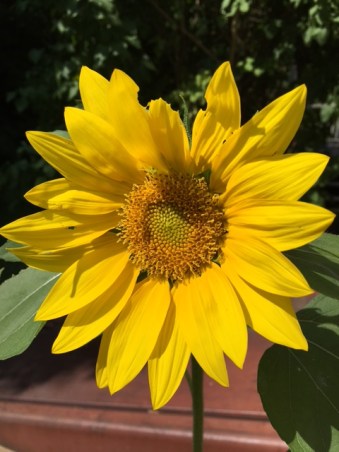
We haven’t filled our bird feeders for months because we don’t want bears wandering through our yard, but that doesn’t mean they aren’t still bringing us beauty and inspiration. I found this lovely visitor tucked into a corner that doesn’t get mowed. What better form than a Fibonacci for a poem about a sunflower?
A
dropped
seed, long
forgotten,
grows summer surprise:
one blossoming, buttery sun.
Happy National Macaroni and Cheese Day! Last week, Tabatha Yeatts, today’s PF Roundup hostess, suggested we celebrate this delectable dish in verse. Coincidentally, I had just read Rita Dove’s prompt, “Your Mother’s Kitchen” in The Practice of Poetry. Dove directs writers to include “the oven… and also something green.” My draft deviates from the instructions slightly by not including “something dead,” and not having a female relation “walk into the kitchen during the course of the poem.” My sister doesn’t like to cook and wouldn’t have been anywhere near the kitchen while my mother was cooking!
Healing Hands
My mother’s hands were healing hands. After standing all day helping doctors stitch broken bodies back together, she came home to tend and mend us.
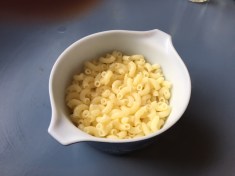
When she was seven, my sister suffered from chronic strep. Soft and smooth on her raw throat, my mother’s macaroni and cheese was all she’d eat.
In the kitchen, my mother gathered milk, butter, and cheese. Velveeta was the cheese of choice. She took the foil-wrapped brick from its bright yellow box, diced it into chunks.
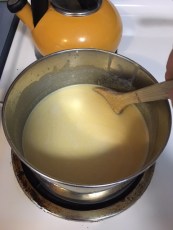
Standing in front of the avocado green stove, she whisked the mornay sauce, stirred until the liquid was smooth and golden, then poured it over steaming macaroni waiting in a pyrex dish. Into the oven it went, where it transformed into a creamy, bubbling concoction.
To this day, whenever I see a box of Velveeta, I can taste the macaroni and cheese my mother used to make with her healing hands.
According to Marcel Gleiser, Carlo Rovelli’s Reality is Not What It Seems: The Journey to Quantum Gravitiy “is a gem. It’s a pleasure to read, full of wonderful analogies and imagery and, last but not least, a celebration of the human spirit, in ‘permanent doubt, the deep source of science.’” What it is not, however, is a beach read. (Krista Tippett’s interview with Rovelli here is worth listening to.) That didn’t stop me from picking it up at the library a few weeks ago. While some of the science confused me, the poetry of Rovelli’s prose was immediately apparent. I decided right away that this book was perfect for the “Collaborative Cut-Up” exercise, shared by Anne Waldman in The Practice of Poetry, that my critique group partner, Margaret Simon, shared on her blog last week.
Rovelli’s text definitely “utilize[s] a vocabulary not [my] own.” Less apparent was what lines of my own I would “intercut” them with. Then, as I sat on my porch one afternoon, the answer was obvious. My yard and the woods and fields around it are a riot of green at this time of year, and I asked the question out loud. Lucy, my trusty beagle, looked up at me, but had no reply.
How Many Greens Can One Day Hold?
How many greens can one day hold? I’m not sure.
As many greens as blades of grass, lit by sun- light falling on a surface like a gentle hail shower? Or ferns, reaching toward the sky, forming small diaphanous clouds of vibrant, growing green.
Nothing stays still. Glossy green treetops tremble like the surface of the sea.
Step into the unknown, where coolness hides. The truth is in the depths of shadowy green pines.
Fireflies’ neon green signals speak with the voice of nature, blink on and off, whisper goodnight, accept living immersed in mystery.
If quantum gravity isn’t a topic you’re anxious to learn more about, this book isn’t a good choice. But in the last chapter, “Mystery,” Rovelli asks some serious questions about the nature of knowledge and what we can know with certainty. He states “to seek to look further, to go further, seems to me to be one of the splendid things that gives sense to life.” Splendid, indeed.
Photo by Aaron Burden via Unsplash.com
Please be sure to visit Carol Varsalona at Beyond Literacy Link for the Poetry Friday Roundup.
I was incredibly fortunate to spend four days this week at the Yale Center for British Art‘s Summer Teacher Institute. The goal of this Institute was to provide teachers with strategies for incorporating visual literacy into their classrooms. This is something I have been working on for many years, but my experience at Yale opened my eyes to new ways of supporting literacy with visual arts. In my final reflection, I stated that although school has just ended, I can’t wait for school to begin again so I can share all I learned with my colleagues and students.
The entire, vast collection at YCBA resonates with poetry. We spent hours with individual paintings, delving into the stories they tell. I’m still a little overwhelmed with all I saw and learned, and am grateful to have a few uninterrupted weeks to process the information and strategies the amazing instructors shared with us. This poem, by Thomas Hardy, begins to capture my experience.
“In a Museum”
by Thomas Hardy
I
Here’s the mould of a musical bird long passed
from light,
Which over the earth before man came was winging;
There’s a contralto voice I heard last night,
That lodges in me still with its sweet singing.
II
Such a dream is Time that the coo of this ancient bird
Has perished not, but is blent, or will be blending
Mid visionless wilds of space with the voice that
I heard,
In the full-fuged song of the universe unending.
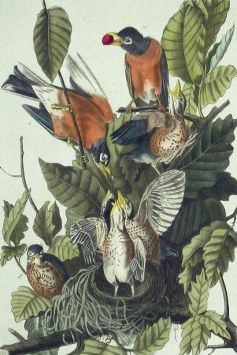
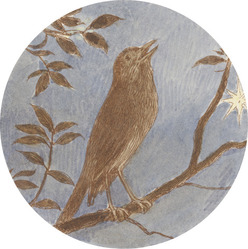
“Tail piece to The Nightingale” by Alfred W. Cooper, via Yale Center for British Art, Paul Mellon Collection
Please be sure to visit Diane Mayr at Random Noodling for the Poetry Friday Roundup.


 Reading to the Core