SOL 17: Our Springer Spaniel

11454297503_e27946e4ff_h

During February, I participated in Laura Shovan’s Found Poetry Project challenge, “10 Words Found in the News.” I didn’t manage to write a poem every day, but I have drafts floating around that I may get to this month. The words that inspired this poem, smile, knitting, spaniel, power, underpants, staring, rage, drawn, magnets, and always, came from Vanessa Davis’s graphic novel, Spaniel Rage.

Our springer spaniel
used to curl up next to me on the sofa,
drawn like a magnet to my side.
I always worried her dog hair,
weaving its way into the sweaters
and blankets I was knitting, would
cause someone’s allergies
to flare and rage.

I smile now when I think of her,
staring out the window,
dreaming of chasing squirrels,
pulling underpants out of the laundry,
always making mischief.
But she always had the power
to make us laugh.
She always had the power
to melt our hearts.

© Catherine Flynn, 2017

Cleo, 1994-2003
Cleo, 1994-2003

Thank you to StaceyBetsyBeth, KathleenDeb, MelanieLisa and Lanny for creating this community and providing this space for teachers and others to share their stories every day in March and on Tuesdays throughout the year. Be sure to visit Two Writing Teachers to read more Slice of Life posts.
SOL 17: “Something Shiny in the Rubble”

11454297503_e27946e4ff_h

“Sometimes fumbling is better than silence”
~ Irene Latham ~

Recently, I finally had a chance to read Kelly Barnhill’s Newbery Award winning novel, The Girl Who Drank the Moon. This gorgeously written ode to storytelling is layered and full of wisdom.

I was particularly struck by these lines:

“Every day the world shuffles and bends. Every day I find something shiny in the rubble.”

“She drew both mindlessly and mindfully.”

For me, these lines capture the essence of writing. Sometimes those shiny somethings reveal themselves only during the mindless writing, but they’re there. Keeping our eyes and minds open for them is the tricky part.

This is my fifth year participating in the March Slice of Life Challenge, and it has always been a rewarding experience. It’s also a stressful commitment. But it’s a commitment I’m willing to make. I’m looking forward to this month of writing with all of you. I’m looking forward to discovering the shiny things hiding in the rubble.

screen-shot-2017-03-01-at-10-01-37-pm

Thank you to StaceyBetsyBeth, KathleenDeb, MelanieLisa and Lanny for creating this community and providing this space for teachers and others to share their stories every day in March and on Tuesdays throughout the year. Be sure to visit Two Writing Teachers to read more Slice of Life posts.

Slice of Life: Things to Do If You’re a Cabin

11454297503_e27946e4ff_h

Last year, a friend gave me a bracelet engraved with these words:

“You only fail if you stop writing”

Although I haven’t been posting too much recently, I have been writing drafts and snippets of poems for Laura Shovan’s Found Word Poetry project. These words, from “34 Books by Women of Color to Read This Year,” were last Thursday’s  prompt: unicorn, cabin, glut, cousin, fever, sing, kitchen, flee, perch, & sour. Refuge was the bonus word.

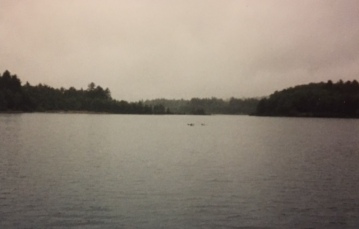
When I first read these words, I thought how easy it would be to write a poem using them. After all, my in-laws had a cabin on a lake in Maine where we spent many happy summers when my children were young. I was confident the poem would write itself.

Loons on the lake.
Loons on the lake.

Wrong.

Sometimes it seems that if I have too many ideas, it’s hard to wrangle them into some sort of shape. When this happens, I usually set the piece aside, move on to other ideas, and let the tangled mess percolate for a few days. Sometimes the idea is ready, but not always. Other times, I have to find the right form for my words. That’s what happened with this poem. After reading Elaine Magliaro’s gorgeous new book, Things to Do (Chronicle Books, 2017), I knew how to write this poem.

Things to do if you’re a cabin:

Perch on the edge of a fish-filled lake.
Wrap yourself in weathered red siding
and dream of summer,
when a glut of cousins
flee the heat and seek refuge
in the shade of soaring pines.

Remember the
mouth-watering aromas
floating out of the kitchen
as Grandma bakes her famous
sour cream peach pie.
Strain to hear whispered stories
of knights and unicorns at bedtime,
then listen to loons sing
their haunting lullaby.

© Catherine Flynn, 2017

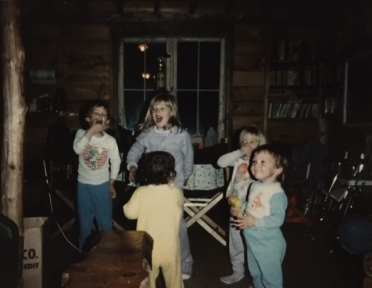
A glut of cousins, not quite ready for their bedtime story.

Thank you, Laura, for once again being so generous with your time and talents.  Thank you also to StaceyBetsyBeth, KathleenDeb, MelanieLisa and Lanny for creating this community and providing this space for teachers and others to share their stories each Tuesday. Be sure to visit Two Writing Teachers to read more Slice of Life posts.

Poetry Friday: Words

poetry_friday

I couldn’t keep up with life, work, and Laura Shovan’s Found Poetry Project, “10 Words Found in the News” this week. A few drafts are hiding in my notebook, and for now, that’s where they’ll stay. Thursday’s words, rural, warm, digester, dumps, compost, hanging, cartel, burial, peels, scraps, were culled by Ruth Lehrer from “The Compost King of New York” in the New York Times. They appealed to me immediately. My grandmother had a compost heap in her back yard for fertilizing her garden, and I initially went down that path. But, as often happens, another possibility presented itself.

Words
bubble up,
seeking my attention.
Some form a cartel,
hanging together
to demand a high
price for their use.

One or two peel away,
shimmering with possibility.

The rest are buried,
dumped along with
scraps of stories
and lines of abandoned poems
to a compost heap in some
rural part of my brain.

In the warmth and darkness
of my unconscious,
as if in a digester,
they ferment,
waiting their turn
to bubble up
to the surface
and bloom.

© Catherine Flynn, 2017

878761b3766f3ddee680b7c2e3df2283

Please be sure to visit Jone MacCulloch at Check it Out for the Poetry Friday Roundup.

Poetry Friday: Truth, the Last Word

poetry_friday

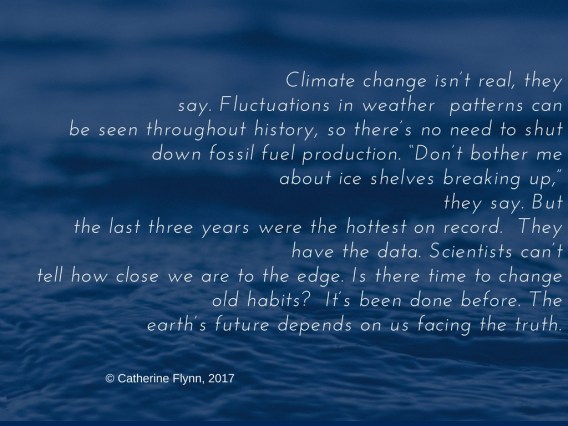
Once again, I am sharing a poem written in response to Laura Shovan’s Found Poetry Project. This year’s theme is “10 Words Found in the News.” For Thursday’s inspiration, Mary Lee Hahn chose Elizabeth Warren’s words from a CNN interview after she was banned from speaking on the Senate floor by Mitch McConnell. “They can shut me up, but they can’t change the truth,” Warren proclaimed.

As soon as I saw these words, Mary Lee’s post on Nikki Grimes’s amazing new poetry collection, One Last Word: Wisdom from the Harlem Renaissance (Bloomsbury, 2017) came to mind. Using the Golden Shovel form, Grimes uses lines from and/or entire poems written by giants of the Harlem Renaissance to create new verses.  Each line in the new poem ends with a word from the original verse. (Be sure to read Mary Lee’s post for a much clearer explanation. Better yet, get yourself a copy of One Last Word and read Grimes’s note about the form. The poetry, both the original poems and the new poems they inspired, is breathtaking. Warren’s statement seemed to be tailor made for a Golden Shovel poem. Here is my attempt at the form.

rachel-zoe

For more information about climate change, watch this video from Yale Climate Connections.

Please be sure to visit Katie at The Logonauts for the Poetry Friday Roundup.


Poetry Friday: “Worldview”

Poetry_Friday_Button-210

This poem was written in response to Laura Shovan’s Found Poetry Project. This year’s theme is “10 Words Found in the News.” Laura’s goal is to “encourage everyone to look at that language as a poet. We can create found poems and word art to reflect what’s happening in our country and world.” Today’s words, worldview, help, shareholders, safer, protections, dishonest, media, replace, business, and Messiah, are from NPR’s February 1st story about Rex Tillerson’s approval as Secretary of State.

"Earthrise" Image Credit: NASA
“Earthrise” by the astronauts of Apollo 8. Image Credit: NASA

Let the worldview
we carry within us
be this:

We are all shareholders,
caretakers of the abundance
of our planet.

We owe her our protection,
to keep our water safe,
to help our neighbors in need.

This is the business of living.

Don’t dwell on the media’s howls
of dishonest, troubled souls.
Replace fear with love,
and find the power of your Messiah within,
in the light of your heart.

© Catherine Flynn, 2017

Please be sure to visit Penny Parker Klosterman here for the Poetry Friday Roundup.

Slice of Life: News from the Natural World

11454297503_e27946e4ff_h

For the past four years, poet Laura Shovan has hosted a February Poetry Project. What started as “a birthday project” has grown to include 54 poets committed (or challenging themselves) to write a poem a day. I submitted one poem in 2015, when Laura’s theme was Pantone paint colors. Last year’s theme was “found object” poems, and I contributed many poems, but did not succeed in writing every day.

This year’s theme is “10 Words Found in the News.” Laura’s goal is to “encourage everyone to look at that language as a poet. We can create found poems and word art to reflect what’s happening in our country and world.” The project officially begins on February 1st, but Laura and other poets have posted several “warm-ups,” pulling words found in articles related to current events. I have been looking at these words and have tried to engage with them in way that doesn’t drive me to despair. One of my biggest concerns about the current administration is their total disregard for the environment and action toward climate change, so I’ve decided the most meaningful way for me to participate in Laura’s challenge is to view the words through the lens of the natural world. This may not always be possible, but that’s my goal.

Here is my first effort in response to warm-up#1, using eight of the ten words Laura’s randomizer pulled from Trump’s inauguration speech. I also changed some tenses. (factories, behind, pleasant, interests, disagreements, fallen, starting, complaining, cash, stops)

News from the Natural World

A honey factory
clings to a branch
high in an ancient maple.
Starting at dawn,
when the first rays
of sun peek from
behind purple hills,
bees begin their ancient
dance anew.

They have no interest
in disagreements
rippling through the world;
cash and complaints
have no currency here.
Golden liquid
is their only care,
oozing, dripping, falling,
from waxy honeycombs,
free for the taking.

© Catherine Flynn, 2017

Thank you, Laura, for once again being so generous with your time and talents.  Thank you also to StaceyDanaBetsyBeth, KathleenDeb, Melanie, and Lisa for creating this community and providing this space for teachers and others to share their stories each Tuesday. Be sure to visit Two Writing Teachers to read more Slice of Life posts.

Poetry Friday Naomi Shihab Nye’s “Truth Serum”

Poetry_Friday_Button-210

Naomi Shihab Nye’s poetry is filled with love, sensitivity, and compassion. Her work has been a source of solace and inspiration to me for years. So I was thrilled when she was announced as the 2018 May Hill Arbuthnot Honor Lecture on Monday during the ALA’s Youth Media Awards Announcements. The Arbuthnot Award recognizes “an author, critic, librarian, historian or teacher of children’s literature, who then presents a lecture at a winning host site.” I can’t think of a more appropriate choice to share her insights and wisdom in our troubled times.

“Truth Serum”
by Naomi Shihab Nye

We made it from the ground-up corn in the old back pasture.
Pinched a scent of night jasmine billowing off the fence,
popped it right in.
That frog song wanting nothing but echo?
We used that.
Stirred it widely. Noticed the clouds while stirring.
Called upon our ancient great aunts and their long slow eyes
of summer. Dropped in their names.
Added a mint leaf now and then
to hearten the broth. Added a note of cheer and worry.

Read the rest of the poem here.

by Jonathan M. Hethey via unsplash.com

Please be sure to visit Carol Varsalona at Beyond Literacy Link for the Poetry Friday Roundup.

Slice of Life: The Woman Citizen

11454297503_e27946e4ff_h

When I was a sophomore in high school, my social studies teacher was an engaging, charismatic young woman named Carla Kazanjian. She was also a feminist. Really the first one I had ever known. (My strong, independent grandmothers and mother would not have considered themselves feminists). In the sleepy, conservative corner of Connecticut where I grew up, Ms. Kazanjian was laughed at by some, and considered by a few to be downright dangerous.

I didn’t care what anyone thought of her, though. I loved her. She taught me about the history of the women’s movement and its heroes: Elizabeth Cady Stanton, Susan B. Anthony, Victoria Woodhull, and so many more. She opened my eyes to injustice, but she also taught me to have confidence and believe that anything was possible. Most importantly, she inspired me to push myself and to never give up.

In the spring of my junior year, Ms. Kazanjian gave me a book that still has a place on my bookshelf. In The Woman Citizen: Social Feminism in the 1920s (University of Illinois Press, 1973), by J. Stanley Lemons describes how “various women and organizations worked for a broad reform movement to civilize, democratize, and humanize the American system, as they worked for progressive reform they advanced the status of American women. And as they fought for women’s rights, they pushed progressivism along in a decade of waning reformist impact.”

                       fullsizerender-1      fullsizerender

This sounds eerily familiar. Although I read this book forty years (!) ago, this passage from the book’s Preface makes me think I need to reread and rediscover how “social feminists held the progressive faith longer than most.” Many of the causes these women fought for, “…conservation…pensions, municipal improvements, educational reform, pure food and drug laws…social justice, and peace” are our causes still. As unbelievable and discouraging as that may sound, it also strengthens my resolve not to give up on the issues I believe in. Issues I know in my heart are worth fighting for.

As I stood on the lawn of the capitol in Hartford on Saturday, I thought of Ms. Kazanjian. I wondered if she was there among the crowd of 10,000 women and men of all ages and races. I knew I was there, in part, because of her.

unnamed

  Thank you to StaceyDanaBetsyBeth, KathleenDeb, Melanie, and Lisa for creating this community and providing this space for teachers and others to share their stories each Tuesday. Be sure to visit Two Writing Teachers to read more Slice of Life posts.

Poetry Friday: “To You”

Poetry_Friday_Button-210

In her “Note from the Author” at the beginning of This Place I Know: Poems of Comfort (Candlewick, 2002), Georgia Heard writes:

“During any difficult time, we all need a place where, as Faiz Ahmed Faiz writes in his poem “Song,” ‘the heart [can] rest.'”

No matter where one falls on the political spectrum, no one can deny this is a “difficult time.” This poem, by Karla Kuskin, gives my heart a place to rest.

“To You”

I think I could walk
through the simmering sand
if I held your hand.
I think I could swim
the skin shivering sea
if you would accompany me.
And run on ragged, windy heights,
climb rugged rocks
and walk on air:

I think I could do anything at all,
if you were there.

by Josh Boot via Unsplash.com

Please be sure to visit Violet Nesdoly at Violet Nesdoly/Poems for the Poetry Friday Roundup.