Slice of Life: From My Grandmother’s Kitchen

11454297503_e27946e4ff_h

Why do we save things? To remind us of momentous occasions, memorable moments, times we had fun? I suppose for all these reasons and more. We say things have sentimental value, but it’s sometimes hard to articulate exactly why. And though I’ve never been sorry I held onto an object, I’ve often regretted getting rid of something, usually within a week or two.

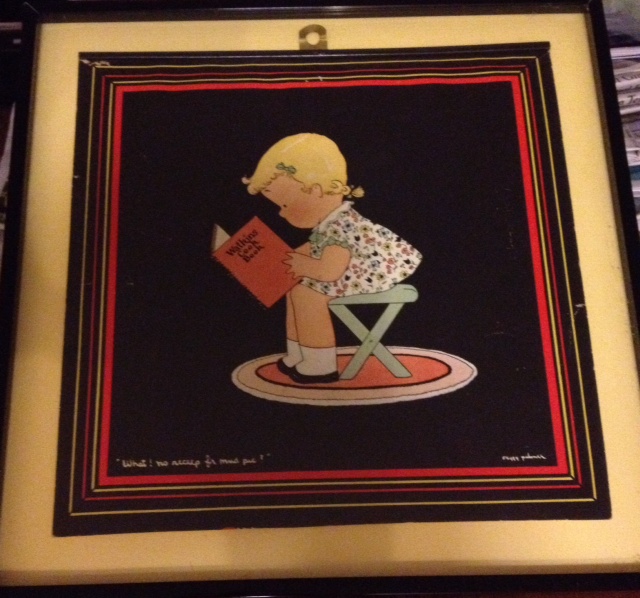
When I get frustrated about my inability to throw things away (usually because a stack of papers or pile of pictures has just collapsed), I think of my grandmother and tell myself it’s genetic. She had a Depression-era mentality of saving everything. When we cleaned out her house, we found bank statements from the 1950s! But we also found many treasures. One was an illustration from a 1930s calendar of a little girl reading a Watkins Cook Book. The caption reads: “What! No recipe for mud pie?” As soon as I saw it, I thought of my mother-in-law. She loved to bake and made delicious whoopie pies. I knew she had to have this picture.

photo

I took it to a shop to have it matted and framed, and gave it to my mother-in-law for Christmas that year. She loved it, and it hung by her stove for the rest of her life. After she died, I told my sister-in-law that this picture was the only possession of my mother-in-law’s I really wanted. She said she’d put it aside for me and that I could get it the next time I was in Pennsylvania.

Except I couldn’t. My sister-in-law had put it aside so well she couldn’t find it. I’ve done this myself, so I figured it would turn up eventually. Except it didn’t. Then the house was sold and emptied. Still no picture. I tried not to be too disappointed. After all, I had plenty of memories of cooking with my mother-in-law in that kitchen, and all the happy meals our family had shared there.

This past weekend my sister-in-law visited, and when she arrived at our house, she handed me a box. “It was in a corner of my attic,” she explained. I opened the lid, and there it was, right on top. A piece of ephemera my grandmother had saved almost 80 years ago, that hung in another kitchen for ten years, will now be at home in my kitchen, linking it to other kitchens, other times. 

This whole episode reminded me of Susan Vreeland’s lovely book, Girl in Hyacinth Blue. Through a series of stories, Vreeland links the owners of a (fictional) painting by Vermeer across the centuries. She creates a vivid depiction of each time period and owner, charting their motivations and desires. These remain remarkably similar over the centuries. At one point, a character realizes that “love builds itself unconsciously… out of the momentous ordinary.”

I think this is why we save things. To have reminders of those unconscious, ordinary moments that add up to a life filled with love.

Thank you, as always, to StaceyTaraDanaBetsyAnna, and Beth for hosting Slice of Life each Tuesday. Be sure to visit Two Writing Teachers to read more Slice of Life posts.

Poetry Friday: Whispers

poetry-friday-1-1

The third week of school is coming to an end. Routines are falling into place, schedules have been ironed out, and most of the tears have dried up. Throughout these hectic weeks, it’s been challenging for me to get my act together at home and find time for writing. I’ve been jotting notes like mad, and keep telling myself that I’ll have time today, I’ll get up early…. You know how that goes!

This Myra Cohn Livingston poem captures the feeling I’ve had as thoughts and ideas keep whispering to me.

Whispers

Whispers

tickle through you ear

telling things you like to hear.

Whispers

are as soft as skin

letting little worlds curl in.

Whispers

come so they can blow

secrets others never know.

This would be a perfect poem to share with young writers as they also settle into the routine of writing every day and learn to keep their eyes and ears open for ideas waiting to be put into words.

Be sure to visit Renee at No Water River for today’s Poetry Friday Round Up.

Searching for a Slice

11454297503_e27946e4ff_h

All day, I’ve been searching for a slice to share.

My search began as I stood at the kitchen sink this morning,

slicing plump, juicy strawberries to stir into my yogurt.

I thought I’d found one when, walking to my car, I glanced up

and saw flock of birds wheeling and diving, their wings

flecks of gold in the morning sun.

But no. They flew away.

At work, possibilities crossed my path at lightning speed.

Third grade lesson— Edgar Badger’s Balloon Day.

Fourth grade read aloud—Three Good Deeds

Concepts of Print assessment—“Show me the word was.

On into the afternoon, ideas came and went.

I despaired of ever finding one.

Then, driving home from Open House,

weary from this long day,

I rounded a corner, and there before me

hung the full moon.

Suddenly I saw the ordinary events of my day

as pearls on a string, luminous in the moon’s glow.

I’d been building my slice all day.

I just couldn’t see it until I had the right light.

Thank you, as always, to StaceyTaraDanaBetsyAnna, and Beth for hosting Slice of Life each Tuesday. Be sure to visit Two Writing Teachers to read more Slice of Life posts.

Is Test Prep the Mint of Education?

Close reading has been my mind a lot lately. I recently read What Readers Really Do, by Dorothy Barnhouse and Vicki Vinton. I revisited Notice and Note: Strategies for Close Reading, by Kylene Beers and Robert Probst as well as Falling in Love With Close Reading, by Christopher Lehman and Kate Roberts. Yesterday, Tara Smith’s excellent post on reading journals gave me more to think about. This is important work. Work that will help our students “grow and develop new ideas and insights.” (Barnhouse & Vinton, pg. 152) I need time to process all this wisdom and work with my colleagues to determine how we’ll integrate these ideas into our teaching. I’ll be sharing more about this in the weeks to come. In the meantime, I want to share a post from 2013 that still holds true today.

Thank you, as always, to StaceyTaraDanaBetsyAnna, and Beth for hosting Slice of Life each Tuesday. Be sure to visit Two Writing Teachers to read more Slice of Life posts.

Catherine Flynn's avatarReading to the Core

Image via Wikimedia Commons

This morning as I was weeding my garden, it occurred to me that the mint that had overrun my herb garden was like standardized test prep. As schools across the country do their best to prepare students for the new CCSS-aligned assessments, test prep is running rampant. Just as the mint in my garden has choked out the basil and parsley, test prep, and the tests themselves, threaten to take over the school day, leaving no time to savor novels, delve into a character’s motivation, or write a deeply personal narrative.

I grow a variety of herbs in my garden because each herb has its own distinct flavor and use. The amount of the herb I use depends on what I’m cooking. The same is true for teaching. We have a wide variety of instructional resources and strategies available. As professionals, we take great care to make…

View original post 202 more words

Slice of Life: Recipe for a Perfect Summer Day

11454297503_e27946e4ff_h

Last week I was lucky enough to spend four wonderful days at a lake in northern Wisconsin with my son, daughter-in-law, and her family. Inspired by the beauty surrounding me, and a poem I read recently by Laura Purdie Salas, I decided to write a recipe poem about my visit to Lake Minocqua.

photo-2

“Recipe for a Perfect Summer Day”

Take one lake filled with calm, clear water,

sun-warmed and sparkling.

Surround it with towering pine trees,

where bald eagles nest and perch.

Fill it with musky and largemouth bass,

walleye and northern pike.

Add:

pairs of loons, warbling their mournful cry,

graceful herons, still as statues on the shore,

iridescent dragonflies, darting over the surface.

Mix in families and friends who spend the day:

swimming and kayaking,

biking or hiking;

your choice.

Top with a campfire,

toasted marshmallows,

and gooey, chocolatey s’mores,

under a star-filled sky.

© Catherine Flynn, 2014

Thank you, as always, to StaceyTaraDanaBetsyAnna, and Beth for hosting Slice of Life each Tuesday. Be sure to visit Two Writing Teachers to read more Slice of Life posts.

Slice of Life: Becoming Fearless

11454297503_e27946e4ff_h

“Play around. Dive into absurdity and write. Take chances. You will succeed if you are fearless of failure.” 

Natalie Goldberg, Writing Down the Bones: Freeing the Writer Within

I highlighted these lines in my copy of Goldberg’s wise and funny book years ago. But I feel like I’m just beginning to truly understand their implication in terms of what is possible for me as a writer.

Why did it take me so long to come to this understanding? Maybe I’m a slow learner. More likely is the fact that I’ve been writing a lot this summer. And through the process of becoming more immersed in the story I’m working on, I have become fearless. Okay, less fearful.

But there’s more to it than just writing more. Two experiences from the past month have played a huge role in helping me get to this point.

Thanks to a conversation Melanie Meehan and Betsy Hubbard had on Twitter a few months ago, I am now part of an online critique group. I cannot overstate how lucky I am to work with Melanie, Stacey, and Julie. They are incredibly supportive and kind, but also offer meaningful suggestions and advice. Another benefit of being part of this group is reading my partners’ amazing writing. Melanie, Stacey, and Julie are all talented writers, and I’ve already learned so much from the pieces they’ve shared with the group.

My experience at art camp earlier this month also helped me be more comfortable to “play around” and “take chances” in my writing. One of the activities that I found especially helpful was creating an “analog drawing” of a problem. In analog drawing, only lines are used to express emotion, among other things. As I sketched my problem, I realized I was creating a narrow doorway with a border that looked very much like battlements. “Is this how I approach problems?” I wondered, appalled at the thought. I began to sketch other doorways, doorways that opened wider and were less rigid. As I continued to draw, I came to the realization that these narrow doorways were impacting my writing.

So it was with these two experiences in mind that I was able to not, in Natalie Goldberg’s words, be “tossed away…by [the] fiasco” of this line in my first draft of a story about a girl whose mother has just died:

“Holly was devastated that she would be separated from her two best friends.”

As my husband might say, “Well, no s*&t, Sherlock.” As soon as I read this line, I knew my critique partners would point out its many weaknesses immediately. I really didn’t want them to even see this lame line. I also thought of my drawing of the opening doors. Why was I afraid to find out how Holly dealt with this devastation?  Just write. Dive in and see where this line leads.

After an hour of revision, one short sentence had become two pages of action and dialogue that reveal much about Holly and her mother. These are the lines (which still need plenty of work) that replaced the original, obvious statement of Holly’s feelings:

“Holly stared in disbelief at the lists taped up on the glass doors. Tears filled her eyes as she turned away and ran from the parking lot toward the playground. “Arrrgh!” she screamed as she jumped onto bottom rung of the jungle gym. Her hands clung to the cold metal of the bars as if they were all that kept her from falling into a giant black cave.”

In her book The Artist’s Way, Julia Cameron writes that we are “creating pathways [into our] consciousness through which the creative forces can operate.” I realize now that I had to write the first line in order to create the pathway to get to the second line. Uncovering deeper understandings about these characters and their story isn’t always possible without a surface level understanding of who they are. Put another way, just as artists have to sketch the outline of a subject before they can add layers of color that create nuance and depth in their drawing or painting, writers have to start with a general idea of what their writing is about before they can add the nuance and depth that creates memorable characters.

While I’m happy about the writing I’ve done over the past month, I’m unsettled by the implications of how I arrived at these insights for teaching. Having the luxury of filling my days with reading, writing, drawing, and thinking about what interests me, at my pace, is not an opportunity we give our students very often, if ever. Children need the time to play and explore, to discover what is possible, not just in writing, but in all areas of their lives. They also need the kind of supportive and nurturing environment my critique group has given me. Finding a way to provide these conditions is critical for anyone, young or old, to create the pathways into their consciousness that will awaken them to all the possibilities within themselves.

Thank you, as always, to StaceyTaraDanaBetsyAnna, and Beth for hosting Slice of Life each Tuesday. Be sure to visit Two Writing Teachers to read more Slice of Life posts.

Slice of Life: Cultivating Creativity

11454297503_e27946e4ff_h

I am not an artist. But over the past year or so, drawing has been nudging its way into my brain. At NCTE, Linda Rief spoke about incorporating several different art techniques into a poetry project. Linda’s presentation inspired Vicki Vinton to invite readers of her blog, To Make A Prairie, to do “something creative” in response to a poem they love. So when I was offered the opportunity to attend an art “camp” for adults, I jumped at the chance. For the past two days, I have been sketching and painting and making collages.  This experience has been everything I hoped it would be and more.

One of yesterday’s activities found us out in the garden, gathering images. It was a classic summer day: bright blue sky, puffy white clouds, insects buzzing from flower to flower, birds chirping from the tree tops. It was lovely just to sit and soak in the beauty of the moment. Our teacher instructed us to do just that, but to write and/or sketch the images surrounding us.

Back in the studio, we were given time to turn our thoughts into haiku, then time to capture the image in watercolor or colored pencil.

I drafted two poems based on my observations:

1.

serene summer day

breezes whisper through pine boughs

lilies trumpet joy

photo-5
First try–tiger lilies are hard to draw!

2.

hidden sweetness

clover blossoms pink as dawn

bees hover and buzz

This experience has been quite an eye-opener, and I’ve had some interesting insights into my writing process through drawing. Driving to the studio yesterday, I was filled with anxiety about this experience. Now I wish I had more than four days to continue to forge what Julia Cameron, in The Artist’s Way, calls “pathways into [my] consciousness through which creative forces can operate.”

Thank you, as always, to StaceyTaraDanaBetsyAnna, and Beth for hosting Slice of Life each Tuesday. Be sure to visit Two Writing Teachers to read more Slice of Life posts.

Poetry Friday: “Do You Have Any Advice For Those of Us Just Starting Out?”

poetry-friday-1-1

Although National Poetry Month has officially ended, poetry continues, always waiting for us to pay close attention and find it. For those of us still honing our craft, Ron Koertge has this advice.

“Do You Have Any Advice For Those of Us Just Starting Out?”

by Ron Koertge

Give up sitting dutifully at your desk. Leave

your house or apartment. Go out into the world.

It’s all right to carry a notebook but a cheap

one is best, with pages the color of weak tea

and on the front a kitten or a space ship.

Read the rest of the poem here.

Image by David Castillo Dominici via freedigitalphotos.net

Thanks to Katya at Write. Sketch. Repeat. for hosting the Poetry Friday Round Up. Be sure to stop by to read more poetry posts.


Slice of Life: Caution Thrown to the Wind

11454297503_e27946e4ff_h

“Imagination is the beginning of the cognitive process through which we create meaning.”

Betty K. Garner

One morning last week, I found myself following a builder’s pickup truck on my way to work. A long length of yellow tape was trailing out of the bed of the truck. At first, I was slightly annoyed that this tape was slowing me down, but I became so fascinated watching its gyrations that I was sorry when the driver realized what was happening and pulled over to capture the escaped tape.

Coincidentally, I had just finished reading an article by Betty K. Garner called “The Power of Noticing” in Educational Leadership‘s February 2013 issue on creativity. Garner explains that taking the time to really notice something “supplies the raw material for creative thinking” and that “this kind of cognitive engagement stimulates curiosity and creativity.”  So when I arrived at school, I rushed to my desk and wrote everything I remembered about what the wayward tape had conjured in my mind. Several days and several drafts later, here is a poem I created out of those images.

Charmed by the warmth of the morning sun

and the fresh air filled with bird songs,

a length of yellow construction tape

rises up out of its cardboard home

in the back of a pickup truck

and catches a ride on the breeze.

Dancing down the road,

it undulates like a cobra,

lured out of its basket by the call of a pungi,

waving back and forth,

creating serpentine shapes,

its message of caution

thrown to the wind.

© Catherine Flynn, 2014

Since this is the last Tuesday of National Poetry Month, I hope Mary Lee won’t find this poem’s link to imagination too tenuous and mind if I share it with the readers of her “Our Wonderful World” poetry project.

Thank you, as always, to StaceyTaraDanaBetsyAnna, and Beth for hosting Slice of Life each Tuesday. Be sure to visit Two Writing Teachers to read more Slice of Life posts.

Our Wonderful World: The Grand Canyon

Mary Lee Hahn is celebrating National Poetry Month by celebrating “Our Wonderful World.” Each day, Mary Lee is writing an original poem in honor of either a man-made or natural wonder. Today’s wonder is the Grand Canyon. I have rafted down the Colorado River through the Grand Canyon twice, so I couldn’t pass up this opportunity to write a poem about my experience.

We have hundreds of photos from both of these trips, and I kept a journal during each trip. I have shared memories of our adventures in the past, Lava Falls and The Legend of the Sanpodohavatulli Expedition. Before attempting to write this poem, I reread my journals, skimmed through many of the pictures, and jotted many notes. But this poem did not come easily. I didn’t know where to start. Then, after listening to Christopher Leheman’s Teacher Poets online workshop this morning, it became clear that I needed to focus on a small sliver of the entire trip. Our hike to Deer Creek was one of the most memorable, so I focused on this beautiful side canyon.

south rim 2

The Grand Canyon

From Yaki Point on the South Rim,

the majestic sun-soaked sandstone

is on full display,

the river a ribbon of green a mile below.

But travel deeper,

into the heart of the canyon

to Deer Creek.

Climb the steep trail,

into the slot canyon behind the falls.

For eons, 

this stream

has carved the soft rock

with a sculptor’s precision; 

finding each chink and crack,

washing the sediment away,

grain by grain,

shaping each sensuous curve,

creating this hidden oasis

where today I soak in a clear, cold pool,

immersed in the wonder of it all.

© Catherine Flynn, 2014

deer creek falls
Deer Creek Falls

            deer creek falls 001   slot canyon

Thank you, Mary Lee, for inspiring this poem!