Poetry Friday: “The Young Poets of Winnipeg”

poetry-friday-1-1

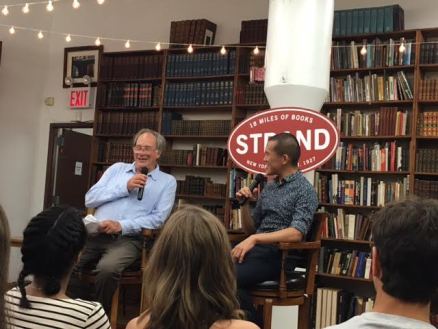
For the past week, I’ve been at the Teachers College Reading and Writing Project August Reading Institute. Every educator deserves to spend a week learning from the passionate, brilliant people here. Each day, keynote speakers share their latest thinking about reading and reading instruction.

The message this week has been loud and clear: WE ARE WHAT WE READ

Matt de la Peña told us on Tuesday that he believes the job of a young person is to “discover the different possibilities that are in front of you.” If a young person is a nonreader those possibilities are very limited.

Stephanie Harvey implored us to “table the labels.” A student is not a number or a letter. A student is a human being with hopes and dreams and desires. When we label them and allow them to read only books that match that label, we are limiting the possibilities they see for themselves. That is unconscionable.

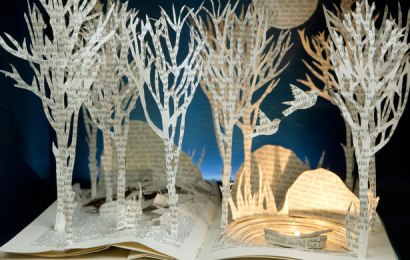
Design by Su Blackwell

With all this in mind, this poem, by Naomi Shihab Nye, seemed especially appropriate to share and keep in our minds and hearts as we head back to our classrooms.

“The Young Poets of Winnipeg”
by Naomi Shihab Nye

scurried around a classroom papered with poems.
Even the ceiling, pink and orange quilts of phrase…
They introduced one another, perched on a tiny stage
to read their work, blessed their teacher who
encouraged them to stretch, wouldn’t let their parents
attend the reading because parents might criticize,
believed in the third and fourth eyes, the eyes in
the underside of leaves, the polar bears a thousand miles north,
and sprouts of grass under the snow. They knew their poems
were glorious, that second-graders could write better
that third or fourth…

Read the rest of the poem here.

Wishing you all a wonderful school year! Please be sure to visit Julieanne at To Read To Write To Be for the Poetry Friday Roundup.

Poetry Friday: Where Poems Hide

poetry-friday-1-1

As summer winds down, thoughts turn to the start of school. Each new year brings new faces new challenges, new curriculum, but poetry remains a constant. Krista Tippet’s interview with Naomi Shihab Nye on last week’s episode of On Being (a must-listen!) prompted me to revisit “Valentine for Ernest Mann” and think about where poems are hiding in my life.

Here is a draft of one I found outside my kitchen window one morning this week:

Poems hide.
They lie crouched in the tall grass
at the edge of a thicket
where each morning
a tawny rabbit emerges
to nibble his breakfast
of grass and sweet clover.
His ears stand at attention,
alert for the slightest sound,
eyes peeled
for the shadow of a hawk,
legs coiled in readiness
to flee back into
the safety of the thorns.

© Catherine Flynn, 2016

By M2545 (Own work) [Public domain], via Wikimedia Commons

I’m looking forward to returning to school and learning where poems are hiding in the lives of my students.

Please be sure to visit Tara Smith at A Teaching Life for the Poetry Friday Roundup.

Poetry Friday: “The Peace of Wild Things”

poetry-friday-1-1

“The Peace of Wild Things”
by Wendell Berry

When despair for the world grows in me
and I wake in the night at the lease sound
in fear of what my life and my children’s lives may be,
I go and lie down where the wood drake
rests in his beauty on the water, and the great heron feeds.
I come into the peace of wild things…

Read the rest of the poem here

By Dcordero7965 at English Wikipedia (Transferred from en.wikipedia to Commons.) [Public domain], via Wikimedia Commons
Please be sure to visit Margaret Simon at Reflections on the Teche for the Poetry Friday Roundup.

Poetry Friday: Play Ball!

poetry-friday-1-1

My sister’s dog, Lily, loves chasing balls. During a recent visit to my sister’s, Lily’s joy and exuberance were on full display as she and my brother-in-law played ball.

 Black fur blurs,
a rocket zooming across the lawn.
She leaps, her quarry captured,
then tumbles to the ground.
Sphinx-like, she waits,
guarding her ball on the sun-dappled grass,
ever eager for the next round of fetch.

© Catherine Flynn, 2016

IMG_0623
Lily with her beloved ball.

Please be sure to visit Chelanne at Books 4 Learning for the Poetry Friday Roundup.

Poetry Friday: Grains of Sand

poetry-friday-1-1

How can we make sense of yet another horrific act of senseless violence? Yesterday’s events in France have me in a state of despair. The light-hearted poem I had planned to share today now seems inappropriate. What to share instead?

As I walked my dog this morning, I was hyperaware of my surroundings, noticing traces of spider webs, ripening blackberries, and the cacophony of bird songs. Noticing the beauty of the world right in front of me. Somehow all this noticing reminded of me of this poem, which I wrote several years ago.

994867_638109806210034_1779419702_n
Sand, magnified 250x via Science is Awesome http://24.media.tumblr.com/tumblr_m0rvfs8x3j1qbwfjko1_500.jpg

The Sand Beneath Our Feet

Sometimes in our busy lives,
we brush others aside
as carelessly as we brush
the sand off our feet
after a day at the beach.

But what if we stopped,
took a moment
for a closer look?

What wonders might be revealed to us?

The geologist, turning
her microscope to those few
grains of sand,
is rewarded with
an astonishing menagerie:

crystal jacks,
ivory sea urchins,
golden honeycombs,
swirls of pink cotton candy,
amber snails, spiraling ever inward.

Shaped by forces beyond our ken,
each one as different from the other
as you and I.

What pressures shaped you?
What winds and rains have buffeted you about?
What marvels have been forged
in the depths of your heart?

© Catherine Flynn, 2016

Please be sure to visit Mary Lee Hahn at A Year of Reading for the Poetry Friday Roundup.

Poetry Friday: Slipping into Summer Mode

poetry-friday-1-1

Summer. Thoughts turn to mornings of clearing away the clutter of a busy school year and lazy afternoons with a book, days at the beach, adventures near and far. But most of all, TIME to write! It’s been a slow transition for me this year, though, as I’ve been writing curriculum and taking care of other work obligations that seem to have no end. I’ve been de-cluttering like mad, but my writing has come in fits and starts and feels stale and stilted. The best remedy for this? Read poetry, of course!

So I revisited one of my favorite anthologies from the past few years, Firefly July (Candlewick Press, 2014). This entire collection, selected by Paul B. Janeczko and brilliantly illustrated by Melissa Sweet, radiates joy. On every page, poets surprise and delight with perfect images and metaphors. “A Happy Meeting”, by Joyce Sidman, is just one example.

IMG_0476

Joyce’s poetry always gives me a jump start, and I remembered she has a new book coming out, so I went searching for more about that. As you may know, Before Morning, with illustrations by Beth Krommes, will be published by Houghton Mifflin Harcourt in the fall. And although I didn’t find too much about that book, I did find this interview, from 2010, with Julie Danielson at Seven Impossible Things Before Breakfast.

At the very bottom of the page, this treasure is waiting:

“How to Find a Poem”
by Joyce Sidman

Wake with a dream-filled head.
Stumble out into the morning,
barely aware of how the sun
is laying down strips of silver
after three days’ rain,
of how the puddles
are singing with green.

Read the rest of the poem here.

Wishing you all sweet, dream-filled summer days! Please be sure to visit Tabatha Yeatts at The Opposite of Indifference for the Poetry Friday Roundup.

Slice of Life: Summer STEAM

11454297503_e27946e4ff_h

“Wisdom Begins in Wonder”
Socrates

These words are as true today as they were 2500 years ago. I may have heard or read them before, but I was happy to see them painted on the wall of the “Cabinet of Art and Curiosity” installation at the Wadsworth Atheneum in Hartford yesterday. I was there to participate in the museum’s “Summer STEAM” workshop, designed to show teachers “the many ways art can enhance science, technology, engineering, and math” in their classrooms.

Lisa Delissio, a STEM Faculty Fellow at Salem State University, began the day with a talk about the intersection of art and science. She explained that the “perspective and knowledge of artists is essential to scientific approaches to problems.” Specifically, she listed the observational skills artists bring to their work that have been found to have an impact on the skills of her biology students. These include:

  • visual qualities
  • other sensory qualities
  • perspectives
  • materials
  • connecting to meaning: memories and metaphor
  • context, function, and purpose

Dr. Delissio then showed us this image:

By Prosthetic Head (Own work) [CC BY-SA 4.0 (http://creativecommons.org/licenses/by-sa/4.0)], via Wikimedia Commons
By Prosthetic Head (Own work) [CC BY-SA 4.0 (http://creativecommons.org/licenses/by-sa/4.0)%5D, via Wikimedia Commons

She asked us to use the observational skills of an artist and the perspective of a biologist to respond to the image with word and/or  pictures. My sketch was very rudimentary, but my jottings were very much dominated by my poetry brain. I was immediately drawn to the stamens of the large flower in the foreground, which reminded me of sunspots exploding on the sun and the flower in the bottom center waiting to bloom. To me, its folded petals looked like hands folded in prayer.

We were given ten minutes to work on this, which sounds like a long time. But it really wasn’t. I could have easily  spent another half hour working on my observations and the poem I was beginning to formulate. Keeping the STEAM theme of the day in mind, I started a Fib poem, a poem which uses the Fibonacci sequence to determine the number of syllables in each line.

Fat
skink
rests on
bright purple
aster petals, their
stamens exploding like the sun.

The auditorium full of dozens of teachers was absolutely still as people worked. But it didn’t feel like work at all. We were completely engaged in our creativity, our intellectual curiosity sparked by the blending of diverse disciplines. As Dr. Delissio explained, students who pursue double majors in science and the arts are more creative, and exhibit more intellectual curiosity and divergent thinking than students with a single major.

Attending this workshop was a joy for me, not because I needed convincing that the arts should be included in STEM, but because it bolstered my belief in the importance of including the arts in our classrooms. As schools across the country embrace STEM and devote time and resources to integrate STEM into the curriculum, we have to ensure that the arts are always included. As Anne Jolly points out in a recent Education Week article, “The purpose of STEAM should not be so much to teach art but to apply art in real situations. Applied knowledge leads to deeper learning.”

Thank you to StaceyDanaBetsyBeth, KathleenDeb, Melanie, and Lisa for this space for teachers and others to share their stories each Tuesday. Be sure to visit Two Writing Teachers to read more Slice of Life posts.

Poetry Friday: “Stanzas for a Sierra Morning”

poetry-friday-1-1

Sometimes when we read a poem there’s an instant connection between us and the poet. Someone we’ve never met, maybe even never heard of, has managed a magical transformation of words into phrases into stanzas that reach into our heart, like the first rays of sunlight bathing the tips of tree branches in its yellow glow. In that moment we know we’ve found a treasure worth keeping.

In her poem “Wish”, Linda Sue Park captures this process perfectly:

Wish
by Linda Sue Park

For someone to read a poem
again, and again, and then,

having lifted it from page
to brain– the easy part—

cradle it on the longer trek
from brain all the way to heart.

From Tap Dancing on the Roof; Sijo Poems (Clarion, 2007) 

Not every poem we read, and certainly not every poem we write, makes that journey. And yet, we soldier on. We keep reading, we keep writing, because, as Katherine Bomer reminds us, “the journey is everything.”

When I first read this poem by Robert Haas, I knew I’d found a treasure that made that journey.

“Stanzas for a Sierra Morning”
by Robert Haas

Looking for wildflowers, the white yarrow
With its deep roots for this dry place
And fireweed which likes disturbed ground.

There were lots of them, bright white yarrow
And the fireweed was the brilliant magenta
Some women put on their lips for summer evenings.

The water of the creek ran clear over creekstones
And a pair of dove-white plovers fished the rills
A sandbar made in one of the turnings of the creek.

You couldn’t have bought the sky’s blue.

Read the rest of the poem here.

Photo by Sam Schooler via unsplash.com

Please be sure to visit Diane Mayr at Random Noodling for the Poetry Friday Roundup.

Poetry Friday: A Bale of Turtles

poetry-friday-1-1

“A Bale of Turtles”

After months of hibernation
buried in the mud and muck,
a bale of turtles emerge
into a world of glimmering green.

Heads raised high in jubilation,
they bask in the glittering sunshine,
silent and still,
chasing away winter’s chill.

© Catherine Flynn, 2016

IMG_0138

I took this picture at the end of April at a pond near my house. Since then, I’ve been working on this poem, trying to find just the right form, words, and phrases. During that time, I’ve felt like I’ve been buried in the mud and muck of school busyness, which has drained my writing energy. Now that school is over, I decided to revisit these happy turtles, and emerge into the sunshine with them.

Please be sure to visit Carol at Carol’s Corner for the Poetry Friday Roundup!

Poetry Friday: “The Arrow and the Song”

poetry-friday-1-1

Some weeks I have my Poetry Friday poems picked out early in the week, especially if I’m sharing an original poem. Other weeks, when work and life in general threaten to get the best of me, as this one has, I’m scrambling to find a poem that speaks to me. But when I saw this on a friend’s Facebook page today, I knew instantly this was the right poem for this week.

“The Arrow and the Song”
by Henry Wadsworth Longfellow

I shot an arrow into the air,
It fell to earth, I knew not where;
For, so swiftly it flew, the sight
Could not follow it in its flight.

I breathed a song into the air,
It fell to earth, I knew not where;
For who has sight so keen and strong,
That it can follow the flight of song?

Long, long afterward, in an oak
I found the arrow, still unbroke;
And the song, from beginning to end,
I found again in the heart of a friend.

Be sure to visit Jone MacCulloch at Check It Out for the Poetry Friday Roundup!