
silver-suited Glenn
steered Friendship Seven toward the stars;
our dreams rode along
© Catherine Flynn, 2016
![By NASA/photographer unknown (Great Images in NASA Description) [Public domain], via Wikimedia Commons](https://readingtothecore.com/wp-content/uploads/2016/12/john_glenn_entering_friendship_7_-_gpn-2000-000652.jpg?w=417&h=286)
silver-suited Glenn
steered Friendship Seven toward the stars;
our dreams rode along
© Catherine Flynn, 2016
The arrival of a new baby brings joy and always inspires me to break out my knitting needles. So it was this past weekend when my niece and her husband welcomed their third child, Vera. As I was putting the finishing touches on a frilly hat, I began thinking about picture books that spread the happiness a hand-knit gift brings.
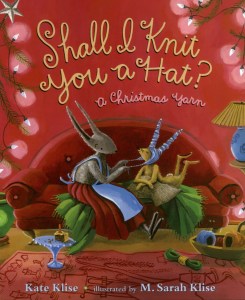
Shall I Knit You a Hat (Macmillan, 2004) by Kate Klise and illustrated by M. Sarah Klise begins with Mother Rabbit hearing the news of “a blizzard moving this way.” She immediately knits a hat to keep Little Rabbit’s ears warm. Kind-hearted Little Rabbit loves his hat so much he asks Mother Rabbit to make hats for all their friends.
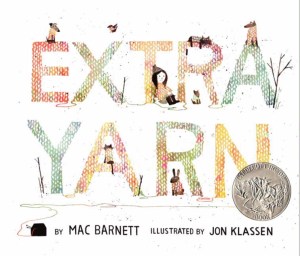
The theme of spreading love and warmth through hand-knitted hats is extended to sweaters for all, including animals, houses, and trees, in Mac Barnett’s Extra Yarn (Blazer + Bray, 2012). Hidden in the simplicity of this Caldecott Honor book, illustrated by Jon Klassen, are deep ideas about generosity and the true worth of a loving spirit.
Much to the dismay of his captain, Ned, the Knitting Pirate, by Diana Murray and illustrated by Leslie Lammle (Macmillan, 2016), loves to knit. But when an sea monster attacks their ship, Ned’s hand-knit “blanket with the jolly roger crest” comforts the angry beast and saves the day.
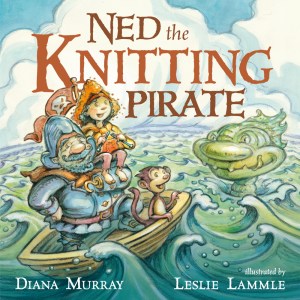
These books share a sense of love and comfort that we sorely need right now. They are perfect read-alouds for inspiring generosity in young children.
My knitting also inspired this #haikuforhealing, part of Mary Lee Hahn’s December haiku project.
loops of spun softness
slip off quicksilver needles
cozy hat blossoms
© Catherine Flynn, 2016
Please be sure to visit Jen Vincent at Teach Mentor Texts and Kellee Moye of Unleashing Readers for more book recommendations.
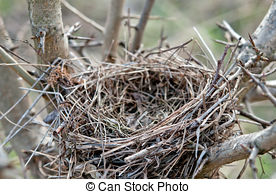
Since Natalie Babbitt’s death at the end of October, I’ve been thinking about her lovely book, The Search for Delicious. (More about that here.) I’ve been keeping an eye out for “those commonplace marvels which [the world] spreads so carelessly before us everyday.” This morning, I noticed this “commonplace marvel” in the apple tree in my front yard:
fallen leaves reveal
robin’s hidden nest, holding
the promise of spring
© Catherine Flynn, 2016
Please be sure to visit Bridgit Magee at Wee Words for Wee Ones for the Poetry Friday Roundup.
“Soon as the evening shades prevail,
The moon takes up the wondrous tale.”
~ Joseph Addison ~
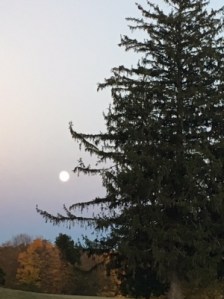
The moon has always fascinated me. Each day, I notice its passage through its eternal journey around the earth. I feel as if my day isn’t complete if I haven’t greeted my old friend. This month, the mystery of the moon has offered me a welcome distraction from the turmoil of our world. I wrote these haiku in response to the mood of the moon throughout the month.
i.
in the crisp gloaming,
a sliver of moon winks through
shadowy branches
ii.
music fills the night;
each note carried on a beam
of silver moonlight
iii
at dawn, a ghost moon
floats above purple hills;
not ready for sleep
iv
eyelid at half mast,
tonight the moon is a
drowsy peach
© Catherine Flynn, 2016
Please be sure to visit Carol Wilcox at Carol’s Corner for the Poetry Friday Roundup.
This afternoon, while her mother was having her conference with her teacher, a first grade student came into my room to say hello. We chatted for a few minutes, then she looked around and said, “It’s kind of messy in here.” Out of the mouths of babes, right? I told her I agreed, it was kind of messy. But the mess is really organized chaos on top of shelves and shelves of books. I have a terrible time getting rid of books. And even though I did manage to shed a few when I moved into a smaller space over the summer, I still have a lot of books. Is that really such a bad thing?
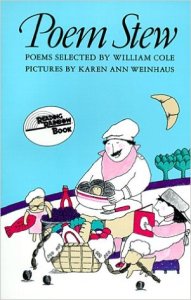
I don’t think so. Because so many of those books are treasures that are now out of print. Including Poem Stew, “a feast of hilarious poems about food” selected by Kenneth Cole and published by HarperCollins in 1981. This book was a favorite of my third graders, but I don’t use it too much anymore as I work mostly with first graders. This year, I see a group of fourth grade students and needed a poem for them with -er endings. And I found just what I was looking for in my well-worn copy of Cole’s rib-tickling collection.
“A Sliver of Liver”
by Myra Cohn Livingston
O sliver of liver,
Get lost! Go away!
You tremble and quiver
O sliver of liver–
You set me a-shiver
And spoil my day–
O sliver of liver,
Get lost! Go away!
Of course the kids loved this. When one girl said she wouldn’t eat liver if her mother served it for dinner, another student immediately noticed that “dinner” had an -er ending. Then they were off, thinking of other words and coming up with ideas with their own foods they wish would “Get lost!” They’ll be writing poems about these foods next week. Stay tuned for the results!
Please be sure to visit Brenda Davis Harsham at Friendly Fairy Tales for the Poetry Friday Roundup.
“…all real unity commences
In consciousness of differences”
W.H. Auden
What is there to say at the end of a week such a this? We turn to poets and find solace in their words. We turn to each other and find comfort in this space.
Krista Tippet recently interviewed Michael Longley, a Northern Irish poet whose work has sought “to reassert the liveliness of ordinary things, precisely in the face of what is hardest and most broken in life and society.”
Living in Northern Ireland throughout the years known as “the Troubles”, Longley has much to teach us as we come to terms with the results of this week’s election. I will keep his wise words in my heart as I go about my work in the coming months:
“And good art, good poems is making people more human, making them more intelligent, making them more sensitive and emotionally pure than they might otherwise be.”
“All of These People”
by Michael Longley
Who was it who suggested that the opposite of war
Is not so much peace as civilization? He knew
Our assassinated Catholic greengrocer who died
At Christmas in the arms of our Methodist minister,
And our ice-cream man who continuing requiem
Is the twenty-one flavours children have by heart.
Our cobbler mends shoes for everybody; our butcher
Blends into his best sausages leeks, garlic, honey;
Our cornershop sells everything from bread to kindling.
Who can bring peace to people who are not civilized?
All of these people, alive or dead, are civilized.
Listen to Michael Longley read his poem here.
Please be sure to visit Jama Rattigan at Jama’s Alphabet Soup for the Poetry Friday Roundup.
When I taught third grade, Leo Lionni’s classic, Frederick, was one of the first books I read to my students. We admired Frederick’s independence and creative spirit. We relished his stock of words and images. Then we went outside to gather our own colors and words.
Back then, I paired this book with Mary O’Neil’s Hailstones and Halibut Bones and the kids wove the images they’d gathered into color poems. Today I would add Joyce Sidman’s Red Sings from Treetops. Sidman’s luscious poetry never fails to get a reader and writer’s creative juices flowing.
For the past few weeks, the autumn days have been spectacular in my corner of the world. I’ve been spending as much time as possible outside, collecting images and ideas. This poem grew out of those noticings.
Breathe in the silence
of a barren field
at evening’s edge.
Listen to the sun’s
last rays, seeping
through leafless trees.
Feel the murmur
of starlings as they
dip and dive in crisp air.
Watch the calm shatter
as a flock of geese
announce their approach.
Taste the first hint
of winter, ruffling
the pond’s glassy surface.
© Catherine Flynn, 2016
Go and gather images and colors and words. Give your students, no matter how young or old, time to write their thoughts, their hopes, their dreams. We’ll all be richer for it.
Thank you to Stacey, Dana, Betsy, Beth, Kathleen, Deb, Melanie, and Lisa for creating this community and providing this space for teachers and others to share their stories each Tuesday. Be sure to visit Two Writing Teachers to read more Slice of Life posts.
Over the past few weeks I’ve been working with 8th graders on poems inspired by memories. After brainstorming possible topics, they began drafting. I was in awe of the depth and range of emotions and tones in their writing, from witty to heartbreakingly serious.
As we began revising, it was clear that they needed some mentor poems to help them think about line breaks. After spending some time on The Poetry Foundation’s archive of poems for children, I found this beauty by Rita Dove.
“Fifth Grade Autobiography”
by Rita Dove
I was four in this photograph fishing
with my grandparents at a lake in Michigan.
My brother squats in poison ivy.
His Davy Crockett cap
sits squared on his head so the raccoon tail
flounces down the back of his sailor suit.
My grandfather sits to the far right
in a folding chair,
and I know his left hand is on
the tobacco in his pants pocket
because I used to wrap it for him
every Christmas.
Read the rest of the poem here.
Please be sure to visit the lovely Laura Purdie Salas at Writing the World For Kids for the Poetry Friday Roundup.
“Attention is the beginning of devotion”
Mary Oliver
For the past week, I have been reading and savoring Upstream, Mary Oliver’s luminous new collection of essays. I am in awe of Oliver’s power of observation, her keen ear, her deft turn of phrase. In an essay on Emerson, she describes his writing as “a pleasure to the ear, and thus a tonic to the heart, at the same time that it strikes the mind.” For me, this is a description of Oliver’s own writing as well.
We had our first snow yesterday, and the everlastings and late roses were “crowned with the first tuffets of snow,” so I thought this was a particularly appropriate poem to share today.
“Song for Autumn”
Mary Oliver
Don’t you imagine the leaves dream now
how comfortable it will be to touch
the earth instead of the
nothingness of the air and the endless
freshets of wind? And don’t you think
the trees, especially those with
mossy hollows, are beginning to look for
the birds that will come–six, a dozen–to sleep
inside their bodies? And don’t you hear
the goldenrod whispering goodbye,
the everlasting being crowned with the first
tuffets of snow?
Read the rest of the poem here.
Please be sure to visit Linda at Teacher Dance for the Poetry Friday Roundup.
Samuel Taylor Coleridge once reminded “clever young poets” that poetry is “the best words in the best order.” Joyce Sidman’s poetry embodies this advice. In her latest book, Before Morning (Houghton Mifflin Harcourt, 2016), Sidman has chosen just sixty-six words and crafted them into a lyrical incantation full of love and longing.
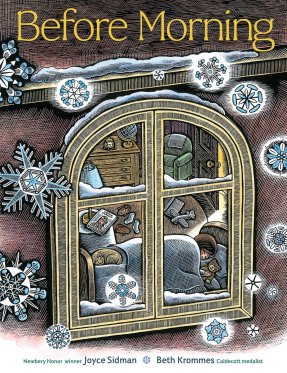
A hallmark of Sidman’s poetry is her unexpected metaphors and images, and Before Morning is true to form. We’re instantly lured into “the deep woolen dark” where “the earth turns to sugar/and all that is heavy/turns light.” A deceptively simple rhyme scheme is almost “hidden from sight,” but adds to this book’s rhythm and beauty.
Beth Krommes‘s scratchboard and watercolor illustrations give a marvelous depth to Sidman’s poem and resonate in unexpected ways. Sidman herself has said that the illustrations were “a complete surprise.” Krommes, who has illustrated two of Joyce’s earlier books, Butterfly Eyes and Other Secrets of the Meadow (Houghton Mifflin Harcourt, 2006) and Swirl by Swirl: Spirals in Nature (Houghton Mifflin Harcourt, 2011), provides a setting that is instantly recognizable to readers: the hustle and bustle of daily life. Children will want to pore over the details of this family’s life and will find surprises on every page.
In her author’s note, Joyce explains that Before Morning is “an invocation—a poem that invites something to happen.” She goes on to encourage readers to think about their own wishes and find the best words for them.
I tried to find the best words I could to express how much I love this book. My wish is for Joyce Sidman and Beth Krommes to continue collaborating and creating stunning picture books like Before Morning.
Please be sure to visit Jen Vincent at Teach Mentor Texts and Kellee Moye of Unleashing Readers for more book recommendations.

