My sister’s dog, Lily, loves chasing balls. During a recent visit to my sister’s, Lily’s joy and exuberance were on full display as she and my brother-in-law played ball.
Black fur blurs, a rocket zooming across the lawn. She leaps, her quarry captured, then tumbles to the ground. Sphinx-like, she waits, guarding her ball on the sun-dappled grass, ever eager for the next round of fetch.
How can we make sense of yet another horrific act of senseless violence? Yesterday’s events in France have me in a state of despair. The light-hearted poem I had planned to share today now seems inappropriate. What to share instead?
As I walked my dog this morning, I was hyperaware of my surroundings, noticing traces of spider webs, ripening blackberries, and the cacophony of bird songs. Noticing the beauty of the world right in front of me. Somehow all this noticing reminded of me of this poem, which I wrote several years ago.
Summer. Thoughts turn to mornings of clearing away the clutter of a busy school year and lazy afternoons with a book, days at the beach, adventures near and far. But most of all, TIME to write! It’s been a slow transition for me this year, though, as I’ve been writing curriculum and taking care of other work obligations that seem to have no end. I’ve been de-cluttering like mad, but my writing has come in fits and starts and feels stale and stilted. The best remedy for this? Read poetry, of course!
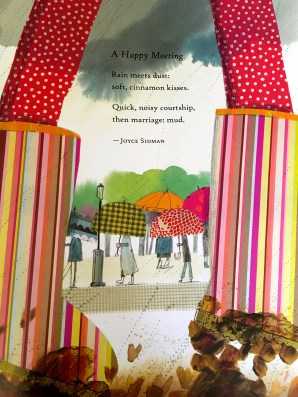
So I revisited one of my favorite anthologies from the past few years, Firefly July (Candlewick Press, 2014). This entire collection, selected by Paul B. Janeczko and brilliantly illustrated by Melissa Sweet, radiates joy. On every page, poets surprise and delight with perfect images and metaphors. “A Happy Meeting”, by Joyce Sidman, is just one example.
Joyce’s poetry always gives me a jump start, and I remembered she has a new book coming out, so I went searching for more about that. As you may know, Before Morning, with illustrations by Beth Krommes, will be published by Houghton Mifflin Harcourt in the fall. And although I didn’t find too much about that book, I did find this interview, from 2010, with Julie Danielson at Seven Impossible Things Before Breakfast.
At the very bottom of the page, this treasure is waiting:
“How to Find a Poem”
by Joyce Sidman
Wake with a dream-filled head. Stumble out into the morning, barely aware of how the sun is laying down strips of silver after three days’ rain, of how the puddles are singing with green.
These words are as true today as they were 2500 years ago. I may have heard or read them before, but I was happy to see them painted on the wall of the “Cabinet of Art and Curiosity” installation at the Wadsworth Atheneum in Hartford yesterday. I was there to participate in the museum’s “Summer STEAM” workshop, designed to show teachers “the many ways art can enhance science, technology, engineering, and math” in their classrooms.
Lisa Delissio, a STEM Faculty Fellow at Salem State University, began the day with a talk about the intersection of art and science. She explained that the “perspective and knowledge of artists is essential to scientific approaches to problems.” Specifically, she listed the observational skills artists bring to their work that have been found to have an impact on the skills of her biology students. These include:
She asked us to use the observational skills of an artist and the perspective of a biologist to respond to the image with word and/or pictures. My sketch was very rudimentary, but my jottings were very much dominated by my poetry brain. I was immediately drawn to the stamens of the large flower in the foreground, which reminded me of sunspots exploding on the sun and the flower in the bottom center waiting to bloom. To me, its folded petals looked like hands folded in prayer.
We were given ten minutes to work on this, which sounds like a long time. But it really wasn’t. I could have easily spent another half hour working on my observations and the poem I was beginning to formulate. Keeping the STEAM theme of the day in mind, I started a Fib poem, a poem which uses the Fibonacci sequence to determine the number of syllables in each line.
Fat skink rests on bright purple aster petals, their stamens exploding like the sun.
The auditorium full of dozens of teachers was absolutely still as people worked. But it didn’t feel like work at all. We were completely engaged in our creativity, our intellectual curiosity sparked by the blending of diverse disciplines. As Dr. Delissio explained, students who pursue double majors in science and the arts are more creative, and exhibit more intellectual curiosity and divergent thinking than students with a single major.
Attending this workshop was a joy for me, not because I needed convincing that the arts should be included in STEM, but because it bolstered my belief in the importance of including the arts in our classrooms. As schools across the country embrace STEM and devote time and resources to integrate STEM into the curriculum, we have to ensure that the arts are always included. As Anne Jolly points out in a recent Education Week article, “The purpose of STEAM should not be so much to teach art but to apply art in real situations. Applied knowledge leads to deeper learning.”
Sometimes when we read a poem there’s an instant connection between us and the poet. Someone we’ve never met, maybe even never heard of, has managed a magical transformation of words into phrases into stanzas that reach into our heart, like the first rays of sunlight bathing the tips of tree branches in its yellow glow. In that moment we know we’ve found a treasure worth keeping.
In her poem “Wish”, Linda Sue Park captures this process perfectly:
Wish by Linda Sue Park
For someone to read a poem again, and again, and then,
having lifted it from page to brain– the easy part—
cradle it on the longer trek from brain all the way to heart.
From TapDancing on the Roof; Sijo Poems (Clarion, 2007)
Not every poem we read, and certainly not every poem we write, makes that journey. And yet, we soldier on. We keep reading, we keep writing, because, as Katherine Bomer reminds us, “the journey is everything.”
When I first read this poem by Robert Haas, I knew I’d found a treasure that made that journey.
“Stanzas for a Sierra Morning” by Robert Haas
Looking for wildflowers, the white yarrow
With its deep roots for this dry place
And fireweed which likes disturbed ground.
There were lots of them, bright white yarrow
And the fireweed was the brilliant magenta
Some women put on their lips for summer evenings.
The water of the creek ran clear over creekstones
And a pair of dove-white plovers fished the rills
A sandbar made in one of the turnings of the creek.
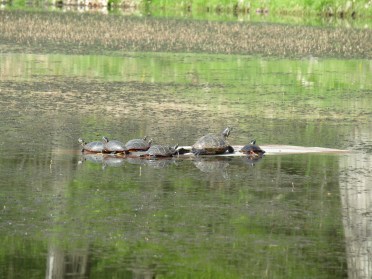
I took this picture at the end of April at a pond near my house. Since then, I’ve been working on this poem, trying to find just the right form, words, and phrases. During that time, I’ve felt like I’ve been buried in the mud and muck of school busyness, which has drained my writing energy. Now that school is over, I decided to revisit these happy turtles, and emerge into the sunshine with them.
Please be sure to visit Carol at Carol’s Corner for the Poetry Friday Roundup!
Some weeks I have my Poetry Friday poems picked out early in the week, especially if I’m sharing an original poem. Other weeks, when work and life in general threaten to get the best of me, as this one has, I’m scrambling to find a poem that speaks to me. But when I saw this on a friend’s Facebook page today, I knew instantly this was the right poem for this week.
“The Arrow and the Song”
by Henry Wadsworth Longfellow
I shot an arrow into the air,
It fell to earth, I knew not where;
For, so swiftly it flew, the sight
Could not follow it in its flight.
I breathed a song into the air,
It fell to earth, I knew not where;
For who has sight so keen and strong,
That it can follow the flight of song?
Long, long afterward, in an oak
I found the arrow, still unbroke;
And the song, from beginning to end,
I found again in the heart of a friend.
Be sure to visit Jone MacCulloch at Check It Out for the Poetry Friday Roundup!
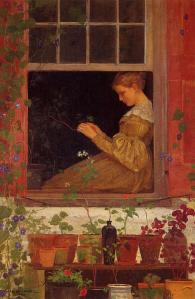
Today I’m sharing the latest draft of the persona poem I’ve been working on for Laura’sDitty Challenge over at Michelle’s blog, Today’s Little Ditty. I’ve loved this painting for years, so it wasn’t hard to decided to write a persona poem for this young woman. The more I studied the painting though, the more contradictions I saw and the more questions I had. This draft answers some of them, but not all.
“Morning Glories” Winslow Homer 1873
Through an open window, the wide world beckons me.
I toss my crewel work aside, its neat silk stitches no match for the ropes of green twining up outside the sill, toward the sky, where a menagerie of clouds is parading by.
I watch them skitter and shift, morphing into fantastic creatures.
I wish I could transform into a hummingbird. I’d dart and hover among the morning glories and geraniums, sipping their summer sweetness.
But like this philodendron, I’m trapped inside, bound to this place, never allowed to roam free, never allowed to touch the sky.
Maybe it’s because I recently spent a day at the Metropolitan Museum of Art, soaking in the beauty of two millennia worth of collected treasures. Or maybe it’s because of Laura Shovan’s ditty challenge to write a persona poem. Whatever the reason, I’ve been thinking about art a lot lately. But because of the nature of teaching, life hasn’t allowed me more than snatches of stolen time to write.
I’ve also been reading in those stolen moments, and found this lovely little poem in Art and Artists: Poems (edited by Emily Fragos; Everyman’s Library Pocket Poems).
“A Flower-Piece by Fantin” by Algernon Charles Swinburne
Heart’s ease or pansy, pleasure or thought, Which would the picture give us of these? Surely the heart that conceived it sought Heart’s ease.
Surely be glad and divine degrees The heart impelling the hand that wrought Wrought comfort here for a soul’s disease.
Deep flowers, with lustre and darkness fraught, From glass that gleams as the chill still seas Lean and lend for a heart distraught Heart’s ease.
Henri Fantin-Latour [Public domain], via Wikimedia CommonsPlease be sure to visit Margaret at Reflections on the Teche for the Poetry Friday Roundup.
“Alertness is the hidden discipline of familiarity” ~ David White ~
Krista Tippet’s show “On Being” is one of my favorite podcasts. Recently, Krista interviewed poet David Whyte. I was only vaguely familiar with Whyte’s name, but in the days since I listened to this interview, I’ve been seeking out more of this wise man’s poetry.
Here is one of my favorites:
“The Lightest Touch”
by David Whyte
Good poetry begins with the lightest touch, a breeze arriving from nowhere, a whispered healing arrival, a word in you ear, a settling into things, then like a hand in the dark it arrests your whole body, steeling you for revelation.


![By Prosthetic Head (Own work) [CC BY-SA 4.0 (http://creativecommons.org/licenses/by-sa/4.0)], via Wikimedia Commons](https://readingtothecore.com/wp-content/uploads/2016/06/cape_skink_flowers.jpg?w=360&h=299)

![Henri Fantin-Latour [Public domain], via Wikimedia Commons](https://readingtothecore.com/wp-content/uploads/2016/05/henri_fantin-latour_-_vase_of_flowers_-_google_art_project.jpg?w=293&h=369)
 Reading to the Core
