I’ve been writing Poems of Presence along with several other Poetry Friday pals over the past few weeks. These haven’t been quite as stressful as my April poetry project, and I’ve started to view finding a topic for each day’s poem as if it’s a scavenger hunt. I suppose that is what all idea generation is, really. As often happens with me, my ideas get ahead of my and I run out of time. Hence this late post with no new poem. Instead, two #PoemsofPresence from earlier this week.
Unaware of social distancing,
a bobcat strides past my kitchen window.
I gasp at his presence.
He gazes up, blinks,
then continues on his way.
I am still at the sink,
my heart racing in awe.
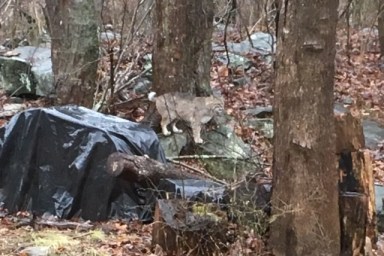
This isn’t this week’s bobcat, but this photo was taken from my kitchen window.
fallen petals
mingle with snowflakes.
It’s hard to tell where
winter ends
and spring begins.
It’s the first Friday of the month, which means it’s time for another Sunday Night Swagger Challenge. This month, Molly Hogan challenged us to write an epistolary poem. Earlier this week, I discovered Audubon Alaska’s National Poetry Month Bird Poetry Corner, which had a different prompt for each week of the month. The final challenge was to
imagine nature coming indoors: Perhaps a thunderstorm in the attic? A flock of Bohemian Waxwings in the kitchen?
A few years ago, starlings built a nest in our bathroom vent, so I decided to combine these two challenges and write those squatters a note.
To the starlings nesting in the attic:
I kept telling my husband to fix that loose vent cover. Of course he didn’t. Then you moved in and it was too late. You worked hard scavenging grass and pine needles for your nest. I’m sure you’re all warm and cozy up there, right above the shower.
How many nestlings do you have? Sometimes I can hear them cheeping, begging for a meal.
Did you set up housekeeping in the rafters or in a box of old clothes? I’ve been tempted to climb up the rickety stairs to peek, but I don’t want to disturb you. Please try not to make too much of a mess. I’ll clean everything up after your babies have fledged. Don’t get too comfortable, though. Before next spring, that vent will be repaired!
Sincerely, Your landlord
Please be sure to visit Elizabeth Steinglass for this week’s Poetry Friday Roundup! Also, find out who my fellow swaggers wrote to at their blogs:
As National Poetry Month draws to a close, it’s time to put the month in perspective (my OWL for 2020). Twenty-four poems in thirty days is short of my goal of posting a poem every day. BUT, it is more than I have ever managed in April. I’m not going to bore you with reasons or rationales for why I didn’t post everyday; you know them all. What I will say is that even on days I didn’t post, I was writing, reading, thinking, observing. In other words, I was being a writer. I have learned much during this month of writing that I will strive to carry forward. Thank you to everyone who followed along on my meanderings. And congratulations to everyone who completed 30 poems in 30 days. I admire your perseverance!
This poem was inspired by and is modeled after Elizabeth Alexander’s stunning “Praise Song for the Day,” which she read at President Barack Obama’s first inauguration.
Praise Song for the Natural World
Each day, wild creatures go about the work of survival. A vibrant bluebird flits through the undergrowth in pursuit of an alluring female.
High in a pine, a nesting hawk surveys the countryside, screeching in protest at a mob of pesky crows.
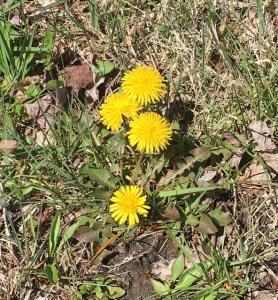
All around, color is brightening the drab world. Brilliant yellow dandelions are open for business and hungry bees buzz joyously among them.
Violets sprinkle the hillside like confetti And every shrub and tree is wrapped In a fine haze of green or pink or red.
In the pond, clumps of frogspawn are silently, mysteriously on their journey of transformation.
Praise song for their confidence, their optimism in the face of a fickle world, for their honest pursuit of life.
Praise song for every blossom, every nest, every egg.
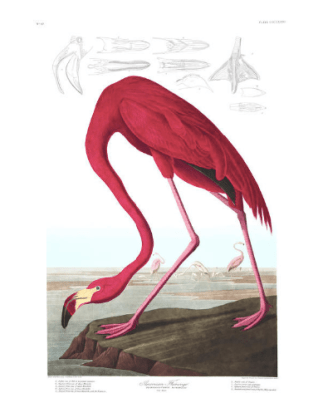
One of the challenges posed by Audubon Alaska for its month-long Bird Poetry Corner was to write an ekphrastic poem. They provided a photograph to use as inspiration, but I recently saw this video of flamingos let loose in the Denver Zoo and knew a flamingo poem was about to take flight. Watching this video was also inspiring. Audubon did paint this stunning, if somewhat stern looking, flamingo:
John James Audubon, 1838
A flamboyance of flamingos march in formation like an army of wind-up tin soldiers. As they parade, heads are bobbing up and down on sinuous necks, pivoting from side to side seeking their one true love.
Suddenly, their wings rise, And a multitude of roses burst into bloom.
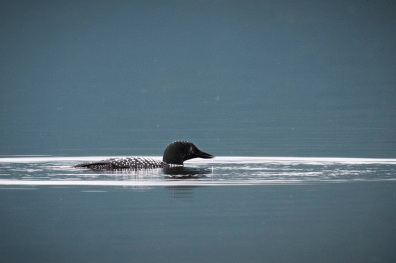
At night in the cabin loft, I lie still as the wind whispers through the pines Now and then a loon cries out from across the lake, or an owl announces himself from deep in the timber.
Beneath these night noises, water laps at the rocky shore slish slosh, slish slosh. Their steady melody lulls me to sleep.
The world will always serenade those who take time to listen.
This morning I came across a Facebook post from Audubon Alaska about their Bird Poetry Corner. How had I missed this? They have had a new prompt each week in April. Now I have a prompt the last five days of National Poetry Month! Today’s poem is my response to Week Four:
Below you’ll find a list of words that relate to nature. These words are your poetry prompts this week. You can use these prompts in several different ways: You can choose a single word and build a poem around it as a topic. You can choose a handful of words (about five would be good) and use those words to kick off different lines or verses. Or you can challenge yourself to write a single poem with all of the words included in it.
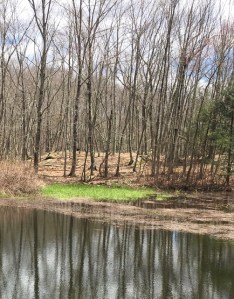
There is a pond in the woods behind our house. It knows how to take care of itself, and we let it. We do try to keep a path cleared so we can walk down the hill and see what’s going on. Over the past few weeks, I’ve observed at least eight ducks living there. They inspired this poem.
A Paddling of Mallards
This spring, a paddling of mallards has moved in on the far side of the pond. They stay concealed, bobbing behind a bloom of bright green pond grass.
I approach the pond on tiptoe, careful not to step on a fallen branch that will snap and startle them.
They sense my presence anyway. Before I can blink, they launch into the sky, seeking refuge in the trees.
I sit on a rock, quiet and still, hoping they will return. Other birds, red-wings and sparrows, tolerate me. Soon, the air is filled with their song. But the mallards stay away.
I sigh, rise, and trudge back up the hill. I want them to come back to their hidden nests. I imagine feather-lined depressions of twigs and leaves, filled with eggs, harbingers of hope.
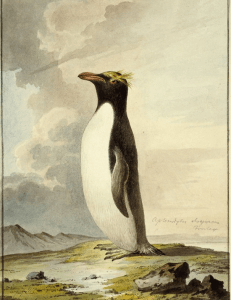
It’s World Penguin Day! What better day for a poem about penguins? I sometimes write acrostics to gather words and ideas for topics, but today I decided that I liked this acrostic well enough to share today.
Penguins promenade over a barren landscape of ice. Elegant in black and white, they Never fly. Instead when it’s time to eat, they Glide gracefully through their frigid Underwater hunting grounds, feasting on krill. Indulging until full, they return to rocky Nests to lay an egg. And So the world begins anew.
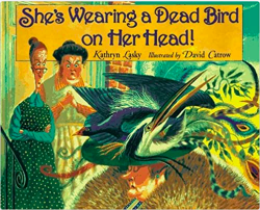
When I taught third grade, She’s Wearing a Dead Bird on Her Head, was one of my favorite pictures books to share with my students. They were shocked at the cruelty of birds being killed so women could have fancy hats. The book tells the story of Harriet Hemenway who, with her cousin Minna Hall, helped launch the Massachusetts Audubon Society. They were part of a larger movement that began in the late 19th century to protect birds and stop their wholesale slaughter in the name of fashion. Florence Merriam Bailey was another fierce advocate for the birds, and wrote one of the first field guides to American birds, Birds Through an Opera-Glass. This poem, which is still very much a draft, is a tribute to these determined women.
In the 1890s, feathered hats Were all the rage. Ladies wore them everywhere: To parties, parks, the stage.
Some women were revolted, They knew that it was wrong To kill quails and loons for fashion. Let them sing their song!
Harriet, Minna, Florence, too, Spread word throughout the land. Stop this ghastly craze, they cried. Save snowy egrets! their demand.
They rallied all their friends, They sounded the alarm. Taking feathers to festoon your head Does hummingbirds great harm.
Soon laws were passed and habits changed. Flamingos and pheasants protected. People still think birds are beautiful, But not to be collected.
Yesterday was the 50th anniversary of the first Earth Day. As sometimes happens, even in quarantine, the day got away from me. Meetings lasted longer than expected, with little time left to devote to writing a poem worthy of the occasion. And although it’s important to have a day set aside to call attention to and raise awareness about our one precious Earth, every day is Earth Day for me.
An Earth Day ABC
An atlas of the world can’t Begin to reveal the Complexity of connections, the Diversity of life on Earth. For centuries, curious humans have Grappled with questions, searching across Hemispheres, seeking Insights into our home, finding pieces of the Jigsaw puzzle, gaining Knowledge and Learning the lessons Mountains teach us. The earth Nurtures and nourishes us. We are Obligated to Protect her, preserve her. Our reckless Quest for riches is irresponsible. Actions Ripple across the globe, casting Shadows on life everywhere. Today and everyday, seek to Understand the Vulnerability and vitality of our Wondrous world. eXchange hubris for humility. Change begins with You. Zoom in and discover nature’s abundant gifts.
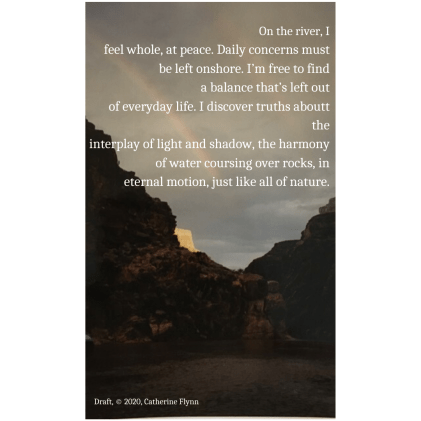
Today’s poem is a Golden Shovel. My strike line was taken from the writings of Alexander von Humboldt, considered by many to be the father of modern environmentalism. It is fitting that the Smithsonian has mounted a exhibition about Humboldt’s impact on art, nature, and culture in the United States during this fiftieth anniversary year of Earth Day.
In addition to being an intrepid explorer, von Humboldt was a prolific writer, writing more than 36 volumes. His work influenced the thinking of Thoreau, Darwin, and John Muir, among others. It seems appropriate to remember and honor him this week.
The line I chose to work from is from a letter von Humboldt wrote in 1799:
I must find out about the harmony in nature.
This poem turned into something a little more personal than I expected, but we don’t always know where we’re headed when we start out.


 Reading to the Core