Slice of Life: Close “Reading” in Kindergarten

11454297503_e27946e4ff_h

Be curious always! For knowledge will not acquire you; you must acquire it.

~ Sudie Back ~

It’s hard to believe NCTE was almost a month ago! Amidst the chaos of the holidays, I’ve been reading books snagged in the Exhibition Hall (thank you, publishers!), reviewing my notes, and sharing the wealth of knowledge I gained from the terrific sessions I attended.

I was lucky to get into Chris Lehman, Kate Roberts, and Kristi Mraz’s standing-room-only session, CLOSE READING AND THE LITTLE ONES: HOW IT’S DIFFERENT (AND INCREDIBLY FUN AND EFFECTIVE) IN EARLY ELEMENTARY GRADES. With their characteristic blend of common sense and humor, these three inspiring educators shared routines K-3 teachers can use to capitalize on the natural curiosity of kids.

Chris, Kate, and Kristi pointed out that close reading in these early grades is akin to close study, or observation, “something that little ones are doing already.” Giving students opportunities to engage in close observation accomplishes many goals that support young learners, including opportunities to talk to others about their ideas. It also encourages students to “open up” their thinking through “meaningful, enjoyable experiences”

Close reading is only one part of “a balanced diet of reading instruction” that should

  • serve a specific purpose
  • focus on details in high success texts
  • allow kids to discover new meaning through carefully looking at details

Adapting the paradigm for middle and high school readers Chris and Kate laid out in their book Falling In Love With Close Reading (Heinemann, 2013) for young readers resulted in this structure, or instructional routine, which should be repeated so often that it becomes a habit, which leads to independence.
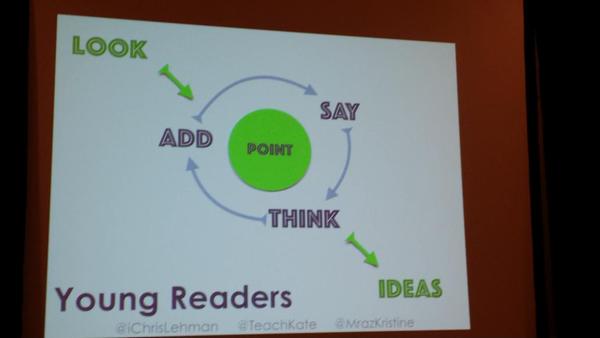
Photo courtesy of Fran McVeigh

Kristi, Kate, and Chris emphasized that this close reading isn’t about teaching kids how to read, nor should everything be read closely. Rather, this routine is about “teaching kids a way of looking at a text or an image or an object so they can develop ideas about it.

This makes so much sense! I was excited to get back to school to share this thinking with my wonderful Kindergarten colleagues. Using Kristi, Chris, and Kate’s ideas about “close looking,” we designed an object study that coordinated with the Kindergarten’s current unit on the animal kingdom AND laid the foundation for daily close observation. As Kristi so wisely pointed out, “If you want to do strong work in reading, you have have to do strong work in other places.”

So we began by closely observing seashells. I modeled the cycle by looking closely at a shell, pointing to its surface and saying something about the color. Then I thought more about the color, and added more details about the variations of color on the shell. The kids couldn’t wait to get their hands on a shell to observe with their partners.
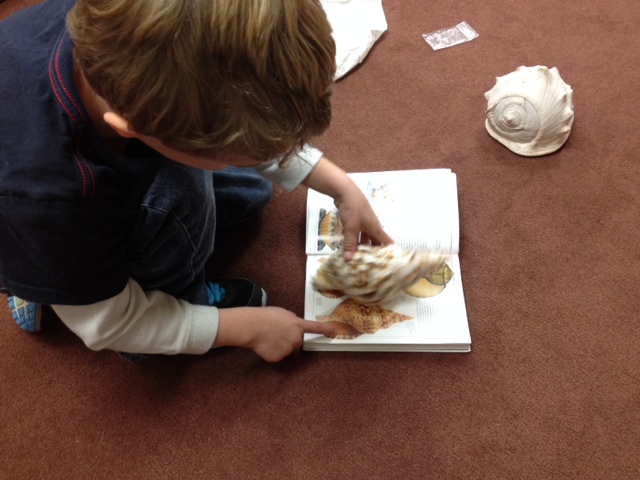
photo 1

Soon the room was filled with the hum of the children’s voices. They talked about the colors and the shapes and the textures. They noticed that some shells had bumps on the outside and others had spikes. They ran their hands along the smooth surface on the mouth of the shell and wondered why the texture was so different from the top of the shell. And they talked about the sounds they heard when they held the shells to their ears.

When we came back together so the kids could share their findings, it was clear they had developed some “big ideas” through their observations. Several children mentioned protection and camouflage when they talked about the colors of the shells or how hard they were. They all wanted to spend more time with the shells, comparing them and “getting to know [them] better.”

This is work we will return to daily. There are countless opportunities for close observation throughout the day, opportunities for kids to look at the world and say     “Wow!”

Thank you, Chris, Kate, and Kristi, for sharing your insights and pushing me as a teacher! Thank you to StaceyTaraDanaBetsyAnna, and Beth for this space for teachers and others to share their stories each Tuesday. Be sure to visit Two Writing Teachers to read more Slice of Life posts.
Slice of Life: ‘Tis the Season

11454297503_e27946e4ff_h

‘Twas two weeks till Christmas, and all through the house

there were presents to wrap, cards to write, and cookies to bake…

You get the idea. Throw in a stressful week at work, and it’s easy to get overwhelmed. I’m doing my best to remain unflappable amidst all the hubbub. Thanks to my sister, who shared this on Facebook today, I have a new motto:

10818413_10152827662024361_1237008838865723602_o
“Don’t get your tinsel in a tangle” From Lily Pulitzer’s Facebook page.

If you do feel like your loosing control of your tinsel, watch this video. It will restore you.

Thank you, StaceyTaraDanaBetsyAnna, and Beth for this space for teachers and others to share their stories each Tuesday. Be sure to visit Two Writing Teachers to read more Slice of Life posts.



Slice of Life: NCTE 2014

11454297503_e27946e4ff_h        logo

As I flew home from the NCTE Convention last night, my mind was full of all I had learned over the past three days. I was also grateful that I had the chance to meet so many of my Slice of Life and Twitter friends. This online community is still a marvel to me. At one point, I glanced out the window and realized a large chunk of the eastern seaboard was spread out beneath me. Millions of lights clustered in cities and stretched into the distance, following roads that seemed to go on forever. They looked like a dew-drenched web, illuminated by the moon.

I was mesmerized by the sight, and my book lay forgotten on my lap. Kate DiCamillo’s words immediately came to mind: “Stories connect us.” The web of lights seemed like the perfect metaphor for the web of stories that were spun out by teachers, storytellers and poets throughout the vast Gaylord National Resort during the convention, connecting educators from all over the country and around the world. These dedicated people had all come to Washington seeking ways to help their students learn.

In his new book, Minds Made For Stories (Heinemann, 2014), Tom Newkirk says “When we strip human motives from our teaching, I suspect we make learning harder, not easier.” (p. 17) The stories shared at NCTE were full of the very human motives of passion and curiosity, and it will take me weeks to sort out and internalize them. Inspired and enlightened by people I admire and feel so lucky to know, I went to school today with one goal in mind: to share this passion with my students and colleagues. I can’t wait to help them, in the words of Paul Hankins, “be wonder bound.” I can’t wait to see them deepen their connections with the world and find their stories.

Thank you, StaceyTaraDanaBetsyAnna, and Beth for this space for teachers and others to share their stories each Tuesday. Be sure to visit Two Writing Teachers to read more Slice of Life posts.


Slice of Life: Unlocking Possiblities

11454297503_e27946e4ff_h

I do a lot of my best thinking in the shower. One morning last week as I was washing my hair, I was thinking about “The Good Old Days,” a poem Ralph Fletcher shared at the Connecticut Reading Conference. Later that morning, I would be facilitating a meeting with ELA teachers and I wanted to share the poem with them. Fletcher had us use this poem as a mentor text, taking the first and last stanzas from his poem and filling in the middle with our own “good old days” memories. As I lathered my hair, I thought about what I had written. I realized I hadn’t focused on any one memory. Instead, I had more of a list of special people and objects. While I was rinsing out the shampoo, it occurred to me that students could use this poem as a way to gather seed stories.

Then my thoughts returned to my poem. One line was about climbing a favorite apple tree in my grandmother’s yard. This made me think of a story I’ve been working on, but have been stumped by about where to go next. Suddenly, the tumblers in the lock aligned and I saw a possible path. Now I was rushing to finish my shower so I could write down my idea. Since that morning, I’ve been steadily working on this story, writing a little each day.

For me, these aha! moments of insight are like finding the perfect gift for someone who is notoriously hard to buy for. They give me immense satisfaction. But they don’t happen unless I’m writing regularly. When I’m writing each day, something is different in my brain. I see the world differently. I see possibilities. Donald Murray said, “The daily practice of craft sharpens the writer’s vision and tunes the writer’s voice. Habit makes writing easy.” I don’t think any amount of writing will ever make writing easy for me. Easier, maybe. But never easy.

Which brings me to students. Many students find writing the most difficult part of their day. Teachers often tell me they find it hard to make time for writing. That writing time is the first thing to go when time is short. Maybe this is because writing is difficult for them, too. This makes me sad. It is only by writing that we build our writing muscle. It is only by writing that we begin to see the world with what Maxine Greene called “wide awake eyes.” I’m constantly amazed by the metaphors children use for everyday objects when we ask them to be observant.

In order to cultivate this kind of awareness, we have to ensure that children have what Penny Kittle calls “time to count on,” time they know they’ll have so “if something occurs to [them] during the day, [they’ll] store it away, knowing [they’ll] have time to write soon, and the idea will resurface then.”  Children deserve this time to write about things that matter to them. Every. Single. Day. Nothing in our curriculum matters more than this. After all, who knows what they’ll think of while they’re in the shower!

Thank you, StaceyTaraDanaBetsyAnna, and Beth for the gift of this space for teachers and others to share their writing each Tuesday. Be sure to visit Two Writing Teachers to read more Slice of Life posts.

Slice of Life: The Gift of Words

11454297503_e27946e4ff_h

Last Saturday morning I sat in the nave of Riverside Church—a soaring space of beauty beyond words—as David Booth addressed the thousands of teachers gathered for TCRWP’s Fall Saturday Reunion. He reminded us that “everyone is making their own story” and that all stories deserve to be heard. It’s our job to help children reveal their story, and Booth encouraged us to “weave a blanket of words to cover our children.” He urged us to give them words we love, words we sing, words we puzzle over. He urged us to “give them as gifts.”

Each session I attended throughout the day gave me the gift of words. Audra Robb shared her wisdom about teaching students how to locate places in their writing for strong verbs and precise nouns, the kinds of words that can fill their writing with details that matter. She told us to read mentor texts closely with our students to help them become aware of the techniques authors use to create specific effects, effects they can try out in their writing. Practicing and experimenting with these techniques empowers them to find their own voice.

Brooke Geller presented a standing-room only crowd with a variety of strategies for building vocabulary. Use words, she told us, in writing, in conversations, and across our lives. Give our children opportunities to use words, think about meanings, and to read them in many different contexts. Soon the words will be part of them.

Finally, Carl Anderson urged us to ask kids questions, but then to be quiet and give them a chance to “get their thoughts together.” He reminded us to prompt them by asking them to “say more about that.” When we do this, “we nudge them to reach for more specific language.” He compared this process to Russian nesting dolls—“Each time you ask, more thinking comes out.” Most importantly, by taking the time to ask kids these questions, we’re giving kids “the gift of thinking about their thinking.”

We create our world with words. Lucille Clifton once said “We cannot create what we cannot imagine.” We can’t imagine what we can’t name. For this reason, children need as many words as we can possibly give them. We need to fill them up, so they’ll have the words they need to imagine the best possible world for us all.

Thank you to Lucy Calkins and everyone at the Teacher’s College Reading and Writing Project for the gift of the Saturday Reunions and all you’ve done for teachers and students around the world.

Thank you, StaceyTaraDanaBetsyAnna, and Beth for the gift of this space for teachers and others to share their writing each Tuesday. Be sure to visit Two Writing Teachers to read more Slice of Life posts.

Slice of Life: Writing Zenos

11454297503_e27946e4ff_h


A couple of weeks ago, Michelle Heidenrich Barnes featured an interview with poet J. Patrick Lewis on her blog. Lewis challenged Michelle’s readers to write a “zeno,” a poetic form he invented. Inspired by the mathematical “hailstone sequence,” a zeno, is “a 10-line poem with 8,4,2,1,4,2,1,4,2,1 syllables that rhyme abcdefdghd.”

I think students will have fun with this form, so I spent some time playing with zenos today. They are quite a challenge! Here’s the example I came up with to share with my students before they try their own:

In October apples ripen,

orchards are full.

Fruit hangs

thick.

Plump, juicy macs,

winesaps,

slick

with morning dew.

Fun to

pick!

© Catherine Flynn, 2014

Winslow Homer, 1878 [Public domain], via Wikimedia Commons
Thank you to Michelle and J. Patrick Lewis for this challenge! And thank you StaceyTaraDanaBetsyAnna, and Beth for hosting Slice of Life each Tuesday. Be sure to visit Two Writing Teachers to read more Slice of Life posts.

Slice of Life: From My Grandmother’s Kitchen

11454297503_e27946e4ff_h

Why do we save things? To remind us of momentous occasions, memorable moments, times we had fun? I suppose for all these reasons and more. We say things have sentimental value, but it’s sometimes hard to articulate exactly why. And though I’ve never been sorry I held onto an object, I’ve often regretted getting rid of something, usually within a week or two.

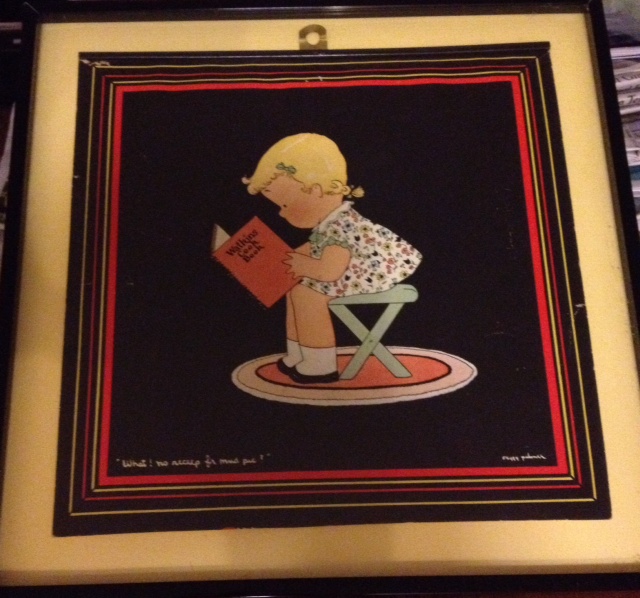
When I get frustrated about my inability to throw things away (usually because a stack of papers or pile of pictures has just collapsed), I think of my grandmother and tell myself it’s genetic. She had a Depression-era mentality of saving everything. When we cleaned out her house, we found bank statements from the 1950s! But we also found many treasures. One was an illustration from a 1930s calendar of a little girl reading a Watkins Cook Book. The caption reads: “What! No recipe for mud pie?” As soon as I saw it, I thought of my mother-in-law. She loved to bake and made delicious whoopie pies. I knew she had to have this picture.

photo

I took it to a shop to have it matted and framed, and gave it to my mother-in-law for Christmas that year. She loved it, and it hung by her stove for the rest of her life. After she died, I told my sister-in-law that this picture was the only possession of my mother-in-law’s I really wanted. She said she’d put it aside for me and that I could get it the next time I was in Pennsylvania.

Except I couldn’t. My sister-in-law had put it aside so well she couldn’t find it. I’ve done this myself, so I figured it would turn up eventually. Except it didn’t. Then the house was sold and emptied. Still no picture. I tried not to be too disappointed. After all, I had plenty of memories of cooking with my mother-in-law in that kitchen, and all the happy meals our family had shared there.

This past weekend my sister-in-law visited, and when she arrived at our house, she handed me a box. “It was in a corner of my attic,” she explained. I opened the lid, and there it was, right on top. A piece of ephemera my grandmother had saved almost 80 years ago, that hung in another kitchen for ten years, will now be at home in my kitchen, linking it to other kitchens, other times. 

This whole episode reminded me of Susan Vreeland’s lovely book, Girl in Hyacinth Blue. Through a series of stories, Vreeland links the owners of a (fictional) painting by Vermeer across the centuries. She creates a vivid depiction of each time period and owner, charting their motivations and desires. These remain remarkably similar over the centuries. At one point, a character realizes that “love builds itself unconsciously… out of the momentous ordinary.”

I think this is why we save things. To have reminders of those unconscious, ordinary moments that add up to a life filled with love.

Thank you, as always, to StaceyTaraDanaBetsyAnna, and Beth for hosting Slice of Life each Tuesday. Be sure to visit Two Writing Teachers to read more Slice of Life posts.

Slice of Life: Between the Words

11454297503_e27946e4ff_h

“What we learn with pleasure we never forget.”

Alfred Mercier

When I was 7 or 8, my grandparents took me to a performance of the U.S. Navy Band. This was a huge thrill, as I’d never been to a live concert before. I can remember sitting in the audience, being mesmerized by the music. I was amazed that the sounds I was hearing were being created by the people and the instruments on the stage before me.

The memory of that night came back to me as I listened to Krista Tippett interview Yo-Yo Ma on her radio program, “On Being” over the weekend. During their discussion, Mr. Ma explained his “philosophy of curiosity about life and of performance as hospitality.” As I listened to this wise and generous man, it occurred to me that many of his ideas about music applied to education, and that infusing our teaching with them would make our classrooms better places.

Mr. Ma talked about the necessity of being flexible with plans. “The plan is always going to change. And you need to make sure that the audience is always the most important person in the room.” Such simple advice. It’s one of the most essential lessons I learned as a beginning teacher. Yet, in the day-to-day deluge of SLO’s, standards, testing, etc., I sometimes have to remind myself that the children at the heart of my plans are the most important people in the room.

Earlier this year, Mr. Ma was honored with the Fred Rogers Legacy Award. When asked about this, he recalled a conversation with Fred Rogers: “…do you know what a present that is, when you play something for somebody? It’s just like giving them a present.” To me, this captures what is at the heart of the interaction between teacher and student—I want to share this precious gift with you. Everything we share with our students should be selected with the care and thoughtfulness we put into choosing gifts. For, as Mr. Ma also said, “When you receive something that’s living, that goes inside you, because it becomes your own.” I want my students to own the stories we share and the lessons they learn when we’re together.

When Ms. Tippet asked him to describe his idea about beauty, Mr. Ma explained that he thinks of beauty as “an encapsulation of a lot of different things in a certain moment” and  “…when that encapsulated form is received, there’s a moment of reception and cognition of the thing that is, in some ways, startling.” This was the feeling I had sitting in that auditorium so many years ago, listening to the “music between the notes.” The wonder and joy within me at “that moment when something [was] transferred…a transfer of life,” seemed like a miracle to me. I’ve seen this same joy on a child’s face at that moment when she realizes that she has read a word or a sentence or a book. When she discovers the magic between those words. These are the moments of beauty that I strive for each day.

Thank you, as always, to StaceyTaraDanaBetsyAnna, and Beth for hosting Slice of Life each Tuesday. Be sure to visit Two Writing Teachers to read more Slice of Life posts.

Searching for a Slice

11454297503_e27946e4ff_h

All day, I’ve been searching for a slice to share.

My search began as I stood at the kitchen sink this morning,

slicing plump, juicy strawberries to stir into my yogurt.

I thought I’d found one when, walking to my car, I glanced up

and saw flock of birds wheeling and diving, their wings

flecks of gold in the morning sun.

But no. They flew away.

At work, possibilities crossed my path at lightning speed.

Third grade lesson— Edgar Badger’s Balloon Day.

Fourth grade read aloud—Three Good Deeds

Concepts of Print assessment—“Show me the word was.

On into the afternoon, ideas came and went.

I despaired of ever finding one.

Then, driving home from Open House,

weary from this long day,

I rounded a corner, and there before me

hung the full moon.

Suddenly I saw the ordinary events of my day

as pearls on a string, luminous in the moon’s glow.

I’d been building my slice all day.

I just couldn’t see it until I had the right light.

Thank you, as always, to StaceyTaraDanaBetsyAnna, and Beth for hosting Slice of Life each Tuesday. Be sure to visit Two Writing Teachers to read more Slice of Life posts.

Is Test Prep the Mint of Education?

Close reading has been my mind a lot lately. I recently read What Readers Really Do, by Dorothy Barnhouse and Vicki Vinton. I revisited Notice and Note: Strategies for Close Reading, by Kylene Beers and Robert Probst as well as Falling in Love With Close Reading, by Christopher Lehman and Kate Roberts. Yesterday, Tara Smith’s excellent post on reading journals gave me more to think about. This is important work. Work that will help our students “grow and develop new ideas and insights.” (Barnhouse & Vinton, pg. 152) I need time to process all this wisdom and work with my colleagues to determine how we’ll integrate these ideas into our teaching. I’ll be sharing more about this in the weeks to come. In the meantime, I want to share a post from 2013 that still holds true today.

Thank you, as always, to StaceyTaraDanaBetsyAnna, and Beth for hosting Slice of Life each Tuesday. Be sure to visit Two Writing Teachers to read more Slice of Life posts.

Catherine Flynn's avatarReading to the Core

Image via Wikimedia Commons

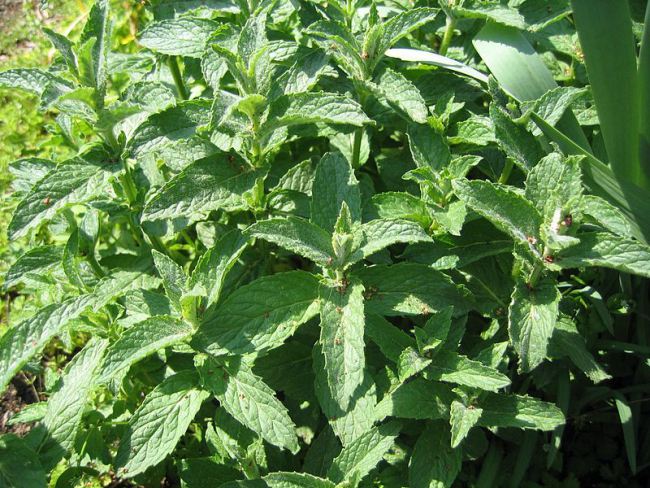
This morning as I was weeding my garden, it occurred to me that the mint that had overrun my herb garden was like standardized test prep. As schools across the country do their best to prepare students for the new CCSS-aligned assessments, test prep is running rampant. Just as the mint in my garden has choked out the basil and parsley, test prep, and the tests themselves, threaten to take over the school day, leaving no time to savor novels, delve into a character’s motivation, or write a deeply personal narrative.

I grow a variety of herbs in my garden because each herb has its own distinct flavor and use. The amount of the herb I use depends on what I’m cooking. The same is true for teaching. We have a wide variety of instructional resources and strategies available. As professionals, we take great care to make…

View original post 202 more words