Slice of Life: Letting Go of Fear

11454297503_e27946e4ff_h

“There is so much we overlook, while the abundance around us
continues to shimmer, on its own.”
Naomi Shihab Nye

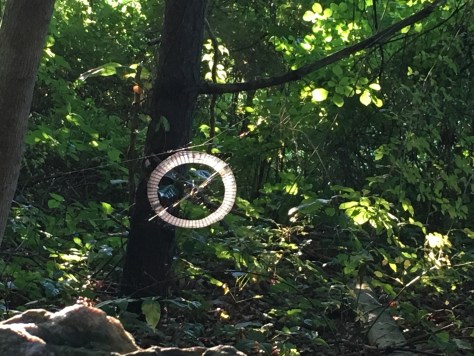
The night’s rain left the earth fresh and smelling of green things growing. The birds, playing hide and seek in the tree tops, called out, “Over here, over here.” And yet I stepped hesitantly into this lush, cool morning. I looked at every spot my foot would land before setting it down because I was afraid. Afraid of stepping on a snake.

My fear of snakes comes from an encounter with a large black snake when I was a child. This fear is totally irrational, since the snake didn’t harm me in any way. And yet, this fear is really the only one I have never outgrown. I know there are snakes in these woods. I’ve seen them. And although I’ve only seen harmless snakes, neighbors have seen copperheads. So despite the fact that my children played in these woods for many years without incident, I rarely venture into them.

Ophidiaphobia, the technical term for fear of snakes, “is among the most common animal phobias,” according to Phobias: The Psychology of Irrational Fear: The Psychology of Irrational Fear, (ABC-CLIO, 2015) edited by Irena Milosevic Ph.D., Randi E. McCabe Ph.D.

Okay, I’m not alone. And, even though, copperheadsnake.net reassures readers that “the chance of a fatal bite and envenomation by a copperhead is probably less than 1 to 5,000,” I’m not sure that makes me feel any better.

But my ophidiaphobia got me thinking about fear in general. Let me be clear, I’m not thinking about fear for our lives when we’re in mortal danger. Being afraid of an approaching hurricane is not the same as being nervous about trying a new teaching method or visiting a new city or country. Rather, I’m wondering about irrational fears and why it’s so hard to let go of them. And, what are we afraid of, really?

My suspicion is that it’s fear of being vulnerable, making a mistake, of looking foolish, or being wrong. So much has been written about this kind of fear lately that it’s hard to distill. TED Talks about vulnerability, failure, and fear are among the most watched, and book shelves bulge with volumes whose goal is to help us overcome our fears.

What exactly is the difference between fear and vulnerability? Psychology Today defines fear as “a vital response to physical and emotional danger,” whereas to be vulnerable is to be “easily hurt or harmed physically, mentally, or emotionally.” And yet Brené Brown has said that “vulnerability is the birthplace of joy, of creativity, of belonging, of love.” Aren’t these the feelings we want to nurture not only in ourselves but in our students?

So the issue isn’t one of not being afraid or vulnerable. As Kathryn Schulz explains in her TED Talk, “our capacity to screw up is not some kind of embarrassing defect in the human system…it’s totally fundamental to who we are.” The issue is to learn how to balance our fear and vulnerability so that we can choose a new or less familiar path. A path where we can see the lushness of the surrounding countryside. A path that can lead us to the delight of discovery.

The world is full of things to be afraid of. But it’s also full of wonder. I don’t want to miss those wonders because I’m so busy looking down, always watchful for a snake.
IMG_0746

 Thank you to StaceyDanaBetsyBeth, KathleenDeb, Melanie, and Lisa for this space for teachers and others to share their stories each Tuesday. Be sure to visit Two Writing Teachers to read more Slice of Life posts.
Slice of Life: Magical Things

11454297503_e27946e4ff_h

“The universe if full of magical things patiently waiting for our wits to grow sharper.”
Eden Phillpotts

Most mornings I can be found walking along our quiet stretch of road with our dog, Lucy. Meandering may be a more accurate description. Lucy is a beagle and has to sniff everything. (You remember the Pokey Little Puppy, right?) Sometimes it takes us half-an-hour to go less than a quarter of a mile. This used to frustrate me because I. had. things. to. do! (More about that here.) But I stopped letting it bother me ages ago. The reason? I took a cue from Lucy and started really paying attention to the action unfolding all around me.

As usual, the birds were very busy this morning. These swallows greeted us as we started off, chittering “Hello!”

IMG_0660

Then something upset this hawk, as he erupted from his perch in the pines with an ear-piercing screech.

           IMG_0662    IMG_0669

IMG_0666

As we moved a little farther down the road, we came across these berries. It looks like they need another day or two to ripen, then they’ll be a perfect breakfast for the birds in the neighborhood.

IMG_0646

Goldfinches love the thistles that grow along the old stone wall at the edge of this pasture.

When we got home, more winged friends were waiting to greet us buzzing around in the hosta.

                      IMG_0680     IMG_0679

Finally, I sat down on the front step where I have a good view of this nest, which was strangely quiet this morning. The mama bird was very busy there yesterday.

IMG_0654

Thank you, Lucy, for making me slow down and sharpen my wits to the “magical things” that are all around.

Thank you to StaceyDanaBetsyBeth, KathleenDeb, Melanie, and Lisa for this space for teachers and others to share their stories each Tuesday. Be sure to visit Two Writing Teachers to read more Slice of Life posts.
Slice of Life: A Weekend in Boston

                                          11454297503_e27946e4ff_h         f36176a2c4703110251c9b8c27654e22

My mind and heart are overflowing with all the passion, knowledge, and energy that was shared by the colleagues I was fortunate enough to learn with and from at the International Literacy Association Conference in Boston. I’ll be reading, digesting and thinking about the sessions for weeks to come. But while the experience is still fresh in my mind, I want to share some key take aways.

“We all have a life worth writing about.” Adora Svitak

“Give your students a little piece of sky; help them soar.” Kwame Alexander

“We get better by doing the best we can” Mark Overmeyer

“Invite students to live writerly lives.” Paula Bourque

“Play opened avenues in my brain that I didn’t know existed.” Jennifer Jacobsen

“Look for the surprises in your writing…that’s where the gold of the story is hiding.” Cynthia Lord

“Let kids know our passion for reading” Penny Kittle & Kelly Gallagher

“Books provide imaginative rehearsals for the real world.” Kelly Gallagher

“Let kids know that “what they have to say matters.” Linda Rief

“We want kids to be responsive to the characters & themselves” Bob Probst

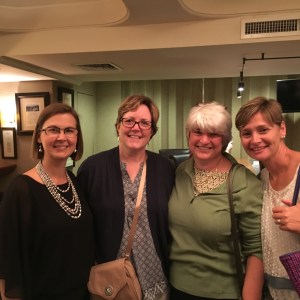
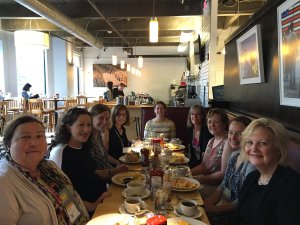
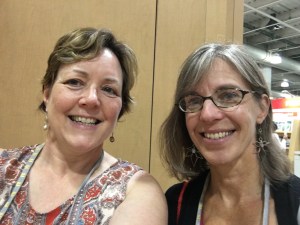
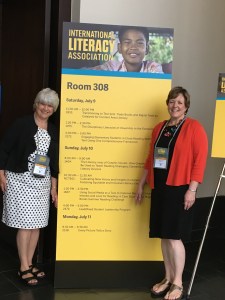
My weekend in Boston was also filled with seeing old friends and meeting online friends in real life.

IMG_0522
With Colette Bennett, Jan Burkins, and Kim Yaris.
CnAb31AWEAAztcN
Slicer Breakfast at the Trident Cafe.
So happy to meet Molly Hogan in real life!
With Colette Bennett before our presentation.

If you’ve never attended a national conference, it’s an experience you’ll never forget. Thank you, ILA, for a wonderful weekend!

Thank you to StaceyDanaBetsyBeth, KathleenDeb, Melanie, and Lisa for this space for teachers and others to share their stories each Tuesday. Be sure to visit Two Writing Teachers to read more Slice of Life posts.
Slice of Life: Summer STEAM

11454297503_e27946e4ff_h

“Wisdom Begins in Wonder”
Socrates

These words are as true today as they were 2500 years ago. I may have heard or read them before, but I was happy to see them painted on the wall of the “Cabinet of Art and Curiosity” installation at the Wadsworth Atheneum in Hartford yesterday. I was there to participate in the museum’s “Summer STEAM” workshop, designed to show teachers “the many ways art can enhance science, technology, engineering, and math” in their classrooms.

Lisa Delissio, a STEM Faculty Fellow at Salem State University, began the day with a talk about the intersection of art and science. She explained that the “perspective and knowledge of artists is essential to scientific approaches to problems.” Specifically, she listed the observational skills artists bring to their work that have been found to have an impact on the skills of her biology students. These include:

  • visual qualities
  • other sensory qualities
  • perspectives
  • materials
  • connecting to meaning: memories and metaphor
  • context, function, and purpose

Dr. Delissio then showed us this image:

By Prosthetic Head (Own work) [CC BY-SA 4.0 (http://creativecommons.org/licenses/by-sa/4.0)], via Wikimedia Commons
By Prosthetic Head (Own work) [CC BY-SA 4.0 (http://creativecommons.org/licenses/by-sa/4.0)%5D, via Wikimedia Commons

She asked us to use the observational skills of an artist and the perspective of a biologist to respond to the image with word and/or  pictures. My sketch was very rudimentary, but my jottings were very much dominated by my poetry brain. I was immediately drawn to the stamens of the large flower in the foreground, which reminded me of sunspots exploding on the sun and the flower in the bottom center waiting to bloom. To me, its folded petals looked like hands folded in prayer.

We were given ten minutes to work on this, which sounds like a long time. But it really wasn’t. I could have easily  spent another half hour working on my observations and the poem I was beginning to formulate. Keeping the STEAM theme of the day in mind, I started a Fib poem, a poem which uses the Fibonacci sequence to determine the number of syllables in each line.

Fat
skink
rests on
bright purple
aster petals, their
stamens exploding like the sun.

The auditorium full of dozens of teachers was absolutely still as people worked. But it didn’t feel like work at all. We were completely engaged in our creativity, our intellectual curiosity sparked by the blending of diverse disciplines. As Dr. Delissio explained, students who pursue double majors in science and the arts are more creative, and exhibit more intellectual curiosity and divergent thinking than students with a single major.

Attending this workshop was a joy for me, not because I needed convincing that the arts should be included in STEM, but because it bolstered my belief in the importance of including the arts in our classrooms. As schools across the country embrace STEM and devote time and resources to integrate STEM into the curriculum, we have to ensure that the arts are always included. As Anne Jolly points out in a recent Education Week article, “The purpose of STEAM should not be so much to teach art but to apply art in real situations. Applied knowledge leads to deeper learning.”

Thank you to StaceyDanaBetsyBeth, KathleenDeb, Melanie, and Lisa for this space for teachers and others to share their stories each Tuesday. Be sure to visit Two Writing Teachers to read more Slice of Life posts.

Slice of Life: Finding Compassion

11454297503_e27946e4ff_h

“Compassion is not religious business, it is human business, it is not luxury, it is essential for our own peace and mental stability, it is essential for human survival.”
~ Dalai Lama XIV ~

how to write a

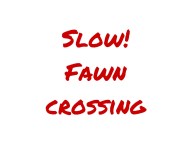
I noticed this sign on the edge of the road as I was driving to work. And it did make me slow down. I noticed its counterpart on the other side of the road on my way home that afternoon. Even though there was no sign of the fawn or its mother, I was thankful for this reminder.

I thought of this sign over the weekend when I was at dinner with my family. It was a beautiful summer evening, and we were eating on the sidewalk terrace of a busy restaurant. Suddenly, a woman was sprawled on the sidewalk.

Her toddler had wriggled away from her (they are slippery little things!) and she tripped while running after him. Her hands were scraped and she split her lip, which was bleeding profusely. I ran into the restaurant to get napkins, and someone else got her a glass of water. She was more startled than injured, and after a few minutes those of us who had helped her returned to our dinners.

Helping this woman wasn’t something I thought about. I just did it. Over the past year, my family, like far too many families, has been coping with a sudden loss. We have been overwhelmed by the many kindnesses, large and small, often from total strangers, shared with us during this time. How could I not extend my hand to this woman?

Since Sunday’s horrific news from Orlando, I’ve felt dismay and revulsion at some of the rhetoric being bandied about so carelessly. But I’ve also been heartened by the countless selfless acts of kindness, from women passing out carnations to the families of the victims to the hundreds of people lined up to give blood. This outpouring of sympathy and solidarity from all corners of the world gives me hope. Hope that we can rise above fear and hate. Hope that we can all find the compassion within ourselves to slow down, extend a hand, and treat others with care. Hope that love will prevail.

Thank you to StaceyDanaBetsyBeth, KathleenDeb, Melanie, and Lisa for this space for teachers and others to share their stories each Tuesday. Be sure to visit Two Writing Teachers to read more Slice of Life posts.
Slice of Life: Meeting Goals

11454297503_e27946e4ff_h

“Not everything that counts can be counted, and not everything that can be counted counts.”
Albert Einstein

After hours of collecting and analyzing data, looking for reading behaviors used or not, identifying vowel patterns known and unknown, after hours of planning lessons, carefully choosing books and poems to support student needs AND spark their interest, after hours of instruction, coaching and supporting strategies or sounds they’re using but confusing, after phone calls and parent meetings about how students are or aren’t progressing, we’ve arrived at the last week of school, and the last lessons with my students for this year.

And the question on everyone’s mind? Did they meet the goal? Not did they meet their personal goal, but did they meet the goal for first grade? In the case of the students I work with, intervention students who came into first grade below the grade level goal, the answer is no.

And yet, they have made tremendous personal progress. They are all confident readers. They read books at their independent level fluently and with expression. They understand what they’ve read and have ideas about why characters act the way they do. They read nonfiction with curiosity and enthusiasm.

Do I feel like I have failed these students? Yes and no. I know their classroom teacher and I did everything we could to support their progress. I know they worked hard when they were with me and made incremental gains on most days. But teachers are always second-guessing themselves. We feel like there must be something else we could have done. But very often, our best truly is enough. These five- and six-year olds just need more time to learn those diphthongs and -r controlled vowels. They need more time to remember to try a different vowel sound if they one they used doesn’t make sense.

I’m willing to give them that time, as long as they’re making progress along the way AND they are falling in love with reading. If both of those things aren’t happening, then something needs to change. If the teaching techniques I’ve been using aren’t meeting their needs, then it’s my responsibility to find a new strategy or technique that does meet their needs. Have I done this? Yes. So back to the original question: Did these students meet the goal?

In my mind, yes. They are readers who can problem-solve to read unknown words, they make meaning from the texts they read, and most importantly, they enjoy reading and are proud of their accomplishments. And isn’t that our goal for all our students?

Thank you to StaceyDanaBetsyBeth, KathleenDeb, Melanie, and Lisa for this space for teachers and others to share their stories each Tuesday. Be sure to visit Two Writing Teachers to read more Slice of Life posts.
Slice of Life: Playing With Grammar

11454297503_e27946e4ff_h

“The purpose of grammar is to enhance writing. Writing is ALWAYS the goal,” Jeff Anderson told a packed conference room last Saturday. Spending an hour and half with Anderson at the New England Reading Association Conference gave me new insights into how engaging grammar instruction can be.

Photo by Aaron Burden via unsplash.com

Anderson began the session by reading a section of his book, Zack Delacruz: Me and My Big Mouth. He correctly pointed out that there are often times when kids (and adults) need to be “juiced up” for writing. Reading a snippet of a book, poem, or article can “inspire great writing.”

After hearing about Zack and his school’s anti-bullying assembly, we had at least four topics to choose from for a free write:

  • assemblies
  • being/feeling different
  • picked on/bullied
  • teachers

I wrote a stream-of-consciousness riff on watching middle school kids at my school, which took me back to my own middle and high school days.

Anderson then explained that grammar “rules aren’t hard; it’s applying them that’s hard.”

So how can we make our grammar instruction effective? By focusing on function and practical application.

Why does this matter? Because grammar “helps writing come alive.”

Anderson urged us to abandon our practice of putting up sentences with errors, a la Daily Oral Language, for correction. Rather, we should display correct sentences, then study these mentor sentences to figure out why they’re effective. In this way, we “merge craft and grammar” instruction.

“Every choice a writer makes has an effect,” Anderson pointed out. By studying models, we can begin to “view grammar with a sense of possibility.” We can begin to imagine how we can use grammar to “help our writing come alive.”

“All grammar decisions add elaboration,” Jeff explained. This seems so obvious, but I had never thought about it that way. He went on to say that “commas act like a zoom lens—going from the big picture to close details.”

Using the first line of Ali Benjamin’s book, The Thing About Jellyfish, Jeff modeled exactly what he meant by this, and how to design a cycle of instruction to “immerse kids in the power of grammar and editing.”

The first step is to display a sentence, then invite kids to NOTICE what the comma is doing when they read it out loud. Then have them read it again and think about what the comma does when they read with their eyes.

Once kids have noticed something and thought about how a comma is used, they begin to see it everywhere, thanks to our reticular activating system. (Thank you, Jeff, for naming this phenomenon.) Once they’re aware of this pattern, the “more likely they are to try it in their own writing.”

Now invite students to COMPARE & CONTRAST the mentor sentence with a teacher-written model. Discuss how the construction of the two sentences is similar and/or different. Then talk about the impact of the two sentences. Is one more intriguing? Why? What grammar decisions (which are really CRAFT decisions) did the author make to create a powerful sentence?

Then collaborate to write a similar sentence together. (We didn’t have time for this in our session, but it’s the logical next step in a gradual-release model. You can view Anderson’s presentation slides here).

Invite students to IMITATE the mentor sentences. By trying it on their own, students will be able to see and understand the “possibilities of grammar acrobatics.” Inviting kids to imitate also gives them choice. Choice of what to write about, but also choices about how to imitate the mentor sentence.

Finally, invite students to REVISE. Have them revisit a piece of writing and “find a place where you can sharpen an image.” Have them imitate the model again, whatever it was. On Saturday we were using “the right-branching closer.”

Here is my revision from the free write we did at the beginning of the session:

Original:

What an act of bravery it is, though, to come to school in middle school with the new shoes or new pants that you think are like everyone else’s, but something isn’t quite right. Now, instead of feeling cool and fitting in, you feel like even more of an outsider. The Levi’s tab isn’t red.

Revision:

I strode into school, feeling cool in my brand new Levis with the red tab waving from the back pocket.

I know I never would have written this sentence without Anderson’s “invitation to play” with my writing. By inviting our students to do this work, not worksheets, we invite them to see what’s possible, and in so doing, invite them do their best work.

Functional application at its finest!

Thank you to StaceyDanaBetsyBeth, Kathleen, and Deb for this space for teachers and others to share their stories each Tuesday. Be sure to visit Two Writing Teachers to read more Slice of Life posts.

Slice of Life: Waiting to Bloom

11454297503_e27946e4ff_h

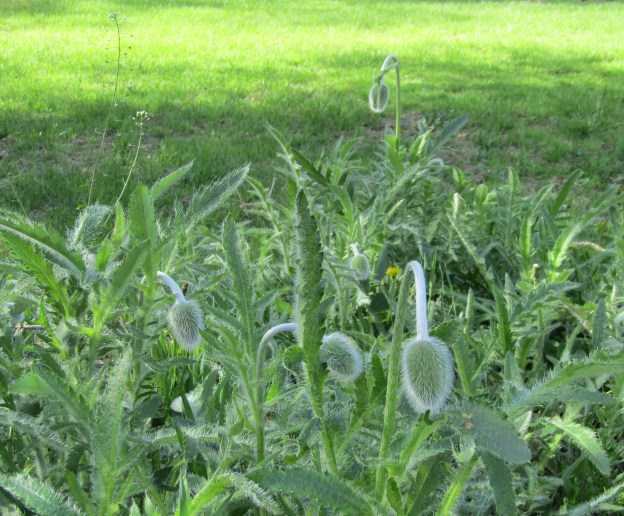
The rain has finally stopped and my flower gardens are ready to burst. It won’t be long before the papery orange blooms of these poppies are dancing in the breeze.

IMG_0162

They inspired this poem:

Patient poppies bow their heads
like dancers offstage
waiting to make their entrance,
waiting their turn to shine
in the spotlight.

© Catherine Flynn, 2016

  Thank you to StaceyTaraDanaBetsyAnnaBeth, Kathleen, and Deb for this space for teachers and others to share their stories each Tuesday. Be sure to visit Two Writing Teachers to read more Slice of Life posts.
Slice of Life: Alive Below Crystal

11454297503_e27946e4ff_h

It is National Park Week, and this year marks the 100th anniversary of the National Park Service. (Thank you to Tricia Stohr-Hunt, aka Miss Rumphius, for the heads up on this.)

My family and I are fortunate enough to have rafted down the Colorado River through the Grand Canyon twice. This is an incredible experience, one that leaves you with a deep appreciation for the grandeur of the canyon and the power of nature.

The course of the river is punctuated by powerful rapids, but there are two that stick out in my mind. One is Lava Falls, which I’ve written about here. The other is Crystal, which was formed, literally, overnight.

“In December 1966 a storm unlike any witnessed before, dropped over 14 inches of rain in some places along the north rim. All this water sent debris flows crashing down side canyons [including Crystal Canyon]. When the storm had passed, the debris fan constricted the Colorado to less than a quarter of its original width, and a large boulder at the top created one of the largest holes on the river”

From “Nature, History, and Culture of the Grand Canyon: Crystal Rapid

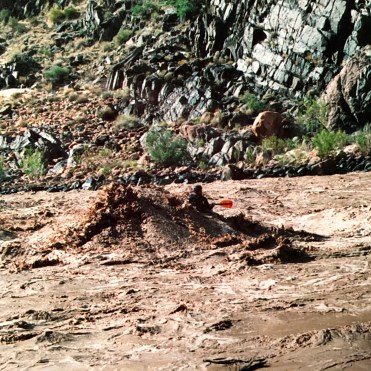
Brian in Crystal Rapid, August, 2007
Brian in what I think is Crystal Rapid, August, 2007

Alive Below Crystal

Skirt the wave
at the edge of the hole,
kiss its lip with your paddle,
close enough to feel its power,
distant enough to avoid being sucked in,
overwhelmed by her might.

In the course of one life,
how often do these upheavals
occur?
The path is altered,
a chasm opens.
Never fully healed,
full of fissures that can crack
without warning,
bringing us to our knees.

Alive below Crystal,
our view forever transformed.
We’ve gazed into the face
of the cataclysm
and survived.

© Catherine Flynn, 2016

Large-Blue-RGB-National-Poetry-Month-Logo

 Thank you to StaceyTaraDanaBetsyAnnaBeth, Kathleen, and Deb for this space for teachers and others to share their stories each Tuesday. Be sure to visit Two Writing Teachers to read more Slice of Life posts.

Slice of Life: PD in My PJs

11454297503_e27946e4ff_h

“I have no special talents, I am only passionately curious”
~ Albert Einstein ~

Last Saturday, I took advantage of a great day of professional development available FREE and ONLINE. The Educator’s Collaborative, founded by Chris Lehman, sponsored a day full of inspiration for educators. More than forty educators and writers were on hand to share their ideas and insights. During her presentation, Linda Hoyt talked about ways to help kids see how ideas go together, to see the relationships between seemingly diverse topics. Over the course of the day, it was hard to miss the relationship between all the sessions. The ideas delivered by so many wise presenters went together like pieces of a giant jigsaw puzzle, and the finished puzzle spelled out: STUDENT ENGAGEMENT = STUDENT LEARNING

In one way or another, each session I watched stressed the importance of inspiring our students, sparking their curiosity, and encouraging them to ask questions. These steps will lead them to make new discoveries, discoveries about the world around them, but more importantly, discoveries about themselves. These discoveries, in turn, will help them dream and discover their passions.

It would be impossible to choose the best session, or the most inspiring idea, for they were all fantastic and full of inspiring ideas. I did love that all the presenters shared the research base and philosophy behind their ideas, then provided practical strategies that we could infuse into our lessons on Monday.

You really should just stop reading and go to The Educator’s Collaborative website and start watching. But in case you’re not convinced yet, here are a few examples of all the wisdom you’ll find there.

Harvey Daniels explained that Curiosity is a better motivator than grit. Working from the positive is always so much better.”

Amy Ludwig VanDerwater reminded us that “Each of has something only we can say” and we should “say it through poetry!”

Rebekah O’Dell and Allison Marchetti gave us ideas for including “notebook time” in our classrooms and explained that this time “is an invitation and a place to play.”

Dr. Mary Howard urged us to build our classroom libraries to ensure that “students have books that will make their hearts sing!”

Linda Hoyt pointed out that we can “ignite a sense of wonder with kids through visuals in nonfiction read-alouds.”

“It’s about generating and creating pathways for thinking. It’s about giving kids new opportunities,” Kristin Ziemke explained.

Maggie Beattie Roberts told us that “tools help us do more, become more, reach dreams we have for ourselves, & make things easier.”

I could keep going, but seriously, just go watch the sessions for yourself. You’ll be so glad you did.

You’ll also find a session I wasn’t able to see because of satellite interference by four of Two Writing Teachers fearless leaders, Stacey Schubitz, Dana Murphy, Betsey Hubbard, and Deb Frazier on “Maximizing Independent Writing Time by Creating Conferring Tool Kits.” I’m looking forward to watching their session later this evening. 

Thank you to StaceyTaraDanaBetsyAnnaBeth, Kathleen, and Deb for this space for teachers and others to share their stories each Tuesday. Be sure to visit Two Writing Teachers to read more Slice of Life posts.