Poetry Friday: Walt Whitman’s “Miracles”

poetry-friday-1-1

Before I began student teaching, my cooperating teacher invited me to the class Christmas party so I could meet the kids. One boy wanted to know what was my favorite holiday. I didn’t hesitate a minute. “Summer,” I replied.

So even though the solstice isn’t until tomorrow, here’s to the miracle that is summer!

Miracles

by Walt Whitman

Why, who makes much of a miracle?

As to me I know of nothing else but miracles,

Whether I walk the streets of Manhattan,

Or dart my sight over the roofs of houses toward the sky,

Or wade with naked feet along the beach just in the edge of

   the water,

Or stand under trees in the woods,

Or talk by day with any one I love, or sleep in the bed at night

   with any one I love,

Or sit at table at dinner with the rest,

Or look at strangers opposite me riding in the car,

Or watch honey-bees busy around the hive of a summer 

   forenoon,

Or animals feeding in the fields,

Or birds, or the wonderfulness of insects in the air,

Or the wonderfulness of the sundown, or of stars shining so

   quiet and bright,

Or the exquisite delicate thin curve of the new moon in spring;

These with the rest, one and all, are to me miracles,

The whole referring, yet each distinct and in its place.

To me every hour of the light and dark is a miracle,

Every cubic inch of space is a miracle,

Every square yard of the surface of the earth is spread with 

   the same,

Every foot of the interior swarms with the same.

To me the sea is a continual miracle,

The fishes that swim—the rocks—the motion of the waves—

   the ships with men in them,

What stranger miracles are there?

Don’t miss this gorgeous video inspired by Whitman’s words:

Be sure to visit Jone at Check It Out for the Poetry Friday Round Up. Happy summer, everyone!

Slice of Life: My Last Class

11454297503_e27946e4ff_h

Seven years ago, I said goodbye to the classroom and stepped into the role of literacy specialist. This position challenges me every day and has allowed me to grow as an educator in ways I could not have imagined. 

But I miss being a classroom teacher. I miss the hum of a classroom hard at work. I miss those moments when a hush falls over the room because we are all mesmerized by the final pages of our read aloud. I miss listening to young writers share their heart-felt stories. I miss seeing the joy on a child’s face when she sees a butterfly emerge from its chrysalis, or the furrowed brow of a child who is determined to solve a math problem. I miss a child trusting me so much and feeling so comfortable with me that he says “mom” when he has a question.

My last first grade class will graduate from eighth grade later this week. I have loved watching them grow into caring, capable young adults, but not as much as I loved spending one precious year with them.

Being their first grade teacher was a privilege I am thankful to have had. As they head off to high school, I hope they have the courage and opportunity to follow their dreams. I wish them love and joy and happiness in the years ahead.

Godspeed, my young friends.

last class

Thank you, as always, to StaceyTaraDanaBetsyAnna, and Beth for hosting Slice of Life each Tuesday. Be sure to visit Two Writing Teachers to read more Slice of Life posts.

It’s Monday! What Are You Reading? Summer Reading Edition

IMWAYR

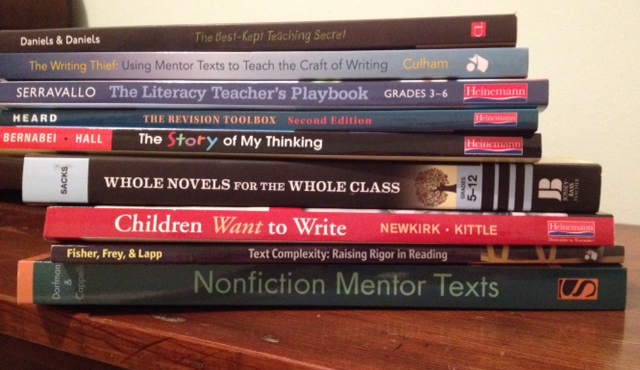
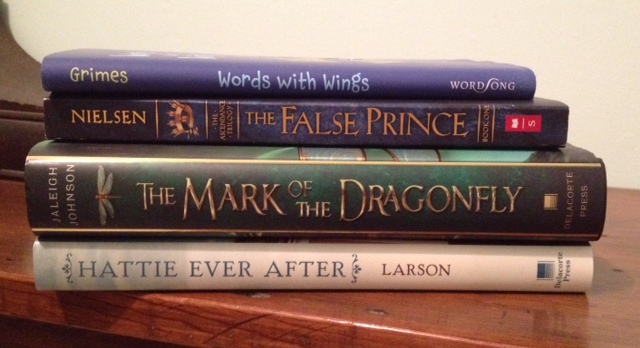
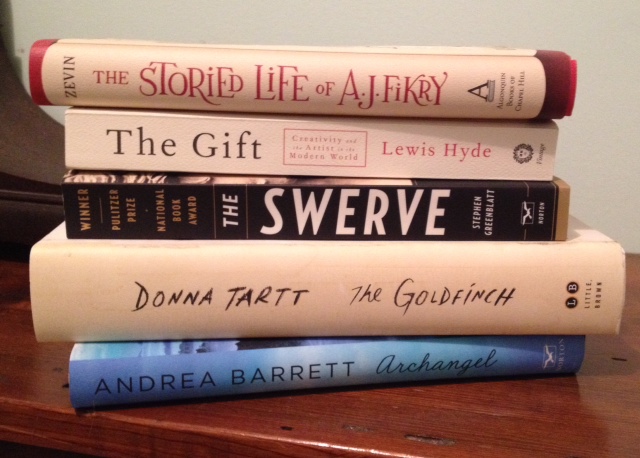
Every teacher knows that the last weeks of school are the most hectic of the year. I haven’t been very successful carving out time for reading anything other than the newspaper and a few blogs lately, but I have been thinking about summer reading. So in lieu of writing about what I have been reading, here are stacks of what I plan to read over the next few months.

photo 1
Professional books
photo 2
Middle grade & YA books
photo 3
Adult books

What’s in your summer reading stack? Happy reading!

Don’t forget to visit Jen at Teach Mentor Texts and Kellee at Unleashing Readers to find out what other people have been reading lately. Thanks, Jen and Kellee, for hosting!

A Saturday Celebration

celebrate-image

Thank you, Ruth, for providing this space and giving us the opportunity to pause and celebrate the joys from our week.

June can be a bittersweet time for teachers as we let go of children we have grown to love. This week, I want to celebrate one of these students.

I began working with this second grade girl at the end of November. She had struggled with reading in first grade, but by last September it was clear that she wasn’t making progress. Her parents consented to testing to see if she was eligible for special education, but these revealed that she had average skills and abilities, and therefore not eligible. But she was eligible for the Tier 3 reading support I provide.

When we began working together, she was reading at a level about a year behind where most second graders are in November. She came to our lessons eager to to her best, and began to make slow but steady progress.  

As I wrote earlier in the week, I usually have a short read-aloud time during my intervention lessons. About a month ago, I began reading Firefly July (Candlewick Press, 2014), Paul B. Janeczko’s wonderful collection of short poems, to this little girl. She was entranced by Melissa Sweet’s whimsical illustrations and several of the poems quickly became favorites. This line from Robert Wallace’s “In the Field Forever” even inspired her to write her own poem:

Sometimes the moon’s a scythe, sometimes a silver flower.

Here is her poem:

The Colors of the Moon

Sometimes the moon looks like a golden banana.

Sometimes it looks like a white hammock.

Sometimes it looks like a ripe orange.

Sometimes the moon looks like a cookie with a splash of milk.

Sometimes it looks like a red apple.

Isn’t that lovely?

All her hard work has paid off. She is leaving second grade only one level below our end-of-year expectation, and she is no longer mixing up lowercase “b” and “d”. But best of all, she is leaving second grade a poet and a much more confident and enthusiastic reader. Hooray for her!

Slice of Life: Read Alouds for Everyone

11454297503_e27946e4ff_h

Last night’s #readingjoy Twitter chat, led by Jennifer Seravallo, got me thinking about read alouds. Much has been written about the importance of parents reading aloud to children from the very start and making read alouds part of every classroom routine. I agree with every bit of this advice. I read to my own children from the day we came home from the hospital, and we never skipped read aloud time in my classroom. But I’ve also come to realize the importance of read alouds in my intervention lessons.

I left the classroom seven years ago to become our school’s literacy specialist. Because I work in a small district, this role includes many duties. One of these is working with tier 3 students. The children I work with are our youngest, most at-risk students who are typically non-readers when we begin working together. One of the biggest challenges they face is understanding why they should bother with reading at all. Usually this is because reading isn’t a priority at home. I meet with their parents to discuss the importance of reading to and with their children. I also give them pamphlets and links to websites with tips and information about how to make reading part of their routine at home. I send books home that children can keep. And yet, they still don’t read at home.

By the time these children arrive in my room, they’re convinced that I’m going to torture them. So I start by chatting with them about their pets, hobbies, and places they like to visit, just to break the ice. Once they are comfortable, I start asking about favorite books or subjects. Then I bring out my secret weapon. A book. I offer it as something I like, not as something I think they should like. Usually they ask for their own copy by the end of the week.

614a7cNL5EL

One of my first students was a first grade boy with a host of issues. (He was diagnosed with Autism during the time I worked with him.) He had no interest in anything other than Legos and hated school because he had to leave his Legos at home. He knew most of the letters and sounds, but didn’t know how to pull them apart or put them together to make words. For some reason, he took a shine to Emily Gravett’s Orange Pear Apple Bear (Simon & Schuster, 2007). I must have read that book to him a hundred times. Soon, he was reading it with me. And before long, he was reading lots of other books, too.

51wjVUX0s9L._SY300_

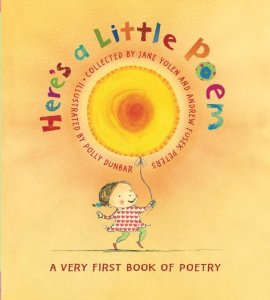
Another boy was adamant that he hated letters and wouldn’t learn to read. I told him that was his choice but that I was going to read to him. His “breakthrough book” was in fact a poem from Jane Yolen and Andrew Fusek Peter’s excellent collection Here’s a Little Poem: A First Book of Poetry (Candlewick, 2007). Peter’s own poem, “The No-No Bird,” introduced this child to a boy who liked the word “no” as much as he did. Maybe it was this flash of recognition that finally brought him around. Or maybe it was simply the fact that he could read the word “no.”

51R1jIhHu3L

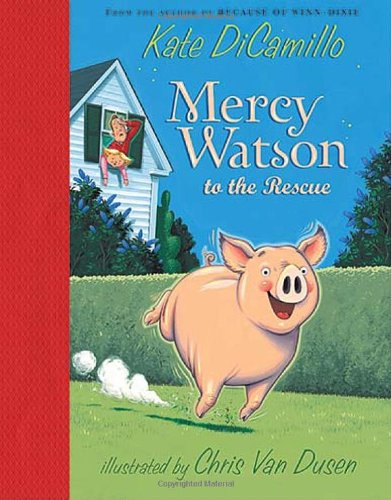
Last year I had a student who was so shy and quiet he barely spoke above a whisper. To break the ice, I began reading Kate DiCamillo’s Mercy Watson to the Rescue (Candlewick, 2005). He loved Mercy and her silly antics! Soon he was reading with me, asking questions, and thinking of further adventures for Mercy. Over the course of the year, we read every Mercy Watson book we could get our hands on. My heart was filled with joy at the look on his face when I presented him with his own copy of Mercy Watson at the end of the school year.

Do I know what it was about each of these books that made them the right books for these children? No. What I do know is that each child heard or saw something in them that made him happy. Something in these books helped him feel connected to another person and let him know he wasn’t alone. And that is, after all, why we read.

Thank you, as always, to StaceyTaraDanaBetsyAnna, and Beth for hosting Slice of Life each Tuesday. Be sure to visit Two Writing Teachers to read more Slice of Life posts.


Poetry Friday: “Carentan O Carentan”

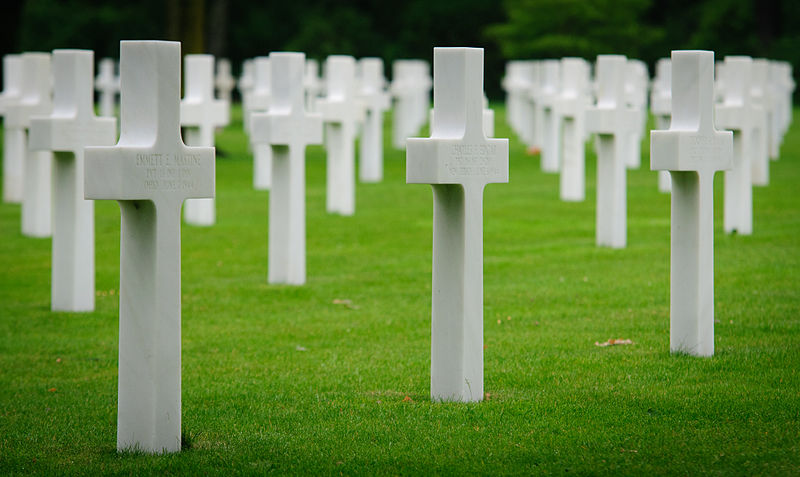
Normandy_American_Cemetery_and_Memorial_(6032771638) “What happened on this day?” my father would often ask as we sat down to dinner. Today, of course, the answer would be D-Day. The invasion of Normandy. The beginning of the end on World War II. Even if we knew the answer to these questions, an impromptu history lesson usually followed. My father wasn’t a scholar or historian, but he had been a small boy during the war, and he revered the soldiers who fought it. And although he never said as much, I think these supper-time history lessons were his way of ensuring my sister and I shared his reverence.

My father isn’t here to ask that question today. But if he were, I know he would be honoring the brave men who landed on the beaches and parachuted into the French countryside seventy years ago.

One of those soldiers, Louis Simpson, captured the horrors endured and the sacrifices made by the courageous souls who fought to liberate “Fortress Europe” in “Carentan O Carentan.”

“Carentan O Carentan”

by Louis Simpson

Trees in the old days used to stand

And shape a shady lane

Where lovers wandered hand in hand

Who came from Carentan.

This was the shining green canal

Where we came two by two

Walking at combat-interval.

Such trees we never knew.

The day was early June, the ground

Was soft and bright with dew.

Far away the guns did sound,

But here the sky was blue.

The sky was blue, but there a smoke

Hung still above the sea

Where the ships together spoke 

To towns we could not see.

Read the rest of the poem here or listen to actor Charles Durning recite the poem:

To read more about D-Day and see photos of Omaha Beach today, visit Remember D-Day by walking the beaches of Normandy by John Hanc.

Please be sure to visit Carol at Carol’s Corner for the Poetry Friday Round Up.

It’s Monday! What Are You Reading? Bird Books

IMWAYR

One of the few memories I have of 2nd grade is learning about birds. My teacher, Mrs. Wheaton, must have been a bird-watcher, because she taught us about the song birds native to our area. I  don’t remember what specific facts about birds I learned from her, but I have clear memories of coloring pictures of the Baltimore oriole, red-wing blackbird, goldfinch, and more. The pages  had the purple ink and intoxicating smell of a mimeograph machine, and I loved them. At the end of the unit, all the pages were stapled together into a little book. 

9780763645618_p0_v1_s260x420I was reminded of this project recently when I read Look Up! Bird Watching in Your Own Backyard. (Candlewick Press, 2013) This book is filled to the brim with fascinating details about bird species, habitats, flight behavior, wing shape, beak shape, songs and more. Author and illustrator Annette LeBlanc Cate tells readers at the start that she is not a scientist; she just really loves birds. Her love shines through on every page of this fact-filled, engaging book.

One of my favorite things about Look Up! Bird Watching in Your Own, which won a Robert F. Sibert Honor, is that it encourages children to hone their powers of observation. Cate urges readers to go outside and “be amazed at just how thrilling it can be to see new birds, find out about them and learn their names.” Tips for successful birdwatching, as well as a bibliography for budding birders are included. Cate also recommends that readers visit the Cornell Lab of Ornithology’s website. This is an extensive resource, where you can search for information about almost any North American bird, hear its song and watch several species in the wild via their Bird Cam.

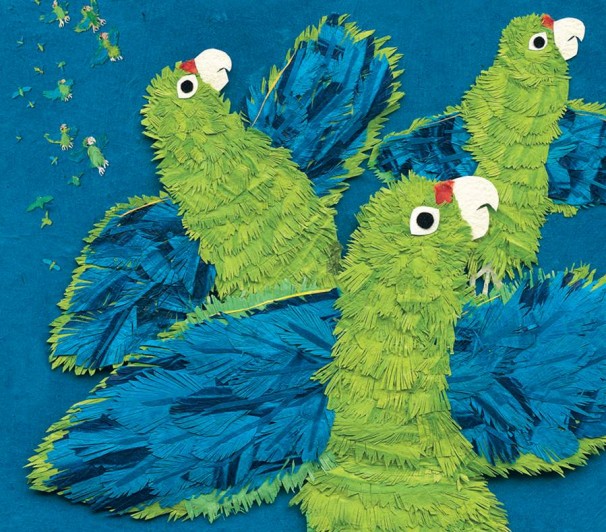
Parrots-over-Puerto-Rico1Parrots Over Puerto Rico (Lee & Low Books, 2013) by Susan L. Roth and Cindy Trumbore is a gorgeous book that tells the story of the Puerto Rican parrot. Called iguaca by the Tainos who arrived on the island over a thousand years ago, “hundreds of thousands of parrots flew over the island” before Puerto Rico was settled by humans. Roth and Trumbore’s description of this paradise is brought to life in Roth’s stunning collages. Using paper and fabric, she creates scenes that have such depth and texture you wouldn’t be surprised if the birds flew off the page.

By weaving the history of Puerto Rico together with the fate of these now extremely rare parrots,  Roth and Trumbore make it clear that humans have been the primary culprits in the birds decline. But they also devote almost half of the book to the efforts humans have taken since the late 1960s to save the Puerto Rican parrot. They describe the setbacks as well as the successes scientists have had as they fight to save the Puerto Rican parrot.

Winner of the 2014 Robert F. Siebert Medal for Most Distinguished Informational Book for Children, Parrots Over Puerto Rico has a lengthy afterword that describes the work of the Puerto Rican Parrot Recovery Program in greater detail and includes photographs of the birds in the aviaries and in the wild. There is also a timeline of events described in the book, as well as a list of sources.

mama-built-a-little-nest-9781442421165_lg

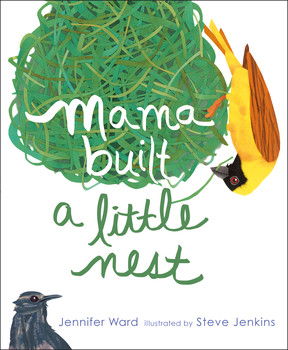
For younger bird lovers, Jennifer Ward has created the lovely Mama Build a Little Nest (Beach Lane Books, 2014). This rhyming book describes how many different species of birds build their nests. Some, like the hummingbird, are “wee and snug,” while others, such as the falcon, scrape “a simple nest/upon a craggy ledge.” Steve Jenkins’ beautiful collages are just right for Ward’s simple, straightforward text. Each page also includes an additional fact about the birds and their habits and a short author’s note provides additional information about nest construction and a list of websites to explore.

If you or your students weren’t bird watchers before, you definitely will be after reading these books. Mrs. Wheaton would have loved them!

Don’t forget to visit Jen at Teach Mentor Texts and Kellee at Unleashing Readers to find out what other people have been reading lately. Thanks, Jen and Kellee, for hosting!

Poetry Friday: A Spicing of Birds

poetry-friday-1-1

One of my earliest memories is finding the remnants of a robin’s egg under a tree in my grandmother’s front yard. When I showed her my treasure, she “oohed” and “ahhed” and told me all kinds of interesting things about robins. 

I’ve been thinking about birds a lot these past few days. Now that spring is finally here, birds start singing in the tree outside my window before my alarm goes off. I don’t know as much about birds as my grandmother did, but they still fascinate me. So yesterday, when I stopped in at the library, my eye was immediately drawn to this book on the new book display shelf:

Schuman comp_final.indd A Spicing of Birds (Wesleyan University Press, 2010) is a gorgeous book. Jo Miles Schuman and Joanna Bailey Hodgman have selected thirty-seven of Emily Dickinson’s poems about birds and paired them with illustrations “by late eighteenth century to early twentieth century artists/ornithologists.” An introduction describes Dickinson as an “intimate of birds;” someone who “observed them closely and knew intimately their songs, habits, and characteristics.” Her poetry is filled with the fruits of her noticings. Here is one of my favorite poems from this lovely collection.

The Robin is the One

That interrupt the Morn

With hurried—few—express Reports

When March is scarcely on—

The Robin is the One

That overflow the Noon

With her cherubic quantity—

An April but begun—

The Robin is the One

That speechless from her Next

Submit that Home—and Certainty

And Sanctity, are best.

Please be sure to visit Jama at Jama’s Alphabet Soup for the Poetry Friday Round Up.

Poetry Friday: “Do You Have Any Advice For Those of Us Just Starting Out?”

poetry-friday-1-1

Although National Poetry Month has officially ended, poetry continues, always waiting for us to pay close attention and find it. For those of us still honing our craft, Ron Koertge has this advice.

“Do You Have Any Advice For Those of Us Just Starting Out?”

by Ron Koertge

Give up sitting dutifully at your desk. Leave

your house or apartment. Go out into the world.

It’s all right to carry a notebook but a cheap

one is best, with pages the color of weak tea

and on the front a kitten or a space ship.

Read the rest of the poem here.

Image by David Castillo Dominici via freedigitalphotos.net

Thanks to Katya at Write. Sketch. Repeat. for hosting the Poetry Friday Round Up. Be sure to stop by to read more poetry posts.


Slice of Life: Caution Thrown to the Wind

11454297503_e27946e4ff_h

“Imagination is the beginning of the cognitive process through which we create meaning.”

Betty K. Garner

One morning last week, I found myself following a builder’s pickup truck on my way to work. A long length of yellow tape was trailing out of the bed of the truck. At first, I was slightly annoyed that this tape was slowing me down, but I became so fascinated watching its gyrations that I was sorry when the driver realized what was happening and pulled over to capture the escaped tape.

Coincidentally, I had just finished reading an article by Betty K. Garner called “The Power of Noticing” in Educational Leadership‘s February 2013 issue on creativity. Garner explains that taking the time to really notice something “supplies the raw material for creative thinking” and that “this kind of cognitive engagement stimulates curiosity and creativity.”  So when I arrived at school, I rushed to my desk and wrote everything I remembered about what the wayward tape had conjured in my mind. Several days and several drafts later, here is a poem I created out of those images.

Charmed by the warmth of the morning sun

and the fresh air filled with bird songs,

a length of yellow construction tape

rises up out of its cardboard home

in the back of a pickup truck

and catches a ride on the breeze.

Dancing down the road,

it undulates like a cobra,

lured out of its basket by the call of a pungi,

waving back and forth,

creating serpentine shapes,

its message of caution

thrown to the wind.

© Catherine Flynn, 2014

Since this is the last Tuesday of National Poetry Month, I hope Mary Lee won’t find this poem’s link to imagination too tenuous and mind if I share it with the readers of her “Our Wonderful World” poetry project.

Thank you, as always, to StaceyTaraDanaBetsyAnna, and Beth for hosting Slice of Life each Tuesday. Be sure to visit Two Writing Teachers to read more Slice of Life posts.