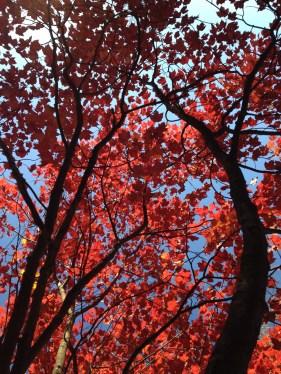
Thursday was a glorious autumn day in Connecticut. The sky was clear blue, and the trees glowed in the afternoon sun. And even though the equinox was a few weeks ago, this poem describes the day exactly.
Please be sure to visit Violet Nesdoly for the Poetry Friday Roundup.
The miracle of a book is a mystery to children. They wonder where books come from. They think authors are, as E.B. White put it, “mythical being[s].” To children, books seem to be conjured out of thin air. Which, in a sense, like a spider’s web itself, they are.
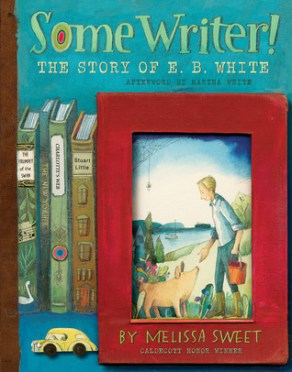
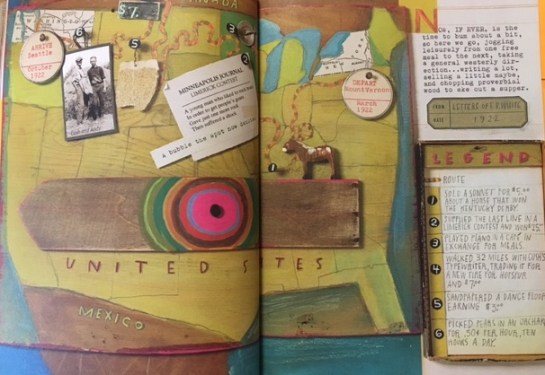
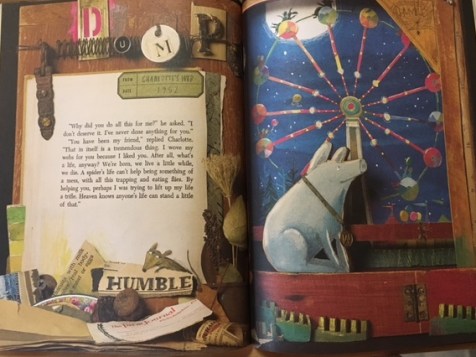
In Some Writer: The Story of E.B. White (Houghton Mifflin Harcourt, 2016), Melissa Sweet has woven a miraculous, magical book that peels back a layer of this mystery to reveal the very human side of one of our most mythical authors, E.B. White.
Sweet’s inviting prose and inventive artwork immediately draw readers into White’s world. The illustrations are a hybrid of photos, collage, and watercolors. Sepia-toned photographs of White with his father and brother in Maine are followed by one of Sweet’s appealing watercolors. White’s own description of the scene, from his 1940 essay, “A Boy I Knew,” is typed out on vintage paper using a manual typewriter, serves as a caption. The effect is beguiling. I wanted to be sitting there “at the water’s edge [on] a granite rock upholstered in lichen.”
Drawing extensively on White’s letters and essays, Sweet takes readers from White’s childhood in Mount Vernon, New York to his death in Maine eighty-six years later. As a boy, he was surrounded by words and discovered at an early age that writing helped him “to assuage my uneasiness and collect my thoughts.” Keeping her text focused on how early events in White’s life impacted his development as a writer and his future work, Sweet helps readers see the roots of Stuart Little, Charlotte’s Web, and The Trumpet of the Swan in his life and his early writings.
White’s early poems and stories were published in St. Nicholas Illustrated Magazine for Boys and Girls. Sweet includes copies of these, giving the book the intimate feel of a scrapbook of a beloved relative. Readers will want to savor every page. Glimpses of White’s masterpieces for children are found throughout his life. Sweet writes about White’s time as a camp counselor at Camp Otter in Canada, and we learn abouthis road trip across the country in a Model T after graduating from Cornell.
Each major work, as well as The Elements of Style, is given its own chapter. We learn of the difficulties White had finishing Stuart Little, the criticism it received from librarians, and the love lavished on it by children. Sweet describes in detail how White’s farm in Maine, his doomed pig, and a spider’s egg sac coalesced into Charlotte’s Web. Sweet’s description, drawing on White’s own words, of how the opening scene of this book evolved is a master class in revision. As every writer knows, “revising is part of writing.” These scenes show how the fantastical elements of White’s fiction are grounded in the real world. As White replied to one of his critics, “children can sail easily over the fence that separates reality from make-believe.”
No detail in the design of Some Writer is ignored: chapter numbers are old typewriter keys, old-fashioned labels are used for page numbers and to identify the essay or letter of White’s that is being quoted. Sweet’s collages are perfect mentor texts for creative ways to convey information.
The publisher lists the age range as 7-10, but middle school readers will also find plenty to be inspired by in this book. All readers and writers have much to learn from E.B. White’s quiet wisdom about writing and life. Interested readers will want to explore the extensive endnotes and bibliography of White’s own work, as well as works written about him. There is a touching afterword by White’s granddaughter, Martha, and notes from Melissa Sweet about her writing process and her art.
Sweet writes with the economy White advocates in The Elements of Style. “Every word tell[s]” a key part of White’s story. She blends her words and her art with White’s words and demystifies the process of becoming a writer… “through hard work and being open to the world around you.”
After White’s death, Roger Angell, William Shawn, and John Updike wrote in his obituary, “White felt it was a writer’s obligation to transmit as best he can his love of life, his appreciation for the natural world.” Sweet’s love of and appreciation of E.B.White, his work, and the natural world shine out from every page of Some Writer. In her author’s note, Sweet quotes White, saying “It has been ambitious and plucky of me to attempt to describe what is indescribable…[But] a writer, like an acrobat, must occasionally try a stunt that is too much for him.” Like Charlotte’s Web itself, Sweet’s “stunt” is nothing short of a miracle.
Review copy received from Houghton Mifflin Harcourt. An Educator’s Guide for Some Writer is available here.
Once again, I’m down to the wire meeting Michelle Heidenrich Barnes’s ditty challenge. This month, Jane Yolen challenged Michelle’s readers to “Write a poem in which reading and or writing is featured in the form of a septercet.” How hard could that be?
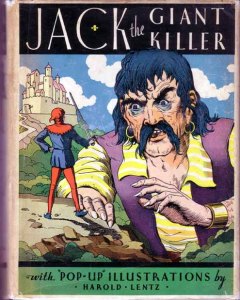
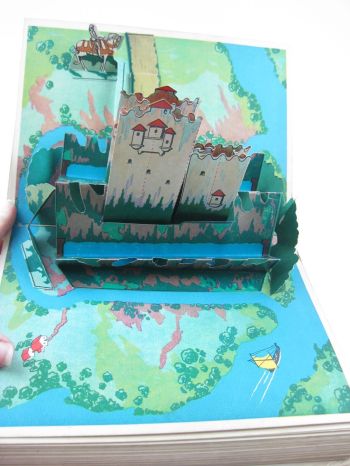
As it turns out, I had a very hard time figuring out my way into this poem. How to narrow down a lifetime of reading and writing? Then, this line, from “Do-Re-Mi” and The Sound of Music came into my head: “Let’s start at the very beginning…” Suddenly, I was on my grandmother’s lap and she was reading Jack the Giant Killer, by Harold Lentz, to me. This book belonged to my uncle when he was little, and it was a favorite of mine and my cousins because of its fabulous pop-up scenes.
Here is a draft of the septercet inspired by this book.
“Sail Away to Fairyland”
Nestled on my grandma’s lap, she opens a book and I’m sailing off to fairyland.
A magic castle rises, princess slumbering within, the prince arrives to wake her.
Turn the page. Red Riding Hood knocks on Grandma’s door. Beware! A devious wolf awaits.
One story ends, another begins. “Fee, fi, fo, fum,” hums a hungry, fearsome giant.
Just in time, Jack saves the day, rescues friends from a sad fate. But Giant, enraged, gives chase,
lumbering down the beanstalk. Will Jack get away? He grabs an axe, chops with all his might. Tales now told, the book is closed.
You know how this story ends. Happily ever after.
Thank you, Michelle and Jane, for sparking this trip down memory lane. Please be sure to visit Karen Edmisten at The Blog With the Shockingly Clever Title for the Poetry Friday Roundup.
This post is part of “DigiLit Sunday,” hosted by Margaret Simon at Reflections on the Teche. Please be sure to visit her there to read more Digilit Sunday contributions.
When Margaret suggested the word agency as our topic this week, my first step was make sure I was using the term correctly. This Merriam-Webster definition confirmed my working ideas about agency:
“the capacity, condition, or state of acting or exerting power”
The next day, a teacher came to me with concerns about one of her students. The teacher felt that Anna (not her real name) wasn’t decoding well or understanding what she read. The teacher had administered a Fountas & Pinnell Benchmark Assessment, which indicated that Anna was reading in the instructional range for her grade level expectation. Because it’s still early in the year, and this assessment had just been done, the teacher really hadn’t tried anything to address her concerns. But it was clear she wanted something specific from me—an intervention, a strategy, anything that might improve Anna’s reading behaviors.
I was at a loss. The information shared by Anna’s teacher was so general, and none of Anna’s previous teachers had ever expressed concerns about her. So I suggested that I come in to visit and read with Anna so I could get to know her better and understand the teacher’s concerns.
Arriving in the classroom during independent reading time, I noted that Anna was intently reading a book that looked like an appropriate choice. I observed her for several minutes as she read. She sub-vocalized in some spots, used her finger to guide her in others, and seemed completely engaged with the book.
After about five minutes, I went over to her and asked her to tell me about her reading. She did a fine job retelling what had happened in the book so far. Then I asked her to read the next page to me. She didn’t hesitate and read the first line fluently and expressively.
Just as I was wondering why there was such a disconnect between what the teacher had observed and what I was seeing, Anna stumbled. “Cloud giants” became “could grants.” This made no sense, and she knew it, so she stopped and looked at me.
Let’s stop for a minute and think about Anna. Everything I had seen suggested that she did have agency when she read. She was reading an independent level text independently and with understanding. She even knew that meaning had broken down for her and she stopped. As we know, many students would have just plowed ahead!
When she said, “that doesn’t make any sense,” I praised her for noticing that and asked her what she could do. She knew that sometimes rereading helped, so she tried that. When that didn’t work, she tried looking for a smaller word she knew. She found “ants” in “giants,” but because she didn’t know (or wasn’t sure about) soft /g/, this strategy didn’t help. I asked her what else she could try, but now she was truly stumped. Her go-to strategies hadn’t helped, and there were no visible supports in the classroom to help her.
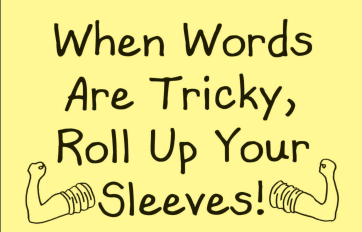
Anna did roll up her sleeves!
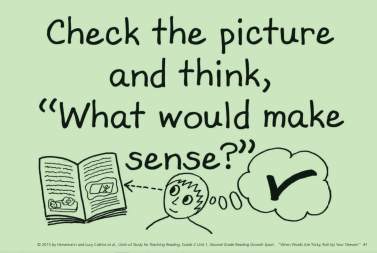
I noticed that the picture held a lot of information that might help her, and she hadn’t even glanced at it. After I reminded her that sometimes readers use the illustrations to help them, she took one look and the light bulb went off. She went back to the text and read it easily. We talked about what she had done to figure out the unknown words, and she told me that using the pictures was a strategy she would use the next time she came to new words.
I’ll talk with Anna’s teacher about using anchor charts to support growing readers.
Now I was feeling a little frustrated. It wasn’t Anna who didn’t have agency. She was doing the best she could with the skills she had. But there were supports that should have been in place for her that weren’t. Where was the anchor chart for this reading unit?And why hadn’t her teacher already had this conversation with her?
I began to wonder if I had provided too many scaffolds for Anna’s teacher in the past. Had I swooped in too quickly when she came to me with questions about students? But isn’t that my job as a literacy specialist?
This is the tip of the iceberg for my work with Anna’s teacher. By sheer coincidence, yesterday I watched Clare Landrigan and Tammy Mulligan’s session about listening to and learning from our students as part of The Educator’s Collaborative’s Online Gathering. (If you missed this, go there now and watch as many sessions as you can.) They confirmed what I had done when I sat down with Anna. “Every single day, when we slow down and get to know the people around us, that’s data.” But sitting down with Anna not only helped me get to know her, it gave me insight into how I can work with her teacher to develop her agency. Watching Clare and Tammy’s session together will be our first step. I anticipate many many follow-up conversations, and I’ll be sharing more about our work together in the future.
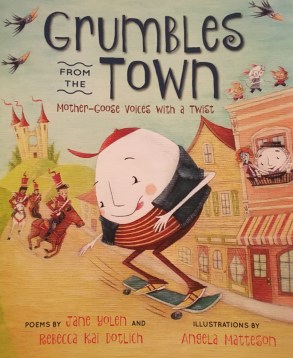
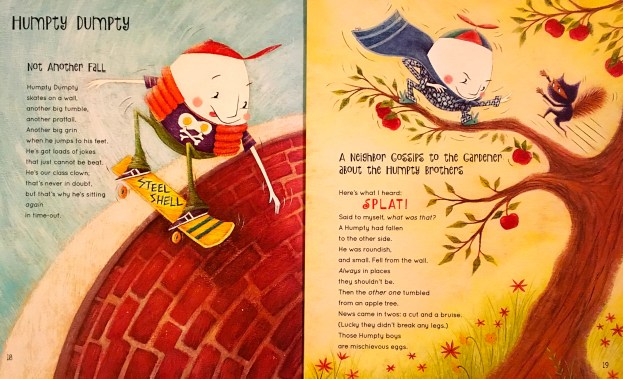
Welcome to the Poetry Friday Roundup! I’m so glad you stopped by. You’re in for a real treat! Not only will you find links to other Poetry Friday posts, I’m thrilled to share poems and illustrations from Grumbles From the Town: Mother-Goose Voices With a Twist (WordSong, 2016), Jane Yolen and Rebecca Kai Dotlich’s hot-off-the-press companion volume to Grumbles From the Forest (WordSong, 2013), with illustrations by Angela Matteson. I was lucky enough to receive an F&G (folded and gathered) of this book when I was at The Highlights Foundation’s workshop, “The Craft and Heart of Writing Poetry for Children” with Rebecca Kai Dotlich and Georgia Heard.
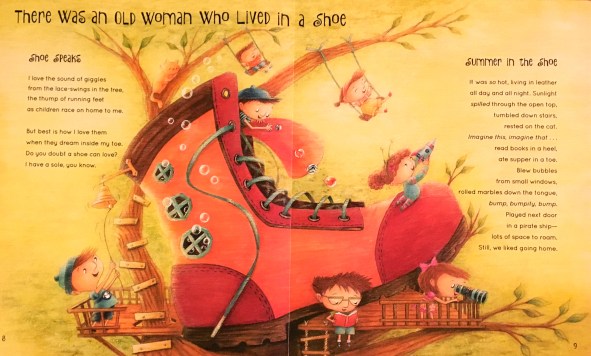
These poems, that “remix old songs anew,” have broad appeal. Jane and Rebecca chose fourteen favorite nursery rhymes and gave voices to objects, (Jack’s plum), real or imagined secondary characters (Old King Cole’s daughter), or let the main character speak for him or herself (the Queen of Hearts). Young readers will love the playful nature of these poems. Older readers will appreciate the wordplay, such as learning that the dog from “Hey Diddle Diddle” always “hated playing second fiddle.” Some of the poems, such as “Not Another Fall,” explore the backstory of the original rhyme. What was Humpty Dumpty doing on that wall in the first place?
“A Neighbor Gossips to the Gardener “Not Another Fall” about the Humpty Brothers”
Angela Matteson’s whimsical illustrations are perfectly suited to these lively rhymes. Her artwork is infused with personality; who wouldn’t want to live in this shoe?
Grumbles From the Town also includes the texts of the original nursery rhymes, and I appreciated the fascinating end notes about the origin of each rhyme. The roots of some rhymes have been lost to history, but in most cases the background includes stories that are always interesting, if not always child-friendly.
This collection is a must-have for all elementary classrooms. Students of all ages will enjoy exploring point-of-view through these poems, and the opportunities for children to write their own nursery rhymes “with a twist” are endless! In addition, the possibilities for lessons about vocabulary and word choice abound. But the best reason for sharing this book with children is that these poems are fun to read and full of humor. Thank you, Jane, Rebecca, and Angela for so generously sharing your work today!
It’s been quite a challenge to re-enter the real world after spending four glorious days at the Highlights Foundation last week. I had to pinch myself more than once to make sure I was really there, learning about “The Craft and Heart of Writing Poetry for Children” from Rebecca Kai Dotlich and Georgia Heard. I’ve loved the work of these two wise and witty poets for years, so being at this workshop was a real thrill.
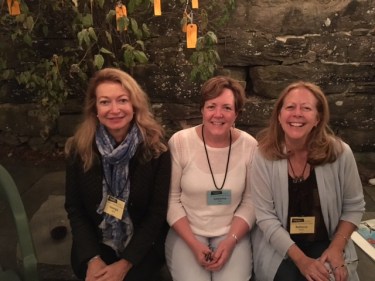
My time at Highlights was made even more special because I got to spend time with fellow Slicer Linda Baie. (Read her thoughts about the workshop here.) Poetry Friday pals Robyn Hood Black, Buffy Silverman, Linda Kulp Trout, and Charles Waters were also there, and it was wonderful to meet so many other talented and passionate poets from around the world.
We were immersed in poetry day and night. Everyone shared their own original poetry as well as poems by favorite poets, including several classics by Georgia & Rebecca. Lee Bennett Hopkins visited with us via Skype, sharing his insights and preferences about poetry. “I want children to read poetry that shows them the beauty of the world,” he explained.
WordSong editor extraordinaire, Rebecca Davis, joined us to answer our questions about publishing poetry and to give us a sneak peak at Georgia’s collection of animal poems for two (or more) voices, that will be published in a few years. We were also treated to a preview ofRebecca’s (Dotlich, edited by Davis) new book with Jane Yolen, Grumbles From the Town. (More about this on Friday.)
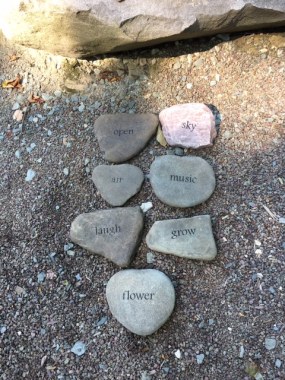
And, of course, we wrote poetry. Rebecca and Georgia led us through a variety of exercises each day. My favorite was “The Art of Observational Poetry.” During this exercise, we carefully examined a small stone, first listing our scientific observations about color, shape, texture, and so on. Then we turned those observations into something more poetic. As Georgia explained, “looking carefully and translating your observations into language is the work of a poet.”Suddenly, my small stone was an asteroid, cratered and misshapen, tumbling through the universe, until the hand of a child plucks it out of its orbit and clutches it close.
It’s not a poem yet, but it has possibilities. Thanks to my new “poetica friends,” I am inspired to “follow the thread” of these words and find the door into their poem.
Thank you to Stacey, Dana, Betsy, Beth, Kathleen, Deb, Melanie, and Lisa for creating this community and providing this space for teachers and others to share their stories each Tuesday. Be sure to visit Two Writing Teachers to read more Slice of Life posts.
When you are already here
you appear to be only
a name that tells of you
whether you are present or not
and for now it seems as though
you are still summer
still the high familiar
endless summer
yet with a glint
of bronze in the chill mornings
and the late yellow petals
of the mullein fluttering
on the stalks that lean
over their broken
shadows across the cracked ground
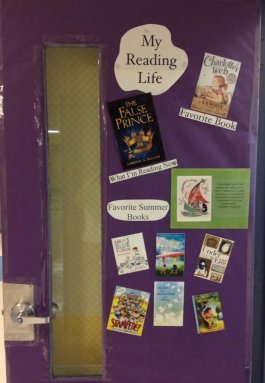
As a literacy specialist, I wear my love of reading on my sleeve for all to see. Or on my door. Donalyn Miller shared her idea for a Reading Life door several years ago, and I’ve been creating them ever since.
My Reading Life, August, 2014 Edition
Until now. Over the summer, I moved into a new room. My old door was perfectly placed for third, fourth, and fifth graders to see everyday. Kids often stopped to study the book covers or ask me about a title.
Now I have three roommates, so the door isn’t just mine. Also, it faces a wall, so it could only be seen if the door was closed, which it never is.
I’m sure there is another way to create a Reading Life display, but I haven’t figured it out yet. (I’m still unpacking all my books!) In the meantime, here’s a virtual door I created in Canva.
What would be on your Reading Life display?
Thank you to Stacey, Dana, Betsy, Beth, Kathleen, Deb, Melanie, and Lisa for creating this community and providing this space for teachers and others to share their stories each Tuesday. Be sure to visit Two Writing Teachers to read more Slice of Life posts.
In a note to readers, Jenni Holm explains that when her son was old enough to read Turtle in Paradise (Random House, 2010), “he wanted to know more about Turtle’s sharp-tongued cousin Beans.” He told her, “Beans needs his own story.”
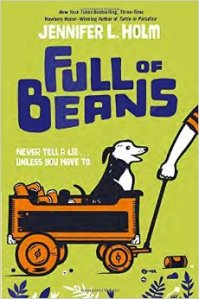
Thankfully, Jenni Holm agreed and has served up Full of Beans (Random House, 2016), a rich, rewarding novel for middle-graders that grapples with hard questions about right and wrong.
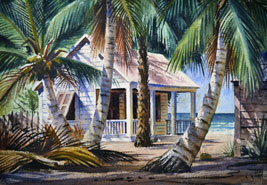
Beans Curry’s authentic voice leaps off the page from the first sentence: “Look here, Mac. I’m gonna give it to you straight: grown-ups lie.” It is 1934 and the Depression has hit Key West hard. Work is scarce, and Beans is doing everything he can to help his family survive. After he and his younger brother, Kermit, are cheated out of money for cans they’ve collected, Beans can’t resist the lure of a job from Johnny Cakes, Key West’s resident gangster.
But even though he tries to hide the fact, Beans is really “a good boy.” Whether he’s helping his mother deliver the laundry she takes in or watching his kid brothers, everyone knows they can count on Beans. So when his work for Johnny causes harm to his friend Pork Chop’s family, Beans feels “like a criminal.” Desperate to redeem himself, Beans learns some hard lessons about telling the truth, being a friend, and doing the right thing.
Holm does a masterful job of bring Key West of the 1930s to life. Local and historical details are expertly woven into Full of Beans. There are references to the Depression, WPA artists painting tourism posters, even Key West’s “resident writer.”
Along with Turtle in Paradise, Full of Beans is a great book club choice for 4th, 5th, or 6th graders studying theme, character, or author’s craft. It’s also a great choice to read for fun. And because Full of Beans is a prequel to Turtle in Paradise, you don’t have to read Turtle’s story first.
Full of Beans is full of humor, full of hope, and, most importantly, full of heart. Beans Curry is a character you won’t soon forget. And that’s no lie.
This post is part of “DigiLit Sunday,” hosted by Margaret Simon at Reflections on the Teche. Please be sure to visit her there to read more Digilit Sunday contributions.
When Margaret posted this week’s topic for #DigiLit Sunday, I groaned. Where to begin with the word motivation?
I started jotting my thoughts as they came to me. My list looked something like this:
Love motivates us to do things for others.
A sense of accomplishment can motivate us to do things.
What about desire? What role does this play?
People are motivated to learn about and do things that are interesting to them.
None of this helped me narrow this topic down. I could think of personal examples for each point on this list, but I was curious about how these feelings work in the classroom. I had some examples from my own teaching experience, but I didn’t want to write only about anecdotal evidence.In The Journey is Everything (Heniemann, 2016), Katherine Bomer advises writers to “Read, watch, and listen. All types of texts—books, movies, art, music, Ted Talks—provide inspiration as well as actual content for elaborating essays.”
Sure enough, a quick Google search brought me to Daniel Pink’s Ted Talk on motivation. After about fifteen minutes of describing why carrot and stick approaches to motivation don’t work for “definitional tasks of the 21st century,” Pink went on to explain that intrinsic motivation is the best way to ensure high performance on creative, cognitively demanding tasks. Pink stated that people are motivated when they “desire to do things because they matter, because we like it, because they’re interesting, and because they’re part of something important.”
He went on to list three factors critical to intrinsic motivation:
autonomy—the urge to direct our own lives
mastery—the desire to get better and better at something that matters
purpose—the yearning to do what we do in the service of something larger than ourselves
I was struck by the similarities between what I wrote on my initial list and the three factors Pink describes as necessary for intrinsic motivation. And although Pink was looking at these elements in terms of business, their application to the classroom is obvious.
My students are always more motivated to read a book they have chosen, even if I limit their choice by giving them two or three options. Writing stories and essays about self-chosen topics is a much richer learning experience because the subject is meaningful to the writer.
The importance of students setting their own learning goals is not a new idea. But I know I need to do a better job at facilitating this process with my own students. Again, we can guide students through this process, even if we give them two or three goals to choose from.
Finally, giving our students a sense of purpose, of working toward “something larger than ourselves” is highly motivating. In the weeks after 9/11, I wanted to find some way to involve my 3rd grade students in efforts to help the families of the victims of the attacks. We ultimately designed and created an afghan that was raffled off. We donated the money raised to a fund for victims’ families. The kids were proud of the fact that they were contributing, and many even wanted to learn to knit so they could help with that part of the project.
So much has been written about motivation that it would take a person years to read all the articles and books that have been published recently. But motivating our students is arguably the most important part of our job. So thank you, Margaret, for selectingmotivation as our theme this week. It’s been helpful for me to examine my own thoughts about motivation and do a little research on the subject. I also found at least two books I’ve been meaning to read right on my bookshelf about this very topic. Now I’m motivated to start reading them today!







 Reading to the Core