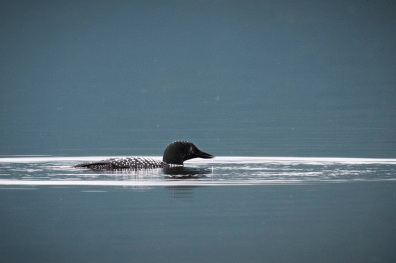
At night in the cabin loft, I lie still as the wind whispers through the pines Now and then a loon cries out from across the lake, or an owl announces himself from deep in the timber.
Beneath these night noises, water laps at the rocky shore slish slosh, slish slosh. Their steady melody lulls me to sleep.
The world will always serenade those who take time to listen.
This morning I came across a Facebook post from Audubon Alaska about their Bird Poetry Corner. How had I missed this? They have had a new prompt each week in April. Now I have a prompt the last five days of National Poetry Month! Today’s poem is my response to Week Four:
Below you’ll find a list of words that relate to nature. These words are your poetry prompts this week. You can use these prompts in several different ways: You can choose a single word and build a poem around it as a topic. You can choose a handful of words (about five would be good) and use those words to kick off different lines or verses. Or you can challenge yourself to write a single poem with all of the words included in it.
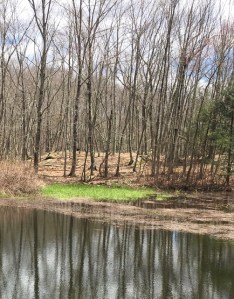
There is a pond in the woods behind our house. It knows how to take care of itself, and we let it. We do try to keep a path cleared so we can walk down the hill and see what’s going on. Over the past few weeks, I’ve observed at least eight ducks living there. They inspired this poem.
A Paddling of Mallards
This spring, a paddling of mallards has moved in on the far side of the pond. They stay concealed, bobbing behind a bloom of bright green pond grass.
I approach the pond on tiptoe, careful not to step on a fallen branch that will snap and startle them.
They sense my presence anyway. Before I can blink, they launch into the sky, seeking refuge in the trees.
I sit on a rock, quiet and still, hoping they will return. Other birds, red-wings and sparrows, tolerate me. Soon, the air is filled with their song. But the mallards stay away.
I sigh, rise, and trudge back up the hill. I want them to come back to their hidden nests. I imagine feather-lined depressions of twigs and leaves, filled with eggs, harbingers of hope.
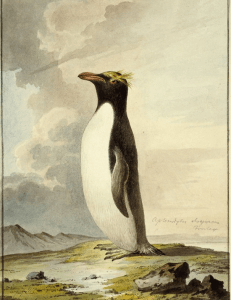
It’s World Penguin Day! What better day for a poem about penguins? I sometimes write acrostics to gather words and ideas for topics, but today I decided that I liked this acrostic well enough to share today.
Penguins promenade over a barren landscape of ice. Elegant in black and white, they Never fly. Instead when it’s time to eat, they Glide gracefully through their frigid Underwater hunting grounds, feasting on krill. Indulging until full, they return to rocky Nests to lay an egg. And So the world begins anew.
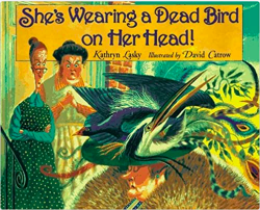
When I taught third grade, She’s Wearing a Dead Bird on Her Head, was one of my favorite pictures books to share with my students. They were shocked at the cruelty of birds being killed so women could have fancy hats. The book tells the story of Harriet Hemenway who, with her cousin Minna Hall, helped launch the Massachusetts Audubon Society. They were part of a larger movement that began in the late 19th century to protect birds and stop their wholesale slaughter in the name of fashion. Florence Merriam Bailey was another fierce advocate for the birds, and wrote one of the first field guides to American birds, Birds Through an Opera-Glass. This poem, which is still very much a draft, is a tribute to these determined women.
In the 1890s, feathered hats Were all the rage. Ladies wore them everywhere: To parties, parks, the stage.
Some women were revolted, They knew that it was wrong To kill quails and loons for fashion. Let them sing their song!
Harriet, Minna, Florence, too, Spread word throughout the land. Stop this ghastly craze, they cried. Save snowy egrets! their demand.
They rallied all their friends, They sounded the alarm. Taking feathers to festoon your head Does hummingbirds great harm.
Soon laws were passed and habits changed. Flamingos and pheasants protected. People still think birds are beautiful, But not to be collected.
Yesterday was the 50th anniversary of the first Earth Day. As sometimes happens, even in quarantine, the day got away from me. Meetings lasted longer than expected, with little time left to devote to writing a poem worthy of the occasion. And although it’s important to have a day set aside to call attention to and raise awareness about our one precious Earth, every day is Earth Day for me.
An Earth Day ABC
An atlas of the world can’t Begin to reveal the Complexity of connections, the Diversity of life on Earth. For centuries, curious humans have Grappled with questions, searching across Hemispheres, seeking Insights into our home, finding pieces of the Jigsaw puzzle, gaining Knowledge and Learning the lessons Mountains teach us. The earth Nurtures and nourishes us. We are Obligated to Protect her, preserve her. Our reckless Quest for riches is irresponsible. Actions Ripple across the globe, casting Shadows on life everywhere. Today and everyday, seek to Understand the Vulnerability and vitality of our Wondrous world. eXchange hubris for humility. Change begins with You. Zoom in and discover nature’s abundant gifts.
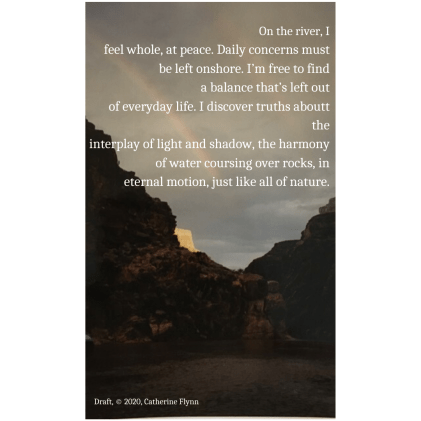
Today’s poem is a Golden Shovel. My strike line was taken from the writings of Alexander von Humboldt, considered by many to be the father of modern environmentalism. It is fitting that the Smithsonian has mounted a exhibition about Humboldt’s impact on art, nature, and culture in the United States during this fiftieth anniversary year of Earth Day.
In addition to being an intrepid explorer, von Humboldt was a prolific writer, writing more than 36 volumes. His work influenced the thinking of Thoreau, Darwin, and John Muir, among others. It seems appropriate to remember and honor him this week.
The line I chose to work from is from a letter von Humboldt wrote in 1799:
I must find out about the harmony in nature.
This poem turned into something a little more personal than I expected, but we don’t always know where we’re headed when we start out.
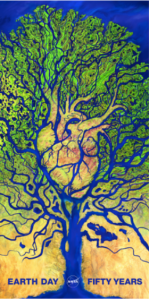
This week marks the 50th anniversary of Earth Day, so I spent some time delving into the many resources available online. NASA’s Global Climate Change initiative has many resources, including this stunning poster created by Jenny Motter, art director for NASA Science. In a video explaining how she created this year’s Earth Day poster, Ms. Motter explained her process and inspiration. She mentioned the work of James Hutton, the father of modern geology.
I wasn’t familiar with Hutton, so I read some short bios of him and looked up some quotes. In his work, Theory of the Earth, Hutton states
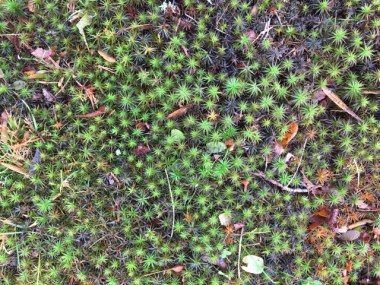
To a naturalist, nothing is indifferent; the humble moss that creeps upon the stone is equally interesting as the lofty pine.
To the poet also. Hutton’s mention of the “humble moss” reminded me of a poem I wrote a few months ago but never shared. Today seemed like an appropriate time. Coincidentally, like yesterday’s poem, this is also a Fib.
Crowns of Moss
green crowns unfurl, burst skyward bedecking the ground brightening shadowy spaces
Today’s poem is a Fib, or Fibonacci poem, a poem that follows the Fibonacci sequence to determine the number of words, or in this case, syllables in each line of the poem. I worked out to eight syllables, then repeated the sequence backwards, ending with a single word. The idea for today’s poem came from “Propagation,” an essay by Naomi Huffman, in this week’s New York Times Magazine. You can read more about the real begonia in the poem here.
Propagation
From one plant, a begonia cared for through the years by grandmothers, aunts, and nieces, nurtured cuttings sprout roots in jars heart-shaped leaves bloom: a new cycle of green life is born.
For this week’s challenge, I’ve selected “Into the Future: Take Yourself There Now” (Chapter 53) from Part III of My Shouting, Shattered, Whispering Voice. Patrice writes:
Is the future a place you wish you could arrive at now? I remember feeling that way.Or maybe here and now is fine. For the length of a poem, venture into that place called future, as you imagine it; peer into its unknown terrain, and see what you find.
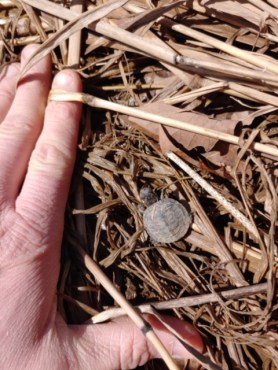
As some of you may know, I have an eleven-week old granddaughter. Fortunately, I was able to visit her in February before we all had to stay home. But of course I’m anxious to see her again. Her father, my son, recently sent me a photo of a baby turtle near the pond in their yard. This poem imagines a future visit to the pond with my granddaughter.
Someday soon I’ll take your hand and we’ll walk to the pond.
Careful where you step! A baby turtle, no bigger than a quarter, is lumbering toward the pond, too.
When he arrives, he’ll slip into the water to forage for algae and insects.
When we arrive, we’ll sit on the bank keeping our eyes peeled. Maybe he’ll climb onto a log to bask in the warm sun after his meal.
Or maybe a heron will alight on the pond’s far edge, where the brook flows in. You’ll grow restless as she tiptoes on her stick-like legs, uncurling her slender neck, thrusting her bill into the murky water, aiming for a fish.
Time for lunch? you wonder. Time for lunch, I nod.
Welcome to the Poetry Friday edition of News From the Natural World, my National Poetry Month project. Be sure to visit my friend and critique group partner, Molly Hogan, at Nix the Comfort Zone for the Poetry Friday Roundup.
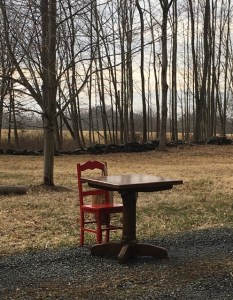
Today’s poem was inspired by the photo below, taken on March 20th, just after our quarantine began. I was quite surprised to see this at the end of a driveway I pass by when I go out for a walk. I still have no idea why it was there, but I knew immediately that I had to write about it. However, finding the right form wasn’t easy.
Yesterday, poet, teacher, and mentor extraordinaire, Georgia Heard, posted this video on Facebook. The poem she shares, “Where Do I Find Poetry,” is one of my favorites. As soon as she started reading it, my mind went back to this red chair and I knew I’d found a way in. A greeting card by British artist Rachel Grant provided me with the first line. Thank you to the owner of the red chair, Georgia, and Rachel, for helping me with this poem.
The Red Chair
It begins here, in a red chair at the edge of a field still wearing its stubbly brown winter coat.
Sit. Be patient… Watch the last bits of snow dissolve into the quickening earth. See grass slowly turn green and vermilion tips of peonies poke their heads up through the softening ground.
Stay a while. Soon robins will be cruising the field searching for fat pink worms and tufts of dried grass to line their nests.
Feel March winds ease into warm April breezes that coax daffodils and dandelions to shine like a thousand suns under spring’s clear blue sky, and seep into your winter-weary soul.

 Reading to the Core