The days are beginning to lengthen, but the gloom of this Covid Christmas is hard to ignore. As always, I turn to favorite authors and nature to escape. This week, on her re-christened website, The Marginalia, (formerly Brainpickings) Maria Papova shared excerpts and insights from Antonio Damasio’s book, Feeling and Knowing: Making Minds Conscious. Papova’s essay delves into Damasio’s fascinating theories about the interplay between consciousness and feelings. I was struck by this quote:
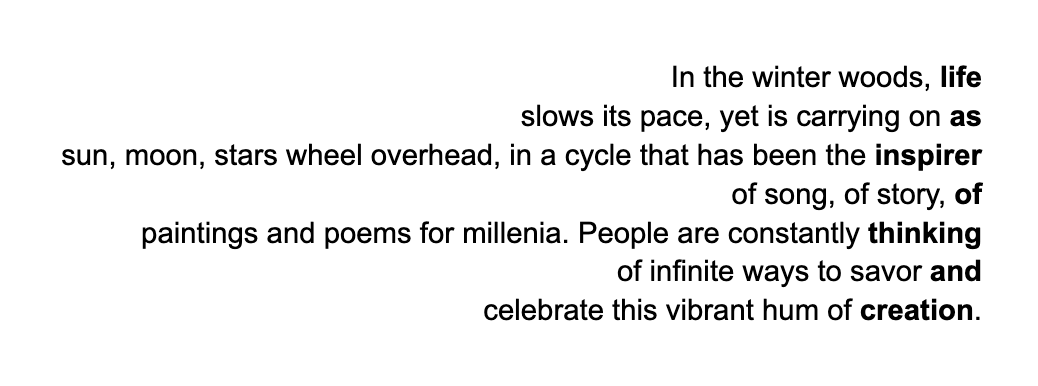
What is more impressive than the entire universe is life, as matter and process, life as inspirer of thinking and creation. Antonio Damasio
I decided that the last few words made a good strike line for a Golden Shovel to ring in the new year.
I wish you all peace, health, and joy and many opportunities to celebrate the vibrant hum of creation in the coming year. Please be sure to visit Carol at Carol’s Corner for the final Poetry Friday Roundup of 2021.
It’s the first Friday of the month, so it’s time for another Inkling challenge. This month, Molly challenged us to “Pick a poetry form you’ve been wanting to try and haven’t, and dive in! Here are a few that I’ve been wanting to play around with:: Clogyrnach and Rondelet (thanks and thanks, Alan!), and Tricube (thanks, Matt!), and Magic 9 , Feel free to choose any form you’d like., or more than one.. No pressure. Just play!”
I decided to play with a Tricube. This form sounds straightforward: three stanzas with three lines, each line with three syllables. As Matt mentioned in his original post, though, the trick is getting “what you’re trying to say in that tiny space!”
After many false starts and playing with many different ideas, this is what I came up with.
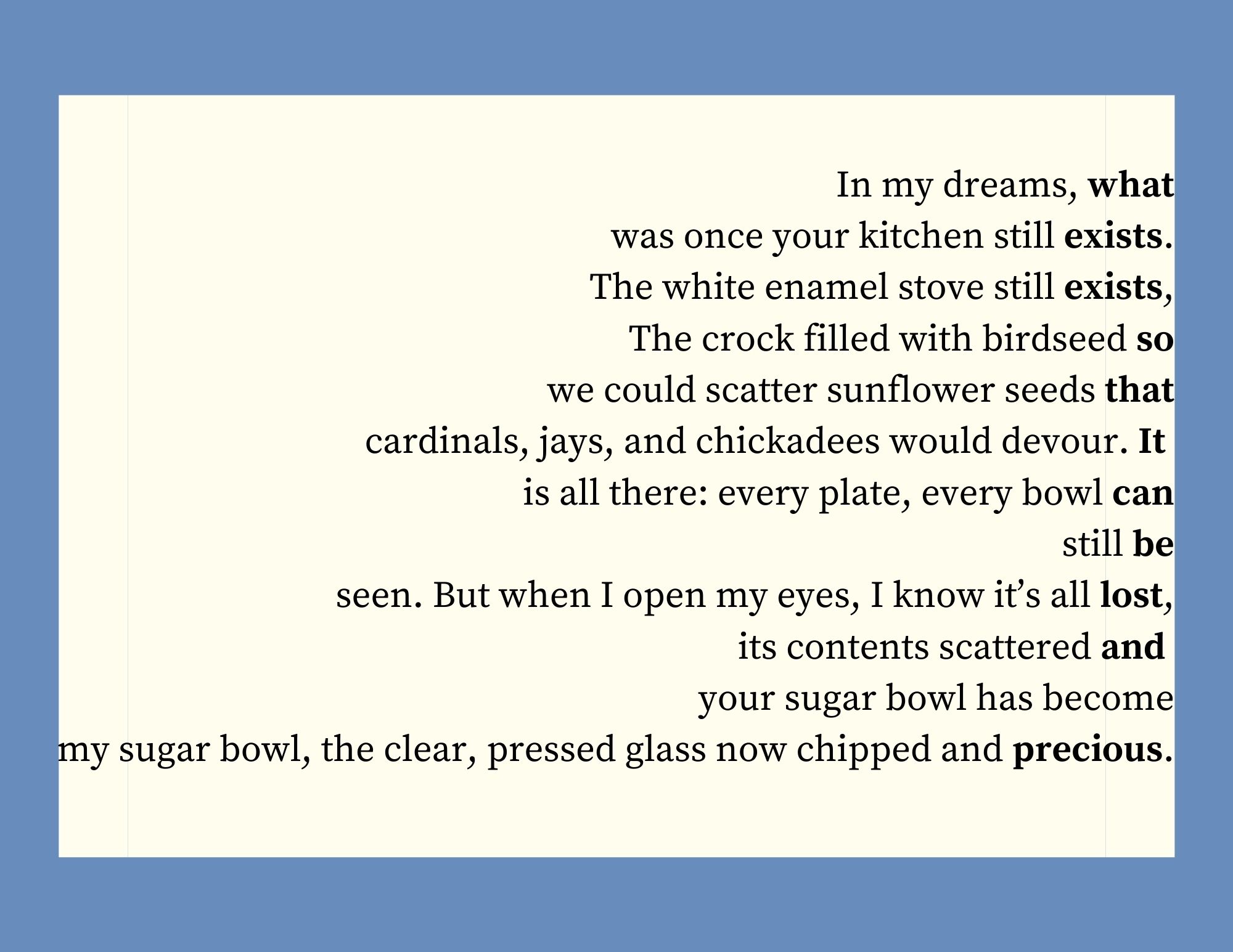
“What exists, exists so that it can be lost and become precious.” ~ Lisel Muller ~
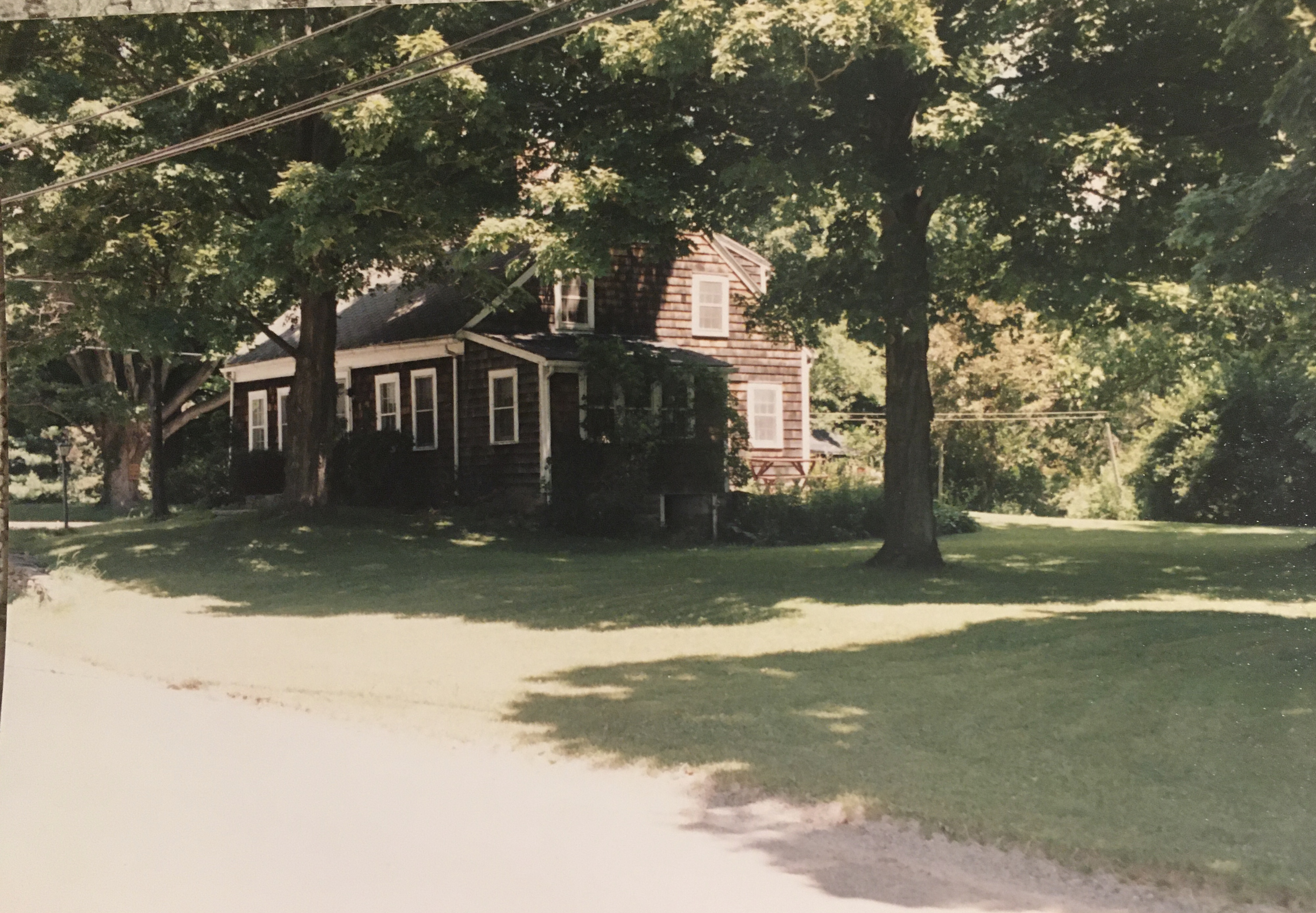
Earlier this week, I found myself standing in the kitchen of my grandmother’s house. I grew up next door to her and spent countless hours with her there. When my grandmother died, her house was sold and the new owners renovated the house. What now stands on that corner is almost unrecognizable, both inside and out. It was a bit surreal to be in a place that was once so familiar but is now utterly foreign. Right after this experience, I came across the above quote on The Marginalia (formerly Brain Pickings) and this Golden Shovel basically wrote itself.
This month, Linda challenged the Inklings to write “write a poem that includes the idea of percentage./percent. Percentages are all around us in recipes, prices, assessments, statistics. Include the idea of percentage in your poem.. In some way.”
During the approximately 1% of my life that I could actually sit down and write last month, I had an idea about writing a series of pi poems–poems using the sequence of pi (3.14159…) for either the word count or syllable count per line. This idea was a bit misguided, as I thought pi was a percentage. In fact, as Mary Lee reminded me, it is a ratio. Math was never my strongest subject.
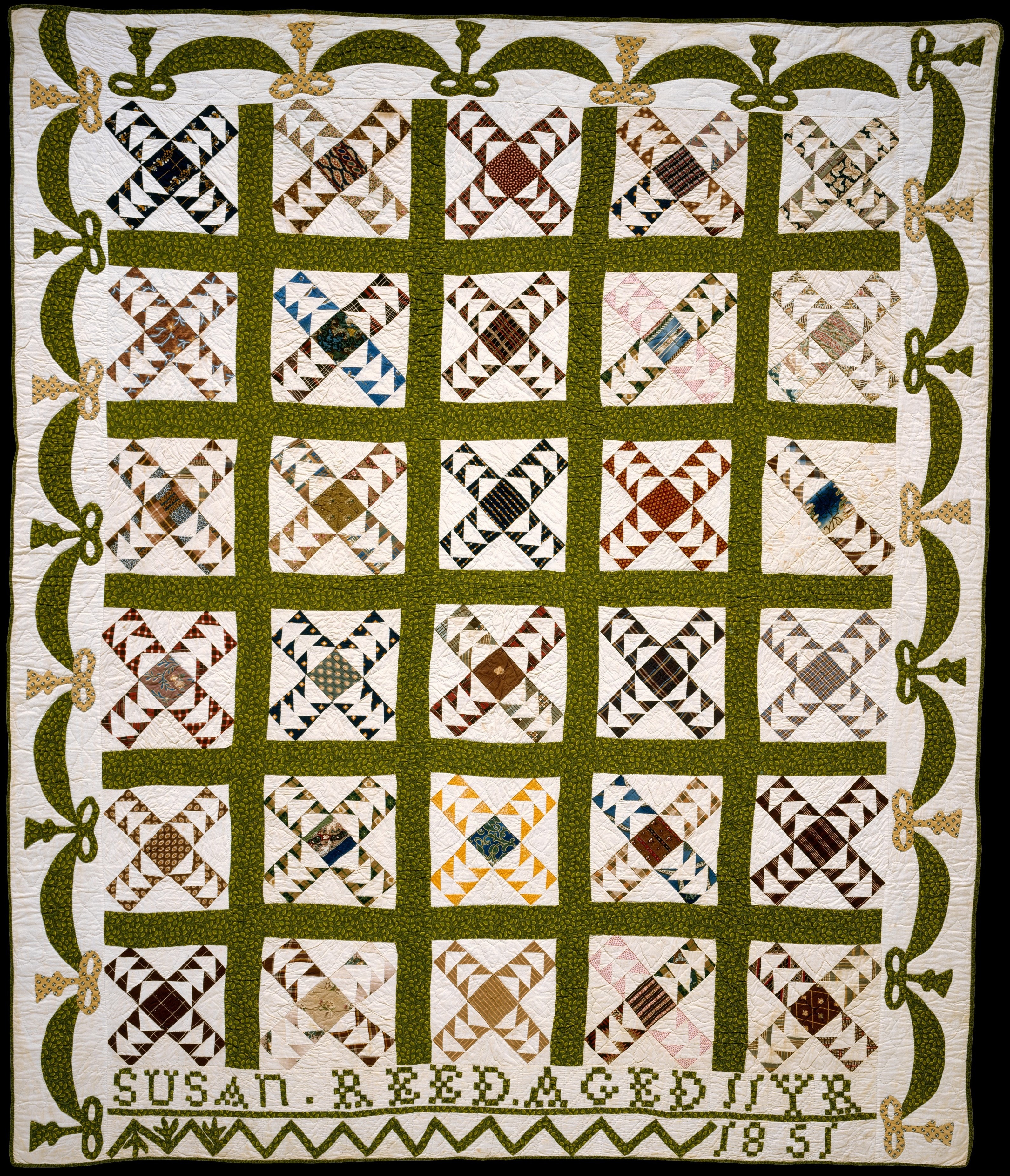
Linda also inspired me with her brilliant idea to write to the #inktober prompts using images she found on Wikiart. There were several similar prompts on Instagram last month, including #theydrawtober and #birdtober, where “Goose” was the bird listed one day. Search results on Wikiart didn’t appeal to me, so I checked Google Arts & Culture, where I found this stunning quilt:
I come from a long line of quilters. Once upon a time, I had grand ambitions of creating my own quilts. Now I write poems instead. (The similarities between the two arts are not lost on me; maybe I’ll write about that one day.) Here is the poem that emerged from this jumble of thoughts.
Fat quarters nestle, forgotten in a dresser drawer hoping to be released, snipped, stitched, flocked, then sent off on a wild goose chase.
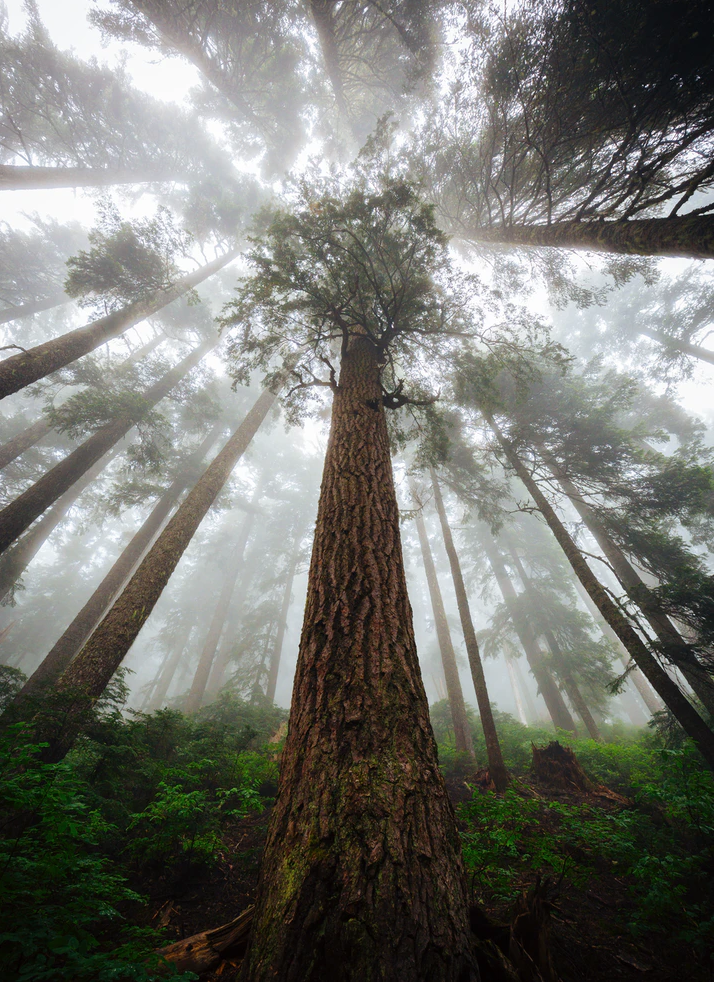
To every year the trees grew without us noticing. Hannah Marshall
In the introduction to The Best American Poetry 2021, Tracy K. Smith states that “the best poems of 2020 reached me as offerings of desperately needed hope and endurance.” She goes on to say that “the best poetry to emerge during a bitter year sprang from whatever else was indispensable to sustenance, peace of mind, justice, and healing at the time.”
Indispensable to sustenance.
That we are still in search of “desperately needed hope and endurance” is enough to drive one to despair. And yet.
One of the poems included in this year’s collection is “This Is a Love Poem to Trees,” by Hannah Marshall. I couldn’t find Marshall’s poem online, but I encourage you to seek it out. Trees have sustained me in countless ways, not just over the past twenty months, but throughout my entire life. Here are two haiku, love songs to two of my favorite trees.
late afternoon light leaves dappled amber and gold sips of sustenance
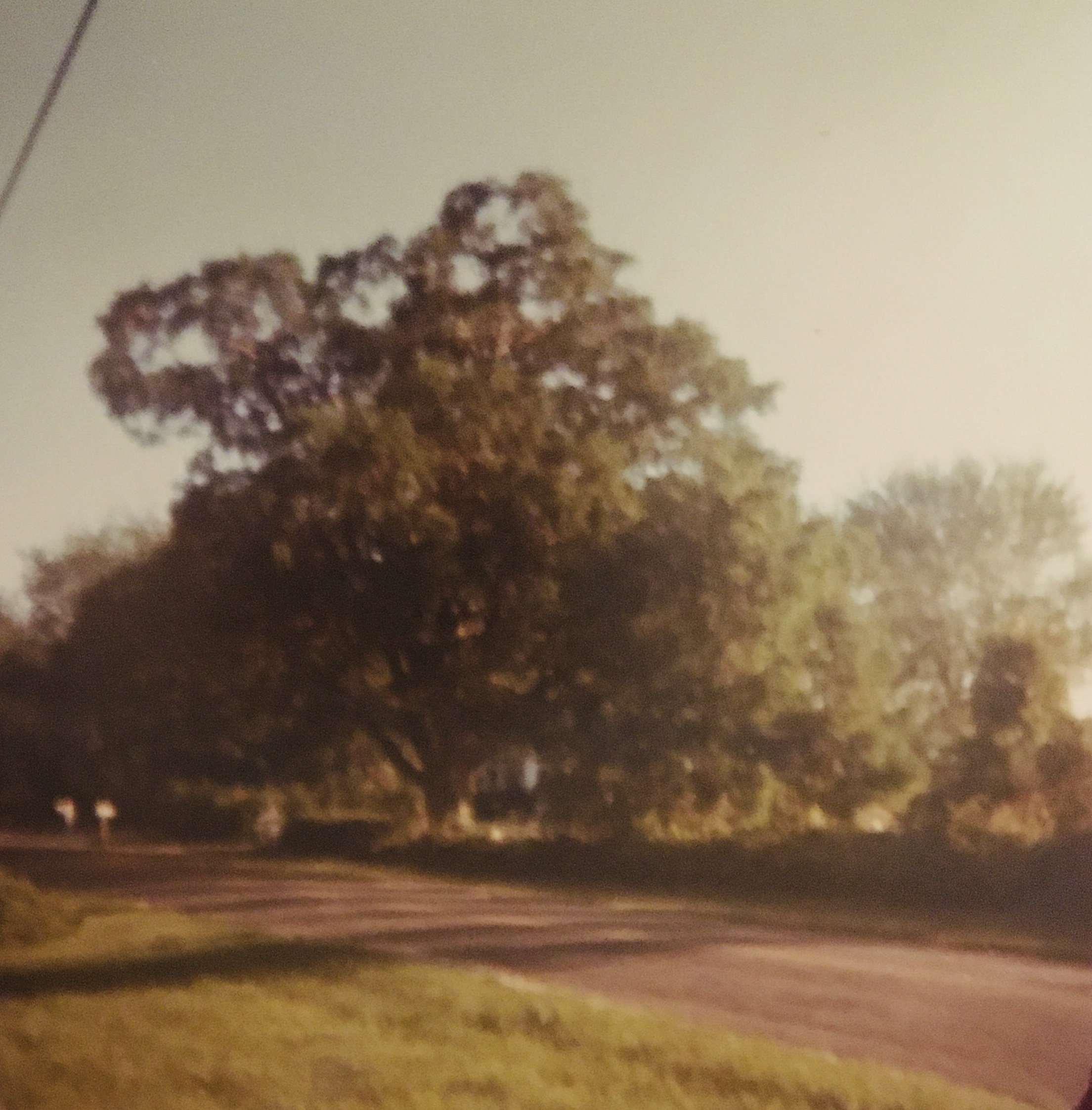
crowned in green cumulus puffs, maple bears witness the world barrels past
Maple in my childhood neighbor’s yard, as seen from the end of our driveway.
Welcome to the Poetry Friday Roundup! (Find our more about Poetry Friday in this post by Renée LaTulippe here.) I’m happy to welcome you all on this first day of one of the loveliest months. As Anne declares, in Lucy Maud Montgomery’s Anne of Green Gables, “I’m so glad I live in a world where there are Octobers.” It’s also time for another Inkling challenge. This month Mary Lee challenged the Inklings to
Explain a poetry term (simile, metaphor, allegory, allusion, etc) in a poem that makes use of that term. OR tell how to write a poetry form (ode, elegy, sonnet, limerick, etc) in that form.
As usual, I wrestled with choosing a topic/form for most of the month. Finally, I decided to write an abecedarian, a poem in which the first line begins with the letter A and the following lines begin with each successive letter of the alphabet. Although it can be tricky to get everything to make sense, these these poems are fun to write. Also as usual, my poem doesn’t follow Mary Lee’s instructions exactly, but I enjoyed the process. Because it’s a most magical month, and poetry is its own kind of magic, I tried to include as many magical words as I could without things feeling forced.
Poetry Primer–An Abecedarian
Assemble ingredients: feelings, ideas, words. Let them Bubble and steep in the Cauldron of your mind. Cultivate curiosity. Delve deeply into subjects. Keep your Eyes open for easily overlooked Features, subtle details, Gifts from the world for you to discover. Hear the heartbeat of your poem. Infuse each line with rhythm, Jazzy words, quiet words, Kernels of hard-won wisdom. Listen. Magic happens when we grow quiet. Nature’s secrets whisper, Open before us, like light Passing through a prism, Quintessence Revealed. Sing a celebratory incantation that Transports us, Uncovers, through Verses luminous with Wonder and memory, a place where we eXperience Yūgen, that elegant mystery, that elusive Zone we’re constantly seeking.
Several years ago, a group of Poetry Friday friends began writing a haiku a day as a distraction from the chaos swirling around us. Maybe it’s a good thing we didn’t know then just how chaotic the world would become. I’m still seeking solace in small wonders, what Natalie Babbitt, in The Search for Delicious, described as “those commonplace marvels which [the world] spreads so carelessly before us every day.” Here are two haiku celebrating some marvels I noticed this week.
notes of moonsong stream crickets hum in harmony lost summer’s lament
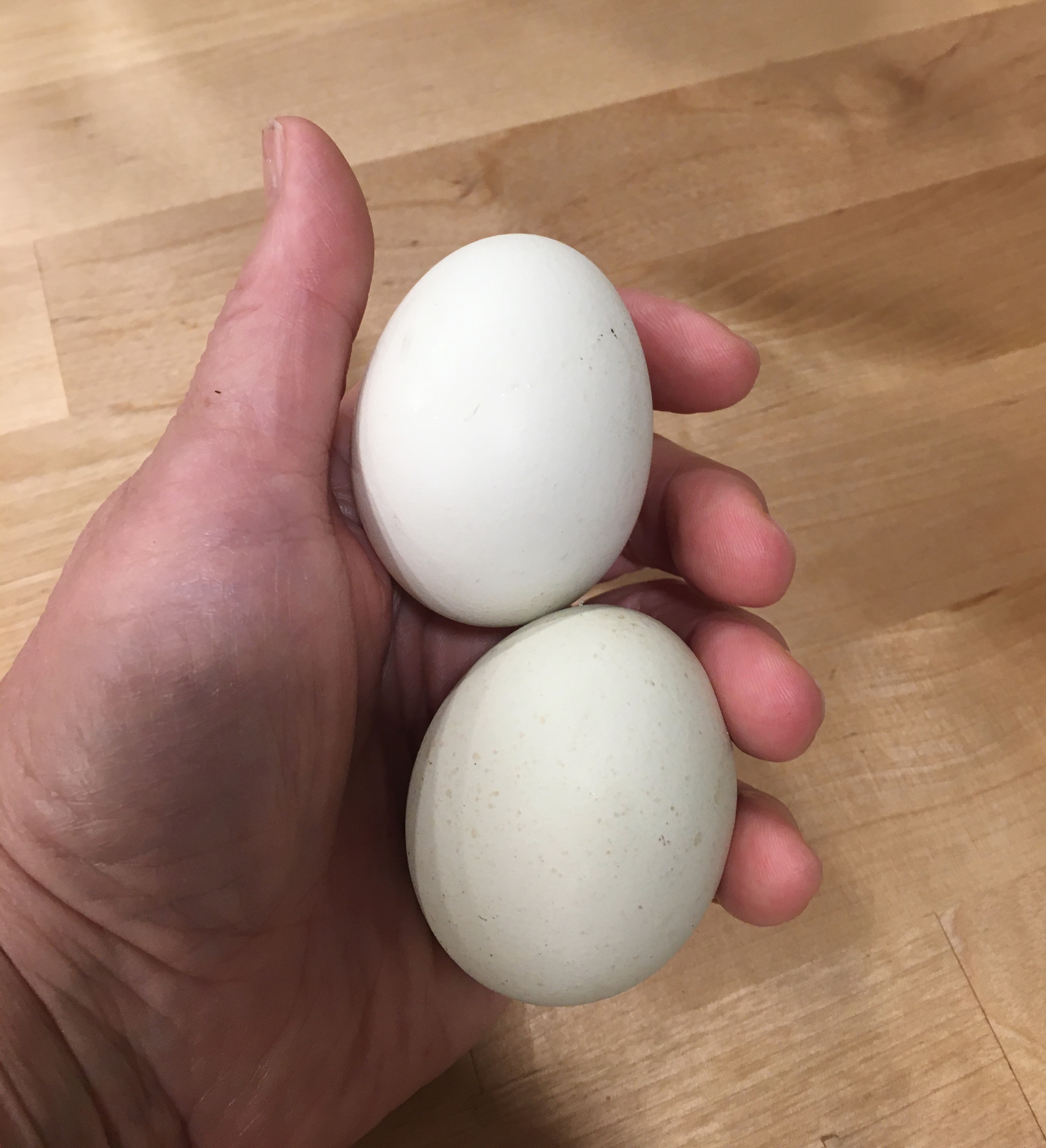
bountiful harvest a pair of sky blue eggs gleaming suns inside
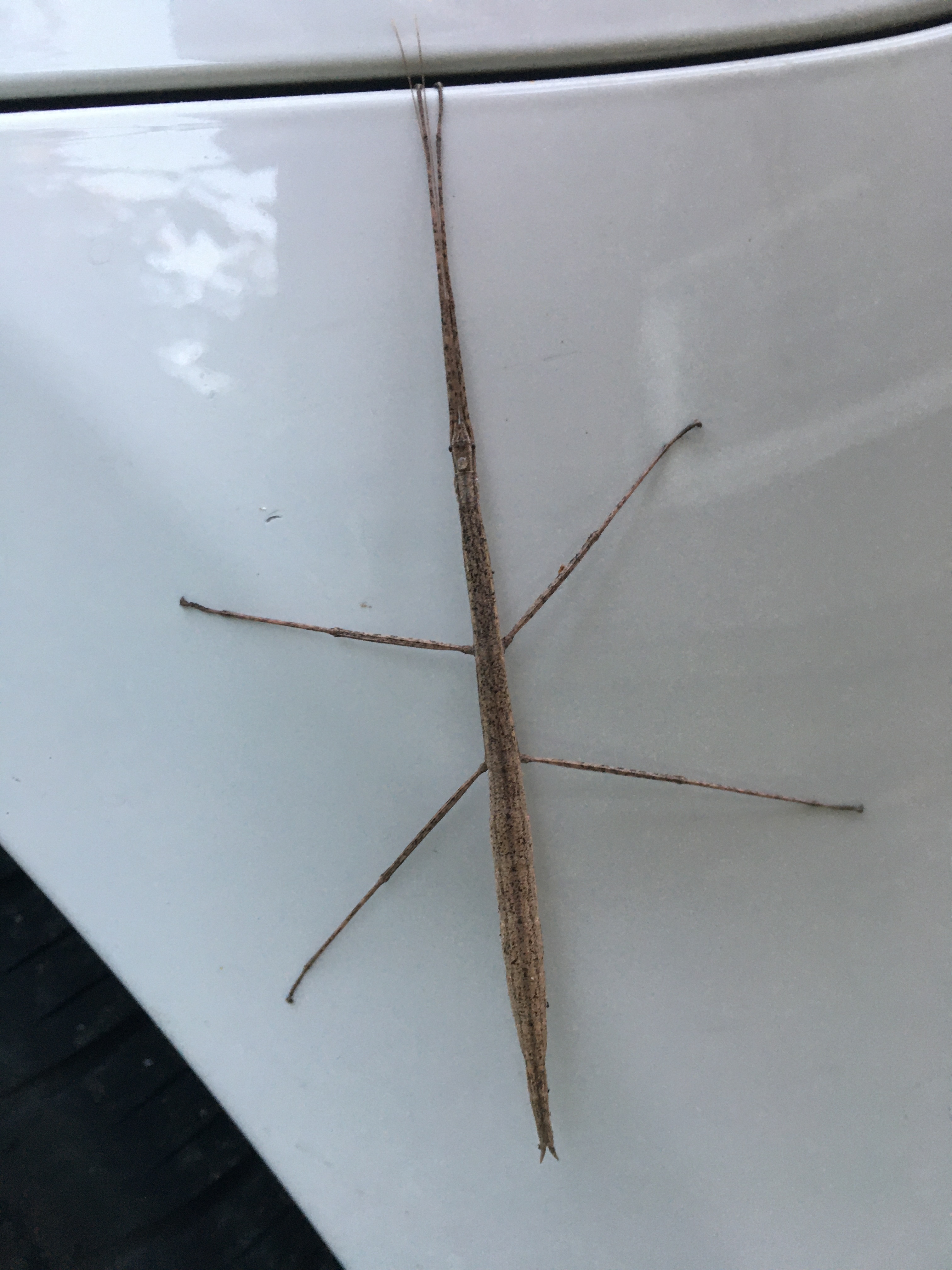
One day a few weeks ago, this fine specimen was hanging out on my car. He was quite content and spent most of the morning resting from his night of feasting. I felt guilty about moving him to a nearby bush when I had to go to the grocery store! I was inspired by this master of disguise, so I did a little research. I always called this a stick bug, but here in Connecticut, its proper name is northern walkingstick. What better form to use for a poem about this skinny bug than a skinny? This form was invented by Truth Thomas in 2005 at the Tony Medina Poetry Workshop at Howard University.
It feels like the world has gotten very loud over the past few weeks. As if it hadn’t been loud enough already. During these tumultuous days, I have found the possibility present in this poem by Alison Deming, with its “…conversation so quiet/the human world can vanish into it,” very reassuring.
The Web by Alison Hawthorne Deming
Is it possible there is a certain kind of beauty as large as the trees that survive the five-hundred-year fire the fifty-year flood, trees we can’t comprehend even standing beside them with outstretched arms to gauge their span, a certain kind of beauty so strong, so deeply concealed In relationship — black truffle to red-backed vole to spotted owl to Douglas fir, bats and gnats, beetles and moss, flying squirrel and the high-rise of a snag, each needing and feeding the other– a conversation so quiet the human world can vanish into it.
The Inklings are kicking off September with ghazals. Margaret challenged us to write a poem using this complex form about a month ago. I’ve been playing with ideas ever since, but really struggled to get something to gel. Even after settling on a topic and rhyme scheme, I still haven’t adhered strictly to the rules. I also have to confess that some of these stanzas are reworkings of poems I’ve shared previously. (School began this week and I moved classrooms. That’s my story and I’m sticking to it!) Here is my very rough “Ghazal of Rivers.”
Flowing at a brisk pace, Quononoquetti*, long tidal river moved people from place to place: ancient Pequot river.
Sinuous canyons carved with a sculptor’s grace and precision; grain by grain, sandstone washes away, effaced by the river.
History is hard to trace when dams are built to harness power entire towns are erased, drowned beneath a now-tame river.
Paddlers in canoes and kayaks chase thrills and adventure, seek glory and fame when they race on a rapid-rich river.
I embrace my fears, watch tongues of water curl, create space and listen to tales of the river.



 Reading to the Core