One of my favorite collections to share with children is Elaine Magliaro‘s Things To Do (Chronicle Books, 2017). Magliaro imagines all sorts of animals, familiar elements of nature (sun, rain, sky), and everyday objects like erasers and scissors. Writing a “things to do” poem is a great way to get children looking at familiar sights in new ways. This can also stretch their vocabulary, as they strive to find that just right word to describe an image.
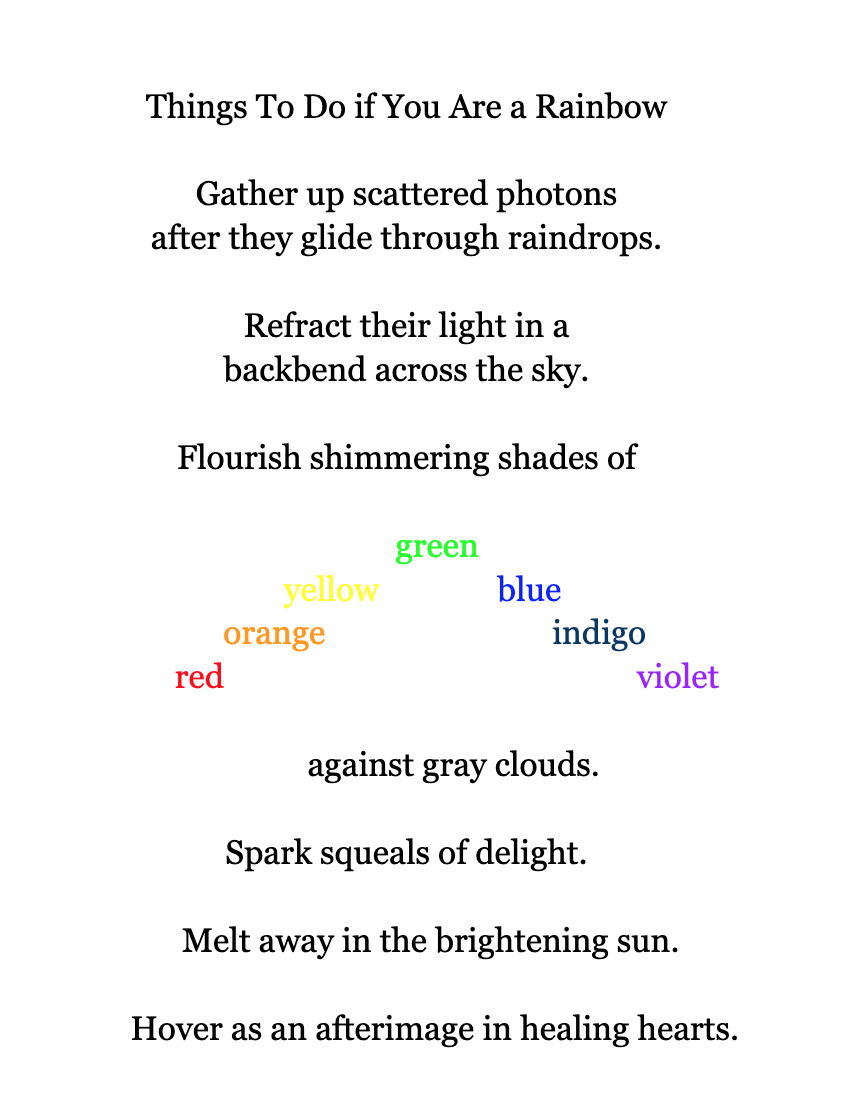
I was recently inspired to write a few “things to do” poems myself. This is one of my favorites (although the last line still needs work.)
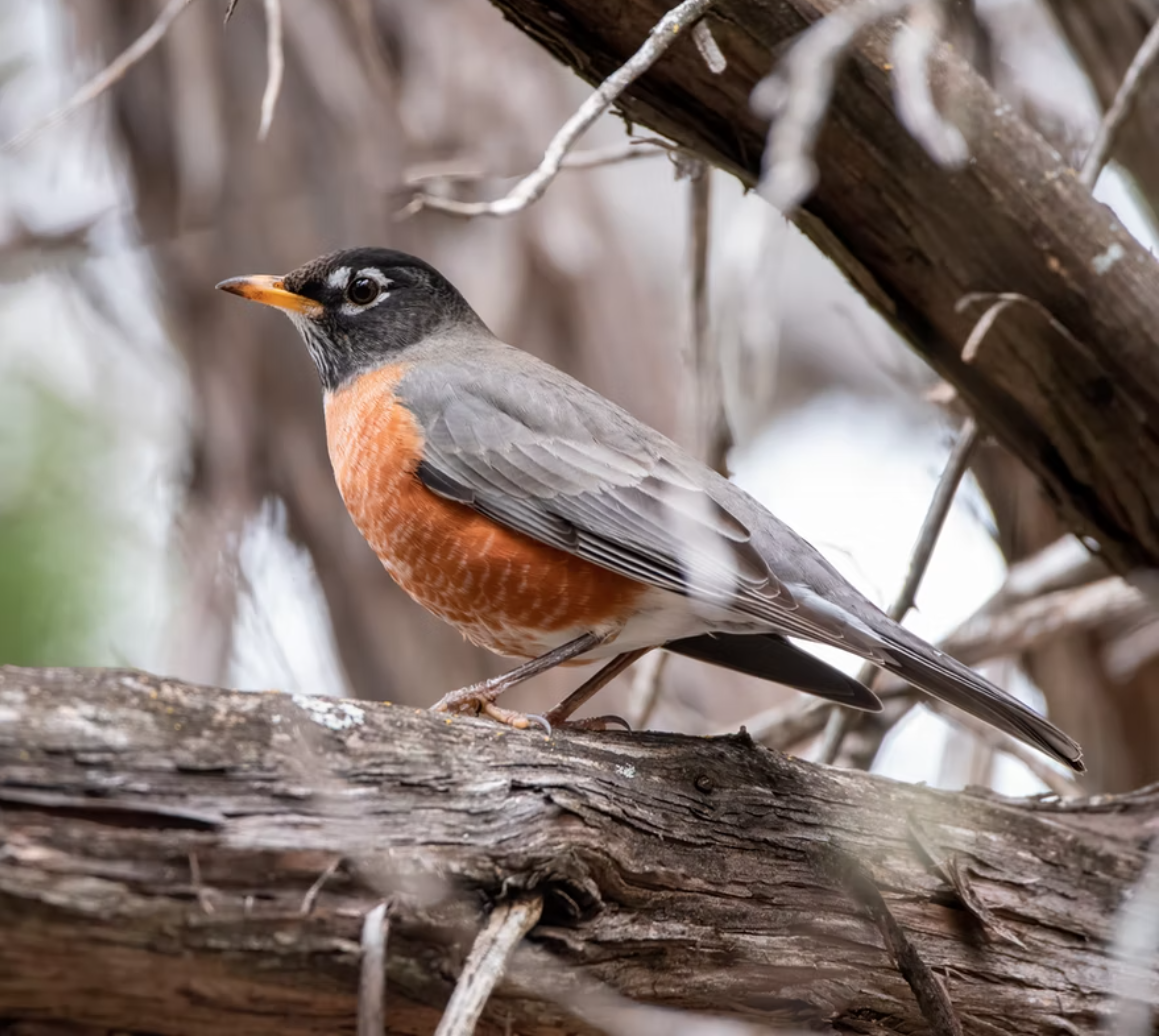
We’re on the cusp of spring, but winter has been reluctant to loosen its grip. In typical New England fashion, the weather has been vacillating between blustery snow and teasing breezes. Last week I was able to sneak in a late afternoon walk. I wasn’t the only one out enjoying the sunshine.
A Riot of Robins
Grace is a leafless maple ablaze with glowing amber lanterns: a riot of robins welcoming spring.
A few weeks ago I wrote about finding a short article by Jane Yolen about her correspondence with Nancy Willard. That led me to seek out more of Willard’s poetry, which led me to A Nancy Willard Reader, which led me to this magical poem by Linda Pastan.
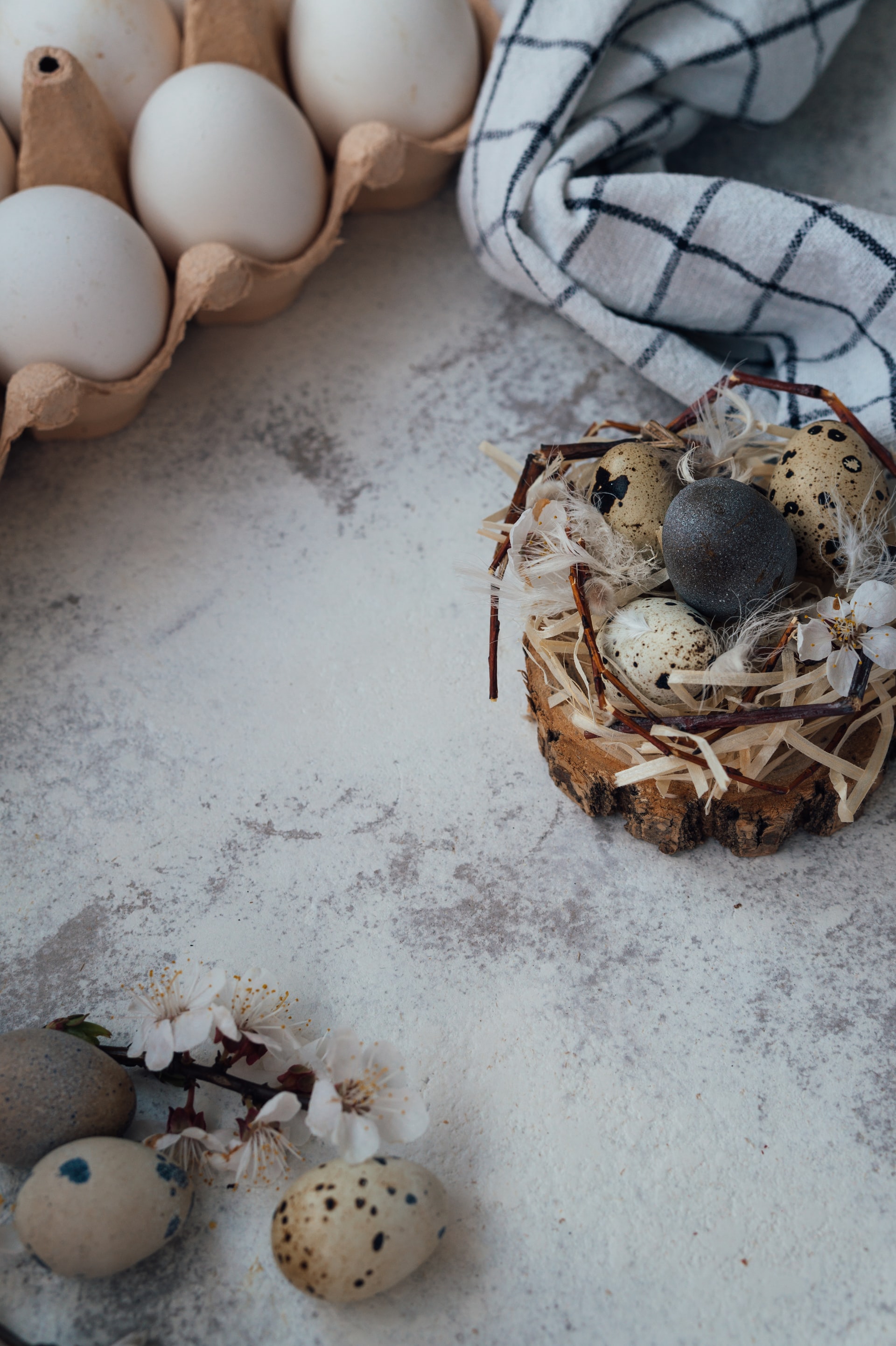
The Egg
In this kingdom the sun never sets; under the pale oval of the sky there seems no way in or out, and though there is a sea here there is no tide.
The Poetry Friday Roundup is happening at Poetry For Children. Please visit Sylvia Vardell and Janet Wong as they lay out a veritable smorgasbord of poetry to help celebrate their latest anthology, Things We Eat.
It’s time for another Inkling challenge. This month, Margaret challenged us to “Choose a quote that speaks to you. Write a poem that responds to the quote. The words can be used as a golden shovel or throughout the poem or as an epigraph.”
Where to begin? I have been collecting quotes for over forty years. They are jotted on legal pads, scribbled in notebooks, carefully copied onto pretty paper. Finally, I opened to a random page in my current notebook. This is what I found:
“In all things of nature, there is something of the marvelous.” Aristotle
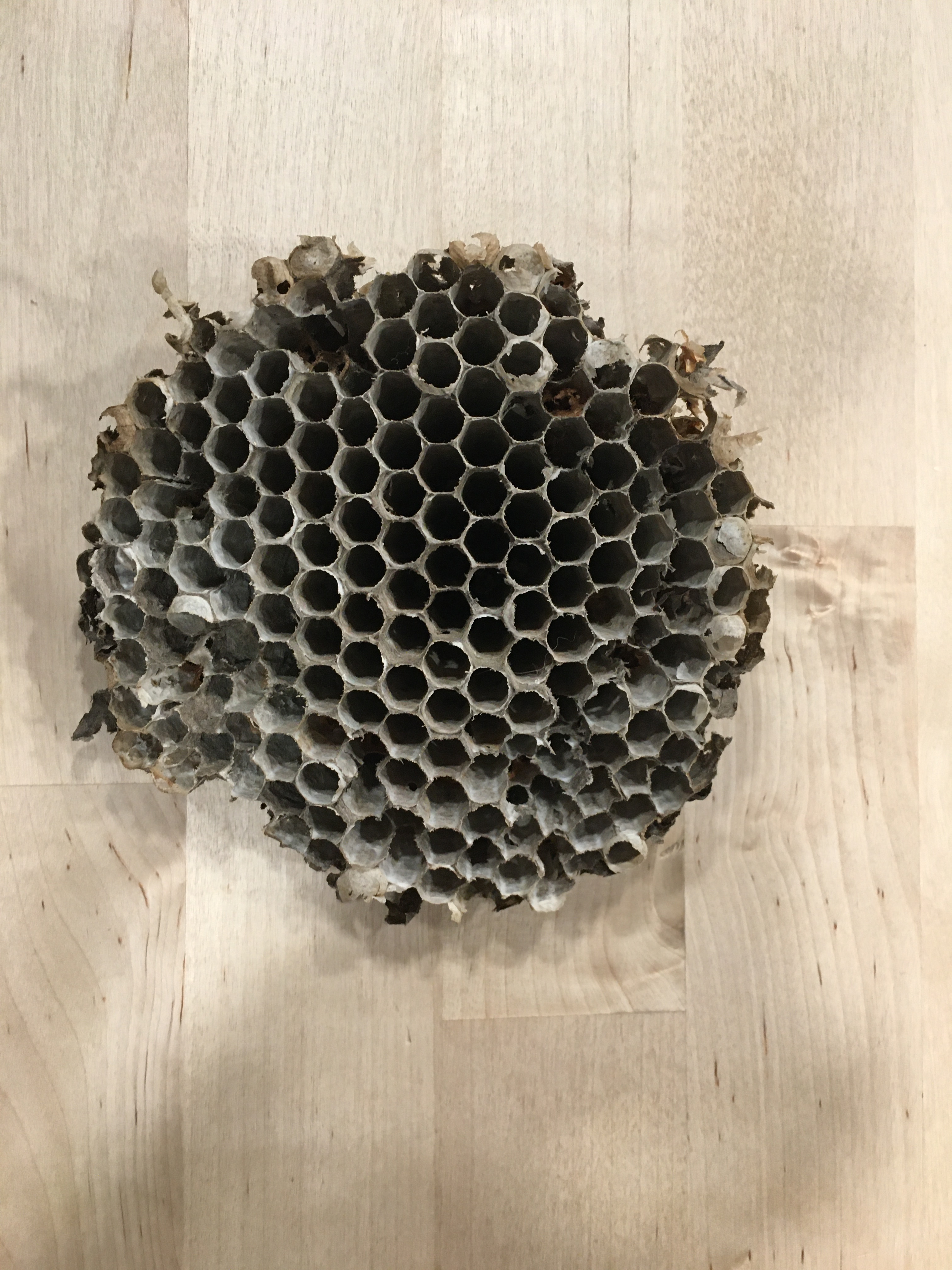
That narrows it right down, doesn’t it? Coincidentally, sitting on my desk is a layer from a wasp nest that fell from a tree during a recent storm.
Amazing, right?
Those perfect little hexagons got me thinking…
How did the humble honeybee learn Euclidean geometry?
Without blueprints, with nothing drawn, they build a home of hexagons.
Mixing pollen, resin, oil, day after day, worker bees toil.
Using their bodies, they mark and measure every cell to house their treasure,
Liquid treasure, golden and sweet. Treasure they share, a delectable treat!
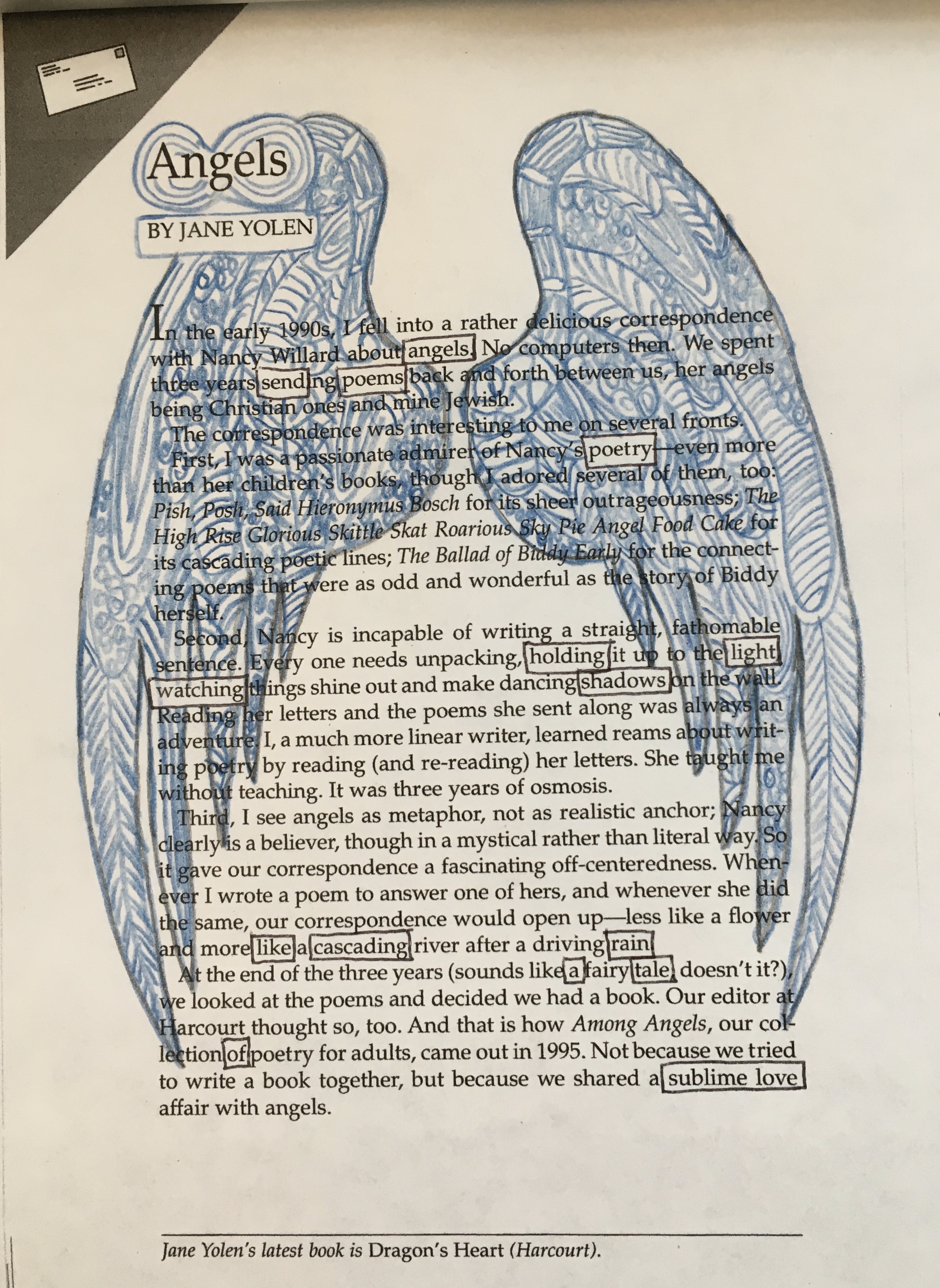
In my never-ending effort to reduce the stacks of New Yorkers and The Horn Book tucked away in various corners of my house, I’ve started purging. It’s a slow process. I can’t just toss these compact containers of wisdom and goodness. So I skim the table of contents, scan a review or two, succumb to Newbery acceptance speeches from years gone by. This is how I stumbled upon a short piece by Jane Yolen recalling her correspondence with Nancy Willard. Their collection of poetry, Among Angels, was the result of this “rather delicious correspondence.” (The Horn Book, March/April 2009, p. 162)
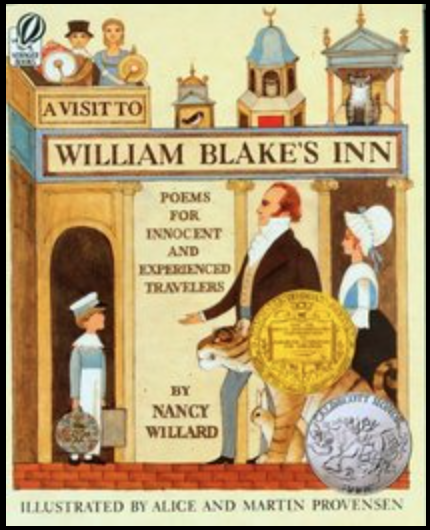
Willard’s Newbery winning book, A Visit to William Blake’s Inn (Harcourt Brace, 1981) was published the year my son was born. And although I read to him from the day we came home from the hospital, William Blake’s Inn didn’t capture my attention until several years later when I went back to school to get my teaching certificate. Of course I loved it immediately and have shared it with students ever since. (My favorite poem, “Two Sunflowers Move Into the Yellow Room,” seems particularly poignant today.) Still, I’m embarrassed to confess that I wasn’t aware of Willard’s poetry for adults until I read Yolen’s piece earlier this week.
After spending just a few hours reading what Willard poems are available online, I’m in awe of her keen observation, metaphor, and wisdom. My favorite so far is “In the Salt Marsh.” Unfortunately, I can’t find the printed text to share, but here is a video version.
Jane’s reminiscence also inspired me to create this found poem:
Angels send poems poetry holding light watching shadows like cascading rain a tale of sublime love.
Let’s all send poems of sublime love to the people of Ukraine today. And then be sure to visit Tricia Stohr-Hunt for the Poetry Friday Roundup.
It’s been an interesting week and I don’t really have a good excuse not to have written a poem earlier. Still, here we are on Friday morning and I’m just pulling this together, so pleasebe patient with my very draftylast minute Poetry Friday offering. I found the strike line for this Golden Shovel in The Birmingham Arts Journal, Vol. 17, Issue 2.
“Every one of us is an artist by default, reinventing the world each time we remember something.”
Ben Brantley
Each and every
day, I have at least one
thought that wants to become a poem. Of
course, only a small fraction of them actually make the journey from pen to page. Experts tell us
to write every day, that this is
the only way to hone our craft, to become an
artist.
But I’m not sure. By
letting ideas simmer on a default
setting deep in my brain, ideas are morphing, reinventing
themselves into something new. When the
time is right, they will alert me they’re ready to go out into the world.
I give each
possibility the time
it deserves. Some are compliant and yielding; others kick my butt. Yet we
always arrive at a solution that pleases us both. Whatever the outcome, I have to remember
It’s the first Friday of the month, so it’s time for another Inkling challenge. This month I challenged my fellow Inklings to “Write a mathematical poem, such as a fib, pi poem, nonet, etc. Feel free to interpret this challenge in any way that feels right for you. Have fun!”
There are a seemingly infinite number of types of mathematical poems, and an argument could be made that every poem that has a regular meter, rhyme scheme, or line count is a mathematical poem. I had every intention of stretching myself and trying a new form, but as January unfolded, it became clear that my mental capacity was limited to using a familiar form. Fib (short for Fibonacci) poems are my favorite math form to write, so I decided to stick with that form.
Still, wanting to push past the familiar, I searched for a math-related topic. I wasn’t having much luck until earlier this week when my son’s girlfriend posted images of sound waves. This sparked a memory of seeing a demonstration of a Chladni plate. Rather than try to explain this, here’s a demonstration.
This all took me down a rabbit hole of how the patterns created on the Chladni plate are related to fractals, and how both are related to the Fibonacci sequence. There are cool images of Chladni plate creations and similar images generated from sound waves all over the web. (Visit Resonantia to view just one of these amazing projects.) After just scratching the surface of all this math and science, this fib poem draft emerged. The second half of the poem is a reverse fib, working back to one syllable.
sound drifts across time and space ripples radiate expand in every direction then shift, create a kaleidoscope of infinite shapes, each small segment an echo of the whole, repeating on and on forever and ever.
I woke this morning to the news of an unexpected snow day as well as news of the expected defeat of changing the filibuster rules in the Senate to allow the John Lewis Voting Rights Act to become law. My immediate reaction was to begin doom-scrolling through Twitter. I soon stumbled upon a tweet about this prompt from Stacy L. Joy on Ethical ELA:
Write a monotetra (or try any form of poetry) that can serve as resolutions for 2022, reminders to pursue peace, hope, and change, or perhaps write one that can bury the hurts and losses of 2020-2021.
A monotetra consists of mono-rhymed quatrains with 8 syllables per line. There is no set number of quatrains. The final line of each stanza should contain a repeating refrain.
Writing a monotetra seemed like a better way to spend my day, so I got to work. For the most part, I was able to achieve 8 syllables per line, but the repeating refrain eluded me.
Be kind to others. Help. Assist. Raise your voice. Demand. Insist. When Justice fails, step up. Resist. Don’t give up. Carry on. Persist.
These empty-sounding platitudes remind us that our attitude relies on strength and fortitude. Ideals aren’t reached in solitude.
We haven’t any time to waste. Each day our values are erased. Our country’s hope has been defaced. We can’t forget the dreams we’ve chased.
I’m still debating if the poem should end here or if the following stanza should be included:
Each day feels like an uphill climb. We are running out of time To strike a chord, make our lives chime. We cannot stop; we’re out of time.
Either way, this is still very much a draft. It did help strengthen my resolve, though, and not give in to despair. At least for today.
This poem by Ellen Bass was exactly what I needed to read this week. Maybe it will strike a chord with you, also.
The Thing Is
to love life, to love it even when you have no stomach for it and everything you’ve held dear crumbles like burnt paper in your hands, your throat filled with the silt of it. When grief sits with you, its tropical heat thickening the air, heavy as water more fit for gills than lungs; when grief weights you down like your own flesh only more of it, and obesity of grief, you think, How can a body withstand this?
Happy New Year! The Inklings are kicking off the 2022 with a challenge from Heidi. She suggested that we use the “The Lost Lagoon” by Mohawk poet, Emily Pauline Johnson (d. 1913) “to build your own poem FOR CHILDREN about a treasured place that you return to again and again (geographical or metaphorical).”
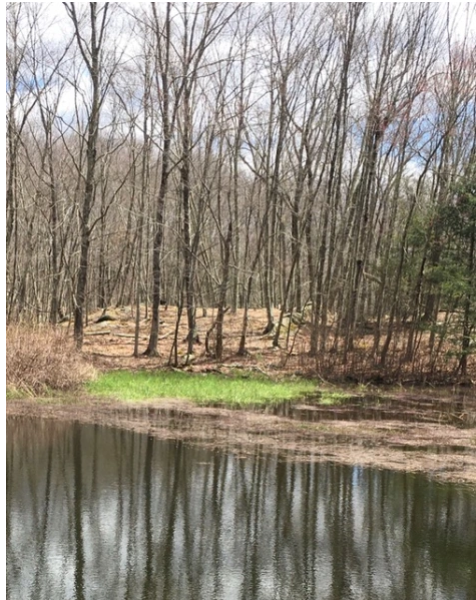
I really didn’t have to think too long about what to write about. There is a pond in the woods behind our house where my family and I have hiked, fished, searched for tadpoles, and skated since we moved here 35 years ago. Johnson included people in her memories of the lost lagoon, but I decided to leave the pond to itself in my poem.
This form was definitely a challenge. Coming up with two rhyming lines per stanza that make sense was hard enough, but THREE? Even though I wrote and rewrote each stanza several times, I’m still not sure everything works, but here is my response to Heidi’s very challenging challenge.
The Forest Pond
It’s spring time at the forest pond. Geese return, led by a starry map, turtles emerge from their winter nap, red-budded maples ooze with sap as nature waves her magic wand.
It’s summer at the forest pond. In mama’s wake, fat goslings trail, while tadpoles lose their legs and tails, over glossy water dragonflies sail, then nature waves her magic wand.
It’s autumn at the forest pond and honking geese fly overhead, beneath the pond, critters make their bed, soon trees are bare and all seems dead, then nature waves her magic wand.
It’s winter at the forest pond. Noisy geese have taken flight, white ice has water tucked in tight, but days grow longer, there is more light as nature waves her magic wand.

 Reading to the Core