“With words at your disposal, you can see more clearly.”
Robin Wall Kimmerer
Last week, We Are Teachers shared this on Twitter:
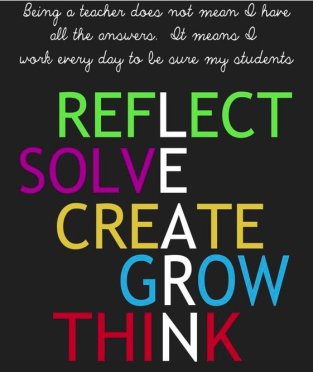
I printed it out to share with teachers right away. I love the visual message that learning is so much more than memorizing facts or formulas. As I considered how to write my final post for this month-long challenge, it occurred to me that these words were a perfect way to organize my thoughts about the experience of blogging every day.
Reflecting has the double benefit of giving me insights into my writing, but also processing and learning from whatever event I’m writing about. The frustrating part about reflecting is that you think of a better way to handle a situation after the event. Of course, this learning can be tucked away for the next time a similar situation arises. Similarly, with writing, a better word or sentence construction occurs to me after I hit “publish.” Still, I’ve become more aware of words and sentence structures I overuse. In my never-ending effort to improve my writing, I’ve tried to use them less often.
Writing daily has made me more attentive to the world in general. This has helped me solve some problems I’ve been struggling with in a story I’ve been working on for the past year.
Creating is the whole purpose of this challenge. Each day has brought forth a new piece of writing. Some posts have been more successful than others, but the very act of creating them has helped me become a more confident writer.
Which brings me to the word grow. Over the past month, I’ve tried writing in new ways, ways that haven’t always been comfortable. In the words of Elizabeth Gilbert, I’m pushing myself out of “the suffocating insulation of personal safety and into the frontiers of the beautiful and the unexpected.”
Finally, this has been a month filled with thinking. Thinking of a topic to write about. Thinking about just the right word or phrase for a poem. Thinking about all the beautiful, heart-felt writing I’ve read on other blogs. Thinking about how lucky I am to be part of this inspiring, nurturing community. Thank you for helping me see things more clearly.
And a very special thank you to Stacey, Tara, Dana, Betsy, Anna, Beth, Kathleen, and Deb for their Herculean effort to provide this space for teachers and others to share their every day during this month. Your hard work is truly appreciated! Be sure to visit Two Writing Teachers to read more Slice of Life posts.
![By photo taken by H. Pellikka (Own work) [GFDL (http://www.gnu.org/copyleft/fdl.html), CC-BY-SA-3.0 (http://creativecommons.org/licenses/by-sa/3.0/) or CC BY-SA 2.0 (http://creativecommons.org/licenses/by-sa/2.0)], via Wikimedia Commons](https://readingtothecore.com/wp-content/uploads/2016/03/kaleidoscope.jpg?w=494&h=371)