“I believe in one day and someday and this perfect moment called Now.” Jacqueline Woodson
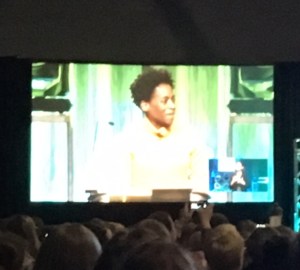
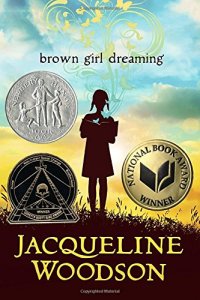
I was lucky enough to be in the audience at NCTE’s Annual Convention last November when Jacqueline Woodson read this passage from Brown Girl Dreaming, her award-winning memoir in verse. Woodson’s work has always had a place in my classroom, and I am thrilled that she has been named the next National Ambassador for Young People’s Literature. This role will allow her to travel around the country sharing her message that “books can drive change and instill hope in young readers.” She summed up her vision as ambassador as “Reading = Hope x Change.” You can hear Woodson talk more about this vision in this NPR interview.
During her speech at NCTE, students from around the country asked questions via pre-recorded video. One student wondered why Woodson chose to write Brown Girl Dreaming and her recent novel Another Brooklyn in verse. Woodson’s brilliant response? “I wrote it in verse because that’s how memory comes to us.”
In “on paper,” from Brown Girl Dreaming, Woodson shares this memory:
Woodson reminded the teachers at NCTE that “everybody has a story, and everyone has a right to tell that story. Encourage students to tell their stories.” It’s clear that Woodson’s work springs from her own story, her own memories. But her writing also shines with her love for her fellow humans. She urged her NCTE audience to remember that “community is so important. We need to know who we are going to walk through the world with.” I am happy I’m walking through the world with Jacqueline Woodson.
Please be sure to visit Jan Godown Annino at Bookseedstudio for the Poetry Friday Roundup.
Happy New Year! Welcome to the first Poetry Friday Roundup of 2018! If you’re new to Poetry Friday, you can learn more from Renée LaTulippe at No Water River.
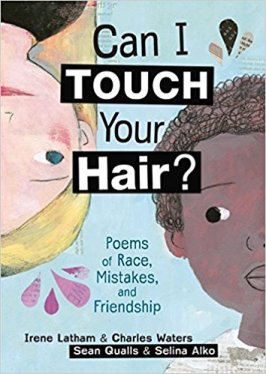
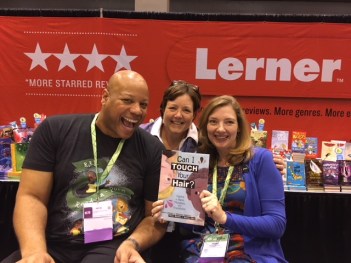
Today I’m proud to feature a brave and beautiful new book by two dear poetry friends, Irene Latham and Charles Waters, Can I Touch Your Hair? Poems of Race, Mistakes, and Friendship, published by Carolrhoda Books on January 1, 2018. With starred reviews from Kirkus and Publisher’s Weekly, this book deserves a place in every classroom. (A Teacher’s Guide is available here.)
Assigned to work together on a poetry project, Irene and Charles are ambivalent. Irene articulates this with the frank honesty of childhood: “Charles is black/and I am white.”
Overcoming their misgivings, they find common ground in the everyday worries of all kids, and begin by writing about shoes and hair. These subjects soon give way to more serious topics such as saying the wrong thing, racial tensions, police brutality, and fear of others because they look different.
They walk the tightrope of adolescent friendships when Irene’s request to join “the black girls/ play[ing] freeze dance” and Charles’s friends “play me dirty.” The poems reveal an unfolding friendship, which Sean Qualls and Selina Alko capture in their sensitive illustrations as heart-shaped flourishes erupting from their pens, mouths, and minds.
Throughout the collection, Irene and Charles make their alter egos come alive by honestly revealing pieces of vulnerability, as when Charles realizes he’s “a few shades too dark/to be allowed to call [a new classmate] by his nickname.” This is balanced by their courage to face fear and shame, as Irene does in “Apology.” When an African-American classmate’s family tree is “draped in chains,” she realizes that the words “I’m sorry…are so small/ for something/so big.”
Both poets use figurative language to bring a depth of feeling and wisdom that amplifies the emotional impact of their writing. We feel the “fury rising inside” Charles, as if he’s “a tidal wave about to crash on land,” as well as the joy they each feel as they “stand in line, cradling our books like newborn kittens,” as they wait to meet author Nikki Grimes.
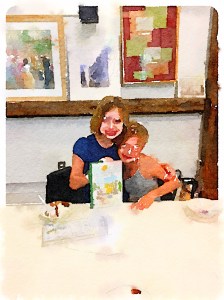
With Charles and Irene at NCTE in St. Louis last November.
Irene and Charles generously allowed me to share two of their poems with you today. Thank you so much!
“The Poem Project”
When our teacher says, Pick your partner, my body freezes
like a ship in ice.
I want Patty Jean,
but Madison
has already looped
arms with her.
Within seconds,
you-never-know-what-
he’s-going-to-say-Charles
is the only one left.
How many poems?
someone asks. About what? Do they have to be true?
Mrs. Vandenberg
holds up her hand. Write about anything! It’s not black and white.
Mrs. Vandenberg wants us to write poems?
Finally, an easy project. Words fly off my pen
onto the paper, like writing is my superpower.
The rest of the time, my words are a curse. I open my mouth,
and people run away. Now I’m stuck with Irene?
She hardly says anything. Plus she’s white.
Her stringy, dishwater blond hair waves
back and forth as she stutter-steps toward me.
My stomach bottoms out. “Hello,” I say. “Hi,” she says.
I surprise myself by smiling at her–she smells like
a mix of perfume and soap. We stare at our sneakers
before I ask, “So, what do you want to
write about?” She shrugs. I say, “How about our shoes, hair?
Then we can write about school and church?”
She takes a deep breath. “Okay.”
I match it. “Let’s start there.”
In an interview with Megan Labrise on the podcast Fully Booked by Kirkus Reviews (starting at 32:40), Charles and Irene share the origin of Can I Touch Your Hair, as well as their hopes for their book. Irene states their wish is that “it will make it easier to have these really difficult conversations about race” and as we “talk about it, listen to each other, [we’ll] realize that we’re all human people, we have more in common than we have separate, different, and that the different parts are beautiful.” Because, as Irene and Charles so wisely point out in the book’s final poem, “Dear Mrs. Vandenberg”: “We are so much more than black and white!”
And now for the Roundup! Please join today’s celebration of poetry by sharing your link.
For many years, schools across the country have been participating in One School, One Book programs to promote a love of reading and build a reading community. After the Children’s Program Coordinator of our local library contacted our school to discuss ways we could join forces to encourage summer reading, we decided to sponsor a One School, One Book event.
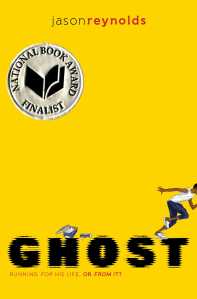
Or rather, a Two Schools, Two Books event. Because I teach in a K-8 school, finding one book for such a broad age range was a real challenge. So we split the school into elementary and middle school grades and chose two books. Students in the lower grades read Tamera Will Wissinger’s heartwarming Gone Fishing, while middle school students read Ghost, by Jason Reynolds. Every child received a copy of a book during the last week of school.
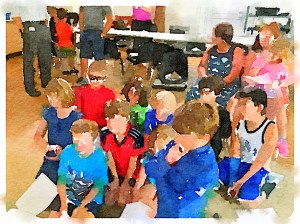
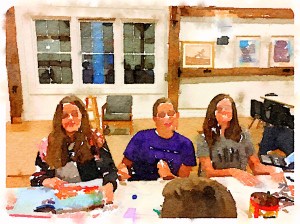
We met twice during the summer to celebrate these books and our reading. Taking a cue from poetry promoter extraordinaire, Sylvia Vardell, Gone Fishing readers made poem collages (scroll to the bottom of the post) for their favorite poems, then performed some of the poems for two (or three) voices. At our second get-together, the kids wrote acrostics and list poems about fishing or other favorite hobbies. The highlight of this evening was a Skype visit with Tamera. She shared that the idea for Gone Fishing grew out of one poem based on Tamera’s memories of going fishing with her family. Some brave poets then read their poems. Everyone was inspired to write more poems, and one lucky girl went home with a copy of Gone Camping, Tamera’s new book about Sam and Lucy.
Proud poem collage creatorSkyping with Tamera
Readers of the National Book Award finalist, Ghost, by Jason Reynolds had two insightful discussions about Castle, the choices he made, and how he dealt with those choices. These middle schoolers loved performing some of their favorite scenes, especially Ghost’s blow-up at Brandon in the cafeteria. They also had fun making heart maps for Castle. Everyone was disappointed that Patina hadn’t been published yet (we met before the August 29th publication date), but had plenty of recommendations for other books they’d read over the summer.
All of our celebrations were topped off with ice cream sundaes, and everyone went home happy. Now that school has started, we’ve been discussing how the main characters of both books exhibit Sherman School’s core values of honesty, courage, responsibility, and respect. Based on the success of these celebrations, we’re hoping to make our version of One School, One Book an annual event.
Happiness is ice cream with a friend AND a new book!
Thank you also to Stacey, Betsy, Beth, Kathleen, Deb, Melanie, and Lanny for creating this community and providing this space for teachers and others to share their stories each Tuesday. Be sure to visit Two Writing Teachers to read more Slice of Life posts.
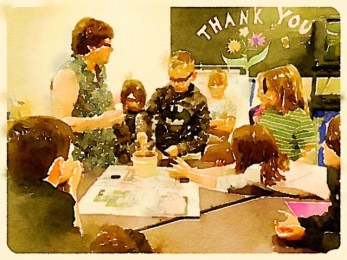
This fall I’m teaching a six-week exploratory course on gardening to 4th and 5th graders. Six weeks isn’t much time, but we’ve already suspended an avocado pit in water, planted oregano, and brainstormed a list of questions we want to answer. Later today we’ll be planting potatoes and next week we’re starting herb gardens.
Planting oregano (Thank you, Keri Snowden, for the photo!)
In addition to all these seeds sprouting, I’d like some writing to blossom during our course. A “things to do” list poem is a form we can collaborate on, and lends itself nicely to a short time frame. Here is a poem I drafted to use as a model.
Things to do if you’re a seed…
nestle into rich, warm soil soak up plenty of water swell like a sponge split your coat plunge thirsty roots deep into the earth poke an eager stem into the air sprout feathery leaves drink up the sun’s shimmering rays
“In music, in poetry, and in life, the rest, the pause, the slow movements are essential to comprehending the whole.” ~ Maryanne Wolf ~
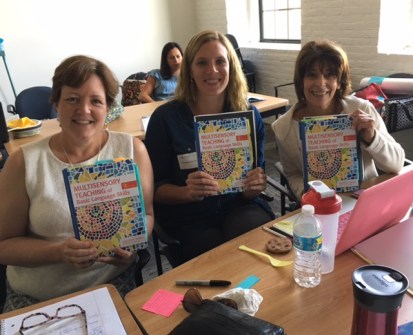
This past week, I attended a training institute on Structured Literacy Instruction. Although I may have grumbled a bit about the ninety minute drive, now that I’ve had time to rest and pause, I’ve realized the time spent learning with and from colleagues from across the state was both rewarding and enriching. I’ll be sifting through my notes and the presentation slides for weeks to come.
One of the requirements of the institute was to prepare a presentation on a chapter from Multisensory Teaching of Basic Language Skills, 3rd Edition, edited by Judith R. Birsh. At over 700 pages, this book is no light read, literally and figuratively! But, it is an important resource for all teachers. My group chose to present the chapter on vocabulary. We all know the impact of a deep vocabulary on reading comprehension, but some of the statistics shared were astounding. In 2006, Stahl & Nagy stated that “knowing individual word meanings is thought to account for as much as 50% of the variance in reading comprehension.”
Semantic relationships was discussed at length. Again, this is a topic that I know about and use with my students, but it was helpful to read again about the importance of developing our students’ “word consciousness,” or their “interest and awareness of words.” (Birsh, 339).
Poetry, of course, is ideal for developing all of these skills and more. As I was looking for a poem to share in our presentation to model these ideas, I stumbled across “School,” by David J. Langton. In the end, we chose Thunder Cake, by Patricia Polacco, but Langton’s poem is rich with possibility.
“School”
by David J. Langton
I was sent home the first day
with a note: Danny needs a ruler.
My father nodded, nothing seemed so apt.
School is for rules, countries need rulers,
graphs need graphing, the world is straight ahead.
“The more clearly we can focus our attention on the wonders and realities of the universe about us, the less taste we shall have for destruction.” ~ Rachel Carson ~
Thank you to Cathy Mere and Mandy Robek for creating and curating this celebration of picture books. You can read all the lists contributed to this labor of love here. It is teachers like them, and others in this community, who will keep the gift of stories alive for years to come.
There was a story on NPR recently about how science teachers are dealing with push back from students because of fake news. I wasn’t surprised to hear that climate change was a controversial topic, but I was shocked when one teacher said that students were challenging him about the Earth being round. How is such a view even possible? The more I thought about this, the more I began to wonder if such skepticism for long-established scientific facts is related to the decrease in the amount of time kids spend outdoors. Much has been written about “nature deficit disorder,” a term coined in 2005 by Richard Louv in his 2005 book, Last Child in the Woods. I’m sure there are many skeptics about Louv’s theory, but too many students tell me they spend entire weekends inside for me to doubt his theory.
I know reading books is no substitute for spending time outside, but these 10 books should whet anyone’s appetite for sunshine (or moonshine) and fresh air. After all, as Henry David Thoreau once said “we can never have enough of nature.”
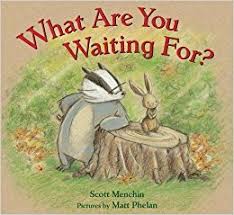
1. What Are You Waiting For? by Scott Menchin, illustrated by Matt Phelan (A Neal Porter Book, Roaring Brook Press, 2017)
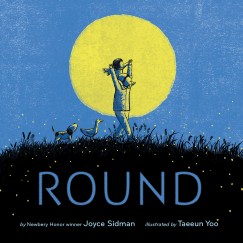
2. Round by Joyce Sidman, illustrated by Taeeun Yoo (Houghton Mifflin Harcort, 2017)
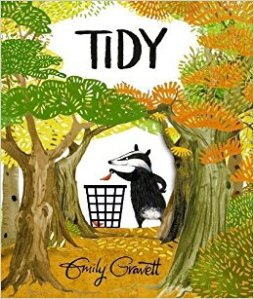
3. Tidy, written and illustrated by Emily Gravett (Simon & Schuster Books for Young Readers, 2017; first published in Great Britain, 2016)
4. Now, by Antoinette Portis (A Neal Porter Book, Roaring Brook Press, 2017)
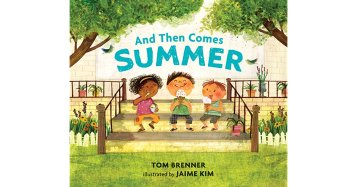
5. And Then Comes Summer, by Tom Brenner, illustrated by Jaime Kim (Candlewick Press, 2017)
6. A River, written & illustrated by Marc Martin (Chronicle Books, 2017; first published in Australia in 2015)
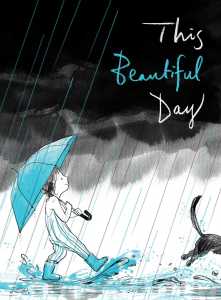
7. This Beautiful Day, by Richard Jackson, illustrated by Suzy Lee (Atheneum Books for Young Readers, 2017)
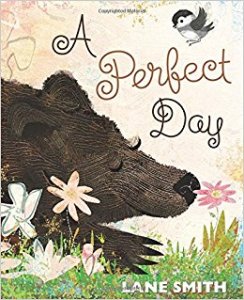
8. A Perfect Day, by Lane Smith (Roaring Brook Press, 2017)
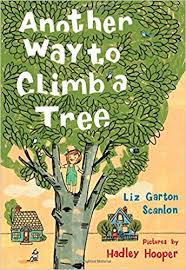
9. Another Way to Climb a Tree, by Liz Garton Scanlon (A Neal Porter Book, Roaring Brook Press, 2017)
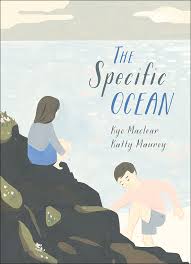
10. The Specific Ocean, by Kyo Maclear, illustrated by Katty Maurey (Kids Can Press, 2015)
One frustration I often have after attending workshops or conferences during the school year is that when I get back to school, I’m immediately caught up in day-to-day demands. This leaves little time to process and implement what I’ve learned. Presenters always advise to “pick one strategy or activity” to weave into your practice, but this too can be a challenge. So I’ve loved having some uninterrupted time to process my learning from the four days I spent at the Yale Center for British Art, which I wrote briefly about here.
As I reread my notes, some overarching ideas stood out:
possibility
observing
thinking
understanding
skill development
I created a document with five columns, sorting my notes according to these ideas. I quickly realized that I was “tackling complexity” by “putting the pieces together, rather than taking them apart, [which allowed me] to see connections, relationships and patterns of interactions.” (p. 4) It was deeply satisfying to see these relationships emerge.
Vicki’s underlying argument is that, in our rush to scaffold our students for success, we have deprived our students of opportunities to engage in critical thinking. They need many opportunities to engage in “productive struggle…the process of thinking, making sense and persevering in the face of not knowing exactly how to proceed” (p.13).
Visual literacy teaches children that, as Linda Friedlaender, Senior Curator of Education at YCBA, pointed out“images have an underlying narrative.” They automatically provide an accessible text that allow students to engage in productive struggle. Images allow students to think “for themselves, with a minimum of scaffolding.” (Vinton, p. 27). Reading images develops the same skills readers need when they read any text, including vocabulary, identifying key details, precise word choice, observation, and formulating and defending a thesis. (What Vicki and Dorothy refer to as “first-draft” thinking). Importantly, visual literacy makes abstract comprehension skills more concrete.
By incorporating visual literacy into our regular literacy routines, we create opportunities for students “to wonder, generate questions, and form hypotheses, then to test out those hypotheses, using reasoning and logic, to arrive at a final judgment or claim” (Vinton, p. 37).
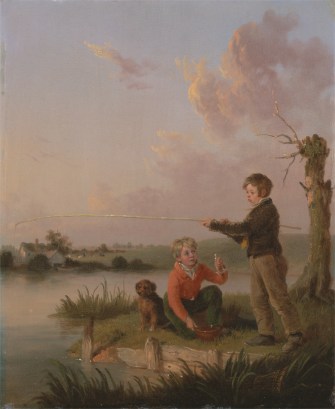
Give it a try. What do you see in this painting? Images such as “The Young Anglers,” by Edmund Bristow, offer students a chance to orient themselves to the narrative of the image, just as readers have to orient themselves when reading written text.
Edmund Bristow, 1787–1876, British, The Young Anglers, ca. 1845, Oil on panel, Yale Center for British Art, Paul Mellon Collection
After observing and gathering information, students share their thoughts. Just as with a piece of writing, students’ ideas have to be grounded in the details of the painting. Again, the process of reading a painting parallels and supports what we do when we read a book. If someone says they think the dog above belongs to the two boys, they have to share the exact detail from the painting that makes them think that. This is a critical step. As Vicki states, “the more opportunities students have to talk about their thinking, the more likely they are to transfer that thinking from one text to the next” (p. 77). This is true for images as well as written texts, and will also transfer from images to written texts.
Once students have developed an understanding of the narrative of the painting, the response options are limitless. Students can sketch or draw their response, write about their thinking, or (ideally), both. And, just as writing deepens our understanding of a text we’ve read, sketching deepens our understanding of visual images by drawing us ever deeper into the fine details.
The possibilities incorporating visual literacy into our classrooms are endless, and I’m excited to get back to school and working with students to build their thinking skills. In the meantime, I’m going to finish reading Vicki’s book and continue gathering images that will “give [students] a chance to build up the muscle to deal with the problems texts like this pose” (p. 79).
I was incredibly fortunate to spend four days this week at the Yale Center for British Art‘s Summer Teacher Institute. The goal of this Institute was to provide teachers with strategies for incorporating visual literacy into their classrooms. This is something I have been working on for many years, but my experience at Yale opened my eyes to new ways of supporting literacy with visual arts. In my final reflection, I stated that although school has just ended, I can’t wait for school to begin again so I can share all I learned with my colleagues and students.
The entire, vast collection at YCBA resonates with poetry. We spent hours with individual paintings, delving into the stories they tell. I’m still a little overwhelmed with all I saw and learned, and am grateful to have a few uninterrupted weeks to process the information and strategies the amazing instructors shared with us. This poem, by Thomas Hardy, begins to capture my experience.
“In a Museum”
by Thomas Hardy
I
Here’s the mould of a musical bird long passed
from light,
Which over the earth before man came was winging;
There’s a contralto voice I heard last night,
That lodges in me still with its sweet singing.
II
Such a dream is Time that the coo of this ancient bird
Has perished not, but is blent, or will be blending
Mid visionless wilds of space with the voice that
I heard,
In the full-fuged song of the universe unending.
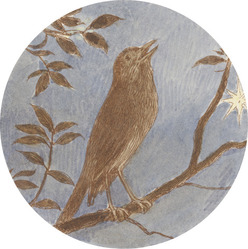
“Tail piece to The Nightingale” by Alfred W. Cooper, via Yale Center for British Art, Paul Mellon Collection
Please be sure to visit Diane Mayr at Random Noodling for the Poetry Friday Roundup.
This post is part of “DigiLit Sunday,” hosted by Margaret Simon at Reflections on the Teche. This week’s topic is Problem Solving. Please be sure to visit her there to read more Digilit Sunday contributions.
“Every problem is a gift—without problems we would not grow” Anthony Robbins
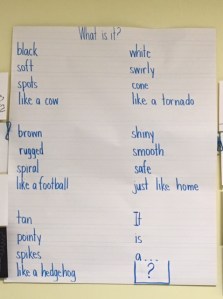
One afternoon a few weeks ago, one of our Kindergarten teachers stopped me in the hall as she was taking her students to the buses. She explained that her class was writing a poem about seashells. “But we’re stuck on the ending, and since you’re a poet, we we’re hoping you could help us.” Then one of the students chimed in, “Yeah, you’re a perfect poem maker.”
Blushing, I thanked them for their confidence and told them I’d love to help them with their poem. Then I immediately panicked and thought, “What if I have no idea how to help them?”
When I arrived in their classroom the next day, they were eager to read their poem to me. I was impressed with the description and similes they had already come up with. But there wasn’t much emotion in the poem. I explained that adding feelings is one way poets improve their work. To help them come up with their own ideas and words, we discussed what shells are for. We talked about how different the inside of a shell is from the outside. Through this conversation, they came up with a final stanza that followed the pattern of the previous stanzas, but changed it just enough. They were very happy with the result.
This exchange with these Kindergarten poets certainly would have played out differently if I didn’t write regularly. Having my own writing practice let me know exactly how these writers felt, knowing their poem was missing something but not knowing what that something was. Because I have worked through problems with my own writing, I was able to help them work through their problem.
By tackling my own knowledge gaps, whether about reading or writing, I’ve acquired (and continue to acquire!) the the tools I need to help students when their stuck. Learning from MY mentors*, whether through their brilliant books or at conferences and workshops, has equipped me with ideas and understandings I can use as a starting place when approaching a problem.
Reading, writing, listening, and learning has not only made me a better problem-solver and teacher. They have made me a better person.
*Thank you to ALL my mentors. You are too numerous to name and I’m afraid I’ll forget someone.
Teachers often wonder about their true impact on students. We have work samples, observations and assessments that help us gauge a student’s progress. But these can’t really let us know the degree of influence we’ve had on a student. And in many cases we may never know. We’re like mother turtles burying our eggs in the sand, only to swim away and hope for the best.
But then there are moments when the stars align and magic happens. This morning I was working with a 5th grade student whom I’ve worked with to varying degrees since first grade. He’s quiet and shy, but very sweet. He’d rather play soccer than anything else, especially read. He read the first few lines in The Amazing Amazon, by David Meissner, (Reading A-Z) then stopped. Looking up at me, he said, “It’s like a poem.”
I. was. speechless. Recovering quickly, I said, “I agree.” I asked why he thought so. Again, his response blew me away.
“Well, it rhymes and it’s describing. It’s like I can see it.”
As I said, magic. Here is the poem E found.
“There Is a Place”
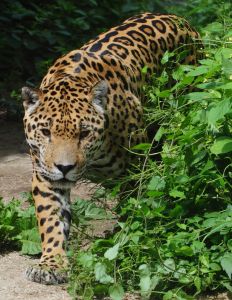
There is a place where monkeys swing and howl. There is a place where jaguars leap from tree to tree. Bananas and pineapples grow for free. Tiny frogs live in flowers. Pink-colored dolphins swim in the river. Storms come often, and the air is sweet.
By spacebirdy (Own work) via Wikimedia Commons
Sweet indeed.
Please be sure to visit Tara Smith at A Teaching Life for the Poetry Friday Roundup.







 Reading to the Core