National Poetry Month: For the Good of the Earth

My National Poetry Month Project has gone off the rails. Instead of writing poetry this week I’ve been changing the diapers of my 3-week old grandson, reading and singing to him and his 2-year old sister, and helping their parents transition to life with 2 kids. 

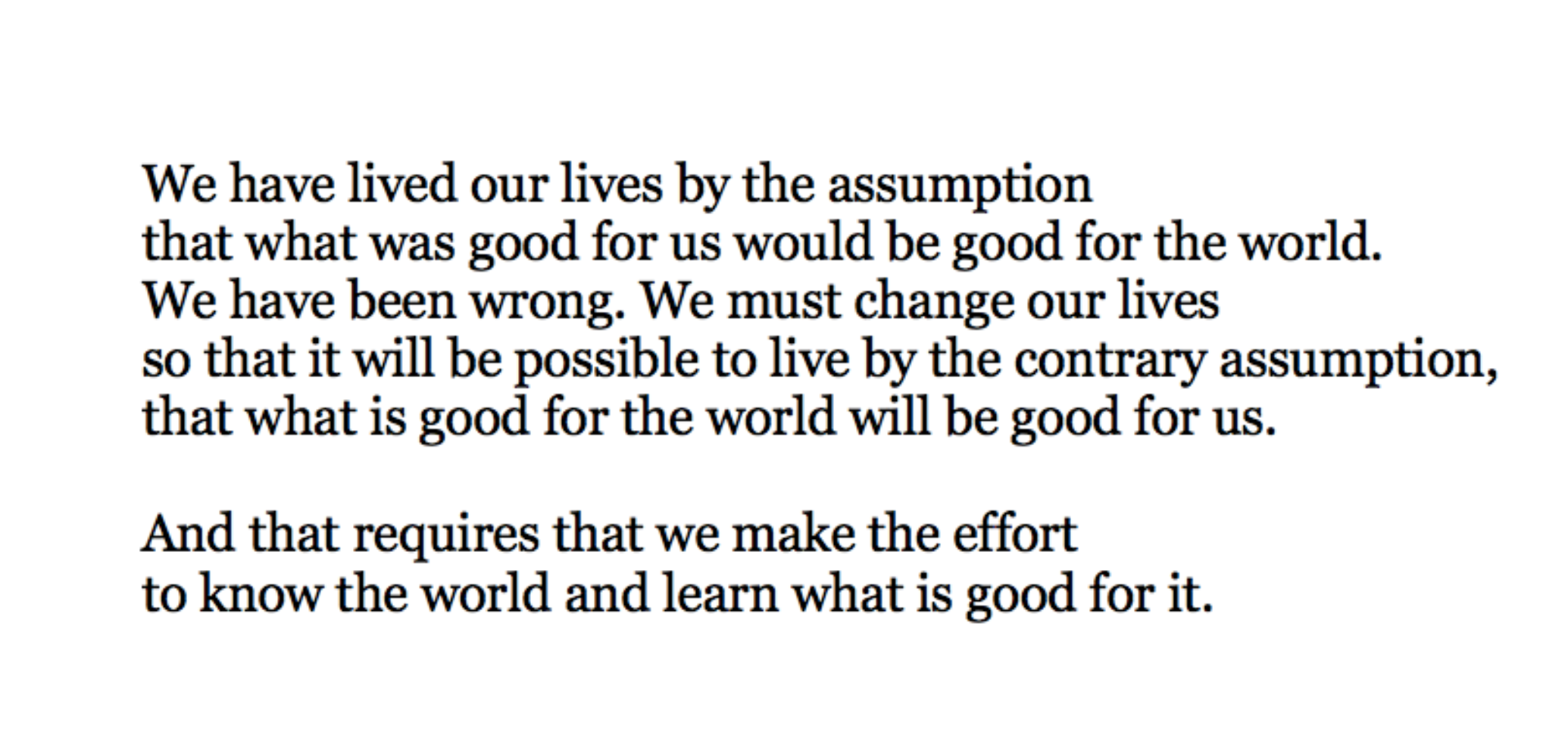
Early in April, I read an article in The New York Times about microplastics hitching a ride on marine snow to the bottom of the ocean. Scientists fear that this will disrupt the food webs throughout the world’s oceans. This has gnawed at me ever since, but I couldn’t figure out how to write a poem about it. Then I found this quote by Wendell Berry. The last line felt like a perfect strike line for a Golden Shovel: 
Here’s my very drafty draft:

How can we pretend to know
with certainty the
ripple effects of our inventions on the world?
Tons of plastic, that miracle convenience*, floats and
swirls through our oceans. Now we learn
that this “indestructible” scourge breaks down, that microplastics have infiltrated what
were once thought pristine, unreachable depths. Is
no place safe from the blizzard of debris we’ve unleashed on the Earth? What good
is all our technology if we can’t protect our only home for
our grandchildren, for all of nature? They deserve it.

Draft © Catherine Flynn, 2022

* See this article to find out how plastic was marketed to our parents in the 1960s. There are many, many articles online about ways to reduce our plastic use. Here’s one with an extensive list of ideas.

Please be sure to visit Matt Forrest Esenwine at Radio, Rhythm & Rhyme for a terrific interview with Leslie Bulion and the Poetry Friday Roundup!

Previous NPM Posts:

Day 4: Enchantment and Wonder
Day 3: Reciprocity
Day 2: Kith and Kin
Day 1: The Thing Is
National Poetry Month: Enchantment and Wonder

This month I will be writing poems in response to the ideas, connections and echoes between All We Can Save: Truth, Courage, and Solutions for the Climate Crisis, edited by Ayana Elizabeth Johnson and Katharine K. Wilkinson and Rooted: Life at the Crossroads of Science, Nature, and Spirit, by Lyanda Lynn Haupt.

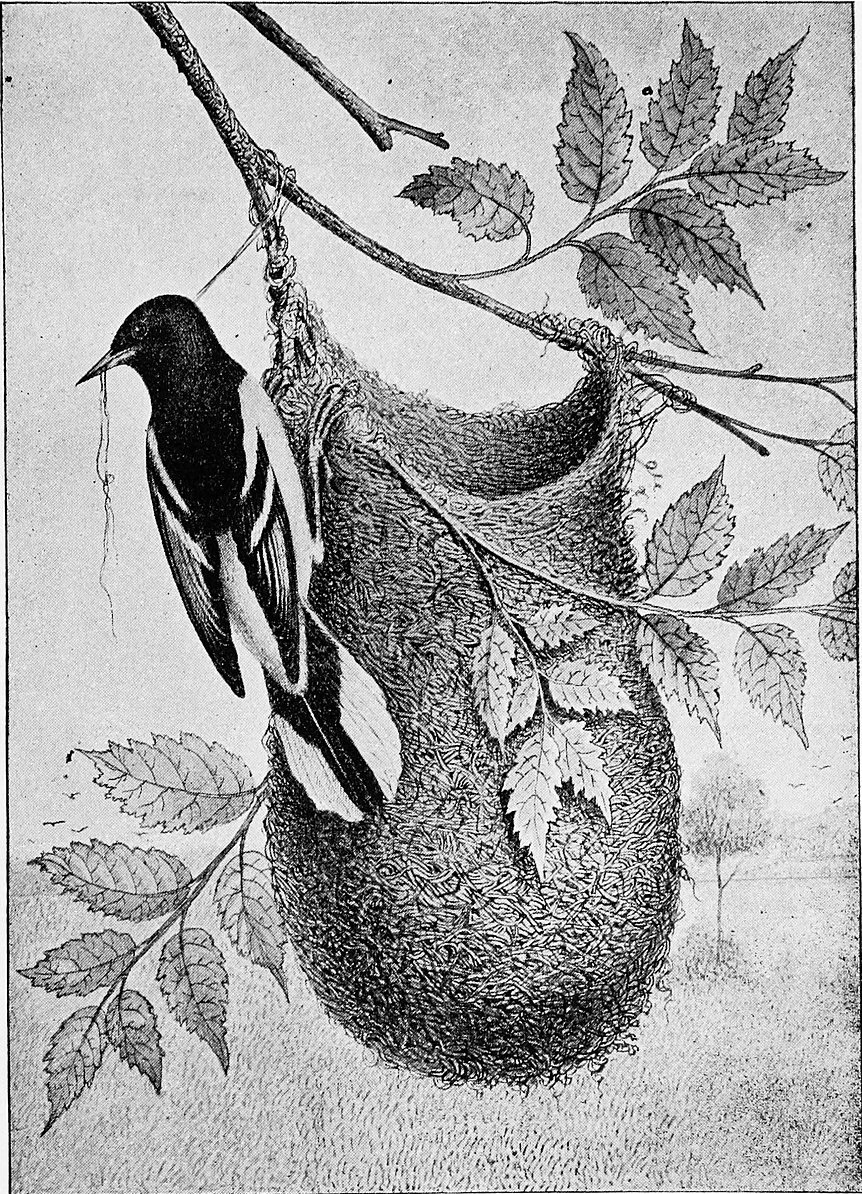
Lyanda Lynn Haupt includes “Enchantment and Wonder” among the tenets of Rootedness. She explains that the word wonder “derives from the Old English wundrian – to be astonished by the presence of the wondrous.” (p. 27) She also explains that we humans, so preoccupied with our busyness, have to be open to the “visitations” of the wondrous. Sometimes I can be a bit too open to wonder. Although I haven’t driven off the road while gazing at some bird, cloud, or tree yet, I’ve come close. That is what happened one day last November. Driving to work one morning, I noticed something hanging from a tree near the road. As I got closer, I slowed almost to a stop. (So I wouldn’t drive into the tree!) Wonder of wonders, it was a Baltimore oriole’s nest! Sadly, it was too far off the ground to get a good look at, but I’ve been marveling at that nest all winter long. Late last week when I drove by, I was enraged to see that the tree had been cut down! I hope whoever cut it down noticed the sock-sized miracle they destroyed. I decided to write a tanka-ish poem in its honor.

hidden since last spring
among dense, sheltering leaves,
an oriole’s nest,
a beak-woven wonder,
survived the winter

but not humans.

Draft, © Catherine Flynn 2022

From Nests and Eggs of North American Birds, by Oliver Davie, 1900
Internet Archive Book Images, No restrictions, via Wikimedia Commons

Previous NPM Posts:

Day 3: Reciprocity
Day 2: Kith and Kin
Day 1: The Thing Is
National Poetry Month: Reciprocity

This month I am writing poems in response to the ideas, connections and echoes between All We Can Save: Truth, Courage, and Solutions for the Climate Crisis, edited by Ayana Elizabeth Johnson and Katharine K. Wilkinson and Rooted: Life at the Crossroads of Science, Nature, and Spirit, by Lyanda Lynn Haupt.

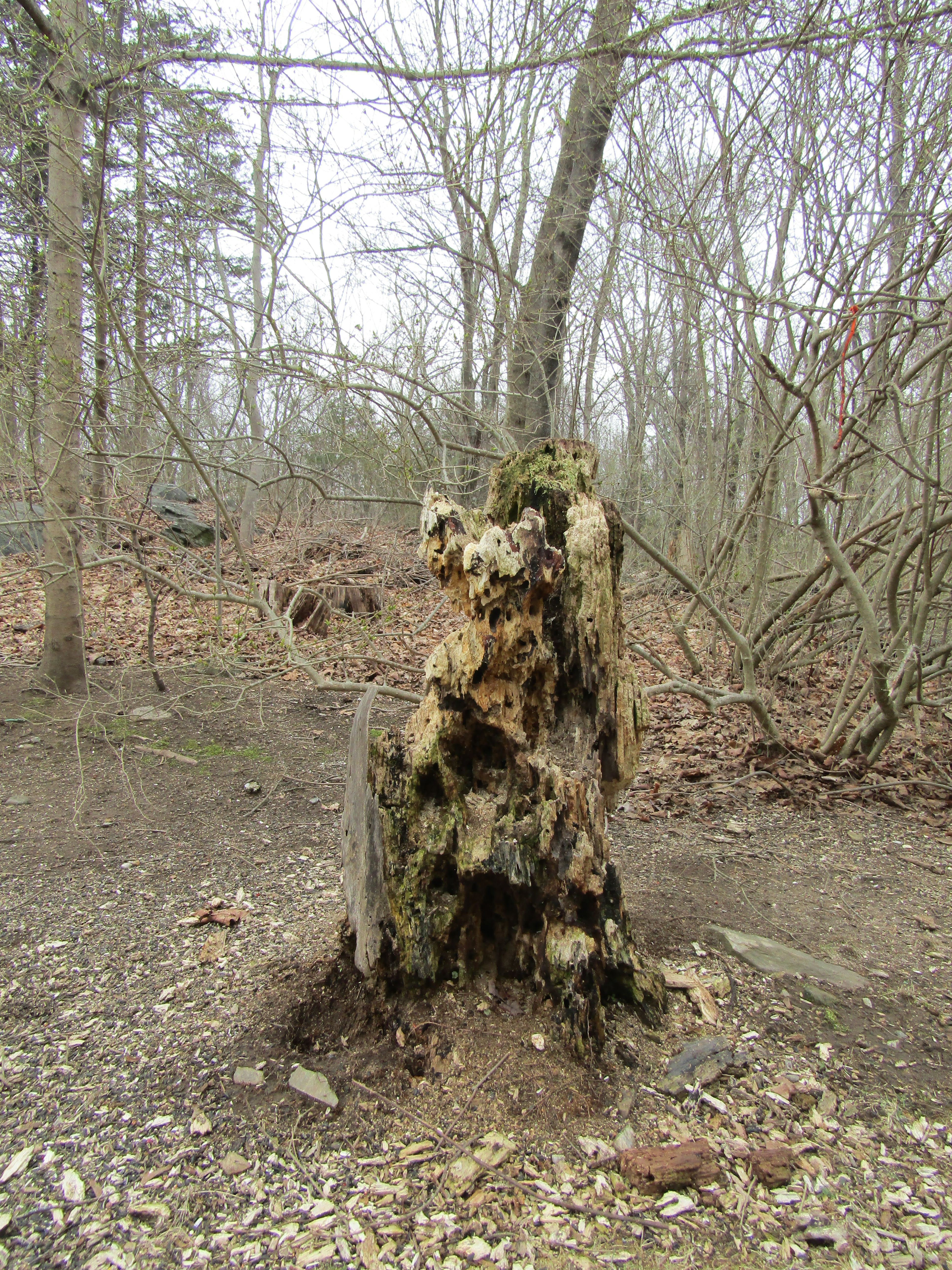
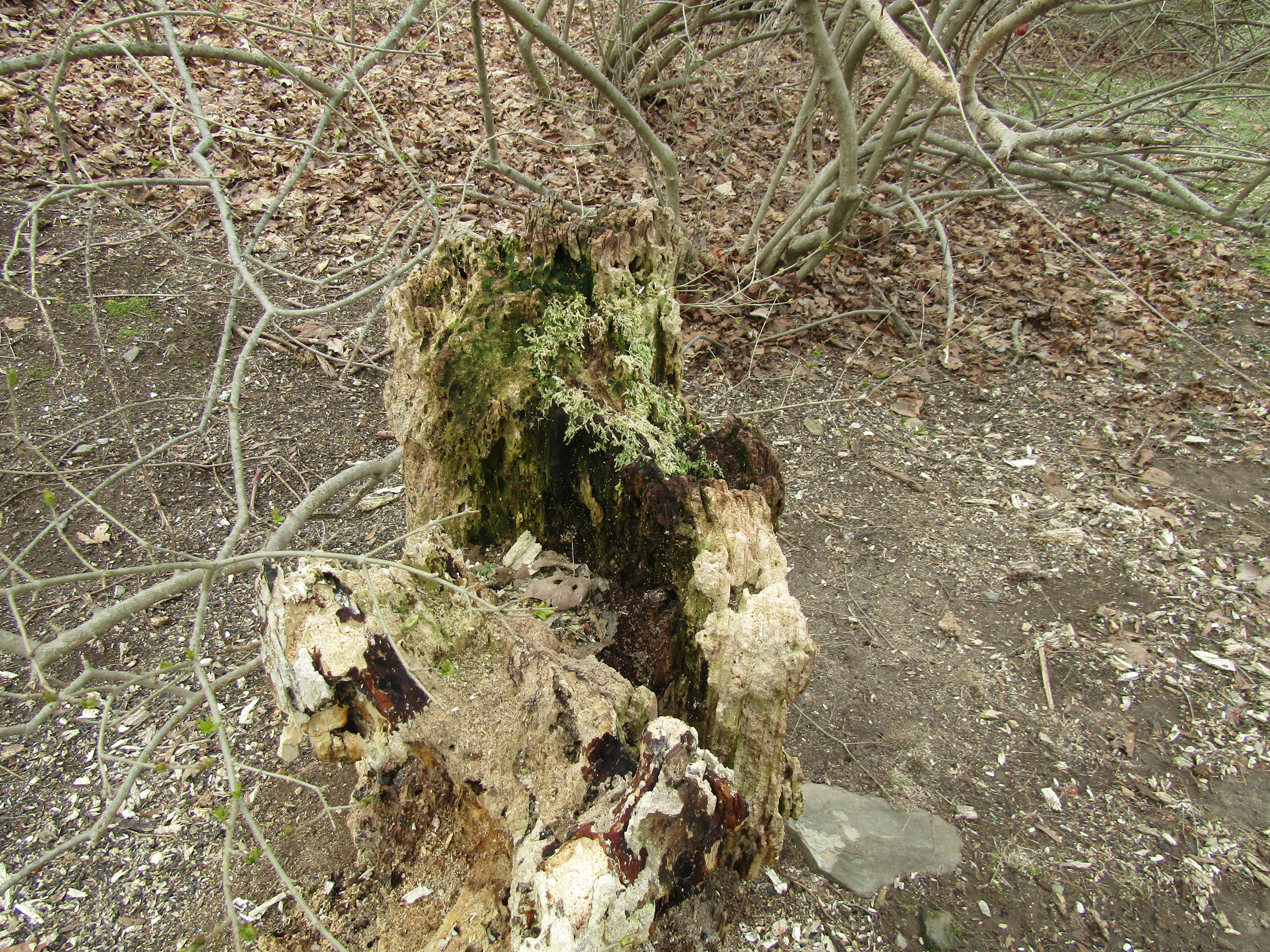
At its heart, reciprocity is the idea that all beings, plant and animal, “facilitate one another in beneficial ways,” Janine Benyus writes in her essay “Reciprocity” (All We Can Save, p. 9). For several years, we have been witnessing reciprocity in action outside our kitchen window. The stump pictured below is all that’s left of a beech tree that died. Worried that it could fall on our house, my husband and son cut it down, but never got around to digging out the stump. I’m glad they left it to finish its natural cycle.

Reciprocity

Red-crested pileated woodpeckers
Excavate the stump of an old beech,
Carving cavities, feasting on
Insects who’ve settled inside the
Pitted, pulpy wood, all that
Remains of a towering tree, where a multitude of
Organisms still thrive, a
Community 
Inextricably intertwined, supporting,
Tending, nourishing one another for
Years to come.

Draft © Catherine Flynn, 2022

Previous NPM posts:

Day 2: Kith and Kin
Day 1: The Thing Is
National Poetry Month: Kith & Kin

One of the first essays in All We Can Save is “Indigenous Prophecy and Mother Earth,” by Sherri Mitchell. Mitchell writes that “everything is interrelated and recognized for its sacred place within the web of life.” (p. 20) This understanding is central to kincentric awareness, the understanding that “life in any environment is viable only when humans view the life surrounding them as kin.” Lyanda Lynn Haupt includes kith and kin as two of the fundamental tenets of “rootedness” in her book Rooted. She explains “where kin are relations of kind, kith is relationship built on knowledge of place–the close landscape…Kithship enlivens kinship.” (p.26)

Our house is built on land that was once part of my great-grandfather’s farm. I feel deeply connected to this land, although I never knew this was really meant by the word “kith.” I also know that before European settlers lived here, people of the Schaghticoke and Paugussett nations lived on this land. We have tried to be good stewards and remember that we share this land with others.

Some of you know that we have a new grandson. I know his parents will help him understand that “each element within creation (including humans) has the right and the responsibility to respectfully coexist as coequals within the larger system of life.” (Mitchell, p. 19) Today’s poem is dedicated to Eamonn.

Kith and kin

On the night you were born,
the moon bathed you in its silvery light,
welcoming you into the world.

Deep in the woods,
a chorus of peepers sang
out in jubilation, celebrating
your arrival.

And sap coursed through
trees and plants
swelling buds,
greening the earth,
greeting you, their brother.

Draft © Catherine Flynn, 2022

National Poetry Month, Day 1

Poetry Friday: Welcome, National Poetry Month!

What a happy coincidence that National Poetry Month begins on a Friday this year! And, because the Inkling challenge is the first Friday of each month, today is a trifecta of poetry goodness. This month, Mary Lee challenged us to “Use “The Thing Is” by Ellen Bass as a mentor text. Keep the title, but choose a theme/message either from your own life or from current events.” Bass’s poem is full of the pain and contradictions of life, asks questions, and reaches a resolution.

Today is also the first day of my month-long poetry project. For the past two years, I’ve explored the natural world through poetry. Two years ago, my poems were about News from the Natural World. Last year’s project was inspired by Kathryn Aalto’s Writing Wild: Women Poets, Ramblers, and Mavericks Who Shape How We See the Natural World. That journey was such an incredible learning experience that I wanted to do something similar this year. My friend and fellow Inkling, Heidi Mordhorst (who is also hosting today’s Roundup), suggested reading All We Can Save: Truth, Courage, and Solutions for the Climate Crisis, edited by Ayana Elizabeth Johnson and Katharine K. Wilkinson. But I also recently discovered Rooted: Life at the Crossroads of Science, Nature, and Spirit, by Lyanda Lynn Haupt. At the risk of being indecisive, I’m not going to commit to one book or the other. Rather, I envision this month’s writing to be a response to the connections between these two books. Who knows where that will lead?

So, using “The Thing Is” as a starting point, this month’s journey begins with a walk in the woods.

The thing is

I have so many
questions,
so many 
things I. Don’t. Understand.

But I know
a walk
in the woods
on a cold day
in late March, 
will hold surprises.

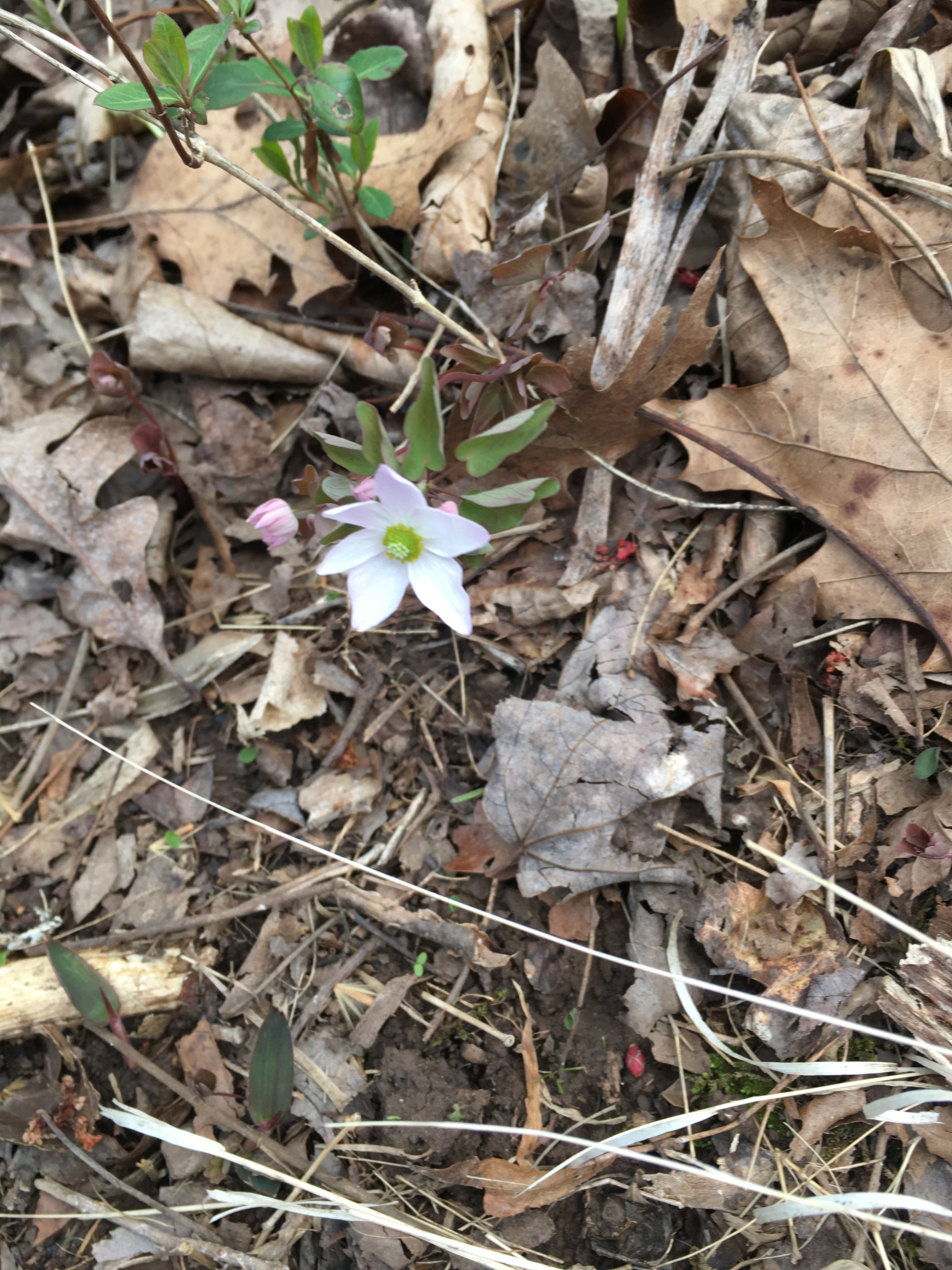
Maybe sharp-lobed hepatica 
are erupting from leaf litter,
scattered beside the trail, 
their pale pink petals
streaked like the morning sky,
each flower with a 
a dazzling supernova
of stamens at the center.

Or a lone antler
rests at the base
of a scarred oak,
or a jumble
of hawk feathers
lay in a heap
by a fallen log.

As I study 
the remains 
of this fierce predator,
my need for answers
becomes urgent.

I realize, though, I don’t know 
who to ask.

Draft © Catherine Flynn, 2022

Please visit my fellow Inklings to read their responses to Mary Lee’s challenge, and the Poetry Friday Round up at Heidi’s blog.

Heidi Mordhorst @ My Juicy Little Universe
Linda Mitchell @ A Word Edgewise
Margaret Simon @ Reflections on the Teche
Mary Lee Hahn @ A(nother) Year of Reading
Molly Hogan @ Nix the Comfort Zone

Poetry Friday: Chasing Rainbows

One of my favorite collections to share with children is Elaine Magliaro‘s Things To Do (Chronicle Books, 2017). Magliaro imagines all sorts of animals, familiar elements of nature (sun, rain, sky), and everyday objects like erasers and scissors. Writing a “things to do” poem is a great way to get children looking at familiar sights in new ways. This can also stretch their vocabulary, as they strive to find that just right word to describe an image.

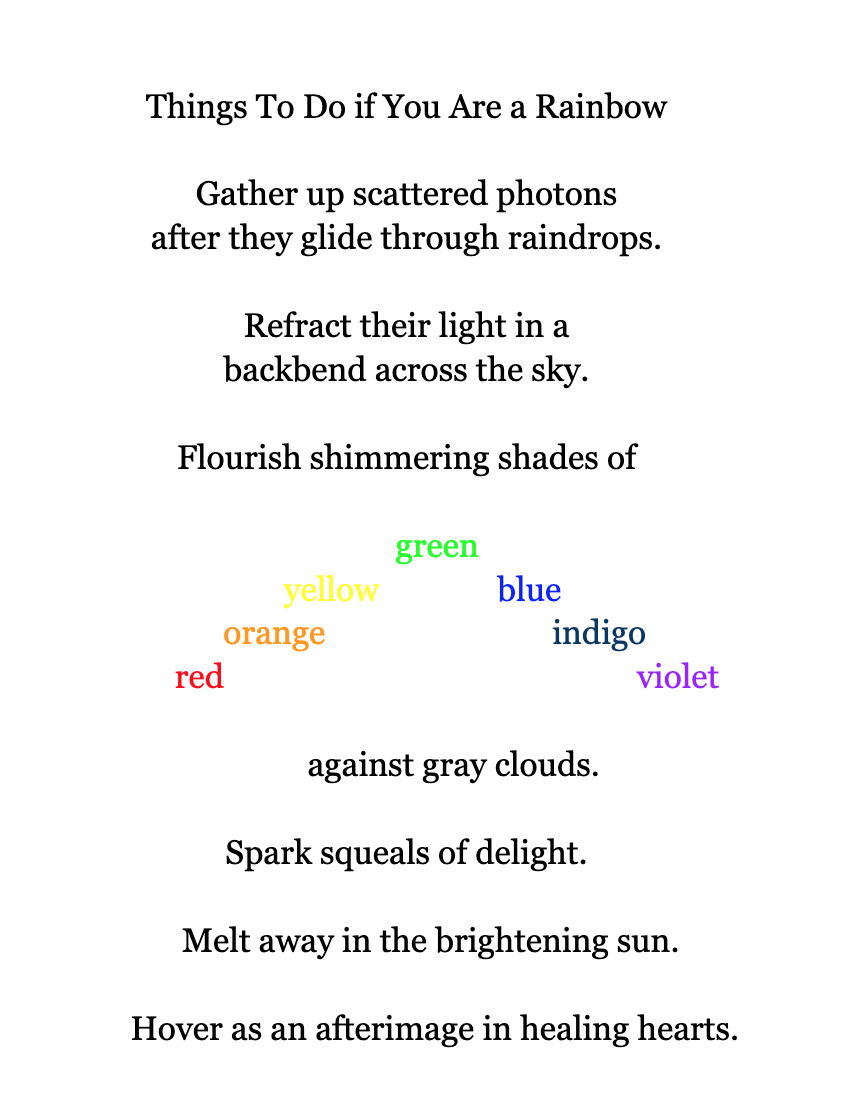
I was recently inspired to write a few “things to do” poems myself. This is one of my favorites (although the last line still needs work.)

Draft, © Catherine Flynn, 2022

Please be sure to visit Amy Ludwig VanDerwater at The Poem Farm for the Poetry Friday Roundup.

Poetry Friday: Rabbit Holes & Eggs

A few weeks ago I wrote about finding a short article by Jane Yolen about her correspondence with Nancy Willard. That led me to seek out more of Willard’s poetry, which led me to A Nancy Willard Reader, which led me to this magical poem by Linda Pastan.

The Egg

In this kingdom
the sun never sets;
under the pale oval
of the sky
there seems no way in
or out,
and though there is a sea here
there is no tide.

Read the rest of the poem here.

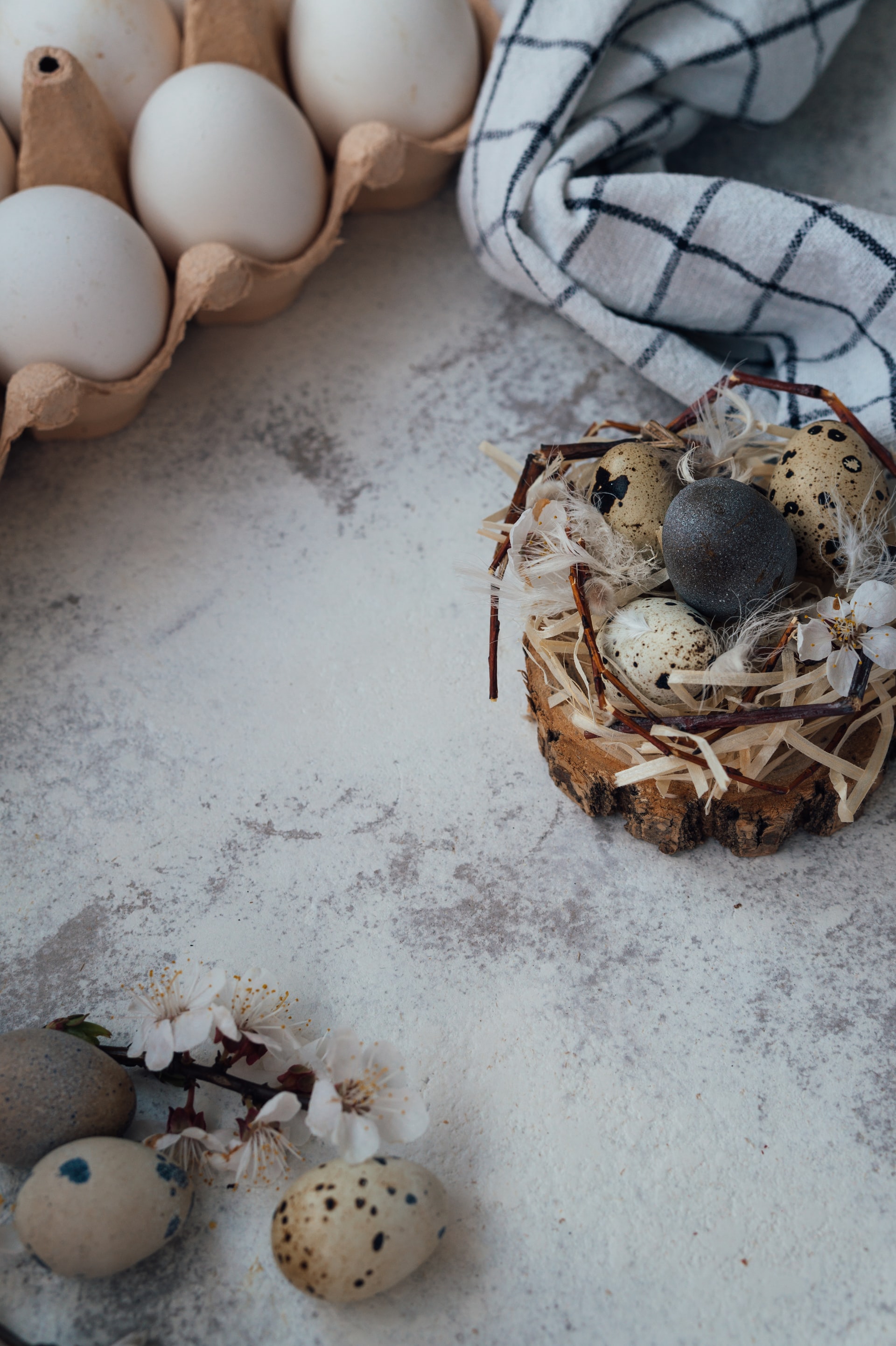
Photo by Hanna Balan via Unsplash

The Poetry Friday Roundup is happening at Poetry For Children. Please visit Sylvia Vardell and Janet Wong as they lay out a veritable smorgasbord of poetry to help celebrate their latest anthology, Things We Eat.

Poetry Friday: Poetry Angels

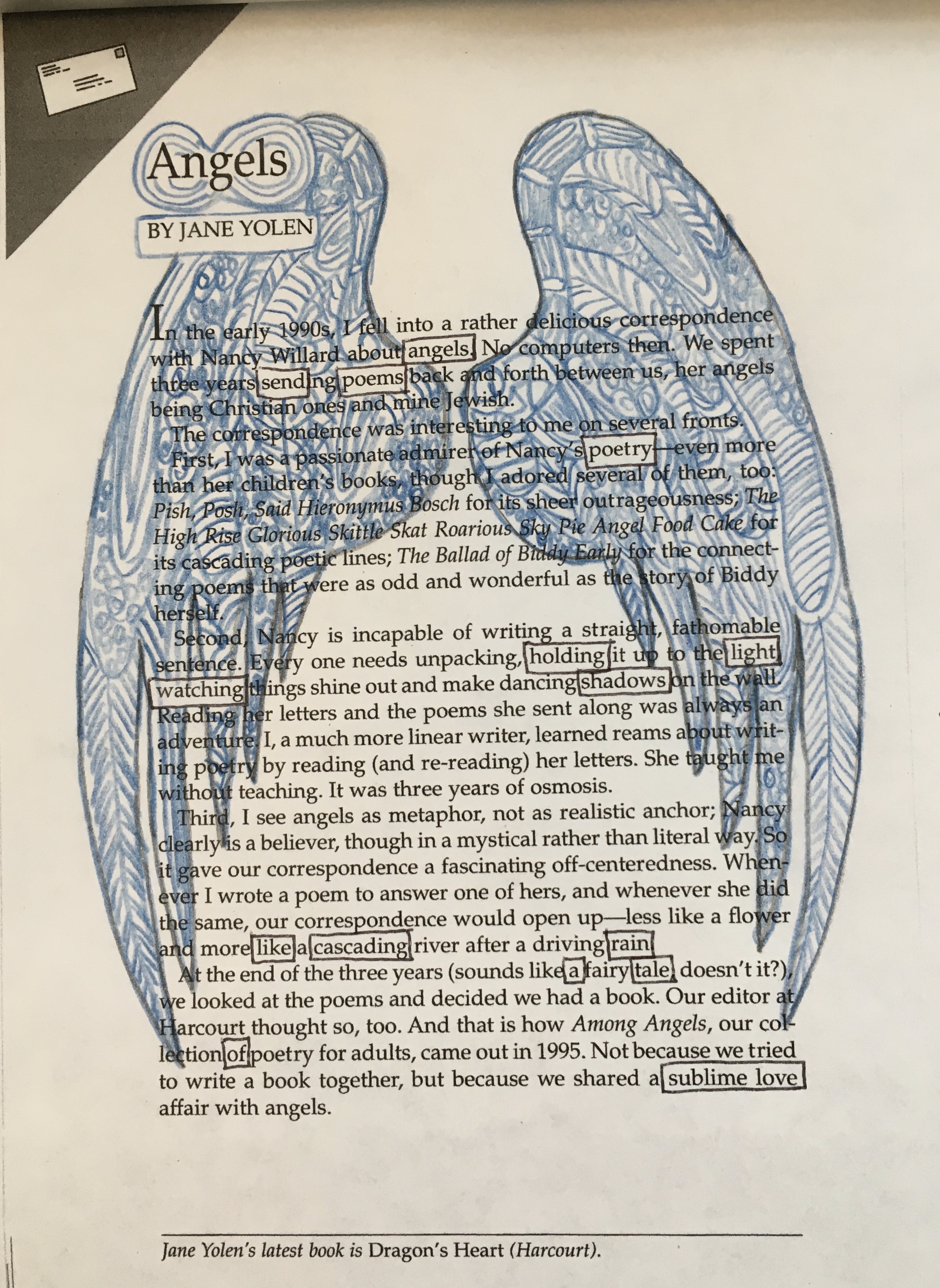
In my never-ending effort to reduce the stacks of New Yorkers and The Horn Book tucked away in various corners of my house, I’ve started purging. It’s a slow process. I can’t just toss these compact containers of wisdom and goodness. So I skim the table of contents, scan a review or two, succumb to Newbery acceptance speeches from years gone by. This is how I stumbled upon a short piece by Jane Yolen recalling her correspondence with Nancy Willard. Their collection of poetry, Among Angels, was the result of this “rather delicious correspondence.” (The Horn Book, March/April 2009, p. 162)

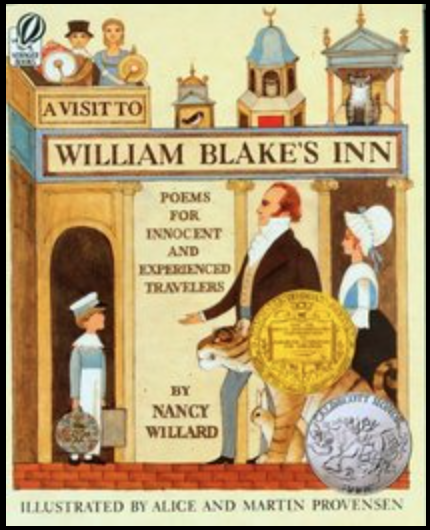
Willard’s Newbery winning book, A Visit to William Blake’s Inn (Harcourt Brace, 1981) was published the year my son was born. And although I read to him from the day we came home from the hospital, William Blake’s Inn didn’t capture my attention until several years later when I went back to school to get my teaching certificate. Of course I loved it immediately and have shared it with students ever since. (My favorite poem, “Two Sunflowers Move Into the Yellow Room,” seems particularly poignant today.) Still, I’m embarrassed to confess that I wasn’t aware of Willard’s poetry for adults until I read Yolen’s piece earlier this week. 

After spending just a few hours reading what Willard poems are available online, I’m in awe of her keen observation, metaphor, and wisdom. My favorite so far is “In the Salt Marsh.” Unfortunately, I can’t find the printed text to share, but here is a video version.

Jane’s reminiscence also inspired me to create this found poem:

Angels
send poems
poetry
holding light
watching shadows
like cascading rain
a tale
of
sublime love.

Let’s all send poems of sublime love to the people of Ukraine today. And then be sure to visit Tricia Stohr-Hunt for the Poetry Friday Roundup.

Poetry Friday: Fractals, Fibonacci, and Beyond

It’s the first Friday of the month, so it’s time for another Inkling challenge. This month I challenged my fellow Inklings to “Write a mathematical poem, such as a fib, pi poem, nonet, etc. Feel free to interpret this challenge in any way that feels right for you. Have fun!”

There are a seemingly infinite number of types of mathematical poems, and an argument could be made that every poem that has a regular meter, rhyme scheme, or line count is a mathematical poem. I had every intention of stretching myself and trying a new form, but as January unfolded, it became clear that my mental capacity was limited to using a familiar form. Fib (short for Fibonacci) poems are my favorite math form to write, so I decided to stick with that form.

Still, wanting to push past the familiar, I searched for a math-related topic. I wasn’t having much luck until earlier this week when my son’s girlfriend posted images of sound waves. This sparked a memory of seeing a demonstration of a Chladni plate. Rather than try to explain this, here’s a demonstration.

This all took me down a rabbit hole of how the patterns created on the Chladni plate are related to fractals, and how both are related to the Fibonacci sequence. There are cool images of Chladni plate creations and similar images generated from sound waves all over the web. (Visit Resonantia to view just one of these amazing projects.) After just scratching the surface of all this math and science, this fib poem draft emerged. The second half of the poem is a reverse fib, working back to one syllable.

sound
drifts
across
time and space
ripples radiate
expand in every direction
then shift, create a kaleidoscope of infinite
shapes, each small segment an echo
of the whole, repeating
on and on
forever
and
ever.

Draft © Catherine Flynn, 2022

Find out how the other Inklings responded to this challenge by visiting them:

Heidi Mordhorst @ My Juicy Little Universe
Linda Mitchell @ A Word Edgewise
Margaret Simon @ Reflections on the Teche
Mary Lee Hahn @ A(nother) Year of Reading
Molly Hogan @ Nix the Comfort Zone

Then be sure to stop by Elisabeth Norton’s blog, Unexpected Intersections, for the Poetry Friday Roundup.

Poetry Friday: Ellen Bass’s “The Thing Is”

This poem by Ellen Bass was exactly what I needed to read this week. Maybe it will strike a chord with you, also.

The Thing Is

to love life, to love it even
when you have no stomach for it
and everything you’ve held dear
crumbles like burnt paper in your hands,
your throat filled with the silt of it.
When grief sits with you, its tropical heat
thickening the air, heavy as water
more fit for gills than lungs;
when grief weights you down like your own flesh
only more of it, and obesity of grief,
you think, How can a body withstand this?

Read the rest of the poem here.

Please be sure to visit Mary Lee at A(nother) Year of Reading for the Poetry Friday Roundup.