“Our task must be to free ourselves by widening our circles of compassion to embrace all living creatures and the whole of nature in its beauty.” ~ Albert Einstein ~
I recently finished reading The Invention of Nature: Alexander Humboldt’s New World, by Andrea Wulf. At 400 pages, this book isn’t a quick read, but it’s worthwhile and enlightening. Born in 1769, “Humboldt gave us our concept of nature itself.” In this amazing book, Wulf describes Humboldt’s life and work as well as his influence on Charles Darwin, Henry David Thoreau, and John Muir, and countless other scientists, artists, and writers. In fact, Wulf writes, “Humboldt’s views have become so self-evident that we have largely forgotten the man behind them.”
A “sense of wonder for the natural world” lay at the heart of Humboldt’s work and writings, and is also found in the work of his followers. The importance of sharing and nurturing this wonder feels more urgent today than ever.
With Wulf’s words about Humboldt still swirling in my brain, it felt like serendipity when I came across these much-loved lines from Walt Whitman’s Song of Myself:
Stop this day and night with me and you shall possess the origin of all poems, You shall possess the good of the earth and sun—there are millions of suns left, You shall no longer take things at second or third hand, nor look through the eyes of the dead, nor feed on the specters in books, You shall not look through my eyes either, nor take things from me,
You shall listen to all sides and filter them from yourself.
Here’s to listening to the world from all sides and learning the lessons nature is desperately trying to teach us.
Please be sure to visit Violet Nesdoly for the Poetry Friday Roundup.
I was two years old when John F. Kennedy declared “we chose to go to the moon…and do other things not because they are easy, but because they are hard.” Space exploration was woven into the background of my childhood, and it has always captivated me. So I was paying close attention last week as the Cassini spacecraft met its fiery end in Saturn’s butterscotch clouds. Cassini and its mission to explore Saturn, its rings, and moons seemed like a worthy subject for Michelle Barnes’s September ditty challenge from Carole Boston Weatherford.
It soon became clear, though, that writing an abecedarian about Saturn and the Cassini mission would be hard! It threatened to become a list of some of Saturn’s 53 named moons. Not giving up, I expanded my focus to include the whole universe and came up with this draft.
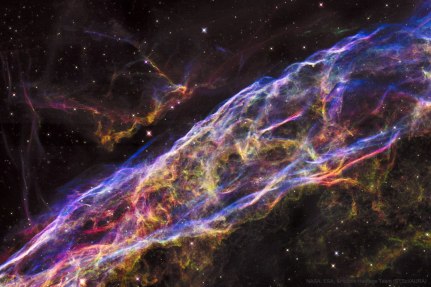
Astral bodies: comets, dwarf planets with eccentric orbits, frozen moons, glowing stars, haloes of hydrogen and helium illuminating jet black space, kindling wonder, launching dreams to mine the mysteries of nebulous interstellar dust, the Oort cloud, pulsing quasars, and rotating spiral galaxies tumbling through the universe, emitting visible and invisible wavelengths of light and X-rays, yielding amazement and awe, our zeal for discovery never-ending.
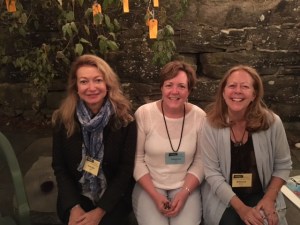
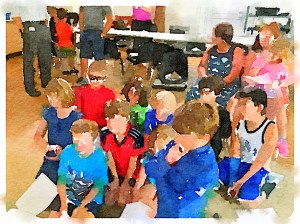
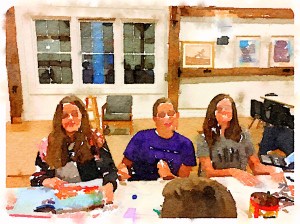
This picture, taken at the Highlights Foundation last year, popped up in my Facebook feed this morning:
What a magical few days I had there, spending time with Rebecca, Georgia and so many other Poetry Friday friends! It made me realize how far I’ve drifted from my poetry practice and how much I miss it. In “What to Remember When Waking,” David Whyte asks “What shape waits in the seed of you/to grow and spread its branches/against a future sky?” I love the endless possibilities contained in this question. With renewed resolve, I can’t wait to find out.
“What to Remember When Waking”
by David Whyte
In that first hardly noticed moment in which you wake,
coming back to this life from the other
more secret, moveable and frighteningly honest world
where everything began,
there is a small opening into the new day
which closes the moment you begin your plans.
What you can plan is too small for you to live.
What you can live wholeheartedly will make plans enough
for the vitality hidden in your sleep.
To be human is to become visible
while carrying what is hidden as a gift to others.
To remember the other world in this world
is to live in your true inheritance.
You are not a troubled guest on this earth,
you are not an accident amidst other accidents
you were invited from another and greater night
than the one from which you have just emerged.
Now, looking through the slanting light of the morning window
toward the mountain presence of everything that can be
what urgency calls you to your one love?
What shape waits in the seed of you
to grow and spread its branches
against a future sky?
This week I’ve been reading poemcrazy: freeing your life with words (1996) by Susan Goldmsith Wooldridge. I found this book as I was scrolling though my Twitter feed a few weeks ago. If you aren’t familiar with it, go find it now. You won’t be sorry.
Sometimes writing poems does drive me crazy, but this book makes you fall-in-love crazy about poetry. Wooldridge is a cheerful, enthusiastic teacher. In the first section of the book, “Following Words”, she urges us to collect words and “create a wordpool.” “The great thing about collecting words,” she writes, “is they’re free; you can borrow them, trade them in or toss them out.” Each short chapter is followed by suggestions for practice. This draft grew out of those suggestions.
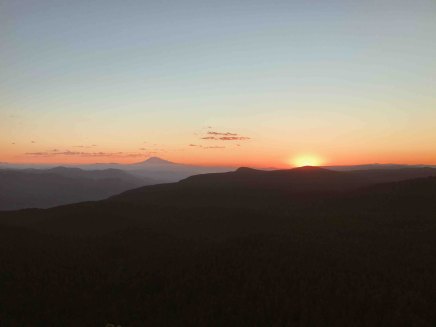
The canary sun sets the sky aglow, whispering pink at the edge of day like a conch, whispering the memory of ocean waves.
Photo by adrian via Unsplash
Please be sure to visit Matt Forrest Esenwine at Radio, Rhythm, & Rhyme for the Poetry Friday Roundup. And to all my friends around the country who are facing hurricanes or fires, please stay safe!
For many years, schools across the country have been participating in One School, One Book programs to promote a love of reading and build a reading community. After the Children’s Program Coordinator of our local library contacted our school to discuss ways we could join forces to encourage summer reading, we decided to sponsor a One School, One Book event.
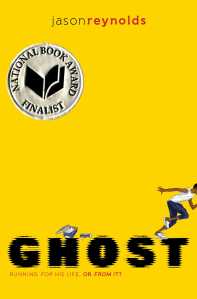
Or rather, a Two Schools, Two Books event. Because I teach in a K-8 school, finding one book for such a broad age range was a real challenge. So we split the school into elementary and middle school grades and chose two books. Students in the lower grades read Tamera Will Wissinger’s heartwarming Gone Fishing, while middle school students read Ghost, by Jason Reynolds. Every child received a copy of a book during the last week of school.
We met twice during the summer to celebrate these books and our reading. Taking a cue from poetry promoter extraordinaire, Sylvia Vardell, Gone Fishing readers made poem collages (scroll to the bottom of the post) for their favorite poems, then performed some of the poems for two (or three) voices. At our second get-together, the kids wrote acrostics and list poems about fishing or other favorite hobbies. The highlight of this evening was a Skype visit with Tamera. She shared that the idea for Gone Fishing grew out of one poem based on Tamera’s memories of going fishing with her family. Some brave poets then read their poems. Everyone was inspired to write more poems, and one lucky girl went home with a copy of Gone Camping, Tamera’s new book about Sam and Lucy.
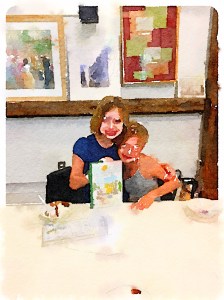
Proud poem collage creatorSkyping with Tamera
Readers of the National Book Award finalist, Ghost, by Jason Reynolds had two insightful discussions about Castle, the choices he made, and how he dealt with those choices. These middle schoolers loved performing some of their favorite scenes, especially Ghost’s blow-up at Brandon in the cafeteria. They also had fun making heart maps for Castle. Everyone was disappointed that Patina hadn’t been published yet (we met before the August 29th publication date), but had plenty of recommendations for other books they’d read over the summer.
All of our celebrations were topped off with ice cream sundaes, and everyone went home happy. Now that school has started, we’ve been discussing how the main characters of both books exhibit Sherman School’s core values of honesty, courage, responsibility, and respect. Based on the success of these celebrations, we’re hoping to make our version of One School, One Book an annual event.
Happiness is ice cream with a friend AND a new book!
Thank you also to Stacey, Betsy, Beth, Kathleen, Deb, Melanie, and Lanny for creating this community and providing this space for teachers and others to share their stories each Tuesday. Be sure to visit Two Writing Teachers to read more Slice of Life posts.
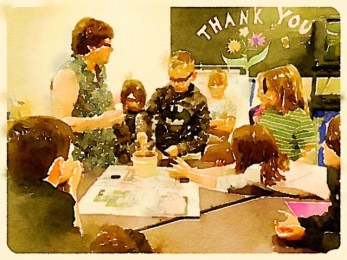
This fall I’m teaching a six-week exploratory course on gardening to 4th and 5th graders. Six weeks isn’t much time, but we’ve already suspended an avocado pit in water, planted oregano, and brainstormed a list of questions we want to answer. Later today we’ll be planting potatoes and next week we’re starting herb gardens.
Planting oregano (Thank you, Keri Snowden, for the photo!)
In addition to all these seeds sprouting, I’d like some writing to blossom during our course. A “things to do” list poem is a form we can collaborate on, and lends itself nicely to a short time frame. Here is a poem I drafted to use as a model.
Things to do if you’re a seed…
nestle into rich, warm soil soak up plenty of water swell like a sponge split your coat plunge thirsty roots deep into the earth poke an eager stem into the air sprout feathery leaves drink up the sun’s shimmering rays
“In music, in poetry, and in life, the rest, the pause, the slow movements are essential to comprehending the whole.” ~ Maryanne Wolf ~
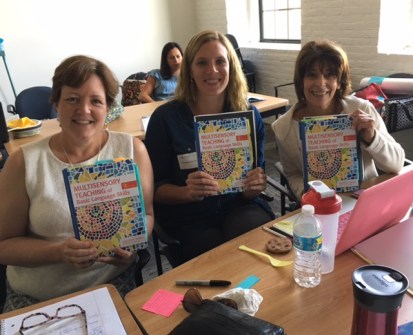
This past week, I attended a training institute on Structured Literacy Instruction. Although I may have grumbled a bit about the ninety minute drive, now that I’ve had time to rest and pause, I’ve realized the time spent learning with and from colleagues from across the state was both rewarding and enriching. I’ll be sifting through my notes and the presentation slides for weeks to come.
One of the requirements of the institute was to prepare a presentation on a chapter from Multisensory Teaching of Basic Language Skills, 3rd Edition, edited by Judith R. Birsh. At over 700 pages, this book is no light read, literally and figuratively! But, it is an important resource for all teachers. My group chose to present the chapter on vocabulary. We all know the impact of a deep vocabulary on reading comprehension, but some of the statistics shared were astounding. In 2006, Stahl & Nagy stated that “knowing individual word meanings is thought to account for as much as 50% of the variance in reading comprehension.”
Semantic relationships was discussed at length. Again, this is a topic that I know about and use with my students, but it was helpful to read again about the importance of developing our students’ “word consciousness,” or their “interest and awareness of words.” (Birsh, 339).
Poetry, of course, is ideal for developing all of these skills and more. As I was looking for a poem to share in our presentation to model these ideas, I stumbled across “School,” by David J. Langton. In the end, we chose Thunder Cake, by Patricia Polacco, but Langton’s poem is rich with possibility.
“School”
by David J. Langton
I was sent home the first day
with a note: Danny needs a ruler.
My father nodded, nothing seemed so apt.
School is for rules, countries need rulers,
graphs need graphing, the world is straight ahead.
“Education is the most powerful weapon which you can use to change the world.” ~ Nelson Mandela ~
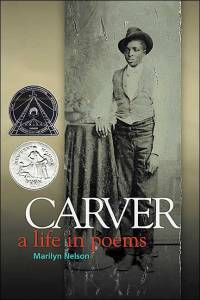
“1905” by Marilyn Nelson
Looking out of the front page, a wild-haired, gentle-eyed young German man stands before a blackboard of incomprehensible equations. Meanwhile, back in the quotidian, Carver takes the school to the poor.
He outfits an open truck with shelves for his jars of canned fruit and compost, bins for his croker sacks of seeds. He travels roads barely discernible on the county map, teaching former field-slaves how to weave ditch weeds into pretty table place mats, how to keep their sweet potatoes from rotting before winter hunger sets in, how to make preacher-pleasing mock fried chicken without slaughtering a laying hen. He notes patches of wild chicory the farmers could collect to free themselves from their taste for high-priced imported caffeine.
He and his student assistants bump along shoulder to shoulder in the high cab, a braided scale of laughter trailing above their raised dust.
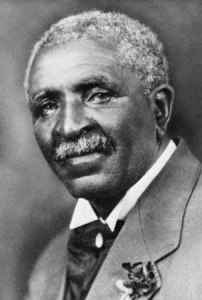
This poem is from Marilyn Nelson’s outstanding Carver: A Life in Poems. George Washington Carver, this poem, and the entire collection are a much-needed reminder of the power of what is possible. Please be sure to visit Kay McGriff at A Journey Through the Pages for the Poetry Friday Roundup.




 Reading to the Core