Slice of Life 19: Pumpkin Bread

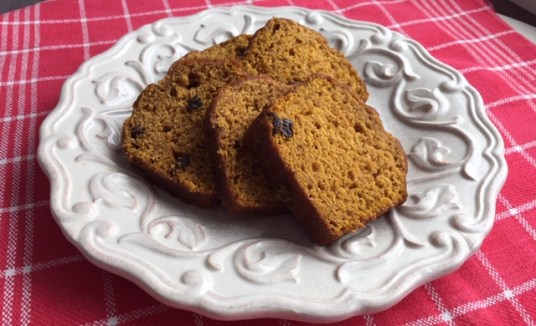
Yesterday, I wrote about the importance of choice. Sometimes that choice is within a broader topic. This poem is an example of that kind of choice. This month I am also participating in Laura Shovan’s “February” Poetry Project. (Why we’re doing it in March is a long story.) The theme this year is food, and yesterday Laura shared a picture of sourdough bread as a prompt. She also offered the alternative to write about a “bread of your choosing.” Since I don’t have much experience with sourdough bread, and have been baking pumpkin bread every year for almost forty years, this was an obvious substitution. Like the goal of writing a daily slice of life, the goal of Laura’s project “is to practice the habit of writing regularly…so that we can focus on generating ideas.” I may return to this poem to rework the ending, or I may not. I did enjoy the process of writing, and the piece of pumpkin bread (from a loaf hidden in the freezer) I ate to help me write it!

Pumpkin Bread

In November,
After the geese have flown south
And only brown oak leaves
Still cling to tree limbs,
It’s time to make pumpkin bread.

The cookbook falls open
To the recipe,
Spattered and stained
From thirty years of use.
The heady scent of cinnamon
And cloves fills the kitchen
As ingredients mix and meld
Into honey-colored batter.

I fill the pans, like a bee
Filling honeycombs.
Then into the oven, where
The golden glop transforms
Into loaves of amber sweetness
That we will devour
When they cool.

© Catherine Flynn, 2019
Thank you to StaceyBetsyBethKathleenDebKelseyMelanie, and Lanny for creating this community and providing this space for teachers and others to share their stories every day in March and each Tuesday throughout the year. Be sure to visit Two Writing Teachers to read more Slice of Life posts.
Poetry Friday: Robins


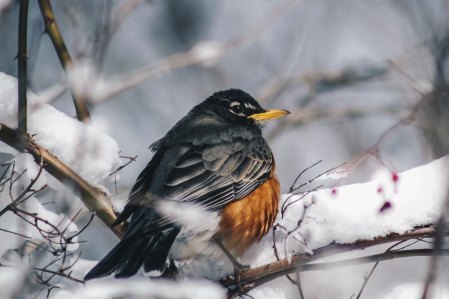
As I left school one afternoon last week, snow had just started falling and an icy wind was picking up. Suddenly, six or seven robins flew across the parking lot, landing in a tree at the edge of the playground. The sight filled me with hope that spring will be here soon.  Here is a poem those robins inspired.

Robins,
plump and ruffled
against the snow,
swoop,
perch;
a maple tree
bursts into bloom.

© Catherine Flynn, 2019

Valerie Worth’s poem, “Robins,” also expresses the delight of the return of these harbingers of spring.

Look how
Last year’s
Leaves, faded
So gray
And brown,

Blunder
Along
Like flimsy
Flightless
Birds,

Stumbling
Beak over
Tail
Before
The wind.

But no,
Wait:
Today
They right
Themselves,

And turn
To the
Stout slate
And ruddy
Rust

Of robins,
Running
On steady
Stems across
The ground.


Photo by Jedidiah Church on Unsplash

Don’t forget that next Friday, March 8th, is International Women’s Day. I’ll be hosting the Roundup that day and would love it if people help to celebrate the day by sharing poems that honor women. You can read more here.  Please be sure to visit Linda at Teacher Dance for the Poetry Friday Roundup.

Poetry Friday: “For You”

Like many of you, I was deeply saddened to learn of Paul B. Janeczko’s death earlier this week. Although I never met Mr. Janeczko, I feel like he was an old friend. His books have been a staple in my classroom since I began teaching and have guided and inspired my own writing. Last night, I spent the evening poring over favorite titles, trying to decide what would be a fitting tribute. In the end, I chose “For You,” by Karla Kuskin, which is included in Poetry From A to Z: A Guide for Young Writers (Simon & Schuster, 1994). This poem is especially poignant for me because my sweet orange cat Noodles passed away just a few weeks ago.

For You
by Karla Kuskin

Here is a building
I have built for you.
The bricks are butter yellow.
Every window shines.
And at each an orange cat is curled,
lulled by summer sun.
The door invites you in.
The mat is warm.
Inside there is a chair
so soft and blue
the pillows look like sky.
In all the world
no one but you
may sit in that cloud chair.
I’ll sit near by.

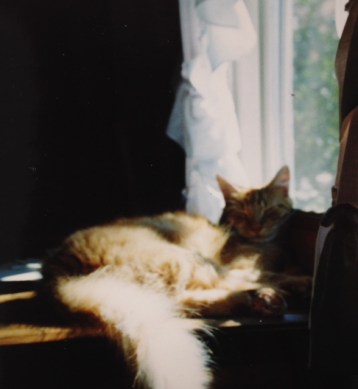
Noodles “lulled by the summer sun.”

There are just two more weeks until March 8th, International Women’s Day. I’ll be hosting the Roundup that day and would love it if people help to celebrate the day by sharing poems that honor women. You can read more here. In the meantime, please be sure to visit Robyn Hood Black at Life on the Deckle Edge for the Poetry Friday Roundup.

Poetry Friday: A Harbinger of Hope


As seen on my drive to work earlier this week:

a ribbon of rainbow
peeks through gray clouds
a harbinger of hope

© Catherine Flynn, 2019

Laura Purdie Salas is hosting the Poetry Friday Roundup today at Writing the World for Kids. Be sure to stop by to read more poetry and to help Laura celebrate the publication of her new book, Snowman – Cold = Puddle. And although this may be a little obvious, my haiku could easily be transformed into an equation poem:

showers + sunbeams = rainbow

Photo by Karen Cantú Q on Unsplash

Poetry Friday: My Grandmother Making Breakfast

Last week, I shared some gleanings from poet and teacher Gregory Orr’s book A Primer for Poets and Readers of Poetry, specifically his thoughts about the distinction between lyric and narrative poetry. Orr acknowledges that these two poetic forms occur along a continuum, with very few poems being purely one or the other. He also observes that while “most poetry readers and writers have shifted toward lyric,

The narrative impulse is still powerfully present in all of us as a fundamental way of organizing experience into meaning.”

Orr includes an exercise at the end of this chapter, challenging his readers to write a narrative poem. He suggests writers “choose a figure who is known to you…then imagine that figure in a context.” Once you have these basic elements, “add yourself to the situation” and keep asking “what happens next?”

This poem is my response to the exercise. As with any prompt, I bent the rules a little, but kept true to Orr’s direction to “narrow the focus.”

My Grandmother Making Breakfast

She stands at the stove
in the center of her kitchen,
cracking eggs
into a cast iron frying pan.

I sit at her drop-front desk
in the corner by the window,
perched on a yellow stool,
trying to shuffle cards
in a collapsing arch,
the way my father does.

She stirs the eggs,
their sunflower yolks blooming
into the black pan.

My attention is on the cards,
my ten-year old hands
not quite dexterous enough
to manage the trick
of mingling and
mixing them.

Meanwhile, my grandmother
adds salt and pepper to the eggs,
now coalescing into fluffy mounds
and the warmth of the stove radiates
throughout the kitchen.

Soon, she will spoon our breakfast
onto flowered plates.
The cards will be scattered
on the desk, forgotten for now.

We will sit and eat.
She will sip her coffee;
I will sip Hi-C  from a glass
that once held shrimp cocktail.

But for now,
we are both focused
on the task at hand,
lost in our thoughts,
content to be alone
together.

© Catherine Flynn, 2019

Please be sure to visit Tabatha Yeatts at The Opposite of Indifference for the Poetry Friday Roundup.

Just a reminder about the Roundup on International Women’s Day (March 8th). I’m hosting that day thought it would be appropriate to celebrate the day by sharing poems that honor women. These could be original poems or poems written by others. They could be poems about an important woman in your life who deserves to be celebrated, someone famous, an unsung woman of historical significance, or a poem by your favorite female poet. The choice is yours. So please feel free to participate (or not) in any way that feels right to you. 

Poetry Friday: “Daybreak”


Over the past few weeks, I’ve been reading A Primer for Poets and Readers of Poetry, by Gregory Orr. In the Preface, Orr describes the book as “one poet’s informal exploration of language and self in relation to the impulse to write lyric poetry.” The book includes in-depth analysis of poems through different lenses, as well as prompts and exercises. I found the chapter “Lyric and Narrative: Two Fundamental Ordering Impulses” especially thought-provoking. Orr offers this fundamental distinction between the two:

The narrative poem is searching for something and won’t be happy (complete, unified) until it has found it. By contrast, the lyric poem has a different shape. It constellates around a single center. (p. 82)

Orr goes on to describe the shape a lyric poem as “that of a snowflake or crystal–an intense geometric concentration around a center.”

Isn’t that a wonderful image? As often happens, while searching for one poem, I found another. Although I’ve read and loved “Daybreak” by Galway Kinnell many times, this week I read it with a new appreciation for how Kinnell’s words “constellate around a single center.”

“Daybreak”
by Galway Kinnell

On the tidal mud, just before sunset,
dozens of starfishes
were creeping. It was
as though the mud were a sky
and enormous, imperfect stars
moved across it slowly
as the actual stars cross heaven.
All at once they stopped,
and as if they had simply
increased their receptivity
to gravity they sank down
into the mud; they faded down
into it and lay still; and by the time
pink of sunset broke across them
they were as invisible
as the true stars at daybreak.


Please be sure to visit Tara Smith at Going to Walden for the Poetry Friday Roundup.

Poetry Friday: “Instructions For A Life”

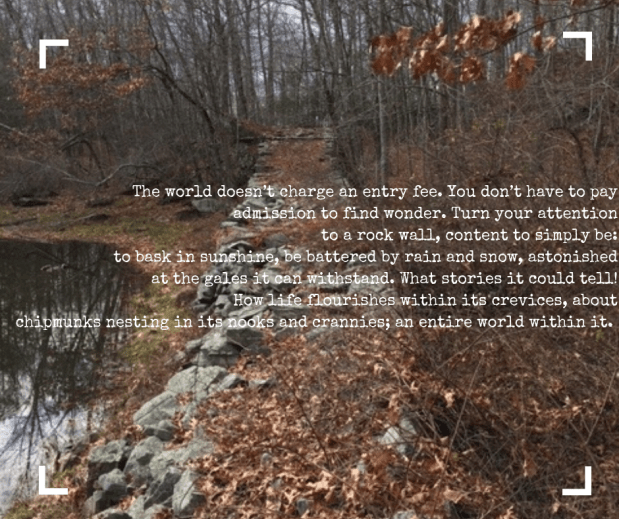
Today I’m joining millions of people in mourning the passing of poet Mary Oliver. Oliver’s poems, essays, and interviews comprise a master class not only in being a poet, but in being a better human. She taught us to live with our eyes, ears, and hearts always open to the multitudes of wonders and possibilities present in the world.  It would be impossible for me to choose a favorite poem or even passage. So instead, I’ve taken the seven magically simple words that make up “Instructions For A Life” and created a Golden Shovel:

“Pay attention. Be astonished. Tell about it.”
Mary Oliver
1935-2019


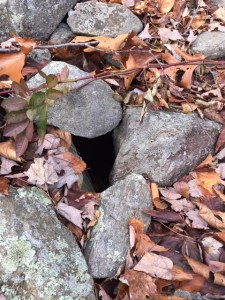
Someone’s not-so-hidden entrance in this ancient rock wall in the woods behind my house.

Thank you, Mary Oliver, for so generously sharing your poetry, wisdom and love of our magnificent world. You will be missed. Please be sure to visit Tricia Stohr-Hunt at The Miss Rumphius Effect for the Poetry Friday Roundup.

Poetry Friday: “I Was an Artist”

“Astonishment is the proper response to reality.”
~ Terence McKenna ~

This week, two astonishing yet unrelated news items filled me with wonder. The first was about the discovery of a series of “high-speed bursts of radio waves coming from deep space”.  The second was the story of the discovery of lapis lazuli in the teeth of a medieval nun. Somehow these amazing stories converged into this draft of a poem.

Hardly a trace
of her bustling world remains.

But there, cradled within her teeth,
flecks of brilliant ultramarine
cry out,
like a signal, bursting,
hurdling across space,
across time
until its pulse
is captured,

a forgotten voice
announcing,
“I was an artist.”

© Catherine Flynn, 2019

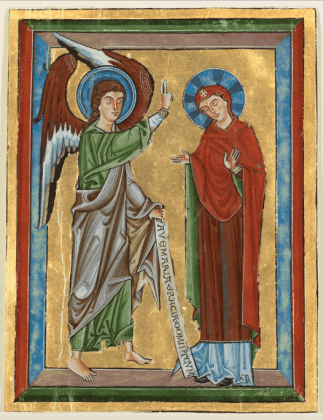
Unknown
The Annunciation, about 1240, Tempera colors, gold leaf, and iron gall ink on parchment
Leaf: 17.8 × 13.5 cm (7 × 5 5/16 in.), Ms. 4, leaf 1
The J. Paul Getty Museum, Los Angeles

In case you missed it, last week I suggested a Poetry Friday celebration of women when I host the Roundup on March 8th, which is International Women’s Day. You can find all the details here. Please be sure to visit Kathryn Apel for the Poetry Friday Roundup!


Slice of Life: Not Procrastinating

Just do it. Put your butt in the chair and write. So here I am, sitting in a chair, writing. I have a project I’ve been working on for several years that is nearing completion. An endless list of writing ideas for poems, picture books, and more. No more procrastinating.

This weekend, before I decided to stop procrastinating, I cleaned out my email inbox. (Is there such a thing as productive procrastination?) As I scanned the subject lines, certain words began to grab my attention. Simple words, but all words are full of possibilities, aren’t they? Soon, I had a list of more than twenty words in my notebook. Before I knew it, the words were arranging themselves into a poem.

There are many variations of found poetry. Some retain the word order as it appeared in an original text; others are more flexible. Because I found these words in email subject lines, I felt free to rearrange the order and add articles and small words such as to. Besides, keeping the beginning of the list in order resulted in this:

Today, hours
Are free.
The code
Is yours,
Waiting

Here

Here

Here.

If only!

Here is another poem I drafted with the found words from my email subject lines:

Seeds lie hidden
in books:
A collection, a code
waiting
to reveal
hidden gifts
for each soul
lucky enough
not to miss

the miracle.

Happy writing, everyone. Keep an eye out for those miracles!

Thank you to StaceyBetsyBethKathleenDebKelseyMelanie, and Lanny for creating this community and providing this space for teachers and others to share their stories every Tuesday. Be sure to visit Two Writing Teachers to read more Slice of Life posts.
Poetry Friday: Strong Women

Happy New Year to all my Poetry Friday friends! As I was entering important dates into my new desk calendar, I discovered that, by pure coincidence, I am hosting the Poetry Friday Roundup on International Women’s Day (March 8th). I thought it would be appropriate to celebrate the day by sharing poems that honor women. These could be original poems or poems written by others. They could be poems about an important woman in your life who deserves to be celebrated, someone famous, an unsung woman of historical significance, or a poem by your favorite female poet. The choice is yours. So please feel free to participate (or not) in any way that feels right to you. I’ll post a few reminders between now and March 8th.

The theme of this year’s celebration is #BalanceforBetter. In 2017, I wrote this poem celebrating the women in my life who helped me be a better person. (You can read the original post here.)

Strong women taught me
how to knit, to bake,
to cook and sew.

Strong women taught me
how to love, to live
through strife and woe.

Strong women taught me
not to count
on others for my bread.

Strong women taught me
to rely
on my own wits instead.

Strong women taught me
to be brave when lies
and hate are spread.

Strong women taught me
how to think, to stand
for what is right.

Strong women taught me
to be kind, to fill
the world with light.

© Catherine Flynn, 2017

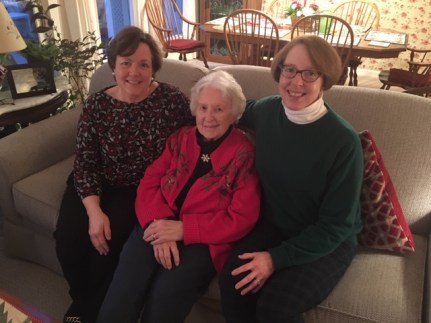
With my sister and mother, still going strong at 81, on Christmas day.

Please be sure to visit Sylvia Vardell at Poetry for Children for the Poetry Friday Roundup.