News From the Natural World: Jewel of the Jungle

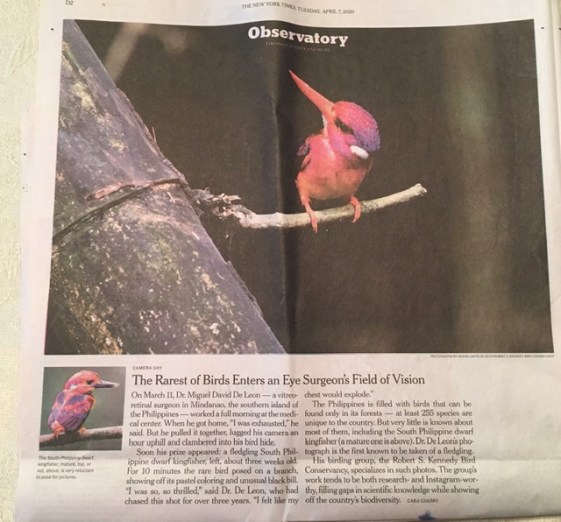
Every Tuesday, the New York Times has a section devoted to science. When I opened the paper yesterday and saw this photo, I knew I had to write a poem about this enchanting little bird!

You can read an expanded version of this article here. This story was also featured in Esquire.

“Jewel of the Jungle”
(South Philippine Dwarf Kingfisher)

Hidden deep within a jungle
of the far-off Philippines
lives a bird so small and shy
she’s hardly ever seen.

Adorned in the colors of sunset,
streaked purple, orange, gold,
with bright black eyes that shine like night,
she’s a dazzling sight to behold.

Zipping, darting through the trees
finding insects for each meal,
she grabs them in her dagger-like bill,
then gulps them down with zeal.

Her jungle home is threatened
by our axes and our brawn.
Let’s stop this mad destruction
Before her habitat is gone.

Draft © Catherine Flynn, 2020

Other “News From the Natural World” poems:

April 5: Phantom of the Forest
April 4: To Build a Nest
April 3: Apple Cake
April 2: Specimen
April 1: Forest Snail

Yesterday, I contributed a line to the Kidlitosphere Progressive Poem. Find out which of my lines Tara Smith chose here, then follow the progress of this year’s “choose your own adventure” version of the poem at the links below.

1 Donna Smith at Mainely Write
2 Irene Latham at Live Your Poem
3 Jone MacCulloch, deowriter
Liz Steinglass
Buffy Silverman
Kay McGriff
7 Catherine Flynn at Reading to the Core
8 Tara Smith at Going to Walden
9 Carol Varsalona at Beyond Literacy Link
10 Matt Forrest Esenwine at Radio, Rhythm, and Rhyme
11 Janet Fagel, hosted at Reflections on the Teche
12 Linda Mitchell at A Word Edgewise
13 Kat Apel at Kat Whiskers
14 Margaret at Reflections on the Teche
15 Leigh Anne Eck at A Day in the Life
16 Linda Baie at Teacher Dance
17 Heidi Mordhorst at My Juicy Little Universe
18 Mary Lee Hahn at A Year of Reading
19 Tabatha at Opposite of Indifference
20 Rose Cappelli at Imagine the Possibilities
21 Janice Scully at Salt City Verse
22 Julieanne Harmatz at To Read, To Write, To Be
23 Ruth, thereisnosuchthingasagodforsakentown.blogspot.com
24 Christie Wyman at Wondering and Wandering
25 Amy at The Poem Farm
26 Dani Burtsfield at Doing the Work That Matters
27 Robyn Hood Black at Life on the Deckle Edge
28
29 Fran Haley at lit bits and pieces
30 Michelle Kogan
National Poetry Month: The Progressive Poem

Welcome to day 7 of the Progressive Poem! Started by Irene Latham,

the Kidlitosphere Progressive Poem began in 2012 as a way to celebrate National Poetry Month (April) as a community of writers.

This year, Margaret Simon generously volunteered to organize the poem. This is only my second year taking part in the poem. I always felt overwhelmed by the responsibility of providing a line to a group poem. Donna Smith upped the ante this year by providing two lines for Irene to choose from for the first line of this year’s poem. Irene liked this idea, so our “choose your own adventure” poem continues. 

Yesterday, Kay McGriff offered these two lines for me to pick from:

deep into nature’s peaceful cocoon (Option A)
OR
and echo the call of a wandering loon (Option B)

I love music and loons, so I didn’t have to think too long before choosing Option B. What has taken me almost all day was coming up with two choices for Tara Smith.

Here is the entire poem as of today, followed by my two line options for Tara.

Sweet violets shimmy, daffodils sway
along the wiregrass path to the lake.
I carry a rucksack of tasty cakes
and a banjo passed down from my gram.

I follow the tracks of deer and raccoon
and echo the call of a wandering loon.

A whispering breeze joins in our song (Option A)

OR

I step onto warm sand, strumming my tune (Option B)

I can’t wait to see which line Tara chooses! Find out tomorrow at her lovely blog, Going to Walden.

Here is the entire line up for this year’s poem:

1 Donna Smith at Mainely Write
2 Irene Latham at Live Your Poem
3 Jone MacCulloch, deowriter
Liz Steinglass
Buffy Silverman
6 Kay McGriff
7 Catherine Flynn at Reading to the Core
8 Tara Smith at Going to Walden
9 Carol Varsalona at Beyond Literacy Link
10 Matt Forrest Esenwine at Radio, Rhythm, and Rhyme
11 Janet Fagel, hosted at Reflections on the Teche
12 Linda Mitchell at A Word Edgewise
13 Kat Apel at Kat Whiskers
14 Margaret at Reflections on the Teche
15 Leigh Anne Eck at A Day in the Life
16 Linda Baie at Teacher Dance
17 Heidi Mordhorst at My Juicy Little Universe
18 Mary Lee Hahn at A Year of Reading
19 Tabatha at Opposite of Indifference
20 Rose Cappelli at Imagine the Possibilities
21 Janice Scully at Salt City Verse
22 Julieanne Harmatz at To Read, To Write, To Be
23 Ruth, thereisnosuchthingasagodforsakentown.blogspot.com
24 Christie Wyman at Wondering and Wandering
25 Amy at The Poem Farm
26 Dani Burtsfield at Doing the Work That Matters
27 Robyn Hood Black at Life on the Deckle Edge
28
29 Fran Haley at lit bits and pieces
30 Michelle Kogan
News From the Natural World: Phantom of the Forest

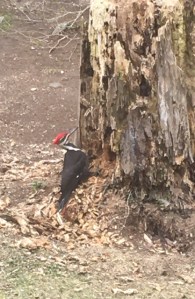
Today’s poem was inspired by the pileated woodpecker who was breakfasting at a stump in my yard this morning.

Our resident pileated woodpecker

Phantom of the forest,
you swoop into a clearing
on silky black feathers,
white epaulets flashing on
broad wings.

You set to work at once,
drilling, gouging, chiseling
precise rectangles in
a soft, decaying stump.

Your noble head,
capped by a lick of flame,
bobs up and down.
You pause to swallow
termite, ant, or beetle,
savory and satisfying.

Full for now, you’re gone
in a sudden swirl of black
and white and red.
Phantom of the forest.

Draft, © Catherine Flynn, 2020

Other “News From the Natural World” poems:

April 4: To Build a Nest
April 3: Apple Cake
April 2: Specimen
April 1: Forest Snail

Find links to more National Poetry Month Projects at Jama’s Alphabet Soup. Also, you can follow the progress of the Progressive poem at the links below:

1 Donna Smith at Mainely Write
2 Irene Latham at Live Your Poem
3 Jone MacCulloch, deowriter
Liz Steinglass
Buffy Silverman
6 Kay McGriff
7 Catherine Flynn at Reading to the Core
8 Tara Smith at Going to Walden
9 Carol Varsalona at Beyond Literacy Link
10 Matt Forrest Esenwine at Radio, Rhythm, and Rhyme
11 Janet Fagel, hosted at Reflections on the Teche
12 Linda Mitchell at A Word Edgewise
13 Kat Apel at Kat Whiskers
14 Margaret at Reflections on the Teche
15 Leigh Anne Eck at A Day in the Life
16 Linda Baie at Teacher Dance
17 Heidi Mordhorst at My Juicy Little Universe
18 Mary Lee Hahn at A Year of Reading
19 Tabatha at Opposite of Indifference
20 Rose Cappelli at Imagine the Possibilities
21 Janice Scully at Salt City Verse
22 Julieanne Harmatz at To Read, To Write, To Be
23 Ruth, thereisnosuchthingasagodforsakentown.blogspot.com
24 Christie Wyman at Wondering and Wandering
25 Amy at The Poem Farm
26 Dani Burtsfield at Doing the Work That Matters
27 Robyn Hood Black at Life on the Deckle Edge
28
29 Fran Haley at lit bits and pieces
30 Michelle Kogan
News From the Natural World: To Build a Nest

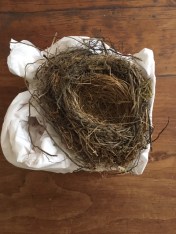
Today’s poem was inspired by a recent article in the New York Times,Why Birds Are the World’s Best Engineers,” a post from the National Audubon Society, “What Nesting Materials Are Safe for Birds?” and this nest, which my boys found in our yard many years ago:

To Build a Nest

When spring arrives
and days grow warm,
Mother robin knows
it’s time to build her nest.

Searching woods and
fallow fields, she scavenges
dried twigs and vines
to build her sturdy nest.

Slowly, slowly, surely,
she presses tangled
scraps and stalks
into a cozy nest.

She daubs the rim
and fills small gaps
with bits of goopy mud
to reinforce her nest.

Inside the cup, a woven whirl
of soft dry grass will
cushion cyan blue eggs
that soon will fill her nest.

Draft, © Catherine Flynn, 2020

Other “News From the Natural World” poems:

April 3: Apple Cake
April 2: Specimen
April 1: Forest Snail

Find links to more National Poetry Month Projects at Jama’s Alphabet Soup. Also, you can follow the progress of the Progressive poem at the links below:

1 Donna Smith at Mainely Write
2 Irene Latham at Live Your Poem
3 Jone MacCulloch, deowriter
Liz Steinglass
Buffy Silverman
6 Kay McGriff at https://kaymcgriff.edublogs.org/
7 Catherine Flynn at Reading to the Core
8 Tara Smith at Going to Walden
9 Carol Varsalona at Beyond Literacy Link
10 Matt Forrest Esenwine at Radio, Rhythm, and Rhyme
11 Janet Fagel, hosted at Reflections on the Teche
12 Linda Mitchell at A Word Edgewise
13 Kat Apel at Kat Whiskers
14 Margaret at Reflections on the Teche
15 Leigh Anne Eck at A Day in the Life
16 Linda Baie at Teacher Dance
17 Heidi Mordhorst at My Juicy Little Universe
18 Mary Lee Hahn at A Year of Reading
19 Tabatha at Opposite of Indifference
20 Rose Cappelli at Imagine the Possibilities
21 Janice Scully at Salt City Verse
22 Julieanne Harmatz at To Read, To Write, To Be
23 Ruth, thereisnosuchthingasagodforsakentown.blogspot.com
24 Christie Wyman at Wondering and Wandering
25 Amy at The Poem Farm
26 Dani Burtsfield at Doing the Work That Matters
27 Robyn Hood Black at Life on the Deckle Edge
28
29 Fran Haley at lit bits and pieces
30 Michelle Kogan
News From the Natural World: Apple Cake

   .   

Heidi Mordhorst is hosting the first roundup of National Poetry Month at My Juicy Little Universe. Be sure to visit her there. It’s also time for another Sunday Night Swagger challenge. Here is Heidi’s description:

Linda Mitchell of A Word Edgewise has challenged the Sunday Swaggers to participate in the poets.org #ShelterInPoems project, which asks us to “share a poem that helps to find courage, solace and actionable energy, and a few words about how or why it does so.”

After spending time browsing through poets.org, I chose “The Wings of Daylight,” by W.S. Merwin. In lines like “what we see that one time departs untouched,” Merwin reminds us of the ephemeral nature of our days. He’s urging us to recognize these fleeting splendors, and appreciate the abundant gifts of our lives, a message made even more important during these tumultuous times. Most importantly, although this poem is filled with shadows, it begins and ends with light, which gives me hope.

The Wings of Daylight
By W.S. Merwin

Brightness appears showing us everything
it reveals the splendors it calls everything
but shows it to each of us alone
and only once and only to look at
not to touch or hold in our shadows

Read the rest of the poem here.

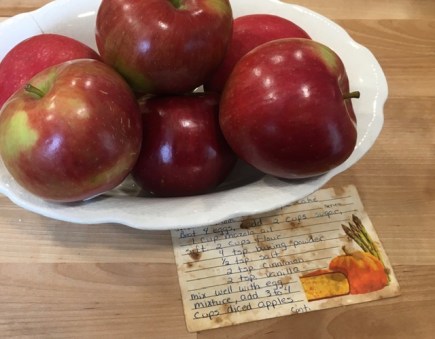
Linda’s original challenge was to write a poem inspired by a hand-written recipe. To keep my News From the Natural World project going, I adapted the first two lines of Merwin’s poem as a jumping off point for a poem responding to Linda’s original challenge.

Apple Cake

Brightness reveals the splendor of everything:

Ripe apples in a bowl, washed and ready to peel
Eggs, oil, vanilla, fine, silky flour
Cinnamon, baking powder, salt

Simple ingredients,
Mixed together since the dawn of time,
Transformed by heat
into treasure.

Alchemy or chemistry?
Who’s to say?
Either way, for a moment
the shadows
are gone.

Draft © Catherine Flynn, 2020

Other “News From the Natural World” poems:

April 2: Specimen
April 1: Forest Snail

News From the Natural World: Specimen

Today’s poem was inspired by Lab Girl, by Hope Jahren, The Overstory, by Richard Powers, and The Hidden Life of Trees, by Peter Wohlleben.

“Specimen” (with a nod to Walt Whitman)

On a summer day, sit against a tree
in the shade of its vibrant green umbrella.

Settle into the peace of the day.
A slight breeze ruffles the leaves.

And then everything seems still.
But appearances are deceiving.

Beneath the scaly bark,
Water is being drawn up, up, up.

In the leaves above, sunlight stirs cells,
creating a coursing stream of sugar.

This fresh new food is pumping
through every part of the silent giant.

Grass tickles the back of bare legs.
Listen for the hum of life.

A whole hidden world
lies just beneath the soil.

Roots and mycorrhizal networks
branch off in every direction.

Sharing food, sending messages,
Communicating, cooperating.

Quietly going about the business
Of making life on earth possible.

Catherine Flynn, Draft @ 2020

Photo by Jan Huber on Unsplash

National Poetry Month: News From the Natural World

“Get curious. Go deep. Feel.
Explore.
Create new paths.”
Johanna Wright

It’s April 1st, the first day of National Poetry Month, the first full month of spring, and the first day of our first full month of quarantine. So it’s hard to say Happy 1st day of April as we ordinarily would. And yet, the blessing of our ability to connect through this amazing technology is something to be happy about. How lucky we are to have thousands and thousands of poems at our fingertips to read and savor and find comfort in.

Many poets of the Kidlitosphere undertake a poetry project each April. In the past I have joined in when I could, but haven’t ever committed to a project of my own before. And although figuring out how to teach online has a steep learning curve, I do have a bit more free time I normally would. So if not this year, when?

On a recent episode of the Ted Talk Radio Hour, Enrico Ramirez Ruiz, an astrophysicist who describes himself as a “stellar mortician,” explained that “we are all atomically connected, fundamentally, universally.” My aim is to focus on some element of the natural world and find those connections, and within them, find tolerance and understanding. Should be a snap, don’t you think? I have no idea where all this will lead, so thank you in advance for your patience. I’m sure there will be false starts and changes along the way, but isn’t that true of all adventures?

Today’s poem was inspired by “Lessons In Being Alone, From A Woodland Snail,” a recent episode of NPR’s podcast, “Short Wave.

Forest Snail

In the soft glow
of a quarter moon,
a solitary snails
glides through
the forest
on a trail of slime.

She finds a patch
of wild violets
and slowly munches
on fallen petals.

When she is full,
she withdraws
into the comfort
of her shell,
a ribboned reflection
of the moon above.

Draft © Catherine Flynn, 2020

Charles J Sharp / CC BY-SA (https://creativecommons.org/licenses/by-sa/3.0)

If you’d like to read more, Jama Rattigan has generously devoted much time and energy to curate a page of links to many National Poetry Month projects.


Poetry Friday: The Comfort of Pie

Tomorrow is Pi day (3.14). We were going to celebrate at school today with a smorgasbord of pies. Instead, we are all home, hoping that closing our school will help prevent the spread of the coronavirus. We received word last night, before I made the chocolate cream pie my family loves. I was still too filled with worry and the stress of the week to bake last night. I may make it later this afternoon. After all, a piece of pie seems like a reasonable way to soothe the soul. 

We were also going to write Pi poems with the kids today, so I went ahead and wrote one that I hope I will be able to share with them soon. 

Chocolate
pie,
topped with dollops
of
whipped cream; nestled in
a crust of chocolaty crumbs. Divine.

From House of Nash Eats. Here’s their recipe: https://houseofnasheats.com/chocolate-cream-pie/.

Be well, my friends.

Please be sure to visit Matt Forrest Esenwine at Radio, Rhythm, and Rhyme for the Poetry Friday Roundup.

Here are other Pi day poems I’ve written over the last few years:

2018
2017
2016

Poetry Friday: The Question is Why

I spend my days helping kids learn to read. This is incredibly rewarding, but given the nature of how we learn, it can also be frustrating. Kids may read words with long vowels effortlessly one day, then forget they exist the next. So when one of my students was unable to read the word why (a word she knew the day before) not once, not twice, but three times in a row, I knew she needed a poem starring the word why!

There are at least 100 books of poetry in my classroom. I know I’ve seen a why poem somewhere. But after searching through the most likely volumes, I had nothing. Rather than spend any more time looking, I decided to write one. I quickly jotted down a list of why questions, using words that included a number of different phonics patterns we’ve worked on recently. She read it beautifully and loved it.

Fast forward to Sunday. As I was getting ready to meet with the Sunday Night Swaggers, I realized that our monthly challenge was coming up this week! I didn’t even remember what challenge Margaret had posed. A question poem! What on earth could I write about? I’m embarrassed to admit that it took me a few minutes to realize I’d already written one!

This draft is a more polished version of the poem I wrote for my student. It’s not perfect, but she likes it. And she now knows the word why.

Why?

Why do ships sail on the sea?
Why is the sky so blue?
Why do fish swim in the pond?
How I wish I knew!

Why does the moon shine at night?
Why is the grass so green?
Why do bees buzz in the garden?
Why won’t my room stay clean?

Why do ducks say quack, quack, quack?
Why can’t I answer back?

Draft © 2020, Catherine Flynn

Photo by Jenny Bess on Unsplash

What questions are my fellow swaggers asking? Find out by visiting their blogs:

Molly Hogan at Nix the Comfort Zone
Linda Mitchell at A Word Edgewise
Heidi Mordhorst at My Juicy Little Universe
Margaret Simon at Reflections on the Teche

Then head over to Rebecca Herzog’s blog, Sloth Reads, for the Poetry Friday Roundup.

In case you missed it earlier in the week, there is still time to be entered in my giveaway of David L. Harrison’s new book, After Dark. Read my post about using this book in the classroom here.

After Dark Blog Tour: The Final Stop

Welcome to the final stop on the blog tour celebrating the publication of After Dark: Poems About Nocturnal Animals, David L. Harrison’s 97th book! Congratulations, David! I am honored to be part of the festivities. Be sure to visit the previous stops (links below) on the tour for interviews with David about where he gets his ideas, his creative process, and more.

Over at No Water River, David told Renée LaTulippe that “being fascinated with the universe” is one of the major influences on his poetry. This fascination is contagious and shines brightly on every page of this gorgeous book. 

One sure-fire way to build students’ curiosity is to introduce topics through poetry. Which is why I was so excited to share After Dark with my students. Each of the 21 poems highlights the nocturnal comings and goings of familiar animals. The beauty of sharing these poems is that they are about animals children will recognize, but will extend their knowledge in playful and engaging ways.

David’s masterful poetry builds vocabulary and will foster a love of language in readers of all ages. First graders loved “Owl Rules,” a perfect mentor text for young writers. They will use this poem to organize what they have learned about animals they are studying. David’s categories are full of humor: “Never work for food,” “Eat whatever,” “Who needs a nest?” and “Tease campers.” Children will be able to adapt these categories or create their own.

Eighth grade students I work with are currently reading A Midsummer Night’s Dream. They quickly recognized similarities between Shakespeare’s play and “The Queen,” which is filled with rich and royal vocabulary: regal, ermine, suitors, serene.

“The Queen”
(Luna Moth)

Like regal monarch of the night
or fairy in the airy light,
richly robed in ermine white,
winged in velvet royal green.

Suitors you have never seen
find you here in woods serene.
You’ve much to do before the dawn
so when your fleeting life is gone,
future queens can carry on.

© David L. Harrison, 2020

Examples of poetic techniques also abound in After Dark. The rambunctious “growly, pouncy, bitey games” played by wolf pups in “The Rehearsal” is a great example of creating adjectives and making words rhyme. My students are excited to try this themselves! Other favorites, “Toothy Grin,” “The King,” and “Hear This! Hear This” focus on prominent features of the kit fox, the Mexican red-knee tarantula, and spring peepers, then emphasize them through repetition. This poetic technique is one that young writers can easily imitate. The possibilities are truly endless!

Observation is the best way to learn about an animal’s behavior and get ideas about a behavior to focus on in their poem. If heading outside to explore isn’t an option, critter cams are a great way to bring the hidden world of animals into your classroom and spark student writing. 

Stephanie Laberis’s expressive digital illustrations are filled with details that are perfectly suited to the personality David emphasizes in each poem. There are two pages of additional facts about each animal at the end of the book. Students could use these fascinating facts in their own poems.

Boyds Mills & Kane has generously donated a copy of After Dark to one lucky reader of today’s post. Thank you! To be entered in the drawing, leave a comment by Saturday, March 7th. If I pick your name at random, a copy of this delightful book will soon be on its way to you. Thank you, David, for inviting me to join in the fun, and for all your wonderful poetry!

Previous stops on the After Dark Blog Tour:

Writing and Illustrating

Beyond Literacy Link

Read, Learn, and be Happy

Poetry for Children

Teacher Dance

Michelle Kogan

Salt City Verse

Reflections on the Teche

Simply 7 Interview

No Water River

A Word Edgewise

Radio, Rhythm & Rhyme

Live Your Poem