Slice 2013 4 of 31: It’s Monday! What Am I Doing?

Image

I’ve made it to day 4! But that was mostly over the weekend. Today the real challenge begins. Will I be able to keep up daily blogging during the week? I came up with a tentative plan to help me accomplish this. Monday shouldn’t be too difficult, since I’m always reading at least one book that I can share for It’s Monday! What are You Reading? (And it can be written over the weekend!) The same is true for Poetry Friday. It’s the middle of the week that worries me. There’s plenty going on at school and really that’s point of all this, isn’t it? Turning the stuff of daily life into   something worth sharing. The trouble is, it usually takes me a couple of hours to write a post. I’m not sure I can find that kind of time during the  week. Fortunately, like many of you, I have stacks of notebooks filled with musings from the past 30 years. Hopefully, some of these can be spruced up and shared.

So what happened today? It’s now 8:30 and we’ve just finished dinner. I did start today’s post last night, but it wasn’t coming together. My straight-forward description of the book I was reading yesterday led me down another path; into a thicket, really. I soon realized I had at least 3 different ideas tangled up together. It was also clear that I needed to do a little research to support some of the points I wanted to make. At 11:30, I decided to go to bed, hoping that I’d be able to prune the mess I’d made into something sensible in the morning.

No such luck. As Robert Burns said, “the best laid schemes of mice and men…” Over the next few days, I’ll sort out the different posts in last night’s draft, do the research needed, and polish them so they make sense to me and anyone who happens to read them. In the meantime, thank you again to Stacey and Ruth at Two Writing Teachers for providing this forum. I really am having fun!

Slice 2013 3 of 31: A Sunday Drive Down Memory Lane

Image

I am in awe of the talent on display in the Slices I’ve read over the past two days. I’m sorry to say I’ve only read a small portion of the many posted. Be sure to visit Stacey and Ruth and their Two Writing Teachers blog for links to all this amazing writing.

In her “March Manifesto,” Christy Rush-Levine shared  that “writing begets writing.” This is undoubtedly true, but I also think that reading begets writing. When I read Melanie Meehan’s thoughts about her father coming along for the ride when she goes out to do errands, I was reminded of the drives my family used to take when I was little.

I grew up in rural Connecticut in the 1960s. I know we didn’t have a ton of money, but I never lacked for anything I needed or wanted. We never went on vacation, but, because I’d never been on one, I didn’t know I was supposed to want to go. Instead, we went for drives. On Sunday afternoons, after my sister and I climbed into the back seat of our 1965 Chevelle (no car seats or seat belts to be buckled!), my parents settled into the front seats and off we’d go.

We drove the narrow, windy back roads past woods, ponds, and pastures filled with cows. I loved looking out the window at all there was to see. I remember when one of the first “developments” was being built in the town next to ours. We drove through looking at all the raised ranches in various states of completion. I think we even went in and explored some of the half-built houses.

Sometimes we’d stop and visit friends, or go to one of the two stores in the area that were open on Sunday. Both had a limited selection of toys, and I usually came home with a coloring book or some small treasure.

Those small trinkets are long gone. Looking back, I realize the real treasure was the time with my parents. They both worked hard during the week and looked forward to these drives as much as I did. As we got close to home, I’d lie down on the seat and close my eyes. Feeling the twists and turns of the road, I’d try to guess where we were, willing the car homeward.

Slice 2013: A Snapshot of My Reading Life

Image            Image

Yesterday was a very busy day, and by the time I sat down to write my first Slice of Life Challenge, I was exhausted. But I was also energized to share my wonderful day with people. So the post was written and online before midnight. Goal accomplished. However, in my sleep-deprived state, I failed to include the Slice of Life logo or thank Stacey and Ruth for organizing this incredible adventure. Thank you, Stacey and Ruth! After reading other people’s Slices last night and this morning, I am more committed than ever to writing every day.

I also noticed that other people were combining their Slice with Poetry Friday. This makes perfect sense, as we are all busy and there are only so many hours in a day. With that in mind, my slice today is my response to the World Read Aloud Day blogging challenge, to share a snapshot of my reading life.

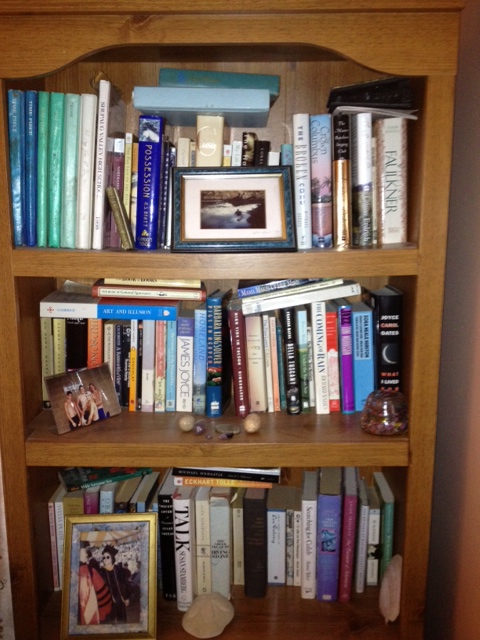
ImageThe only rooms in my house that don’t have a bookcase are the bathrooms. (Of course there are books, though!)  Yet, I still have a stack by my bed, by my desk, on my desk. ARRRGH! I do my best to read them all, but I’m not going to hold my breath that I’ll ever finish them all. Then there’s the added problem of new books constantly being published. There is an organizational plan, but it’s flexible. During the school year, I do most of my work-related reading on the sofa or sitting at my desk when I’m at home. I do read in bed, but only novels or poetry. During the summer, I love to read outside. I have a wicker love seat on the front porch that I share with the cat. We’ve spent entire afternoons out there, me reading, him dozing. (Okay, sometimes I doze, too.)

As the literacy specialist at my school, I feel very lucky to have a full classroom. It is filled to the brim with books! All our guided reading books are housed here, as are many, many professional books. The bulk of my collection of picture and poetry books are also kept here. Not surprisingly, my reading at school typically consists of journal articles, blog posts, e-mails, etc. Of course, if I’m planning lessons, I’ll read and reread the text I’m sharing.

This all adds up to lots of books in lots of places. How lucky am I that I have such a rich reading life?

Poetry Friday: Monumental Verses by J. Patrick Lewis

url

Earlier this week, I took part in Nonfiction 10-for-10, a celebration of nonfiction books for kids. I struggled to narrow my list down to 10 titles, but decided to leave this book off when it occurred to me I could share it today.

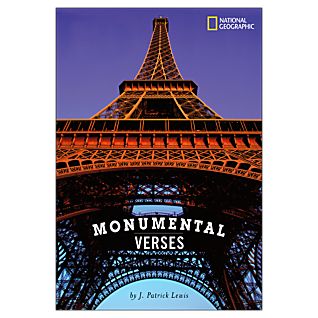
When I was a kid, I loved arranging furniture in my dollhouse. As I got a little older, I filled notebooks with house plans and furniture arrangements. And while I did think about becoming an interior decorator, I never really considered becoming an architect. I’m not sure why, but I suspect it had something to do with my less than stellar math skills. So when I discovered Monumental Verses (2005), by J. Patrick Lewis, the latent architect inside of me was thrilled.

A bow to all who hoist the spirit high

And carve imagination into stone

By fire and forge, thrown hugely to the sky.

Whether they be well-or little-known,

The buildings in this picture book cement

A thought: No matter who the builders were,

They gave to time a timeless monument–

A human star-chitcture signature.

I cannot say what others make of this,

The mystery of Stonehenge, a Taj Mahal,

And yet I know how much the world would miss

Majesty at a glance if they should fall.

This book is for the curious at heart,

Startled at sights they seldom get to see

Or even dream of-science born of art,

Such works of genius these were meant to be.

Fourteen poems and gorgeous photographs celebrate architectural wonders from around the world. Lewis’s uses a number of poetic forms to describe wonders of the Empire State Building, Easter Island, the Arc de Triomphe, and more. Playful shape poems bring the pyramids, the Great Wall of China and Stonehenge to life. Vital statistics regarding when each structure was built, where it’s located, the architect (if known), and an amazing physical fact are included. An Epilogue offers writing advice to budding poets.

We have used this book with 5th graders as a mentor text. Engagement is high because students are fascinated by these incredible feats of design and engineering. After reading, they chose a well-known building or monument that interests them. Research is done, and once they’ve collected their facts, they write their own poetic tributes. A project like this doesn’t have to be terribly time consuming, and it covers a number of CC Standards. Lewis’s rich vocabulary addresses  Reading Literature standard 5.4, “Determine the meaning of words and phrases as they are used in text, including figurative language such as metaphors and similes.” Writing their own poems allows student to “Integrate information from several texts on the same topic in order to write or speak about the subject knowledgeably,” (RI.5.9) as well as “Produce clear and coherent writing in which the development and organizations are appropriate to task, purpose, and audience.” (W.5.4)

A book like this can pique a student’s curiosity about the man-made wonders of the world. It might even inspire them to become an architect!

You can learn more about J. Patrick Lewis on his website and find additional ideas for using Monumental Verses with your students here.

Don’t forget to visit Sheri Doyle’s blog for other Poetry Friday posts!

Poetry Friday: STORM

0618023747

School is closed,

The trains have stopped,

Over two feet of snow cover the

Roads. Nothing

Moves.

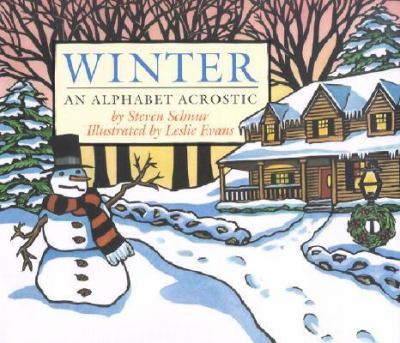
Today’s poem comes from Steven Schnur’s Winter: An Alphabet Acrostic. (Clarion, 2002) This lovely, deceptively simple book examines winter from all angles. Indoors, outdoors, living or not, everything is affected by this harshest time of year. The poems chronicle the unfolding season, from the first hints of ice at the edges of a pond, to the height of the holiday season, until finally, subtle signs of spring begin to appear. Leslie Evans created linoleum-cut illustrations that capture the tone of each poem. Schnur and Evans have a book devoted to each season and each one is worth a look.

I love acrostics because they can free students from being intimidated by poetry. They can be as simple as a list, and they don’t have to rhyme. I have shared this book with first and third graders, and both age groups loved the poems. Use the book as a mentor text so students become familiar with the acrostic form and the idea of focused description. Schnur’s poems never feel forced, although you might have to look up “xyst.” (I did!) They are also fine examples of “how specific word choices shape meaning or tone” (http://www.corestandards.org/ELA-Literacy/CCRA/R), which, according to the CCSS, students should be able to analyze and interpret.

Vocabulary and word choice show up again in CCSS Language Anchor standard five. Again, reading Schnur’s acrostics, as well as those by other poets, are a natural way to develop vocabulary and help students be conscious of word choice. The standard calls for students to “Demonstrate understanding of figurative language, word relationships, and nuances in word meanings.” (http://www.corestandards.org/ELA-Literacy/CCRA/L) First graders are expected to “distinguish shades of meaning among verbs differing in manner…and adjectives differing in intensity.” (L.1.5.d) Writing their own acrostic poems and creating a class book is a natural extension of reading this book. This is an authentic way to introduce the idea of precision of word choice and allows for exactly the kind of work expected by CCSS. In addition, composing their own poems and searching for just the right word is a much more natural way to develop vocabulary than with mindless worksheets or computer games. Students can choose everyday objects or events that they associate with the season, or any other topic, really. Giving students the opportunity to choose their own subject ensures they’ll be engaged in work that’s meaningful to them.

Be sure to stop in over at A Teaching Life for other Poetry Friday posts. Thanks, Tara, for hosting! Hope you all stay safe and warm over the next few days. Happy reading!

Reflections on One Year of Blogging

Image

Today is Reading to the Core’s first birthday! Although my posts have been sporadic at best, I’ve learned a lot over the past year. Since birthdays and anniversaries are always a good time to look back and reflect, here, in no particular order, are my thoughts on becoming a blogger.

The blogosphere is filled with friendly, supportive and generous people. While this may not be true of all corners of cyberspace, this describes the kidlitosphere in spades. I’ve been inspired by you all! Kate Messner’s Teacher’s Write summer camp prodded me to write more. While not everything I wrote in response to her prompts ended up here (trust me, that’s a good thing!), she and all the writers who joined in encouraged me to stretch myself and take risks. Thanks, Kate!

It’s Monday, What Are Your Reading (Book Journey), Tuesday’s Slice of Life (Two Writing Teachers) and Poetry Friday (various hosts, but you can always find the line up at A Year of Reading) have also been especially motivating. Thank you to all you equally busy bloggers who’ve found your way here via one of these memes.

I’m also thankful for the kind words people have left in their comments. I especially appreciate my loyal commenters Colette, Betsy, and Elizabeth. Some people may despair that the internet is changing the world as we know it, but I am incredibly grateful that it allows me to connect with faraway friends so easily.

One of the most eye-opening realizations I’ve had from blogging is just how difficult it is to sit down and compose a half-way intelligible piece of writing. Not one of these posts has been completed in less than an hour, and they have usually been rolling around in my head for a day or two before I begin writing. Why we think our students should be able to sit down and hammer out a fluent story or essay in 45 minutes is beyond me. They should have at least an hour! Seriously, without regular, sustained writing practice, it simply isn’t fair to subject our students to the kind of writing assessments that dominate today’s instructional landscape. As a result of this insight, I have been more mindful of my own writing instruction and my support of teachers implementing writing workshop this year.

Over the next year I’m really going to make a concerted effort to post at least once a week. I have lots left to say about books, teaching, and life in general. Which brings me to the name of this blog. In one sense, the “Core” of the title refers to the Common Core. I think about the implications of the CCSS on instruction almost all the time. (Sad, I know.) And yet, much of what I wrote about over the past year had nothing to do with these standards. They were more about what’s at the core of me: curiosity about the world around us and a passion to help all kids find their own true self, to find their own true core.

Poetry Friday: Mindfulness and the Poet Joyce Sidman

Mindfulness, according to Jon Kabat-Zinn, “means paying attention in a particular way; On purpose, in the present moment, and nonjudgmentally.” Much easier said than done.  Author/illustrator Bryan Collier once asked an audience if they had caught the color of the day that morning when they left the house. In other words, were they being mindful.

Winter has a reputation for being drab and gray. Sometimes a pristine blanket of white brightens the landscape, but too quickly it becomes trampled and dirty. Earlier this week, while driving to work (the one time of day I remember to be mindful), I was treated to a glorious pink sky. Joyce Sidman’s award-winning Red Sings from Treetops: A Year in Colors immediately came to mind. She writes

“In the WINTER dawn

Pink blooms

powder-soft

over pastel hills.”

Isn’t that lovely? Pamela Zagarenski’s Caldecott-Honor winning illustrations perfectly complement Sidman’s beautifully crafted images.

Image

Sidman’s mindfulness, her keen observation, is evident in every poem. Colors are personified as they change from season to season. Sidman’s imagery seems effortless, yet creates a sense of wonder that makes readers want to rush outside and drink in the beauty that surrounds them.

Teachers across the country have many questions about the place of poetry as they implement the CCSS. Can they even still teach poetry? Of course they can! Reading Literature Standard 4 states that students will “Interpret words and phrases as they are used in a text, including determining technical, connotative, and figurative meanings, and analyze how specific word choices shape meaning and tone.” This begs to be addressed through poetry. Joyce Sidman’s work is a perfect place to start. Not only can students examine her figurative language and word choice, they can follow her example of mindfulness. Teaching students to view the world with awareness so they can gather their own ideas, seeds of writing to come, is just as critical as any skill listed in the standards.

Joyce Sidman’s work deserves a place in all classrooms. Indeed, the National Council of Teachers of English just named her the 2013 winner of the NCTE Award for Excellence in Poetry for Children. Read more about Red Sings from the Treetops and Sidman’s other books here. Congratulations, Joyce, and thank you for creating poems that remind us to always pay close attention to the world around us.