Slice 28 of 31: Unpacking Poetry

Image

Earlier this month, I attended the TCRWP’s Saturday Reunion in New York City. One of the sessions I went to was “To Lift the Level of Writing, We Need to Lift the Level of Rehearsal and Revision: Mentor Texts Can Teach Not Just Qualities of Good Writing, But Process,” presented by Brooke Geller. The session began with Geller stating that kids need to see the big picture before they begin writing. Knowing what the finished product will look like is the first step in engagement. Geller described the following process to immerse students in the genre being studied, in this case, a research-based argument essay.

Unpacking a Text

  • could be a published text, student work, or your own writing.
  • students should spend time with the text, reading and rereading
  • ask “What are you noticing?”
  • put kids in groups of 3-4, give them a piece of writing in the middle of a big sheet of paper
  • have them mark up the text with their observations and the evidence
  • students should use their prior knowledge about genre– “What do you know about essays?”
  • read first, then read with the eyes of a writer
  • teacher should go from group to group and add her own thoughts
  • come back together–create list of what they think are characteristics of the genre
  • charts can be used as teaching tools

At my school, the fifth grade teachers were getting reading to begin a unit on poetry. We’ve been talking about ways to increase student engagement and the quality of their writing, and I suggested that unpacking poems would be a great way to begin.

The teachers and I selected five poems and mounted them on sheets of butcher paper. At the start of class the next day, the classroom teacher and I modeled the process for the students. We discussed the importance of reading the poem aloud and rereading it several times. Then gave each group their poem and a marker. As they began working, the room was filled with the hum of their reading. The classroom teacher and I moved from group to group, talking and rereading along with the kids. Certain poetic elements were easier to spot; the poem either rhymed or it didn’t. Some students could describe what they noticed, but didn’t know what it was called.  It occurred to me that this activity was also an excellent form of pre-assessment. The teachers and I had a concrete list of what the students knew about poetry.

mentor text  photo-1

photo-3
We left empty space so we can add more elements as they’re introduced.

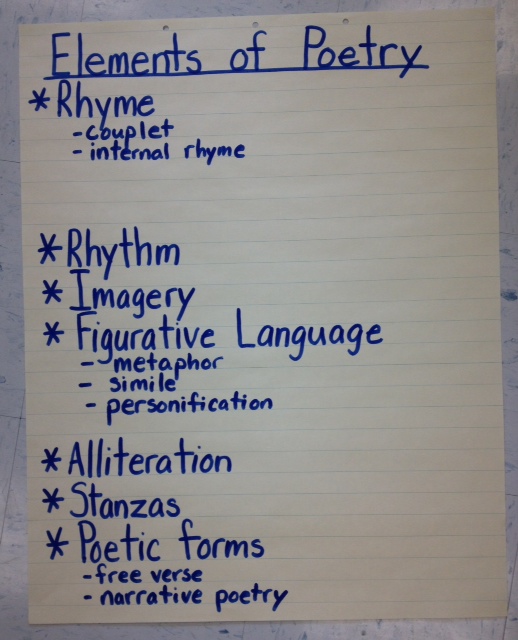
After school, the classroom teacher and I created this chart to use throughout the unit.

photo-2

As students find examples of these poetic elements, they will be added to the appropriate column. These examples will support them when they begin writing their own poems. We will also add columns to the chart as we teach more poetic elements and devices.

A variation on this process suggested by Geller would be to put the same piece of writing on sheets of paper, but have a different focus question on each sheet.

Possible questions include:

  • What makes this text (poetry, essay, etc)?
  • How is this text set up? Why is this important?
  • What is the purpose? How do you know this?
  • How does the author show the heart of the story?

Students could rotate around room, rereading the text in light of each question.

As we reflected on the work of our students, we noticed that engagement had been high and all students participated in the discussions. We also noted that no one had mentioned anything about repetition of words, or the word choices the poets made. And while most students could spot a simile, metaphors were more difficult. Over the next few weeks, we will be crafting mini-lessons to teach these elements.  We will continue to use the wonderful ideas Brooke Geller shared at TCRWP throughout the unit. I’ll let you know how it goes.

Thank you to Stacey and Ruth at Two Writing Teachers for hosting this Slice of Life Challenge!
Slice 27 of 31: The Search for Delicious

Image

We got new laptops last spring and changes were made to the way we save and access old files on our server. This transition has been fairly smooth, but today I went looking for an old file that wasn’t showing up in my document folder. I found it eventually, after I uncovered some real treasures.

9780590129312
Farrar, Straus and Giroux, 1969

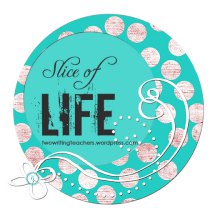
Early during my first year of teaching, I got a terrible head cold and stayed home one day to rest. For some reason, I picked up a copy of Natalie Babbitt’s The Search for Delicious that had been sitting on my shelf for ages. From the moment I began reading, I knew I had to read this book to my third graders. Here was a magical tale, rich with descriptive language. The final sentence of the prologue, which foreshadows everything to come, is a perfect example:

“Nobody believed [mermaids, dwarves, and woldwellers] were real any more except for an occasional child or even more occasional worker of evil, these being the only ones with imagination enough to admit to the possibility of something even more amazing in the world than those commonplace marvels which it spreads so carelessly before us every day.” (p. 10)

Isn’t that lovely?

Babbitt’s story is that of Galen, son of Prime Minister DeCree, who is writing a dictionary for the King. Everything is going well until he gets to the word “delicious.” No one in the palace is satisfied with “Delicious is fried fish,” so Galen sets out to ask everyone in the kingdom their choice for delicious. Galen’s is a classic quest; he encounters friends, foes, and discovers much more than the elusive definition of delicious.

At the time, my students were struggling with adding descriptive details to their writing. I decided to have them write their own straight-forward definition of delicious, using Babbitt’s example as a starting point. Then they added details describing what made their choice so delicious. We wrote these in the computer lab and illustrated their definitions using KidPix so they could practice their computer skills as well. Here are some of their creations, long-buried in a folder on our school’s server:

Screen Shot 2013-03-27 at 9.33.14 PM
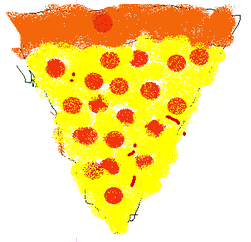
Delicious is one piece of hot pizza shaped like a pyramid covered with lots of tasty cheese, pepperoni, and tomato sauce.
Screen Shot 2013-03-27 at 9.35.11 PM
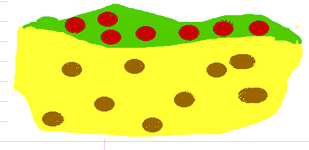
Delicious is six tacos with crunchy layers of cheese, meat, lettuce, and tomatoes.
Screen Shot 2013-03-27 at 9.38.36 PM
Delicious is a big plate of hot, freshly baked,chewy brownies with about 1,000 chocolate chips inside.
Screen Shot 2013-03-27 at 9.41.11 PM
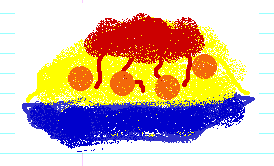
Delicious is a steaming hot heaping mountain of spaghetti dripping with dark red tomato sauce, slippery, curly noodles and huge meatballs cooked just right.

The Search for Delicious is listed on CCSS Appendix A list of text exemplars as a read aloud for grades 2-3, but that’s not why you should read this book. You should read this book because it is, well, delicious.

Thank you to Stacey and Ruth at Two Writing Teachers for hosting this Slice of Life Challenge!

Slice 26 of 31: The Power of Observation

Image

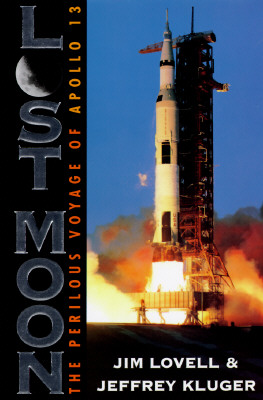
In Lost Moon: The Perilous Voyage of Apollo 13, Jim Lovell’s memoir of the “successful failure” of Apollo 13, Lovell and his co-writer, Jeffrey Kluger, describe the moments after the explosion of the oxygen tank. Gauges were reading zero at Mission Control, but not on the spacecraft, and the best engineers in the world were sure it was a “sick sensor-type problem.” (p.99) As his frustration mounted, Lovell’s instinct kicked in:

“The Commander let go of the attitude controller, punched open his seat buckle, and floated up to the left-hand window to see if he could determine what was going on out there. It was the oldest pilot’s instinct in the world…what Lovell really needed was a simple walk-around, a chance to make one slow, 360-degree circuit of his ship, to eyeball the exterior, kick the tires, look for damage, sniff for leaks, and then tell the folks on the ground if anything was really wrong and just what had to be done to fix it. However, he had to settle for a look out the side windows…The odds of diagnosing the ship’s illness this way were long, but…they paid off instantly. As soon as Lovell pressed his nose to the glass, his eye caught a thin, white, gassy cloud surrounding his craft…”(p. 101)

Even with millions of dollars of computers, equipment, and engineers, the source of the problem wasn’t identified until someone looked out the window.

Image
Lost Moon: The Perilous Voyage of Apollo 13. Boston, New York: Houghton Mifflin, 1994.

I thought of this scene as I administered a DRA2 (Developmental Reading Assessment, Joetta M. Beaver, Celebration Press. 2006) to a student the other day. I watched this student carefully as he negotiated the challenges that a level 10 benchmark book presented. Could he decode the long vowel words? Check. Was he strategic when he came to other unknown words? Check. Did he monitor for meaning when he read an unfamiliar word? Check. Did he read fluently and with expression? No.

This boy, who has worked so hard this year and has made so much progress, did not meet the criteria established by the publisher to be considered “Independent” at this level. Does that mean I’ll tell his parents at conferences this week that their son is a “deficient reader?” Absolutely not. I will tell them that their son is a reader who knows what to do when he gets to a word he doesn’t know. That he’s a reader who goes back and rereads when something doesn’t make sense. That he’s a reader who is starting to read in longer phrases. That he gets tired as he reads and should read more at home to build up his stamina so he’ll be able to keep up as the books he reads get longer.

Presenting his parents with his oral reading fluency score of 10 out of 16 would be meaningless to them, just as meaningless as the data on Mission Control’s computers as they tried to figure out what to do after Apollo 13’s oxygen tank exploded. It took the trained mind of a pilot to make sense of those numbers. Just as it takes an expert teacher, who knows her students because she has spent countless hours with them, observing them, to know that her students are more than a number. To know they are people who have strengths to build on, and with her help, will overcome their challenges.

Thank you to Stacey and Ruth at Two Writing Teachers for hosting this Slice of Life Challenge!
Slice 25 of 31: It’s Monday! What Are You Reading?

ImageMon Reading Button PB to YA

Like many of my fellow participants in the month-long Slice of Life Challenge going on over at Two Writing Teachers, I spent much of my free time this weekend reading other slices. The caliber of the writing is incredible, and there’s such variety! I read many heart-felt remembrances of friends and family that moved me to tears. Observations about the trials and tribulations of daily life, both in and out of the classroom, had me laughing until I cried again. As the month is almost over (how is that possible?), many Slicers reflected on the lessons learned from writing every day and what they had learned about themselves as a writer. In addition, my sister was visiting from Rhode Island, so I spent lots of time with her. Needless to say, I didn’t make much of a dent in my TBR pile.

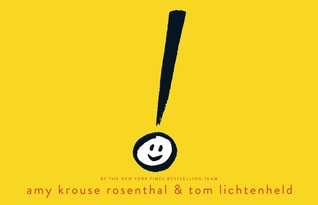
The one book I did get to, however, is priceless. Exclamation Mark (Scholastic Press, 2013), by Amy Krouse Rosenthal and Tom Lichtenheld, is the clever tale of a punctuation mark who knows he’s different from all the periods surrounding him. He tries to fit in, but nothing feels right. Then he meets a question mark, and he “discover[s] a world of endless possibilities.”

Image

The possibilities for using this book in the classroom also seem endless. Reading it for the fun of it is where I’d begin. I love the fact that the pages look like the lined paper familiar to Kindergarteners and first graders everywhere, and the word play is a riot.

With deceptively simple language, Exclamation Mark, is the perfect mentor text for asking questions and using “end punctuation in sentences.” (CCSS L.1.2.b) Exclamation Mark’s facial expressions perfectly match every word, and the word choice itself lends this book to addressing CCSS Language standard 5.d for first grade, “Distinguish shades of meaning among verbs differing in manner (e.g., look, peek, glance, stare, scowl) and adjectives differing in intensity (e.g., large, gigantic) by defining or choosing them or by acting out the meanings.” You can get a glimpse of all the fun by watching the book trailer:

Whatever else you do this week, get this book!

Thank you to Stacey and Ruth at Two Writing Teachers for hosting this Slice of Life Challenge!
Slice 21 of 31: A Book Spine Poem

Image

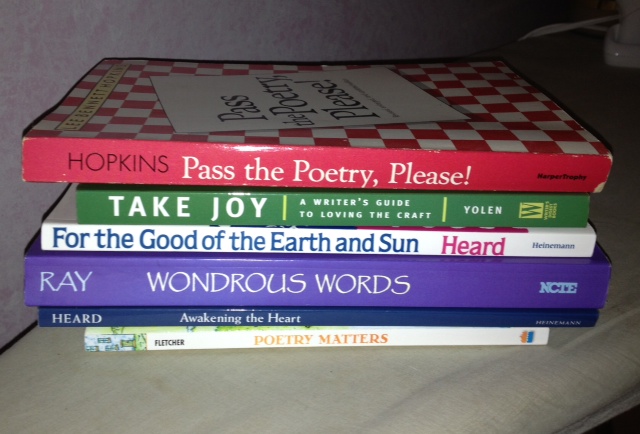
National Poetry Month is just around the corner, and although I teach and use poetry all year, I do make a fuss about all things poetical in April. This book spine poem really wrote itself as I revisited some of my favorite resources:

Image

Pass the Poetry, Please!

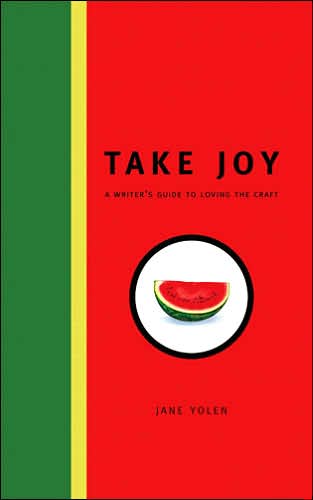
Take Joy

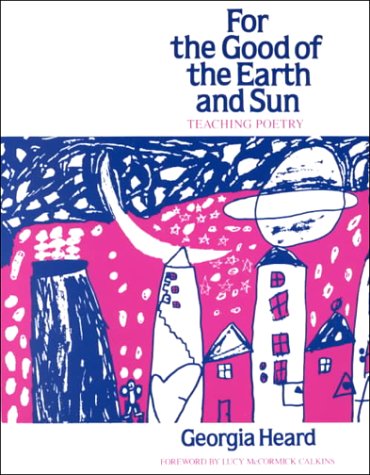
For the Good of the Earth and the Sun

Wondrous Words

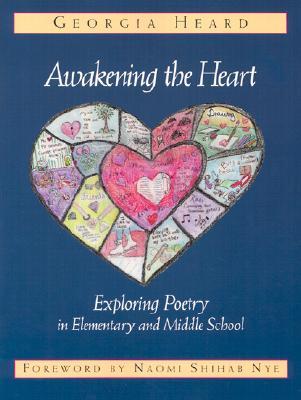
Awakening the Heart

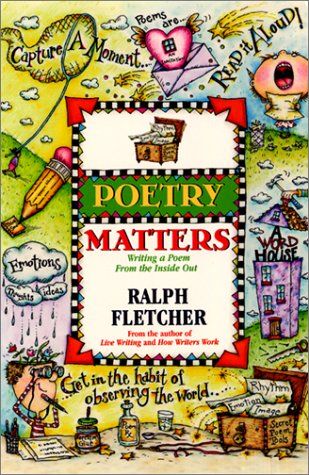
Poetry Matters

I’ve written before about using poetry with students (here, here  and here) and I know I’ll be writing about it again. For now, here’s a snippit of the wisdom contained within each of these excellent resources.

9780064460620Originally published in 1972, Lee Bennett Hopkins’ book is a classic resource for sharing and teaching poetry. Here is a comment he shares from poet David McCord:

“Poetry is so many things besides the shiver down the spine.” (p. 7)

Take-Joy

Jane Yolen is one of my all-time favorite authors. In Take Joy: A Writers Guide to Loving the Craft (Writers Digest Books, 2006), her wisdom and passion for writing permeate every page.

“…poetry, at it’s most basic, is a short, lyrical response to the world. It is emotion under extreme pressure or recollection in a small space. It is the coal of experience so compressed it becomes a diamond.” (p. 87)

043508495X

For the Good of the Earth and the Sun: Teaching Poetry (Heinemann, 1989), by Georgia Heard, is filled with practical advice and inspiration. In chapter 5, “Language:  The Poet’s Paint,”  she offers this:

“Sometimes I pretend a word is like a geode: rough and ordinary on the outside, hiding a whole world of sparkling beauty inside. My job as a poet is to crack the words open to find that inner treasure.” (p. 74)

wondrous-words-writers-writing-in-elementary-classroom-katie-wood-ray-paperback-cover-art

Wondrous Words: Writers and Writing in the Elementary Classroom (NCTE, 1999), by Katie Wood Ray, was a revelation to me. Here were the answers I’d been looking for about how to teach writing. Ray’s thoughts about read aloud confirm what we know in our hearts:

“Our students need to be…fortunate enough to be read to every single day by someone who values wondrous words and knows how to bring the sounds of those words to life in the listening writer’s ears and mind and heart.” (p. 69)

27041

Georgia Heard offers more thoughts about teaching poetry in Awakening the Heart: Exploring Poetry in Elementary and Middle School (Heinemann, 1999).

“One of the most important life lessons that writing and reading poetry can teach our students is to help them reach into their well of feelings–their emotional lives–like no other form of writing can.” (p. xvii)

poetry%20matters

Ralph Fletcher wrote Poetry Matters: Writing a Poem From the Inside Out (HarperTrophy, 2002) for kids, but it’s one of my favorite books about the craft of poetry. Speaking directly to children, he advises them

“There is poetry everywhere. [Write] What you wonder about. In my book A Writer’s Notebook, I wrote a chapter on ‘fierce wonderings’ and ‘bottomless questions.’ These are the kinds of haunting questions you can live and ponder but never really answer. Not surprisingly, these ‘wonderfull’ questions provide great grist for poems.” (p. 51)

Thank you to Stacey and Ruth at Two Writing Teachers for hosting this Slice of Life Challenge!

Slice 20 of 31: Challenges

Image

Yesterday was a challenging day. Since what constitutes a challenge in my life pales in comparison to the real challenges faced every day by many, many others, I’ll spare you the details. When I sat down to write this, I intended to write something like, “I really don’t have the energy for writing tonight.” I pulled out my most recent journal with every intention of finding a halfway interesting entry and posting that. But then I got to thinking about the word challenge. Posting something I wrote a year ago didn’t seem like an acceptable offer to a challenge or to the friends I’ve made over the past few weeks. What does the word really mean, anyway? We all have a working definition in our head, but what does the dictionary say? The entry in my trusty World Book Dictionary (which came with the set we purchased when our oldest son started first grade in 1986) takes up more than half the column. The meanings of challenge as a verb are listed first:

  • “to call to a game or contest; dare”
  • “to call to fight” “to stop (a person) and question his right to do what he is doing or to be where he is”
  • “to demand proof before one will accept; call in question; doubt; dispute”
  • “to claim or command (effort, interest, or feeling)”

There were several other verb definitions, and the noun definitions were all variations on those for the verbs. The events of my day definitely claimed my feelings, commanded my interest, and my effort. And now that I’ve devoted more than 30 seconds of interest and effort to this post, I feel better. Not completely satisfied, but better. I didn’t back down in the face of a challenge.

Thank you to Stacey and Ruth at Two Writing Teachers for hosting this Slice of Life Challenge!
Slice 19 of 31: Play, Bill Harley and the CCSS

Image

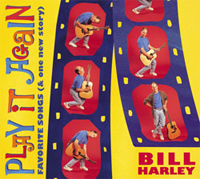
Yesterday I spent an hour with Kindergarteners. I love going into Kindergarten classrooms. The energy and enthusiasm of 5 and 6 year olds is contagious. Our celebration of kindness continued with a lesson built around storyteller/singer/songwriter/ Bill Harley’s “Sitting Down to Eat.” A variation of the folktale, “The Mitten,” the narrator is continually interrupted as he’s trying to eat, yet he always manages to find room for one more.

ImageI love using non-print resources to help kids learn important comprehension strategies. Taking away the print removes a layer of difficulty for struggling readers, but also allows developing readers to engage with material they aren’t ready to read but are certainly ready to comprehend. We do this all the time with read-alouds.

Maybe I shouldn’t be surprised that some kids don’t automatically visualize, given the amount of time they spend in front of screens. Poetry and songs are a perfect choice for developing this critical comprehension skill. I always begin this kind of lesson by demonstrating how to visualize. I have a few tried-and-true favorites, but any brief, descriptive poem will work. Then I tell them I’m going to play a song. Their job is to close their eyes and listen for words in the song they can use to make a picture in their head. Most of the kids are very serious and tightly scrunch their eyes; others are skeptical and leave their eyes half open. When the song is over, I have the students share what they were visualizing with a partner.  Usually, we listen to the song at least two more times as students create an illustration to match their visualization.

Harley’s song is made for movement. So after listening once, the kids were on their feet, dancing and gesturing knocking on the door. They all joined in on the chorus and had great fun acting out the ending. By the time they were sitting down on the rug again, they were able to work together to put pictures of the animals in the order they knocked on the door, match the names of the animals to the correct picture, and talk about the importance of sharing. Each child also created a page for a class book about who they like to share with.

This lesson strives to incorporate the CCSS (Kindergarten RL standards 1, 2 & 3) in a way that preserves “play, imagination and discovery” which, as Deborah Kenny in a recent Washington Post op-ed states, “are how kindergarteners learn.”

For more of Bill Harley’s brilliance, watch his TEDx talk:

Thank you to Stacey and Ruth at Two Writing Teachers for hosting this Slice of Life Challenge!

Slice 17 of 31: Common Core Connections and Teaching Science

Image

Last weekend, at the TCRWP Saturday Reunion, I attended Elizabeth Moore’s session titled “Reading, Writing, Content Area, and Common Core Connections: Using Our Best Methods to Teach Science.”  One of her main points was that we can use shared demonstrations and experiences to support non-fiction reading and writing. She emphasized that by giving students concrete experiences to write from, we can develop language arts skills through our science curriculum. Incorporating science topics into read aloud selections is another important element in supporting science instruction. While primary teachers have been doing this kind of experiential writing for decades, there is a new urgency to our instruction since by the end of second grade, students are expected to “Write informative/explanatory texts in which they introduce a topic, use facts and definitions to develop points, and provide a concluding statement or section.” (W.2.2)

Moore suggested using shared and interactive writing to write about the procedures of science activities. Break the writing down into manageable chunks and do a little each day.  Here is one possible routine:

Day 1–do experiment

Day 2–write procedures

Day 3–write findings & conclusions

Day 4–hypothesis–this could be done on day 2

Another point that Moore emphasized was that kids don’t necessarily ask good questions, so we have to teach them through modeling and practice. She shared these video clips to demonstrate asking and answering questions:

Sesame Street: Cookie Monster Questions Prairie Dawn

The Adventures of Asking Elmo

When I taught third grade, we taught a unit on the life cycle of plants. We sprouted beans, peas, and corn, then grew bean plants. As someone who came of age in the 70s, I thought sprouting an avocado would be a good addition to this unit. The kids loved checking the pit each day for signs that it would sprout, although many had doubts that anything green was going to ever come out of the very dead looking pit.

We kept track of how long it took the pit to sprout, then measured the growth of the seedling, which we eventually planted in soil. We created graphs galore to go along with this unit, but I don’t remember ever writing about it. What a missed opportunity!

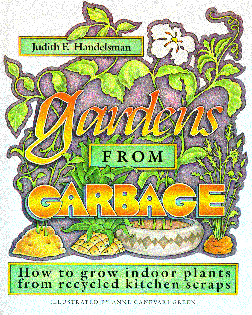
During this unit there were a number of informational texts that I read aloud to the class, but I haven’t taught this unit in eight years, and I’m sure many new and wonderful books have been published in the meantime. One of my favorites was From Seed to Plant  by Gail Gibbons (Holiday House, 1991). A favorite of mine was Gardens from Garbage. This book inspired us to branch out and try to sprout other plants:

Image
Gardens From Garbage, by Judith Handlesman (Millbrook Press 1994). Unfortunately, this is out of print.

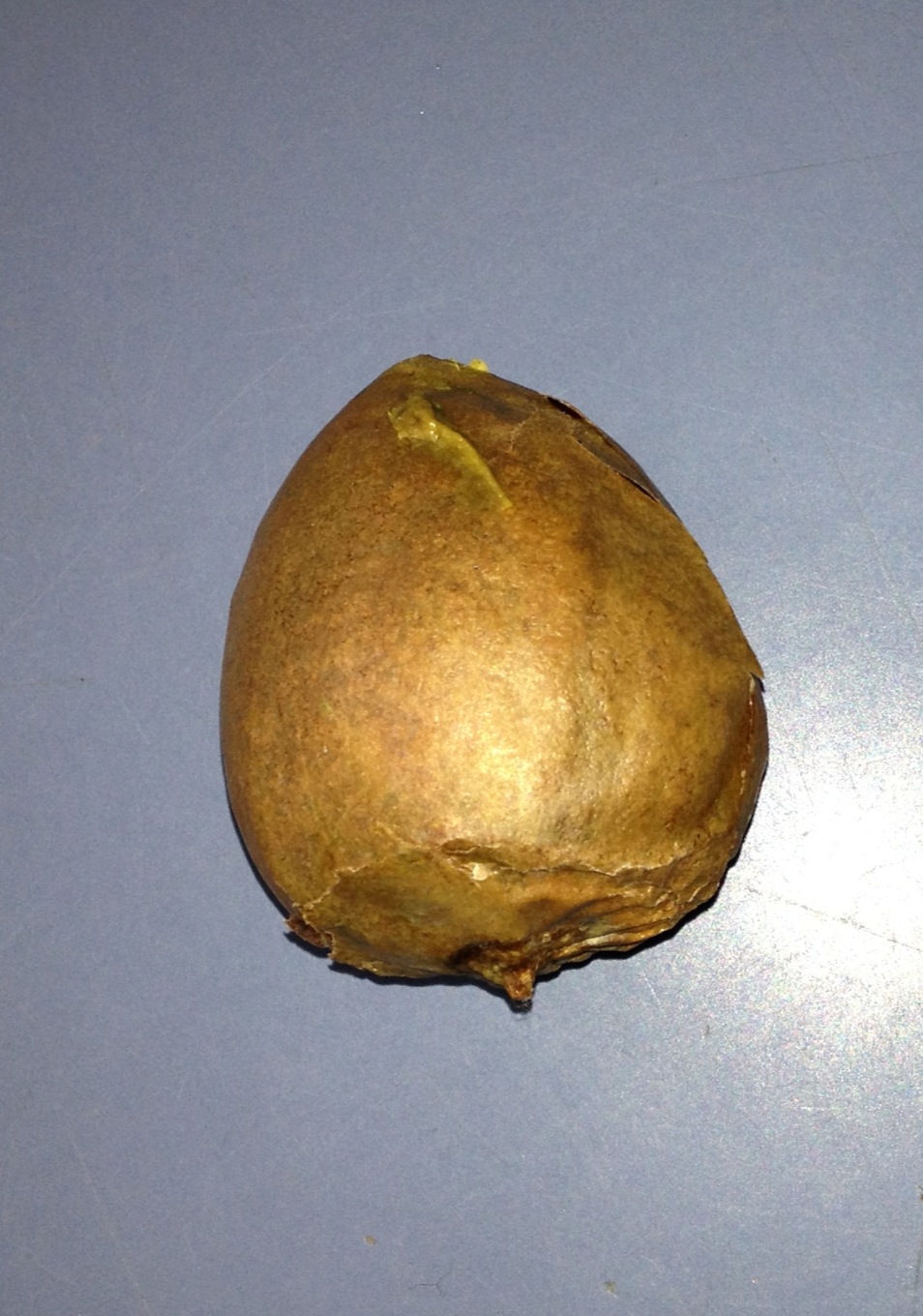
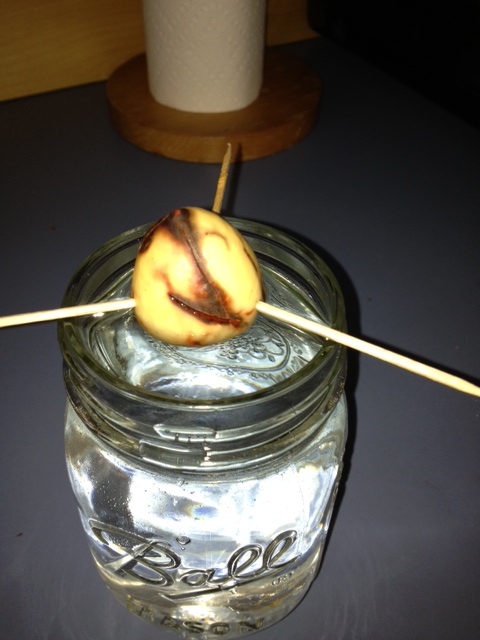
Coincidentally, my son made guacamole last week, so I asked him to save the avocado pit. After letting it dry out for a few days, I peeled the outer skin, poked three toothpicks into the side, and suspended it in a jar of water. This kind of shared experience involves a longer time frame than Moore’s demonstration, but still accomplishes her goal of giving students a concrete experience to write about.

Unpeeled avocado pit
Will it sprout?

Thank you to Elizabeth Moore for her inspiring session, and thank you to Stacey and Ruth at Two Writing Teachers for hosting this Slice of Life Challenge!

Slice 16 of 31: An Afternoon at the Opera

sols_6

Today I went to the local movie theater to see an HD simulcast of this afternoon’s performance of Riccardo Zandonai’s opera Francesca da Rimini by the Metropolitan Opera. The tragic story of Francesca and her lover, Paolo, which was immortalized by Dante in The Inferno (and which I wrote about briefly here), has inspired numerous plays, operas, and paintings over the centuries.This production, which was last performed in 1984, is stunning. Francesca and her attendants wear gorgeous gowns in rich, deep colors covered with sumptuous embroidery. The sets transport you to 13th century Italy, and the music is filled with the passion of these desperate lovers.

T.S. Eliot wrote that “Immature poets imitate, mature poets steal.” The numerous versions of this story speak to the unending influence of its original source, which in turn contains countless references and allusions to other works of literature. In his brief telling of Paolo and Francesca’s story, Dante includes lines about Lancelot and Guinevere. While a reader or viewer of the opera doesn’t have to have knowledge of these works to understand what’s going on, having that knowledge deepens their appreciation of the story.

Last weekend, in her closing remarks at the TCRWP Saturday Reunion, Lucy Calkins urged teachers to build our knowledge base about the CCSS. She urged us to be wary of the Publishers’ Criteria, written by David Coleman and Susan Pimentel, which directly contradict the standards and intentions laid out in the original document. Anchor standard nine of the CCSS expects that students will be able to “analyze how two or more texts address similar themes or topics.” Eighth grade readers are specifically asked to:

Analyze how a modern work of fiction draws on themes, patterns of events, or character types from myths, traditional stories, or religious works such as the Bible, including describing how the material is rendered new. (RL.8.9)

Yet in the Publishers’ Criteria, Coleman and Pimentel demand that readers “focus on what lies within the four corners of the text.” How will students successfully meet standard nine if they can’t leave the confines of the text in front of them? Why would we make them try?

I’m glad I didn’t have to stay within the four corners of Zondanai’s opera this afternoon. I had a much richer experience.

Thank you to Stacey and Ruth at Two Writing Teachers for hosting this Slice of Life Challenge!
Slice 2013 15 of 31: A Big Sister Poem for Poetry Friday

Image

Earlier in the week I wrote about using Miss Rumphius to address Common Core standard 3.3, which deals with characters, their traits, motivations, feelings, and how their actions contribute to the sequence of events. While there are many picture books and chapter books that can and should be used to address this standard, I wanted to include poetry in the unit we’re developing.

Image

Kristine O’Connell George’s Emma Dilemma: Big Sister Poems (Clarion Books, 2011; illustrated by Nancy Carpenter) is ideally suited for this unit. These short poems are told from the point of view of Emma’s older sister, Jessica. Each poem deals with the daily life of a typical fourth-grader and her feelings about Emma. Taken together, the poems form a loose narrative chronicling Jessica’s evolving feelings toward Emma. An older sister myself, I especially appreciated this poem:

“Role Model”

Emma copies

everything I do

and sometimes

I don’t do

something

I might do

or really

want to do

because

I know

she is

always

watching

every single thing I do.

You can watch the trailer here:


Sylvia Vardell has collected much more information about Kristen O’Connell George, Emma Dilemma, and using this book in the classroom on her blog, Poetry for Children.

By the way, my sister hasn’t copied anything I’ve done for at least 40 years. And now we’re best friends.

Poetry Friday is at Check It Out today. Thanks for hosting!

Thank you to Stacey and Ruth at Two Writing Teachers for hosting this Slice of Life Challenge!