Slice of Life: The 4th Grade Readers’ Choice Awards

Image

Last week, on the sixth day of school, my fourth grade colleagues kicked off the year in style with their annual “Readers’ Choice Awards.” Wanting to make summer reading assignments more purposeful, Bernadette and Kim came up with a plan that also energized their students about reading.

Each student was encouraged to nominate one of their summer reading selections (all chosen from a list of suggested titles, but students could chose a book not on the list) for the best book in one of the following categories: Best Character, Best Setting, and Best Plot. Students wrote their nominations, hoping to persuade their classmates to vote for their book. Once all the nominations were shared, the children voted for a book in each category.
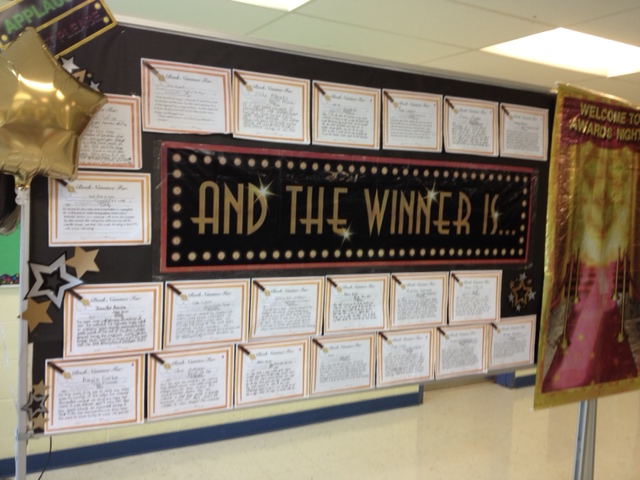
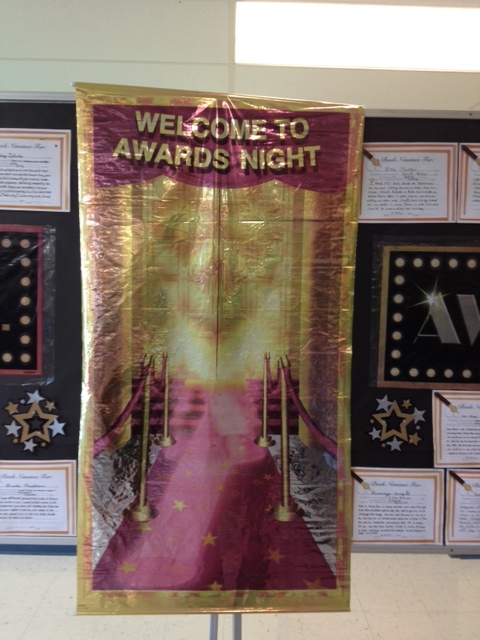
ImageMost fourth-graders arrived at school on Friday dressed to the nines for the awards ceremony, which included a red carpet, golden statues, and lots of applause. After a quick thank-you to the parents from Kim and Bernadette, the Masters of Ceremonies were introduced, and the nominees for the first category were announced. Students were called up to the podium to share the book they nominated, and the runner-up was announced. Then the emcee opened the envelope containing the name of the winner. To heighten the excitement, students in the audience provided a drum-roll on their laps. A statue was presented to the student who nominated the winning book before he or she read a short thank-you speech.
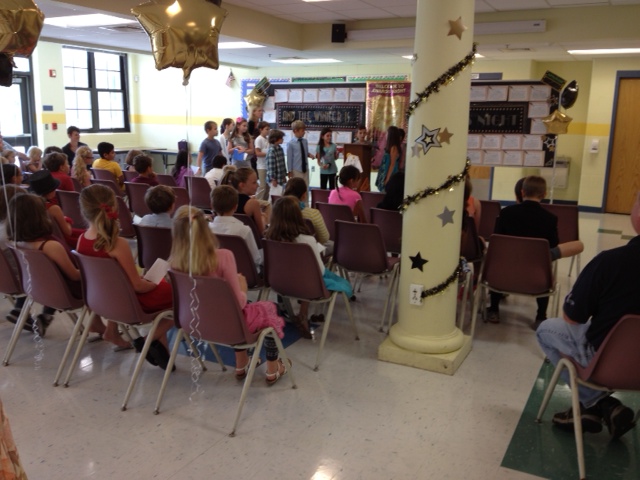
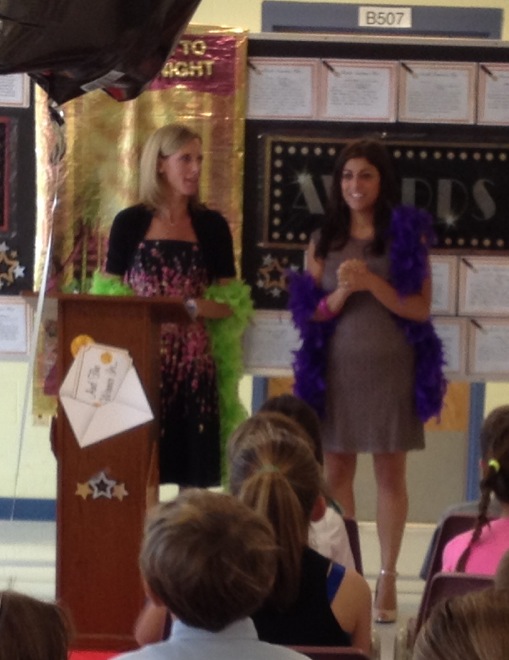
   Image   Image

Once all the awards had been handed out, students mingled with their parents and other guests and posed for photos. All the nominations were displayed for visitors to read, and there were even Hollywood-like stars on the floor leading into the cafeteria.
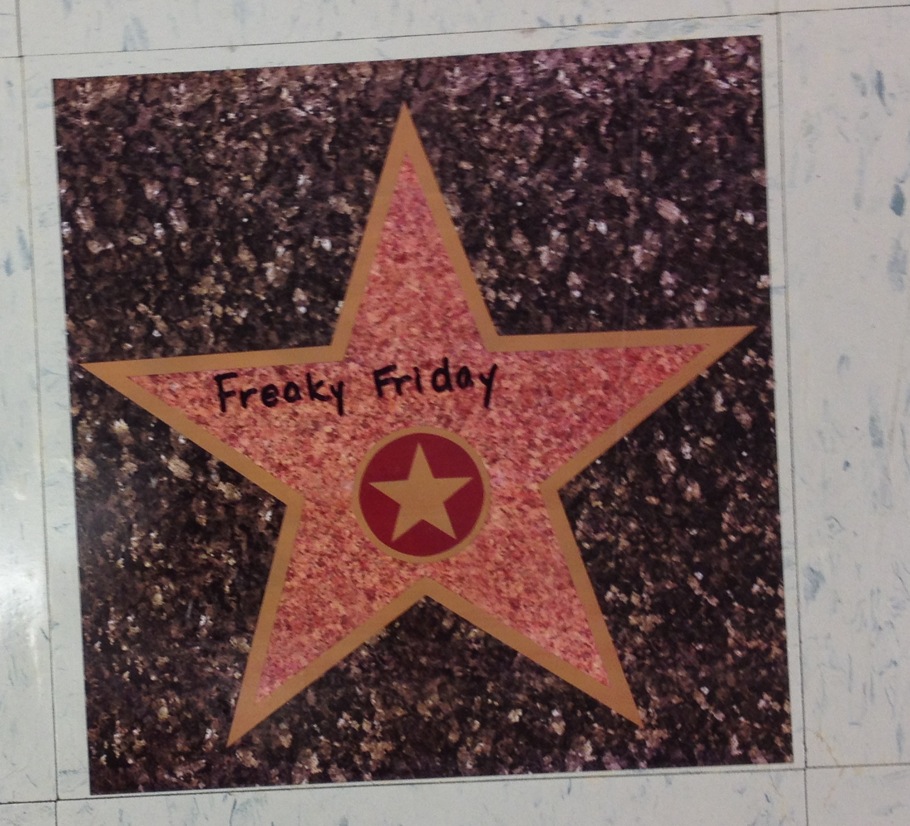
ImageAlthough this ceremony lasted only half-an-hour, it’s impact will be felt for the rest of the year. By being sensitive to including as many students as possible in the ceremony, Kim and Bernadette created a supportive tone in their classrooms and sense of community that often takes much longer to establish. Even students whose books weren’t chosen had the opportunity to share the title of their book. Parents loved seeing their children celebrate their summer reading in a meaningful way, and the students started the year off with style, excited about reading and sharing books with their friends.

Thank you to Stacey at Two Writing Teachers for hosting Slice of Life Tuesdays!
Poetry Friday: Puzzling Through the Possibilities

Image

Puzzling Through the Possibilities

The clue seemed so simple:

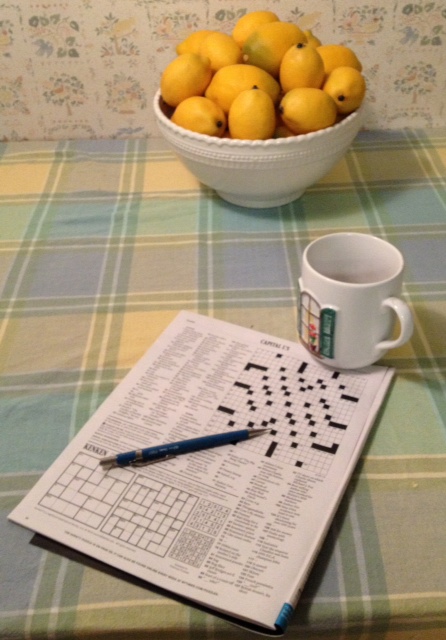
“Rossini’s William Tell and others”

Overtures even fit.

But the crosses didn’t work.

What word meaning “unprepared” begins with “nu?”

As I puzzled through the possibilities,

it occurred to me that

a writer feels this same frustration

as she reaches for the right word,

the clearest meaning,

so often just beyond her grasp.

Aren’t we all really just searching for that missing piece?

The one that clicks into place?

When we find it, it’s often a surprise.

And better than we ever dreamt.

© Catherine Flynn, 2013

Poetry_Friday_Button-210

The idea for this poem came from a journal entry I wrote in response to one of Corbett Harrison’s “Sacred Writing Time” prompts. When my colleagues and I were working on our writing curriculum, we began each day by writing for ten minutes. On this particular day, the slide stated that “dreamt” is the only word in the English language that ends with “mt.” As a Scrabble player and crossword puzzle lover, this intrigued me. So I wrote about filing this tidbit away, thinking it would come in handy as I was “puzzling through the possibilities” when solving a puzzle. Right away, I noticed this phrase. I loved the alliteration and the potential it contained. So I began playing with ideas. I’m still puzzling over this draft; I’m not sure the middle flows as well as it could, but I’ve had fun working on it.

By the way, the Rossini clue is from the New York Times Sunday puzzle from August 25, 2013, constructed by Victor Barocas.

Be sure to visit Laura at Author Amok for the Poetry Friday Round Up.

Slice of Life: More Thoughts on Writing

sols_6

“Quantity produces quality. If you only write a few things, you’re doomed.” –Ray Bradbury

800px-Парное-взаимное_обучение-в.Германии-080423-12
via Wikimedia Commons

To say that I have been obsessed with writing lately would be an understatement. The curriculum work I wrote about last week has me very excited about our school year. As I’ve prepared for school over the past week, though, I realized I left out at least one critical element of writing instruction: time.

In his 2008 book Outliers, Malcom Gladwell popularized the idea that it takes 10,000 hours of practice to become a master at any given task. Recently, some have questioned this notion, and Gladwell responded with a clarification on The Atlantic Wire by pointing out that this rule applies to “cognitively demanding activities that need significant thought.” Writing is certainly a cognitively demanding endeavor.

As Ronald T. Kellogg points out, writing “poses significant challenges to our cognitive systems for memory and thinking.” Researchers Flower and Hayes developed a Cognitive Process Model of Composition which illustrates that “most of the composing process is complex, multi-layered and recursive, so that many of those processes can be operating at once, and information can flow back and forth among boxes in several directions at once.”

For students to become even proficient writers, they need time every day to write. Students need ample time to generate ideas. They need time to play with language so they develop a richer vocabulary and deeper understanding of language structures. They need time to develop confidence and their writing voice.

Time is a four letter word for most of us. We never have enough, are always running out of it. But time is exactly what our students need if they are to come anywhere close to mastery of writing. We will never make more time, but teachers are creative problem solvers. By closely examining long standing routines and our priorities, we can find more time in our schedule for this skill that is so critical to learning.

At our meeting to kick off the year yesterday, all of the speakers shared a personal story about their experience in education. Our students have their own stories that they want to share. They deserve the opportunity to tell them. After all, caring about each others’ stories is what makes us human.

Thank you, as always, to Stacey and Ruth at Two Writing Teachers for hosting the Slice of Life Challenge and providing a space for us to become better writers by telling our stories.

Slice of Life: Thoughts About Writing

sols_6

For the past six days, I’ve worked with an amazing group of teachers making revisions to our writing curriculum. The dedication and passion these men and women brought to this work made my job of facilitating much easier. I feel good about what we accomplished and know that these teachers all feel prepared to launch the writing workshop in their classrooms next week.

We still have so much work to do, but thanks to the Units of Study developed by Lucy Calkins and her colleagues at the Teachers College Reading and Writing Project, we have a good grasp of the process and new expectations. Everyone is excited for school to start so we can begin working with students and help them become capable, confident writers.

Teachers often ask me about the purpose of the writer’s notebook. They are uncomfortable with the idea of letting kids write about a self-selected topic. They want to know what they’re supposed to do with this writing. Do they grade it? Does it have to become a story or some other kind of a polished piece. I always explain that no, this writing is not graded. It doesn’t necessarily have to become something else.

Because of these questions and the discomfort some of them have with writing itself, I began our work days by giving the teachers time to write. Some days I offered a photograph or piece of art; some days I shared one of Corbett Harrison’s Sacred Writing Time slides. It was interesting to watch how the teachers reacted to the prompts and how they worked. (I did write, also.) But the real revelations came when the teachers shared their writing.

Everyone had approached the task from a different angle, an angle that was meaningful to them. Some were surprised by the direction their writing took. Others were grateful for the opportunity to sit quietly and be reflective after a hectic morning trying to get to school by eight o’clock. We talked about the importance of giving our students choices about their writing and about the importance of feeling comfortable enough to share our work. We all agreed that going through this process ourselves would help us as we guide our students in the weeks to come.

The most valuable insight for me came from what I wrote this morning. Harrison’s slides always include whatever “National” day it is. Today happened to be National Radio Day. This made me remember a record album of old time radio programs that my mother used to listen to when I was little. Like links in a chain, this thought led to other ideas, which led me to an insight about a character in a story I’ve been writing this summer. This cascade of memories reminded me of one of my favorite scenes from Ratatouille, when Anton Ego takes his first bite of the dish Remy and Colette have lovingly prepared for him.

Why wouldn’t we want our students to have this same kind of opportunity to see where their writing takes them? Who knows what they might discover about themselves?

Thank you, as always, to Stacey and Ruth at Two Writing Teachers for hosting the Slice of Life Challenge.

Poetry Friday: The Sand Beneath Our Feet

Image                  Image

TeachersWrite, the summer writing camp for teachers organized by Kate Messner, Gae Polisner, Jo Knowles, and Jen Vincent, ends Monday. While I’m sad that the structured lessons, quick-writes, and feedback opportunities will be ending, I’m very excited about the writing I’ve done this summer. I’ve learned so much and can’t wait to get back to school to share these insights with my colleagues and students.

Image
Sand, magnified 250x via Science is Awesome
http://24.media.tumblr.com/tumblr_m0rvfs8x3j1qbwfjko1_500.jpg

Today’s poem was inspired by this photo, which a friend shared on Facebook a few weeks ago. I was amazed by the uniqueness of each individual grain, and it got me thinking. This is the current draft of the resulting poem:

Sometimes in our busy lives,

we brush others aside

as carelessly as we brush

the sand off our feet

after a day at the beach.

But what if we stopped,

took a moment

for a closer look?

What wonders might be revealed to us?

The geologist, turning

her microscope to those few

grains of sand,

is rewarded with

an astonishing menagerie:

a crystal jack, broken in half

translucent beads, flecked with whirls of milky white

ivory sea urchins

golden honeycombs

a swirl of pink cotton candy

amber snails, spiraling ever inward

a puffer fish, gaping up out of the darkness.

Shaped by forces beyond our ken,

each one as different from the other

as you and I.

What pressures shaped you?

What winds and rains buffeted you about?

What marvels have been forged

within your heart?

© Catherine Flynn, 2013

Many, many thanks to Kate, Gae, Jo, and Jen, for a wonderful, rewarding summer of writing. I’m looking forward to being back next summer! (And maybe meeting some of you at NCTE in Boston?)

There are more incredible photos of magnified sand at InspirationGreen. I think this would be a perfect quick-write to share with students of any age.

Thanks also to Renee at No Water River for hosting the Poetry Friday Round Up. Be sure to visit her and all the other Poetry Friday folks.

Slice of Life: The Birth of Sunset’s Kittens

Image

“Our abilities are limited only by our perceptions.”

~ Debbie Millman~

On her blog, Read, Write, Reflect, Katherine Sokolowski recently wrote about her childhood impression that authors were a “chosen few” who “lived in magical worlds.”

This got me thinking about my experience with authors as a child. The town where I grew up (and am lucky enough to still live) is only about an hour and a half from New York City. When I was a kid in the sixties there were at least 10 working farms in town (3 on my road alone) and there was exactly one “development.” Needless to say, it was a pretty peaceful place. The perfect place for writers to get away from the hustle and bustle of the city, yet close enough to go in when they had to.

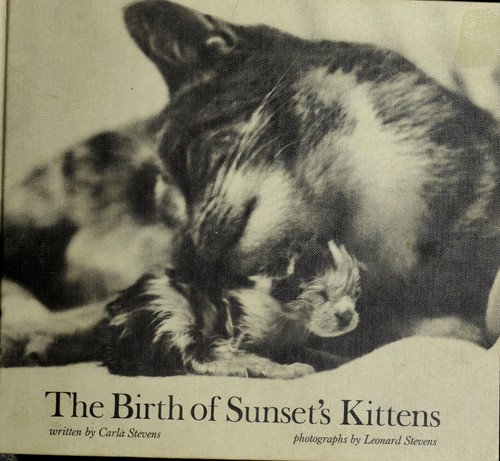
Because the mother of one of my classmates was a writer, I was lucky enough to know a “real” author. I remember Mrs. Stevens bringing Where the Wild Things Are into school one day. It was still in great big sheets, just as it had come off the printing press, and she showed us how it was cut and assembled into a book. In 1969, her book, The Birth of Sunset’s Kittens, was published. I loved this book and I checked it out of the library many times. To me, Mrs. Stevens was very sophisticated and glamorous, and reading her book made me feel that way, too.

Image

Imagine my delight, then, when I found a copy of this book at a local book sale! I scooped up this precious find and reread it on the spot. It is longer than I remember, and includes more details than I imagine our librarian was comfortable reading to us, but it’s as charming as ever. (And it smells like it’s been in a library for 35 years! Heavenly!)

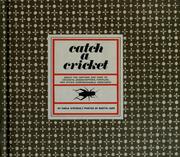
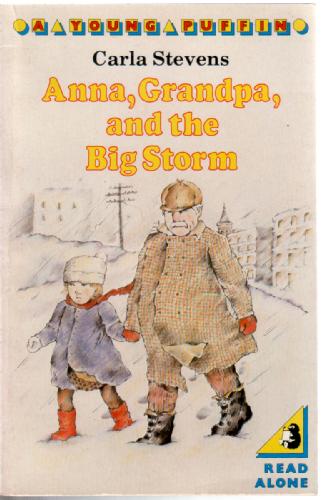
This isn’t the first time I’ve found a book written by Mrs. Stevens at a book sale. One year I found a copy of Catch a Cricket, a title I wasn’t familiar with. And I’ve found several copies of Anna, Grandpa, and the Big Storm over the years, all of which are now in my book collection.

Image          Image

My husband thinks I’m nuts to keep all these books. He doesn’t understand that I keep  them because of what they represent: a portal to my childhood and the person I was. I look back on that awkward, self-conscious nine-year-old and am grateful beyond words to Mrs. Stevens for writing these books, and for being such a great role model. Her books helped fan the flames of my passion for reading. A passion that helped me become the person I am today.

Thank you, as always, to Stacey and Ruth at Two Writing Teachers for hosting the Slice of Life Challenge.

Poetry Friday: A Splot, Buildings, and A Windmill

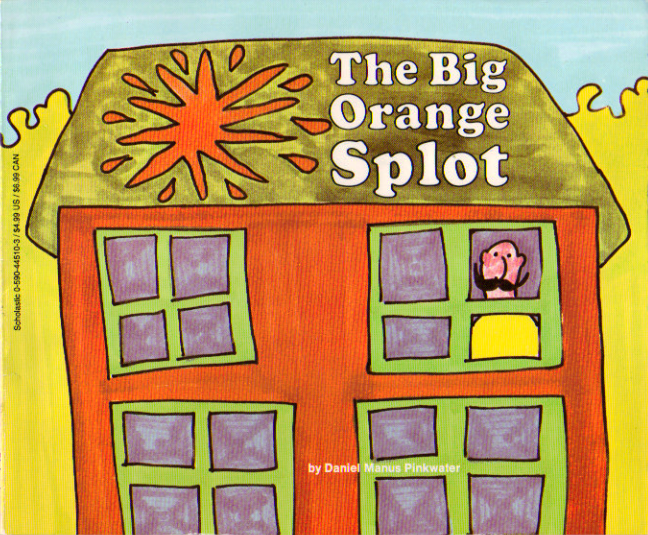
When I taught third grade, The Big Orange Splot, by Daniel Pinkwater, was always a favorite. This is the improbable story of what happens after an errant seagull flies over Mr. Plumbean’s house and drops a can of orange paint on the roof. Because “all the houses were the same” on their “neat street,” the neighbors assume that Mr. Plumbean will get right to work repainting his house. But he waits a little while. He thinks about the splot. When he finally does paint his house, it’s not at all what the neighbors had in mind. When asked what he has done, Mr. Plumbean simply replies, “My house is me and I am it. It looks like all my dreams.” At first the neighborhood thinks he’s nuts, but after a while they start to see the wisdom of Mr. Plumbean’s mantra. Eventually the houses aren’t the same at all and Mr. Plumbean’s neighbors dreams are revealed through their houses.

The_Big_Orange_Splot

Kids loved the wackiness of Mr. Plumbean and his house, and were intrigued by the other houses in the neighborhood. I began collecting photos of unusual houses and buildings to display on a bulletin board when we read this story.  Then I found this poem, the perfect complement to the pictures.

Buildings

by Myra Cohn Livingston

Buildings are a great surprise,

Everyone’s a different size

Offices grow long and high

Tall enough to touch the sky.

Houses seem more like a box

Made of glue and building blocks

Every time you look, you see

Buildings shaped quite differently

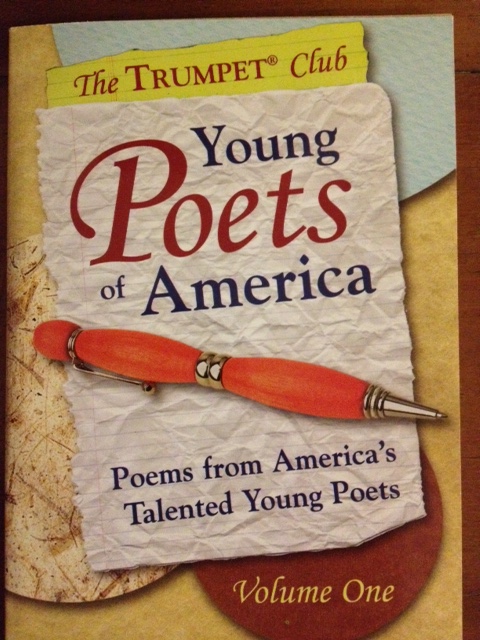
One year during this unit, a poetry contest was announced in the Trumpet Book Club order. (Trumpet either was or became part of Scholastic.) We had been reading and writing poetry since the start of school, so I shared this with my students and encouraged them to enter. I don’t remember specifically telling anyone to write a poem about a building, but the bulletin board did inspire some of them. Several students did submit poems to the contest and we were all thrilled when Allie’s poem was chosen to be included in this anthology:

photo-2

A Windmill

by Allie Mandeville

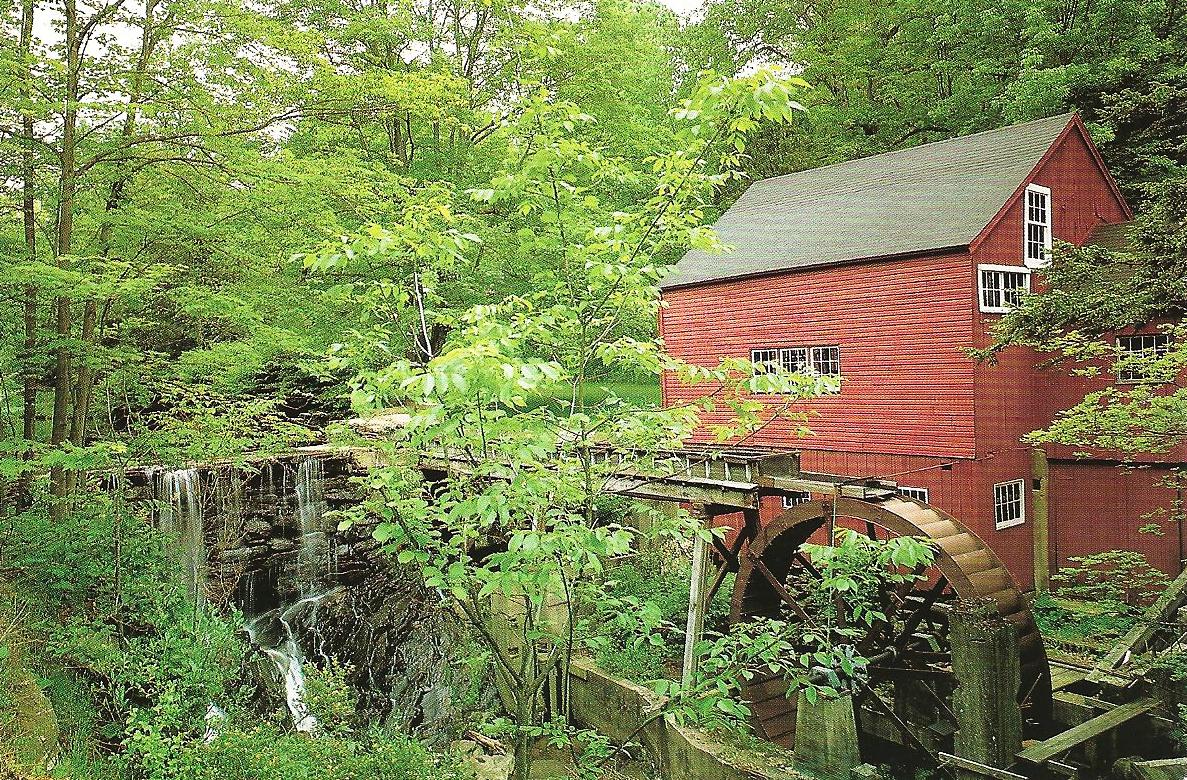
Windmill dancing in the breeze,

With a swift, turning ease.

The windmill makes a squeaky sound

As it’s turning round and round.

Spinning once, spinning twice,

The sound of spinning

Sounds so nice.

And as the wind makes it turn,

The windmill looks so very stern.

The windmill looks so beautiful.

The windmill looks so nice.

But don’t you think

It must be full of mice?

(Thank you, Allie, for permission to share your poem.)

Image
The picture that inspired Allie’s poem. Photo by Brad Stanton

I was reminded of all this recently when I found a copy of the anthology at a local book sale. I’m sure that if I were teaching third grade today I would still put up bulletin boards of interesting photos related to what we were reading and learning about. I know I would still be teaching writing using a workshop model. I would allow students to choose topics and subjects that interested them, not limit them to prompts provided by the state or some other distant textbook publisher. 

I would do all this and more to help them understand that the world is full of possibilities. I would do this so they could write poems that are full of all their dreams.

Be sure to visit Sherry at Semicolon or Matt at Radio, Rhythm & Rhyme for the Poetry Friday Round Up.

Poetry Friday: Sonnet 30 by William Shakespeare

Image

Sonnet 30

William Shakespeare

When to the sessions of sweet silent thought

I summon up remembrance of things past,

I sigh the lack of many a thing I sought,

And with old woes new wail my dear time’s waste;

Then can I drown an eye (unused to flow)

For precious friends hid in death’s dateless night,

And weep afresh love’s long since cancelled woe,

And moan th’expense of many a vanished sight.

Then can I grieve at grievances foregone,

And heavily from woe to woe tell o’er

The sad account of fore-bemoaned moan,

Which I new pay as if not paid before;

But if the while I think on thee, dear friend,

All loses are restored, and sorrows end.

I’ve been thinking about this sonnet for the last week or so for a number of reasons. I love the phrase  “sweet silent thought.” And while the speaker is brooding for much of the poem, to me this phrase implies time to contemplate new ideas. Having quiet, unhurried time to think is a rarity these days. Just as by the end of the poem, the speaker has achieved peace thinking of his friend, taking this time to think can bring us peace. (Both literal and figurative!)

This poem has also been on my mind because of a story I’ve been working on. The main character is grieving over the loss of her mother, and by the end of the story I want her to come to the kind of reconciliation with her grief that this speaker has. Whether or not I can accomplish that for her is another story, but I’m going to try.

In the meantime, I think I’ll listen to Kenneth Branagh read this lovely poem once more:

http://www.popscreen.com/v/7adx9/William-Shakespeare-Sonnet-30-Kenneth-Branagh

Be sure to visit Keri at Keri Recommends for her inaugural Poetry Friday Round Up.

Routines, Writing, and Excellence

Image

“We are what we repeatedly do. Excellence then, is not an act, but a habit.” Aristotle

Phil Jackson was interviewed on NPR about his new book not too long ago. He talked about the importance of practicing the fundamentals of basketball and how his teams  always started practice by working on the nuts and bolts of the game. Jackson related this to a story about Pablo Casals, one of the greatest cello players ever. When asked about his playing, Casals stated “I go through my fingering for an hour before I start playing a piece of music.”

This got me thinking about the fundamentals of writing. I don’t think we give students enough time to really practice the basics or build stamina for writing. We need to be more mindful of our established routines and ask ourselves “Is this activity/assignment helping the students become better writers?” If the answer is no, then we need a different routine.

The importance of keeping a writer’s notebook/journal has been underscored for me recently. For the past week, I’ve been participating in TeachersWrite! by responding to daily prompts. Some of this writing had nuggets taken from my journals, thoughts I’d jotted down without any specific purpose. Giving our students time to write each day about what interests them gives them the opportunity to practice the fundamentals in an engaging, meaningful way. Who knows what nuggets they’ll come up with when given the opportunity.

Providing our students with a daily opportunity to write about topics of their choice has the added benefit of getting them to think like writers. Since I’ve been writing regularly, I find myself observing the world differently. Telling students that they should see the world with “wide awake eyes” (Did Lucy Calkins write that? I can’t remember where I read it.) and actually getting them to do it are two different things.

A daily writing routine, one that offers students a period of time to just write, whether they respond to a prompt, take that prompt in their own direction, or just write about what’s on their mind, is critical if we want our students to be writers. Not just effective writers, but passionate writers. Writers who learn about themselves and the world through writing.

After I first heard the Phil Jackson interview and started drafting this post, I got side-tracked by work. In the meantime, Kate Roberts and Maggie Beattie Roberts posted “The Do-Re-Mi of Writing,” a thoughtful and practical piece about students improving their writing by having them go through their “scales,” just as musicians do. Be sure to read their terrific post.

Maria Popova also recently wrote about the importance of habit in “The Pace of Productivity and How to Master Your Creative Routine” on Brain Pickings. She gives lots of examples of famous creators, their daily routines, and the excellence they achieved through habit.

Thank you to Stacey and Ruth at Two Writing Teachers for hosting this weekly Slice of Life Challenge!

Poetry Friday: The Cities Inside Us

Image

I’m participating in Teachers Write! this summer, so I’ve been thinking about writing a lot this week. (If you haven’t heard about  this fabulous online summer writing camp for teachers and librarians, you can learn more on Kate Messner’s blog.) With all these thoughts whirling around in my head, it seems appropriate today to share a poem that speaks to the writer in all of us.

“The Cities Inside Us”

by Alberto Rios

We live in secret cities

And we traveled unmapped roads.

We speak words between us that we recognize

But which cannot be looked up.

They are our words.

They come from very far inside our mouths.

You and I, we are the secret citizens of the city

Inside us…

Read the rest of the poem here.

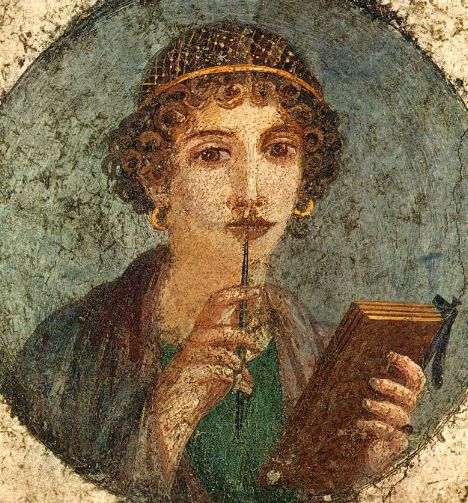
By Herkulaneischer Meister  via Wikimedia Commons
By Herkulaneischer Meister via Wikimedia Commons

Be sure to visit Amy Ludwig VanDerwater’s Poem Farm for today’s poetry round up.