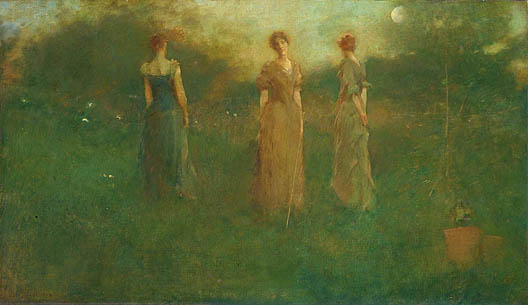
Several years ago, I visited the Smithsonian American Art Museum in Washington, D.C. with a friend. At the time, a room was devoted to the work of the American Impressionist Thomas Wilmer Dewing. I was captivated by the ethereal quality and soft colors of Dewing’s canvases. I bought a calendar that included several of his paintings, thinking I might frame them. Not long after this, my artist son asked if there was anything in particular I wanted for Christmas. I asked him to paint me a version of this painting:
Thomas Wilmer Dewing In the Garden 1892–94 oil 20 5/8 x 35 in. Smithsonian American Art Museum, Gift of John Gellatly
Michael’s version has hung over my bed ever since. I’ve often thought these women, my own graces, deserved a poem, but I never got around to writing one for them.
I was inspired to finally pick up my pen last month when Laura Shovan announced her Pantone® Poetry Project. Laura shared two or three colors each day, and challenged poets to write poems inspired by the colors. Day 10 featured Amberglow and Golden Glow, and although these aren’t the colors in Dewing’s painting, they are similar to Michael’s colors.
This day got away from me. You know those days. You wake up with plans and a list. And then one thing, probably some minor mishap, happens, and your day is now a day full of falling dominoes. There are no true disasters on days like this; they are mostly just full of frustration.
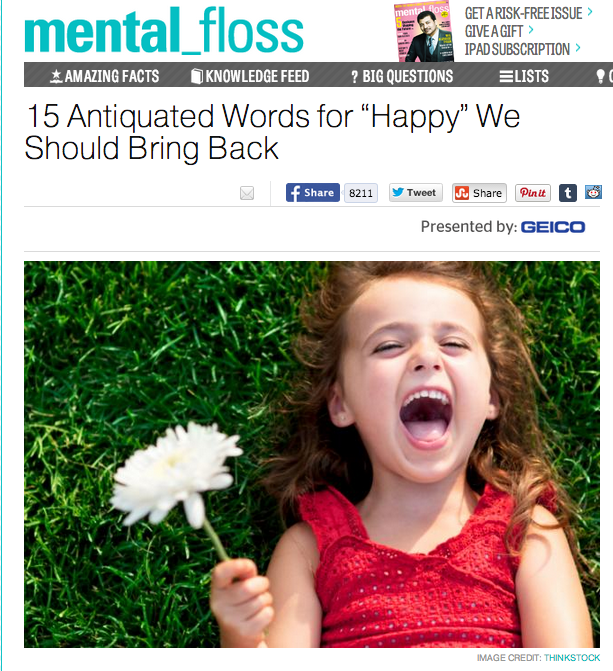
So rather than bore you with the details of this frustrating day, I want to share this post I stumbled across on Facebook over the weekend:
See that picture of me on the lower left corner of this page? That is me being “over the moon” when my son got engaged. (My daughter-in-law is a real gem.) My grandmothers both said “tickled” often, and Stacey used “kvelling” in today’s introduction.
So find a word that puts you “in high snuff” and work it into your writing. I’m going to go write about all those “chirky” robins who were in my yard this afternoon.
Last week, I mentioned sharingKing Midas and the Golden Touch with the fourth grade students at my school. They all enjoyed the story, and because of our rich discussion, had a good understanding of the theme. They were also able to write about this understanding, but incorporating evidence from the story into their writing was more of a challenge.
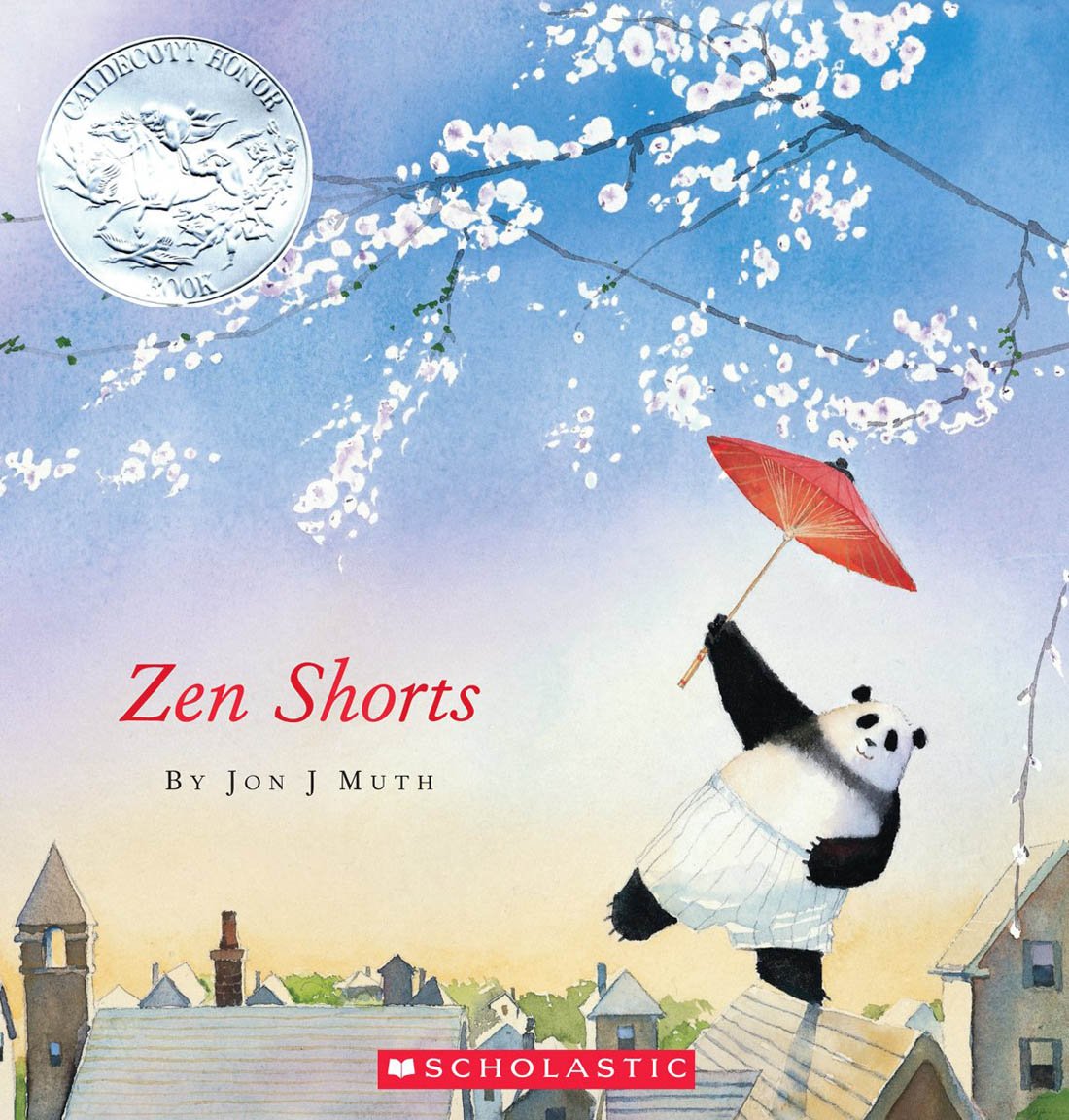
Their teachers and I knew from the start that this wasn’t going to be a “one-shot deal.” We knew there would be many more lessons, including guided and independent practice, as well as feedback, to get our students to be able to do this kind of work well. So on Friday, I was back in their classrooms with a very short excerpt from Jon J. Muth’s Zen Shorts, “Uncle Ry and the Moon.” I love sharing this deceptively simple story with students, and have done so many times. Muth’s book is quiet and unassuming, but it contains a powerful message.
Following the same routine we had used with King Midas, I read the story through once. The kids followed along on a typed version of the text. When I finished reading, I was met with a roomful of puzzled faces. I asked the kids to write what they had noticed and what they were wondering (We used a modified version on Vicki Vinton’s “Know/Wonder” chart for this.) Once they had their thoughts written down, they shared. All of the students were confused by Uncle Ry’s attitude toward the intruder. This clearly conflicted with the action they would take, or expect anyone to take, under similar circumstances. I complimented them for noticing this important contradiction, and explained to them the importance of this kind of observation. When an author includes those contradictions, he’s doing it for a reason. (Notice & Note, pg. 71)
Our next step was to reread the story, more carefully this time, and we stopped along the way to discuss what we were noticing now, and trying to sort out our confusion and begin to answer some of our questions. As we read, some students made thoughtful observations or raised interesting questions. Others asked questions to clarify a simpler element of the story, but these were important, too. I let them discuss these with their partners before sharing with the whole class.
It was during this conversation that one boy tentatively raised his hand. I have known and worked with this student since he was in first grade. His thinking is often perceptive, but can sometimes be muddled. I paused before calling on him to give him time to organize his thinking. Then I nodded to him and he said, “It’s like he’s the opposite of King Midas. Uncle Ry gives things away because he doesn’t mind being poor, and Midas wanted to have as much gold as he could get.”
I was speechless. I hadn’t thought of that myself. His teacher and I exchanged a look of joy. Of course, we let him know how impressed we were with his thinking and the he had made such a meaningful connection to King Midas. Then, another student started to raise her hand, and again, I could see the wheels still turning. She proceeded to tell us that another reason Uncle Ry was different from Midas is that Midas was blinded by greed, but Uncle Ry was blinded by his kind nature, and that was why he saw the intruder as a visitor.
I have shared this story with students many times before, but they have never come to these deep and thoughtful conclusions or level of understanding. So what was different? I hadn’t read the story right after King Midas before, but I wasn’t consciously thinking of a thematic connection between the two. Just as before, I had a plan when I began the lesson, but it was more open-ended. In the past, we were usually focusing specifically on character traits or summarizing. I firmly believe that the kids were able to achieve this level of understanding because I followed their lead. I let them develop the questions they had about the story. I let them go back and locate significant passages in the text. We do our students a huge disservice when we teach from a script and ask only preplanned, canned questions.
Are we finished with this work? Absolutely not. But we are laying a solid foundation for the kind of close reading and thinking skills our students will need to be thoughtful, caring human beings. And that, my friends, is worth all the gold in the world.
We are halfway through March, which means we’re also halfway through the daily Slice of Life Challenge. Like many of you, I questioned the wisdom of committing to a daily blog post. Writing in my journal regularly is one thing. Composing a piece worthy of other people’s valuable time on a daily basis is another.
One reason I worried is that, since September, I’ve gotten out of the habit of writing every day. I made dozens of excuses for not writing more often, most of them pretty weak. But after writing daily for two weeks, I’ve noticed a shift in my brain. My thinking is clearer and I’m more observant because I’m writing every day.
Early last week, when I was working on the haiku I shared yesterday, I went through an old journal looking for the entry where I first wrote about the snow being the field’s counterpane. Instead, I found this, from February 2000: “I think I’m too afraid to find out how awful a story I would write, so I don’t write one.”
Fourteen years later, I’m not afraid anymore. Thanks to many people, I “have the spirit to try.” I know that writing something bad isn’t the end of the world. It’s only the beginning.
Thank you to Stacey, Tara, Dana, Betsy, Anna, and Beth for hosting the Slice of Life Challenge and helping me have the courage to write. Be sure to visit Two Writing Teachers to read more Slice of Life posts.
The month-long Slice of Life Challenge, hosted at Two Writing Teachers, is almost at the half-way point. Because this is a writing challenge, I’ve decided to share original poems for Poetry Friday during the month. What poetic form is better suited to capture Slices of Life than haiku?
1.
Slices of life–
Pieces of hearts on the page.
Stories connect us.
The weather has been extreme in Connecticut this week. Early in the week, the temperature soared, the sky was bright blue, and spring filled the air.
2.
Coming untucked,
the deep counterpane of snow
hides spring underneath.
But on Wednesday, the weather changed. Apparently, winter isn’t through with us, although we have had enough of him.
Kate DiCamillo, the National Ambassador for Young People’s Literature, claims
“When we read together…we are taken out of our aloneness. Together, we see the world. Together, we see one another. We connect.”
We typically think of stories being in the pages of a book. But they also come in the form of letters. One of my aunts was a great letter writer. This, of course, was pre-email and texting, even before free long distance was ubiquitous. My grandmother always looked forward to her sister’s letters, and she loved sharing them with my mother as soon as they arrived. Thinking of her now, sitting at her kitchen table, reading and commenting on my aunt’s news, has suddenly overwhelmed me with longing.
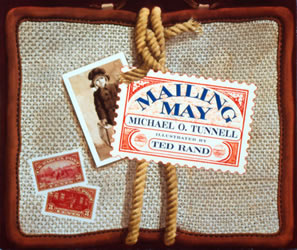
Charlotte May Pierstorff also longed for her grandmother, who lived “a million miles away through the rough old Idaho mountains.” Her parents had promised her a visit, but when the time came, there was no money for a train ticket.
The solution to May’s problem is told in the 1997 book, Mailing May (Greenwillow), by Michael O. Tunnell and illustrated by Ted Rand. With the help of a cousin who works for the railroad, May’s parents decide to mail her to her grandmother via parcel post. After having fifty-three cents worth of stamps and a mailing label attached to the back of her coat, May boards the train for Lewiston and is off on her adventure.
Tunnell lets May tell her own story, which really conveys May’s excitement about her trip. She describes hanging “on the edge of mountainsides” and crawling “through tunnels.” The story ends with May’s joyous reunion with her grandmother, “with a little help from the U.S. Post Office!”
I knew the minute I read Mailing May that it was perfect for my third grade students. May’s experience was so far removed from anything they could imagine, I wanted to immerse them in this book. We turned it into a springboard for a day’s worth of learning. We discussed the theme of the book, and made personal connections about visiting grandparents far away.
But we also wrote letters to grandparents, even if they lived down the street. We studied a map of Idaho and learned about its geography. In the book, Tunnell describes how the postmaster weighs May, then calculates the cost of mailing her. We were piloting a new math program at the time, and there was a lesson about calculating shipping costs for packages. So I brought in my bathroom scale and weighed each child so they could calculate how much it would cost to ship themselves to Florida (where many grandparents did indeed live).
Each year I looked forward to our Mailing May day. The kids were amazed by May’s story and loved her sense of adventure. And while I can’t say they all loved writing the letters, they all had a new appreciation for our quick and easy communication abilities. More importantly, they also gained an understanding and appreciation of how stories, whether in books or letters, connect us all across distances of space and time.
Thank you, as always, to Stacey, Tara, Dana, Betsy, Anna, and Beth for hosting the Slice of Life Challenge and creating this space for us to share our stories. Be sure to visit Two Writing Teachers to read more Slice of Life posts.
I grew up next door to my grandmother and have many happy memories of hours spent at her house. Many of those hours were spent in her kitchen watching and helping her cook. So in January, when Mary Lee Hahn shared her poem “Recipe,” I was inspired to write a poem about my grandmother and her kitchen. A list of words and phrases grew, but I couldn’t seem to find a way to organize them.
A few days later, Tricia Stohr-Hunt challenged readers to write a pantoum in her Monday Poetry Stretch. As I read about the structure of pantoums, I began to see possibilities for a poem about my grandmother. Then Fran McVeigh shared memories of her grandmother for her Slice of Life Challenge post earlier this week, and her slice prompted me to go back and revise this poem.
UPDATED: My apologies to Margaret at Reflections on the Teche for not thanking her for hosting the Poetry Friday Round Up yesterday. It’s not too late to visit her and read all the wonderful poems shared there.
Like many of you, I feel overwhelmed at the prospect of writing a blog post every day for the entire month of March. Last year, I began the Slice of Life Challenge more or less on a whim. I really didn’t think I’d ever be able to post every day. About half way into the Challenge, I decided I couldn’t stop. This year, I’m totally committed to completing the Challenge, but I need a plan. We encourage our students to make writing plans, to have a notebook where they collect ideas. When he spoke at the Connecticut Reading Conference last year, Lester Laminack referred to a writer’s notebook as “the junk drawer for your ideas,” full of all sorts of odds and ends. Some of these snippets become longer pieces of writing; others stay in the drawer just in case they’re needed some day.
My junk drawer is full today, but my brain doesn’t feel up to the task of sorting through the ideas I’ve accumulated over the past day 24 hours from reading blog posts, books and articles, so I’m going to write them here so they won’t be forgotten.
Yesterday, Fran wrote about memories of home and her grandmother. This got me thinking of some pieces I’ve written about my own grandmother. Maybe I’ll reread them and polish one so it’s ready to share.
A colleague had a baby girl yesterday, and I’m thinking about what to knit for her. I don’t have the yarn I need, and this makes me think that choosing the right yarn for a knitting project is like choosing the right words for our writing. I once taught a lesson on word choice exactly this way. I even brought in different types of yarn to help the kids visualize the analogy!
Finally, I read Tricia’s post on her lovely blog, The Miss Rumphius Effect, about her new dog. She shared “Dog in Bed”, by Joyce Sidman, and that got me thinking about my own dog (and cat) and what I could write about them.
So, I have much to think about, but also many other obligations to take care of this evening. The good news is that I have a plan, and these thoughts will be waiting here for me when I’m ready to write more.
Today’s post is doing double duty as my contribution to the Slice of Life Challenge at Two Writing Teachers.
We’ve all heard of a school of fish and a flock of birds. But what about an ostentation of peacocks?
Collective nouns, those words that turn a group of people, animals, or things into a singular noun, are words that children often learn intuitively as they acquire language as toddlers and preschoolers. The CCSS calls for collective nouns to be formally introduced to students in second grade.
If the goal of teaching these words to young writers is to have them use them in their writing, they need to have “read that language, to have heard it in [their] mind, so that [they] can hear it again in order to compose it.” (NCTE Beliefs About the Teaching of Writing) Although the styles of these books are very different, each one would be a good choice for introducing the concept of collective nouns.
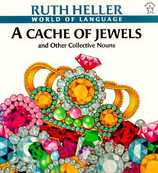
Ruth Heller’s A Cache of Jewels (Grosset & Dunlap, 1987) is an old favorite, one I read to my third graders when I began teaching almost twenty years ago. This brightly illustrated book is still a good model for using collective nouns. Heller includes collective nouns of all kinds, not just those that describe groups of animals.
I’ve found some new books students will enjoy as they learn more of these words. My favorite is A Zeal of Zebras: An Alphabet of Collective Nouns (Chronicle Books, 2011). Woop Studios, a London-based collective (honestly, that’s what the book says!) of four artists, have created “a visual safari through the animal kingdom” (back cover). This oversized picture book is filled with stunning illustrations, unique collective nouns and facts about each group of animals. Some, “an implausibility of gnus,” for example, seemed so improbable that I looked it up. (It’s true, and you can find an extensive list of collective nouns for groups of animals here.) Others are so appropriate: of course it’s “a galaxy of starfish.” Some of the longer words will be a challenge for second graders, but these are the kinds of words kids love learning and trying to use.
One Sheep, Two Sheep: A Book of Collective Nouns, (Little Hare Books, 2010), by Patricia Byers and illustrated by Tamsin Ainslie develops the concept of collective nouns being a group of three or more. Each two-page spread follows the same pattern: “One sheep, two sheep, a flock of sheep.” Charming illustrations provide visual support for the growing numbers in the group described by each collective noun.
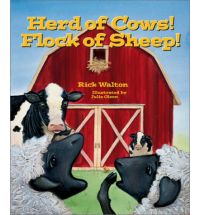
Finally, silliness ensues in Rick Walton’s Herd of Cows! Flock of Sheep! (Gibbs Smith, 2002, 2011; illustrated by Julie Olson). This book incorporates the collective nouns into the story of how Farmer Bob’s animals jump into action to save him after his bed is swept away in a flood.
I don’t know if there’s a collective noun for a group of bloggers, but Stacey, Tara, Dana, Betsy, Anna, and Beth are the best around! Thank you for hosting the Slice of Life Challenge. Be sure to visit Two Writing Teachers to read more Slice of Life posts.
I’ve been thinking a lot about writing rubrics lately. All year, we’ve been continuing to incorporate the CCSS into our writing instruction and part of this work has been creating new rubrics. My school purchased the Units of Study by Lucy Calkins and her colleagues at the Teachers College Reading and Writing Project last spring, and we’ve made some minor changes to the rubrics in those units for grades K-5. However, the middle school rubrics have been a bit more of a challenge. Connecticut is part of the Smarter Balanced Assessment Consortium, and they have published rubrics that we’ve used as a guide to create documents that work for us. We found the Smarter Balanced documents cumbersome, so we’ve used the language from Smarter Balanced with the Units of Study format to draft rubrics for grades 6-8.
There has been some disagreement among the teachers, however, about how many categories were needed on the rubric. Ultimately, we felt that everything on the SBAC rubric should be included on ours, but there is concern that the document has become unwieldy.
The challenge is to create a document that includes the standards being taught and assessed, but isn’t so lengthy that teachers don’t use it as a formative assessment tool to determine what our students are learning. As Clare Landrigan and Tammy Mulligan, authors of Assessment in Perspective, have pointed out on their blog, “Assessment, formal and informal, is the window into knowing our students.” Using the information gathered through these assessments to guide instruction is essential if our students are going to grow as writers.
One option is to use the whole rubric for pre- and post-assessments. Then, once learning needs are identified, relevant sections of the rubric can be used as an interim assessment tool to monitor the students’ progress toward their learning goals. Some teachers have found that this works for them; others are not yet convinced.
I know many of you have grappled with this same issue. I’d love to hear if anyone has any other solutions.







 Reading to the Core