SOL: A Happy Accident

“Chance favors the prepared mind.”
Louis Pasteur

My One Little Word for 2018 is focus. At school, I’ve been focused on incorporating the growth mindset stances laid out by Kristine Mraz and Christine Hertz in their book, A Mindset for Learning, as well as the habits of mind explained in Learning and Leading with Habits of Mind, by Arthur L. Costa and Bena Kallick. This means I’m constantly on the lookout for opportunities to weave these habits into my lessons.

In Costa and Kallick’s work, this focus would fall under the habit of “creating, imagining, and innovating.” Maybe it’s the poet it me, but I prefer to think of this as “serendipity,” those happy accidents of chance that occur when we’re paying attention. Yesterday, such a moment occurred.

As I was working with a second grader, he noticed The Day the Crayons Quit in a basket on a nearby bookshelf. “Can we read this, too?” L. asked as he pulled the book from the basket. “Mr. M. read it to us in Library and it’s really funny.”

“Absolutely,” I replied. “Let’s finish our other work first.” He agreed, and I presented How Bear Lost His Tail from Fountas & Pinnell’s Leveled Literacy Intervention kit.

He wasted no time in reminding me that he’d already read this book. The advantages of rereading are well-known and many. Among other benefits, rereading increases fluency and deepens comprehension, my goal in this case. I explained to him I knew he’d read the book before, but that readers always find something new when they read a book a second, third, or even fourth time.

He launched into the book, and because it was his second read, he read it fairly fluently and with good expression. When he finished, I asked him if he had an idea about why Fox tricked Bear. He replied, “Maybe Fox was sad.” Seeing an opportunity to develop his vocabulary, I asked him if there were any other words he could use to describe how Fox felt. “Upset?” he said, with a hint of a question.

“Why would he be upset?” I asked him.

“Because Bear’s tail is bushier than his,” he replied, this time with more confidence.

I asked him if he knew the word “jealous.” He said he didn’t. I explained that if someone has something you would like to have, you might be jealous. I asked him if his sister ever had anything he wanted but couldn’t have. He remembered that at her last birthday party, he’d been upset that she was getting so many presents. “That’s what it feels like to be jealous,” I explained.

Seizing the opportunity he’d presented me with when he asked to read The Day the Crayons Quit, I asked, “Do you think any of the crayons were jealous?” He shrugged and said he couldn’t remember. “Let’s find out,” I suggested.

Working together, we reread the first few letters of protest from Duncan’s crayons. Lo and behold, there was Beige, feeling very left out because Brown got to color all the “bears, ponies, and puppies.”

“He’s jealous,” L. announced proudly.
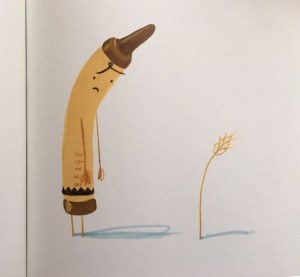
From The Day the Crayons Quit, by Drew Daywalt, pictures by Oliver Jeffers

New learning sticks when learners apply “past knowledge to new situations” (Costa & Kallick, p. 28). Granted, this new situation was within five minutes of L.’s introduction to the word, but he made the connection between the two characters on his own and was articulated his thinking clearly. It’s unlikely that I would have planned this sequence of events ahead of time. But L. is more likely to remember this new vocabulary because a number of conditions were in place that engaged him in a meaningful way. Serendipity at its finest.

Thank you to StaceyBetsyBeth, KathleenDeb, Melanie, and Lanny for creating this community and providing this space for teachers and others to share their stories every day in March and each Tuesday throughout the year. Be sure to visit Two Writing Teachers to read more Slice of Life posts.

SOL18: By the Book

My Saturday morning routine almost always includes a first glance at The New York Times Book Review. It’s only a first glance because I always note which reviews I want to return to and read more carefully. The second read always begins with “By the Book.” This column, subtitled “Writers on literature and the literary life,” interviews authors about what they’re currently reading, which books they love, and other interesting questions related to their reading. Last week’s column featured beloved children’s book author, Brian Selznick, whose newest book, Baby Monkey, Private Eye (Scholastic, 2018) came out last week.

I always love to know what other people are reading, and I don’t know many teachers or writers who aren’t curious about this also. Last year, one of my March Slices was modeled after By the Book, and, since today is Saturday, I decided today was time for an update.

What books are on your nightstand?

At the moment, I’m alternating between Mary Oliver’s beautiful new collection Devotions and Voices in the Air by Naomi Shihab Nye. I am in awe of both of these poets and sometimes come away from their work wondering why I even bother. More often than not, though, the masterful imagery of these two women inspires me to keep writing.

Next is The Essex Serpent, by Sarah Perry. A friend gave me this book for my birthday in October and I’m just now getting to it. The jacket copy states this book “masterfully explores questions of science and religion, skepticism and faith, but it is most of all a celebration of love.” The Essex Serpent got great reviews when it was published and was on many “Best of 2017” lists last December. I’m only on page 17, so I’ll keep you posted.

There is always at least one professional book in the stack, and currently it’s Learning and Leading with Habits of Mindby Arthur L. Costa and Bena Kallick. My colleagues and I have been working this year to embed these habits of mind into our teaching. Costa and Kallick have countless suggestions for incorporating these habits into our days in thoughtful, meaningful ways that will help our students internalize them.

I’m embarrassed to confess I haven’t read this year’s Newbery Medal winning book, Hello Universe, by Erin Entrada Kelly yet. As soon as it’s in our library on a Friday afternoon, I’ll bring it home for the weekend. (I never take books until after the kids have left on Friday; if they want the book I want them to have it!)

What books are on your nightstand?

Thank you to StaceyBetsyBeth, KathleenDeb, Melanie, and Lanny for creating this community and providing this space for teachers and others to share their stories every day in March and each Tuesday throughout the year. Be sure to visit Two Writing Teachers to read more Slice of Life posts.

A Slice of Poetry


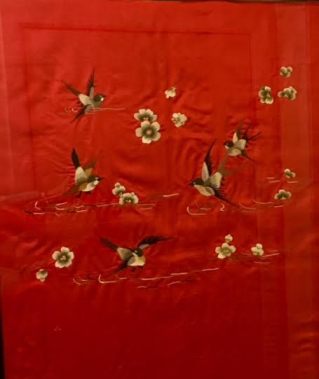
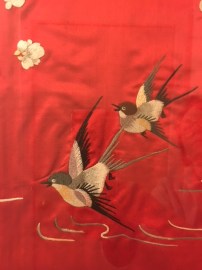
Have you ever had the experience of passing an object on a daily basis and not really seeing it? We get so wrapped up in our busyness that we fail to notice the beauty present all around us. This is certainly true of this silk embroidery. It was given to my husband’s grandfather, an Army major, when he served in Southeast Asia during World War II. (I’m embarrassed to admit I don’t know exactly where or by whom.) When our son, the first son of a first son, was born, Rodney’s grandparents gave it to us. It’s been hanging in our upstairs hallway ever since, but I never really stop to LOOK at it.

When Laura Shovan announced that her February Poetry Project would be ekphrastic poetry inspired by art in participant’s homes, I knew I wanted to share this embroidery. These playful birds and delicate petals deserve a poem. (Or a dozen or more!)


Playful swallows swoop
among dancing white blossoms
chittering, chirping
iridescent acrobats
tumbling on a spring breeze

© Catherine Flynn

Don’t forget to visit Renée LaTulippe at No Water River for the Poetry Friday Roundup. Also, thank you to StaceyBetsyBeth, KathleenDeb, Melanie, and Lanny for creating this community and providing this space for teachers and others to share their stories every day in March and each Tuesday throughout the year. Be sure to visit Two Writing Teachers to read more Slice of Life posts.


March SLO: The Breathings of My Heart

My father and grandfather built the house I grew up in when I was two years old. The house wasn’t completely finished when we moved in, and the closet in my bedroom remained unpainted for several years. That vast, empty expanse of sheetrock became my own personal graffiti wall. I can barely remember what I drew on those walls. If I wrote anything, it was the scribbles and loops of an emergent writer. Of course this drove my mother crazy, but I wouldn’t stop. I had a story to tell!

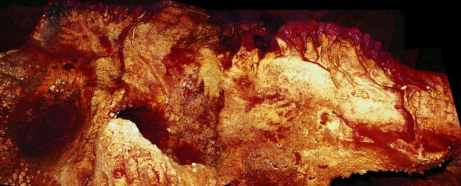
Humans have always been compelled to tell their story. Recently discovered cave paintings in Spain were made by Neaderthals, our close ancestor, at least 65,000 years ago! In his novel Waterland, Graham Swift writes, “Man—let me offer you a definition—is a storytelling animal. Wherever he goes he wants to leave behind not a chaotic wake, not an empty space, but the comforting marker buoys and trail signs of stories.” Those handprints deep inside caves around the world are the ancient equivalent of “Kilroy was here.”

Hand stencils in Maltravieso Cave in Spain made at least 66,000 years ago. (H. Dollado)

I stopped scribbling on my closet wall once my father painted it, but I’ve always filled notebooks with what Wadsworth calls “the breathings of my heart.” I love the joy I feel when I uncover a forgotten memory or make some other discovery about myself when I write. I love the clarity writing brings to my thinking about relationships, work, and the world around me. For the next month, I’ll be joining hundreds of writers and teachers around the world delve into the mysteries that writing uncovers as well tell our stories, one slice at a time. I hope you’ll join us.

Thank you to StaceyBetsyBeth, KathleenDeb, Melanie, and Lanny for creating this community and providing this space for teachers and others to share their stories every day in March and each Tuesday throughout the year. Be sure to visit Two Writing Teachers to read more Slice of Life posts.
SOL: Focus

After eight weeks of trying it on for size, I’ve decided “focus” is the right OLW for me in 2018. We develop our own understanding of words throughout our life, so I was curious about what the dictionary had to say about my word. The first definition listed in my old Merriam Webster states that focus is “the point where rays of light, heat, etc, or waves of sound come together, or from which they spread.” Although my original thinking had more to do with “to concentrate, as to focus one’s attention,” I love the image of rays of light coming together or spreading out as I pour my energy into two projects, one personal, the other work-related, that are the real impetus for me choosing this word.

In a recent blog post, Vicki Vinton, author of Dynamic Teaching for Deeper Reading, invited her readers to become “protagonists in their own learning” by adopting an inquiry based approach to a problem or question. Over the past few months, my colleagues and I have been focused on cultivating a growth mindset in our students. This is challenging, ongoing work that easily lends itself the kind of action-research Vicki advocates.

Following Vicki’s model, we have our question: How can we cultivate a growth mindset in our students? We have done research, although this is really ongoing process, and have a hypothesis: Modeling growth mindset behavior and embedding growth mindset stance vocabulary into our daily interactions with children will cultivate their own growth mindset.

Our research began by reading Carol Dweck’s foundational book on the subject, Mindset: The New Psychology of Success (Random House: 2006). Two books are guiding us as we move forward. Learning and Leading with Habits of Mind: 16 Essential Characteristics for Success, (ASCD, 2008) edited by Arthur L. Costa and Bena Kallick is an incredible resource, filled with suggestions for creating “thought-full” environments, assessing students’ (and our own!) attitudes and ideas about mindset, as well as lists of additional resources. Kristine Mraz and Christine Hertz’s A Mindset for Learning: Teaching the Traits of Joyful, Independent Growth (Heinemann, 2015) has guided our K-3 teachers in making the stances of mindset accessible to our youngest learners.

Through surveys, we gathered information regarding how students perceive their current mindset. To encourage reflective thinking about these stances, we asked them to include specific examples of when they engage in a particular behavior. The results were a mixture of brutal honesty (I am not persistent when my math homework is hard.) and responses that need a bit more reflection. (I am always persistent.)

Read-alouds are one way we are embedding the vocabulary of growth mindset into our day. Children’s literature is filled with determined, resilient, flexible characters who overcome incredible odds to achieve their goals. My personal favorite is Brave Irene by William Steig, which has been my go-to book for teaching character traits since it was published, but there are hundreds of worthy titles to choose from. Nonfiction is also full of inspiring stories of people who didn’t give up on their dreams. (This post from 2013 has a short list of a few of my favorites.)

We are still in the process of testing our hypothesis, and will be for months to come. As Costa and Kallick point out, “we never fully master the Habits of Mind…we continue to develop and improve them throughout our lives.”

I’ll let you know how well I’m doing staying focused and share any glimmers of light spreading out from our work.

Thank you also to StaceyBetsyBeth, KathleenDeb, Melanie, and Lanny for creating this community and providing this space for teachers and others to share their stories each Tuesday. Be sure to visit Two Writing Teachers to read more Slice of Life posts.

Slice of Life: Catalog Nerd

Each autumn when I was a kid, I looked forward to the arrival of the Sears Wish Book. Within this catalog were the items I needed to ensure a perfect life. Barbie dolls I dreamt of, a dollhouse I coveted, and more. There were matching skirts and sweaters and perfectly appointed bedrooms. (I confess, though, the white French Provincial furniture never appealed to me.) I pored over the pages, carefully considering each item before adding it to my letter to Santa.

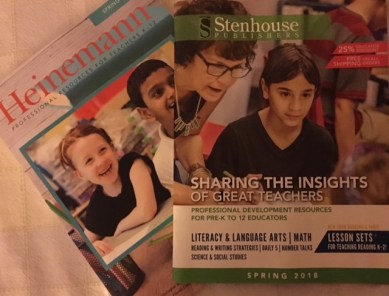
Of course the Sears Christmas catalog, and others like it, have gone the way of the dodo. But over the course of my teaching career, I’ve discovered two catalogs that fill me with as much excitement as the Wish Book did so many years ago. The Heinemann and Stenhouse spring catalogs arrived today, and I swear I did a little happy dance. Filled with professional books by educators I trust and admire, I now study the pages of these two catalogs with more intensity that I ever invested in the Sears catalog. Because, although I won’t ever have time to read all the smart, inspirational books offered by Heinemann and Stenhouse, I am certain that the three or four books that I do purchase will make me a better teacher. They won’t ensure a perfect life (I gave up that wild goose chase long ago), but they will provide me with ideas, tools, and strategies that I can use to do the best work I can for my students. And while that won’t give them a perfect life either, it will go a long way toward instilling in them the passions and skills they’ll need to create their own best possible life.

Thank you also to StaceyBetsyBeth, KathleenDeb, Melanie, and Lanny for creating this community and providing this space for teachers and others to share their stories each Tuesday. Be sure to visit Two Writing Teachers to read more Slice of Life posts.
Slice of Life: Be Astonished

“You were made and set her to give voice to this, your own astonishment.”
~ Annie Dillard ~

When I took my dog outside one morning not long ago, I gasped when I looked up. The moon was a glowing, golden egg hanging in the western sky. Just to the south, his sword raised for eternity, his quarry just out of reach, Orion stood tall. A scattering of fainter stars dotted the sky around him. It was an astonishing sight.

It occurred to me how rare the word astonish has become. In fact, Merriam-Webster ranks it in the bottom 50% of words. This is a shame, and a fate this word doesn’t deserve. Defined as “to strike with sudden and usually great wonder or surprise,” astonish arrived in our vocabulary from the Middle English words astonen or astonien. These, in turn, are derived from the Anglo-French word estoner, “to stun,” which comes from the Latin ex- + tonare, “to thunder.” An obsolete meaning is “to strike with sudden fear.” I prefer our modern definition,  

And although Mary Oliver instructs us to “Pay attention. Be astonished. Tell about it,” modern life throws so many distractions at us, it’s easy to forget even these simple steps.

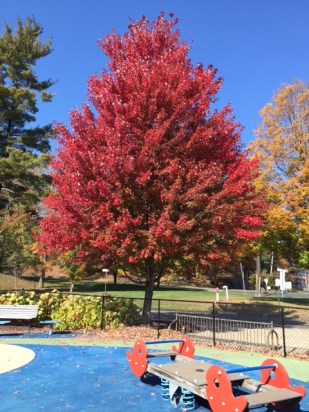
Each day as I come and go to my classroom, I pass a wall of windows that looks out over the playground. At the far end is a maple tree whose leaves turn the most gorgeous red I’ve ever seen. I’ve always felt a kinship with that tree, that I was the only one who appreciated its beauty.   Yesterday, two teachers were standing by the windows deep in conversation about a student. They paused and said hello as I walked by. With Mary Oliver’s words in my mind, after returning their greeting, I pointed out the flaming red leaves of the tree. One of the teachers hadn’t ever noticed the tree’s beauty and thanked me for pointing it out to her.

I want my students to be astonished by the world around them. I want them to notice the wooly bear scurrying off toward his winter hiding spot. I want them to astonish themselves, like one of my first grade students. After reading a sentence perfectly, he looked up at me and exclaimed, “I read that!” He was truly astonished that he had such power within himself.

Writing also gives us access to that power. My writing practice has been in the doldrums lately, for all the reasons you already know. But I miss writing about small astonishments I see each day. This rather scattered slice is a first step in returning to this practice. One of the profound lessons of writing each day is that those small astonishments lead to larger insights and discoveries. And like Orion, always on the hunt, I don’t ever want to stop searching for those bigger insights about who I am and my place in the world.

Thank you also to StaceyBetsyBeth, KathleenDeb, Melanie, and Lanny for creating this community and providing this space for teachers and others to share their stories each Tuesday. Be sure to visit Two Writing Teachers to read more Slice of Life posts.
Slice of Life: One School, One Book

For many years, schools across the country have been participating in One School, One Book programs to promote a love of reading and build a reading community. After the Children’s Program Coordinator of our local library contacted our school to discuss ways we could join forces to encourage summer reading, we decided to sponsor a One School, One Book event.

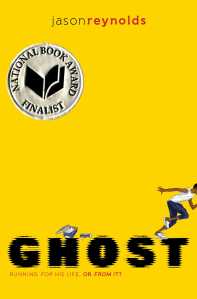
Or rather, a Two Schools, Two Books event. Because I teach in a K-8 school, finding one book for such a broad age range was a real challenge. So we split the school into elementary and middle school grades and chose two books. Students in the lower grades read Tamera Will Wissinger’s heartwarming Gone Fishing, while middle school students read Ghost, by Jason Reynolds. Every child received a copy of a book during the last week of school.


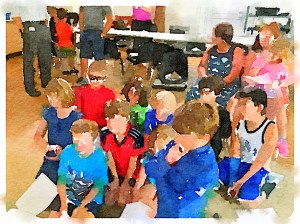
We met twice during the summer to celebrate these books and our reading. Taking a cue from poetry promoter extraordinaire, Sylvia Vardell,  Gone Fishing readers made poem collages (scroll to the bottom of the post) for their favorite poems, then performed some of the poems for two (or three) voices. At our second get-together, the kids wrote acrostics and list poems about fishing or other favorite hobbies. The highlight of this evening was a Skype visit with Tamera. She shared that the idea for Gone Fishing grew out of one poem based on Tamera’s memories of going fishing with her family. Some brave poets then read their poems. Everyone was inspired to write more poems, and one lucky girl went home with a copy of Gone Camping, Tamera’s new book about Sam and Lucy.

Proud poem collage creator
Skyping with Tamera

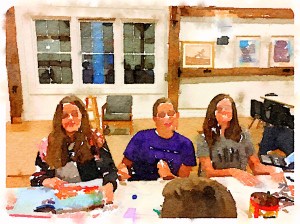
Readers of the National Book Award finalist, Ghost, by Jason Reynolds had two insightful discussions about Castle, the choices he made, and how he dealt with those choices. These middle schoolers loved performing some of their favorite scenes, especially Ghost’s blow-up at Brandon in the cafeteria. They also had fun making heart maps for Castle. Everyone was disappointed that Patina hadn’t been published yet (we met before the August 29th publication date), but had plenty of recommendations for other books they’d read over the summer.

All of our celebrations were topped off with ice cream sundaes, and everyone went home happy.  Now that school has started, we’ve been discussing how the main characters of both books exhibit Sherman School’s core values of honesty, courage, responsibility, and respectBased on the success of these celebrations, we’re hoping to make our version of One School, One Book an annual event. 

Happiness is ice cream with a friend AND a new book!

Thank you also to StaceyBetsyBeth, KathleenDeb, Melanie, and Lanny for creating this community and providing this space for teachers and others to share their stories each Tuesday. Be sure to visit Two Writing Teachers to read more Slice of Life posts.
Slice of Life: Root Beer Floats

Yesterday was National Root Beer Float Day. I love that there is a National day for almost everything, and I was especially happy to have an excuse to make a root beer float. When we were little, my sister and I spent a lot of time with our grandmother, especially during the summer. Her house was surrounded by shady maple trees that kept us cool, but on sweltering afternoons, nothing beat the heat like a root beer float.

Grandma had tall pink plastic tumblers that were reserved for these warm-weather treats. Joanie and I got them from the cupboard while Grandma took the ice cream from the freezer and the cans of root beer from the fridge. She scooped two precise balls of Sealtest vanilla into each cup. Then she slowly poured in the root beer, trying to prevent streams of bubbly foam from erupting over the rim.

We sat together at the kitchen table and sipped as the icebergs of softening ice cream dissolved into crystal-coated blobs. We laughed at the foamy mustaches on our upper lips. Grandma never threw anything away, so we used long-handled, red plastic spoons from Carvel’s to scoop out the last remnants of the ice cream from the bottom of the cup, savoring the creamy blend of sweet and sharp flavors, the perfect antidote for a hot summer day.

Those plastic tumblers are long gone, and I don’t think Sealtest Ice Cream is even made anymore, but that didn’t stop me from savoring a root beer float yesterday. It was just as delicious as I remembered.

Thank you also to StaceyBetsyBeth, KathleenDeb, Melanie, and Lanny for creating this community and providing this space for teachers and others to share their stories each Tuesday. Be sure to visit Two Writing Teachers to read more Slice of Life posts.
 

Slice of Life: “Be Astonished”

I didn’t make it to all the Poetry Friday posts over the weekend. I rarely do, despite my best intentions. But the posts I did read were, as usual, full of beauty and inspiration. Jama Rattigan shared Mary Oliver’s breath-taking poem, “Messenger.” (Read it here.) These lines have been in my head all weekend:

“… Let me
keep my mind on what matters,
which is my work,

which is mostly standing still and learning to be
astonished.”

We owe it to the world to “be astonished” and “give shouts of joy” about the beauty that surrounds us. As I was walking to my classroom this morning, I looked out the window and was astonished by the beauty of fallen cherry blossoms.

Scattered by the wind,
cherry blossoms dart and dance
across the playground

© Catherine Flynn, 2017

I also appreciated Brenda Harsham’s interview with Irene Latham. Both of these smart women inspire me, but I really appreciated Irene’s advice to “just WRITE. Even if all you have is fifteen minutes, just do it.” Why do I need to be reminded of this constantly? At this time of year, though, it seems especially important to find those quiet moments amid all the hubbub, both for our students and ourselves. Recent research “suggest[s] that short doses of nature—or even pictures of the natural world—can calm people down and sharpen their performance.” So amidst all the busyness of the day, find a minute to just be. Then (to remind myself) write about it!

Thank you also to StaceyBetsyBeth, KathleenDeb, MelanieLisa and Lanny for creating this community and providing this space for teachers and others to share their stories each Tuesday. Be sure to visit Two Writing Teachers to read more Slice of Life posts.