Slice of Life: Purpose and Passion

11454297503_e27946e4ff_h

“The purpose of knowledge is to appreciate wonders even more.”
Richard Feynman

(A few weeks ago, the theme of Margaret Simon’s #Digilit Sunday was PURPOSE.  Since then, I’ve been jotting ideas and working to clearly articulate my thoughts around this topic.)

In the Prologue of The Search for Delicious, Natalie Babbitt refers to “those commonplace marvels which [the world] spreads so carelessly before us everyday.” When I taught third grade, I read this book to my students every year. Babbitt’s magical tale of mythical creatures and human folly was a perennial favorite. The story of Galen’s quest for the elusive definition of delicious is nothing less than a metaphor for the quest for knowledge of any kind.

Helping children be attuned to these marvels and to be filled with a sense of wonder about the world has always been at the heart of my teaching. I want to help my students learn to be enchanted with the world around them. In my classroom, as often as possible, routines are woven into our days that nurture this ability. Such seemingly prosaic objects as dried sunflower heads, birds’ nests, and seashells become treasures to marvel over. I want my students to understand that they are explorers, and that the world is full of mysteries waiting to be uncovered.

So every book I read, every lesson or activity I teach is chosen or designed to lay out these wonders and enchant students. Enchant them so they grow a love of the world and become better stewards of our planet. I want them to look at the moon and see a peach nodding off, its eye at half-mast. Or hear music in the rattle of dried out bamboo as a woodpecker prospects for his breakfast.

I want to enchant them so they grow a love of words, and come alive as readers and writers. I want them to read and write with joy, in a way that allows them to deepen their understanding of themselves. I want them to find a book that holds up a mirror and lets them know they’re not alone. Someone else understands them and loves them, warts and all. I want them to read books that will open windows and help them discover truths about others, and the world around them. I want them to set out each day searching for, finding, and loving the possibilities in themselves and in one another.

That is my purpose. That is my passion.

Thank you to StaceyDanaBetsyBeth, KathleenDeb, Melanie, and Lisa for creating this community and providing this space for teachers and others to share their stories each Tuesday. Be sure to visit Two Writing Teachers to read more Slice of Life posts.
Slice of Life: The Edge of Winter

11454297503_e27946e4ff_h

When I taught third grade, Leo Lionni’s classic, Frederick, was one of the first books I read to my students. We admired Frederick’s independence and creative spirit. We relished his stock of words and images. Then we went outside to gather our own colors and words.

Back then, I paired this book with Mary O’Neil’s Hailstones and Halibut Bones and the kids wove the images they’d gathered into color poems. Today I would add Joyce Sidman’s Red Sings from Treetops. Sidman’s luscious poetry never fails to get a reader and writer’s creative juices flowing.

For the past few weeks, the autumn days have been spectacular in my corner of the world. I’ve been spending as much time as possible outside, collecting images and ideas. This poem grew out of those noticings.

Breathe in the silence
of a barren field
at evening’s edge.

Listen to the sun’s
last rays, seeping
through leafless trees.

Feel the murmur
of starlings as they
dip and dive in crisp air.

Watch the calm shatter
as a flock of geese
announce their approach.

Taste the first hint
of winter, ruffling
the pond’s glassy surface.

© Catherine Flynn, 2016

Go and gather images and colors and words. Give your students, no matter how young or old, time to write their thoughts, their hopes, their dreams. We’ll all be richer for it.

Thank you to StaceyDanaBetsyBeth, KathleenDeb, Melanie, and Lisa for creating this community and providing this space for teachers and others to share their stories each Tuesday. Be sure to visit Two Writing Teachers to read more Slice of Life posts.
The Landscape of Everyday Life

poetry-friday-1-1

It’s only half a mile from where I live now. Follow the road as it snakes its way down a rock-strewn hill, then flattens out and runs like a ribbon in front of lawns where holsteins once grazed on sweet clover. Round another corner and the house comes into view: a cape, white with black shutters, just like so many others scattered across New England. Except this one is special, at least to me. This is the house I grew up in.

More than thirty years have passed since my family sold this house, yet hundreds of memories flooded through me as I stood in front hallway on Sunday. Ordinary days of running out the door when I was late for the bus; extraordinary days when I left for college, when I got married.

Who was that person, rushing out, so anxious to find out what life had in store? Is there some trace of her within me? When I look in the mirror, I see her still, even though the face, like the house, is transformed with age. Are her dreams so different now?

How long do we keep our previous homes in our hearts? All these years later, I could walk through that house blindfolded. I wept as I stood in my old bedroom, utterly changed, yet still mine. In The Most Beautiful House in the World (Penguin Books, 1990), Witold Ribczynski describes his home as “the landscape of my everyday” life. This landscape of my childhood is seared into my soul because it was there that my soul was forged.

Memory is a tricky thing. The rooms felt smaller, but the sunlight pouring through the window was as bright and warm as it had ever been. Not every memory from that house is happy. How could it be? But I was loved there, and felt safe there. Birds build nests that suit their habitat, their biology and anatomy. They nestle into contours that fit their bodies precisely. That house was a perfect fit.

Thank you to StaceyDanaBetsyBeth, KathleenDeb, Melanie, and Lisa for creating this community and providing this space for teachers and others to share their stories each Tuesday. Be sure to visit Two Writing Teachers to read more Slice of Life posts.

Finding My Writing Rhythm

11454297503_e27946e4ff_h

Have you ever had one of those weeks when you have something going on every single evening? This is one of those weeks for me. I’ve been distracted by all I have to accomplish in the next few days. I’m still am not sure how I’ll manage it all. But I haven’t written a Slice in almost a month, and I didn’t want to let another week slip by without writing.

Then all of a sudden it was after eight o’clock. I’d been tossing around a couple of ideas throughout the day. I’d even started drafting one. But nothing was coming together. As I was cleaning the kitchen, considering my options, I heard snatches of the baseball game from the living room. It sounded like the starting pitcher had walked the first two batters. Not an auspicious way to begin a game.

Hall of Fame Pitcher Sandy Koufax By Bell Brand ([1]) [Public domain], via Wikimedia Commons
By Bell Brand ([1]) [Public domain], via Wikimedia Commons

As a lifelong baseball fan, I know that pitchers sometimes take time to settle into a rhythm and hit their stride. Sometimes their first few pitches are erratic: high, low, outside. Sometimes they don’t recover from these rough starts. They give up too many runs too early, and they are done for the day. But sometimes they settle down a pitch a brilliant game.

I realized that I was having trouble writing my slice because, like that pitcher, I couldn’t settle down. I couldn’t find my writing rhythm.

How often do our students find themselves in this situation? Probably more often than we know. They may have an idea, but aren’t really sure how to find their way into it. Or maybe they can’t choose between a few ideas. Whatever the case, we can establish routines and provide supportive writing environments, but we can never completely prevent a bad writing day. The key is not to give up, and to let our students know we’re not giving up on them. When the manager goes out to the mound to take the ball away, he doesn’t yell and scream. (Although he might later.) He’s calm and nurturing, just as we are when our students are stuck.

And just like that struggling pitcher, we will either settle down and write something, or we’ll put down our pen after only a sentence or two. But we’ll also be back tomorrow, pen in hand, ready to face the page with our best effort.

Thank you to StaceyDanaBetsyBeth, KathleenDeb, Melanie, and Lisa for creating this community and providing this space for teachers and others to share their stories each Tuesday. Be sure to visit Two Writing Teachers to read more Slice of Life posts.

Slice of Life: “Poetica Friends”

11454297503_e27946e4ff_h

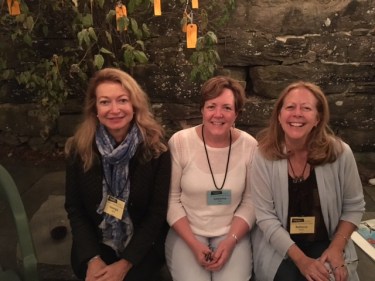
It’s been quite a challenge to re-enter the real world after spending four glorious days at the Highlights Foundation last week. I had to pinch myself more than once to make sure I was really there, learning about “The Craft and Heart of Writing Poetry for Children” from Rebecca Kai Dotlich and Georgia Heard. I’ve loved the work of these two wise and witty poets for years, so being at this workshop was a real thrill.

img_1082

My time at Highlights was made even more special because I got to spend time with fellow Slicer Linda Baie. (Read her thoughts about the workshop here.) Poetry Friday pals Robyn Hood Black, Buffy Silverman, Linda Kulp Trout, and Charles Waters were also there, and it was wonderful to meet so many other talented and passionate poets from around the world.

We were immersed in poetry day and night. Everyone shared their own original poetry as well as poems by favorite poets, including several classics by Georgia & Rebecca. Lee Bennett Hopkins visited with us via Skype, sharing his insights and preferences about poetry. “I want children to read poetry that shows them the beauty of the world,” he explained.

WordSong editor extraordinaire, Rebecca Davis, joined us to answer our questions about publishing poetry and to give us a sneak peak at Georgia’s collection of animal poems for two (or more) voices, that will be published in a few years. We were also treated to a preview of  Rebecca’s (Dotlich, edited by Davis) new book with Jane Yolen, Grumbles From the Town. (More about this on Friday.)

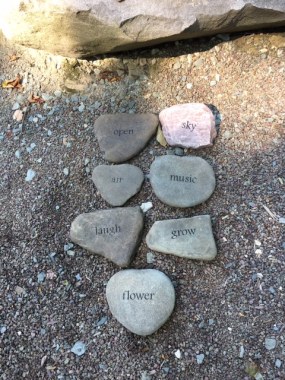
And, of course, we wrote poetry. Rebecca and Georgia led us through a variety of exercises each day. My favorite was “The Art of Observational Poetry.” During this exercise, we carefully examined a small stone, first listing our scientific observations about color, shape, texture, and so on. Then we turned those observations into something more poetic. As Georgia explained, “looking carefully and translating your observations into language is the work of a poet.”  Suddenly, my small stone was an asteroid, cratered and misshapen, tumbling through the universe, until the hand of a child plucks it out of its orbit and clutches it close.

It’s not a poem yet, but it has possibilities. Thanks to my new “poetica friends,” I am inspired to “follow the thread” of these words and find the door into their poem.

fullsizerender

Thank you to StaceyDanaBetsyBeth, KathleenDeb, Melanie, and Lisa for creating this community and providing this space for teachers and others to share their stories each Tuesday. Be sure to visit Two Writing Teachers to read more Slice of Life posts.

A Slice of My Reading Life

11454297503_e27946e4ff_h

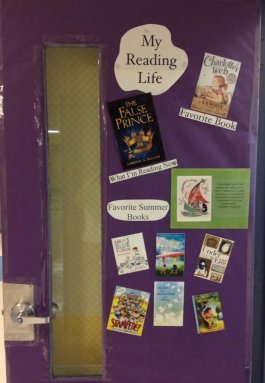
As a literacy specialist, I wear my love of reading on my sleeve for all to see. Or on my door. Donalyn Miller shared her idea for a Reading Life door several years ago, and I’ve been creating them ever since.

My Reading Life, August, 2014 Edition

Until now. Over the summer, I moved into a new room. My old door was perfectly placed for third, fourth, and fifth graders to see everyday. Kids often stopped to study the book covers or ask me about a title.

Now I have three roommates, so the door isn’t just mine. Also, it faces a wall, so it could only be seen if the door was closed, which it never is.

I’m sure there is another way to create a Reading Life display, but I haven’t figured it out yet. (I’m still unpacking all my books!) In the meantime, here’s a virtual door I created in Canva.

7

What would be on your Reading Life display?

Thank you to StaceyDanaBetsyBeth, KathleenDeb, Melanie, and Lisa for creating this community and providing this space for teachers and others to share their stories each Tuesday. Be sure to visit Two Writing Teachers to read more Slice of Life posts.

Slice of Life: Ode to Microbes

11454297503_e27946e4ff_h

Each month, I look forward  to the ditty challenge on Michelle Heidenrich Barnes’s blog. But when Diana Murray, August’s featured author, challenged Michelle’s readers to “write a poem about an unlikely hero,” I was stumped.

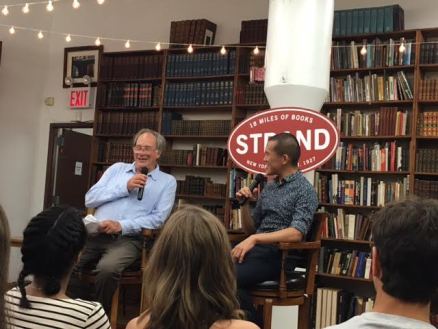
Then I heard Robert Krulwich interview Ed Yong about his new book, I Contain Multitudes: The Microbes Within Us and a Grander View of Life (Ecco, 2016) at the Strand Bookstore. Within minutes I knew I’d found my hero.

unnamed

That turned out to be the easy part. Yong’s book makes it clear that microbes are endlessly fascinating, but they are also endlessly complex. The more we learn about them, the more apparent it is that they play a vital role in our existence. They deserve high praise. Here is the latest draft of my attempt to give it to them.

Pasteuria ramosa spores By Dieter Ebert, Basel, Switzerland (Own work) [CC BY-SA 4.0 (http://creativecommons.org/licenses/by-sa/4.0)], via Wikimedia Commons
Pasteuria ramosa spores By Dieter Ebert, Basel, Switzerland (Own work) [CC BY-SA 4.0 (http://creativecommons.org/licenses/by-sa/4.0)%5D, via Wikimedia Commons

Ode to Microbes

Despite your microscopic size
you have tremendous power.
Somehow you’ve managed to colonize
every human, hummingbird, and flower.

No habitat’s too hostile,
you flourish everywhere.
And though some may think you’re vile,
you deserve a trumpet fanfare.

The jobs you do are myriad.
Research uncovers more each day.
Your relationships are spirited,
with both symbionts and prey.

The work you do inside our gut
helps digest our food.
On our skin, any scrape or cut
heals faster thanks to your multitudes.

So sing a song to microbes
and their endless variation.
Thank you, mighty microbes,
for propelling our creation.

© Catherine Flynn, 2016

Thank you to StaceyDanaBetsyBeth, KathleenDeb, Melanie, and Lisa for creating this community and providing this space for teachers and others to share their stories each Tuesday. Be sure to visit Two Writing Teachers to read more Slice of Life posts.

Slice of Life: Turn Up the Volume!

11454297503_e27946e4ff_h

“Reading became my rocket ship out of the second-floor apartment in the projects. I traveled the world through books.”
~ Sonia Sotomayor ~

“Reading became my rocket ship out of the second-floor apartment in the projects. I traveled the world through books.” Sonia Sotomayor
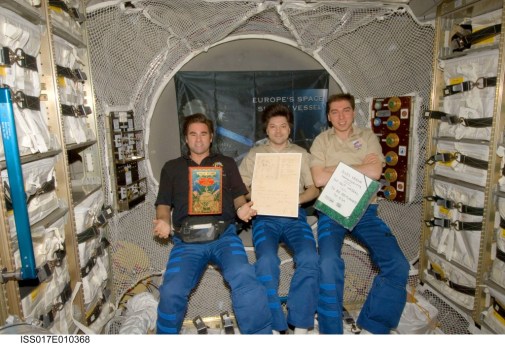
Space Station Expedition 17 crew holding Jules Verne book and manuscript inside ATV Jules Verne. Credits: NASA

There’s a welcome chill in the air this morning, and in just a week, students will be streaming into my school. They’ll be eager to see their friends and meet their teachers. I’m eager to greet them. My summer has been filled with reading and attending conferences that have given me a plethora of ideas about ways to help my students learn and grow as readers, as writers, as people.

As I reflected on all of the professional development I’ve participated in the past few months, one work kept coming up: volume.

Kelly Gallagher talked about the importance of reading volume at ILA in Boston: “If the volume doesn’t happen, it doesn’t matter what standards we cover.”

At TCRWP’s August Reading Institute, Kylene Beers shared that research shows that “reading volume is the single best predictor of how good a reader is.”

She also shared Richard Allington’s finding that “the more minutes of high-success reading completed each day is the best predictor of reading growth.”

How will I translate this into classroom practice? By keeping my minilessons truly MINI. This is a huge challenge for me, but I know it’s critical. It’s critical because the less time spent on a minilesson means more time for students to read and write independently. It means more time for me to confer with individuals and small groups, where powerful learning is more likely to happen.

Kids also need this space to practice the skills they’re learning. Because, as Kathleen Tolan recently reminded teachers, “it’s in the over and over again of trying that you get better at something.” She also pointed out that “it’s not always about moving them higher, but for them to get better at it.” And, according to Mark Overmeyer, in order to be effective and lasting, “practice must be done in context.”

This means that kids are practicing reading in books that they choose. I might guide this choice, but the child should have the final say. In his decades of research, Richard Allington has found that “the best intervention is a good book that a child can and wants to read.”

How will I ensure that kids have books they can and want to read? I’ve read more books this summer than I’ve ever read in a single summer. I’ve done this because I want to be able to say to a student, “I thought of you when I read this book.” In his Newbery Medal Acceptance speech, Matt de la Peña told listeners that he didn’t identify himself as a reader until college, when a professor gave him a copy of Alice Walker’s The Color Purple. “When I finally fell for literature, I fell hard.”

He went on to say, “But what if I can nudge a few…kids toward the magic of books at a younger age?” That is my mission. To know my students well enough that I can read a book and know that it’s a book they might love. A book with a character they can look at and say, “I know how she feels.” Or, “That’s me. I’m not alone.” A book that nudges them toward the magic.

Stephanie Harvey says that when we give them the access, the choice, and the time, the volume will follow naturally. Because when students find that magic, they read more. 

And when they know they’re not alone, that we’re there to cheer them on, to lend a hand, an ear, a shoulder, that is when they do their best learning. That is how we, in the words of Kylene Beers, “change tomorrow, each and every day.”

Thank you to StaceyDanaBetsyBeth, KathleenDeb, Melanie, and Lisa for creating this community and providing this space for teachers and others to share their stories each Tuesday. Be sure to visit Two Writing Teachers to read more Slice of Life posts.

Slice of Life: The Butterfly Effect?

11454297503_e27946e4ff_h

“We human beings don’t want to be alone, especially during the hard parts.”
Lucy Calkins

My week at the TCRWP August Reading Institute reaffirmed my knowledge that, when it comes to working through the hard parts of reading and writing workshop, (and, as Katie Wood Ray assures us, “they’re all hard parts”!) I have a worldwide community behind me. And, thanks to the internet, at my fingertips.

But just as often, we want someone to sit next to and talk with face-to-face about our triumphs and small victories, our missteps and questions. Sometimes it’s comforting just to talk about life in general.

We all have these people in our lives. We turn to them often and are there when they need someone to listen. Inevitably, we turn to different people at different times in our lives. People move away or change jobs, our routines alter and we just don’t see them as often as we once did.

This has happened to me with a friend of almost thirty years. Our boys were in the same class and we went back to school to finish our Bachelor’s degrees at the same time. We were in many  of the same classes, carpooled when we could, and commiserated over professors. We stayed in touch after we graduated, even though our boys were getting older and we both were now working full time.

Then, a few years ago, Rosemary and her husband moved to Florida. For whatever reason, I didn’t get to see her before they left. I felt terrible for not having called her all those times I’d meant too.

Fast forward to last Friday afternoon. I was exhausted from my week in New York, but had plans to have lunch with a woman I’d gotten to know at last year’s Institute. We both had travel arrangements, but managed to squeeze in a lovely meal together.

My next stop was Grand Central. Traffic in midtown was crazy, but I sat calmly in the back of my cab as the minutes ticked by and I missed the 2:47. “There’s always the next train,” I reminded myself. Which I made with time to spare. Once we were out of the tunnels, I texted my husband to let him know when to pick me up. He soon texted back to say that the highway was backed up for miles.

“Not to worry,” I replied. “I know a back way.”

The train ride was uneventful and we were soon pulling into the station. Once settled in the car, I directed my husband away from the highway toward our very round-about route home. As he drove, we chatted about the week. More importantly, we discussed where we were going to stop for dinner. We hadn’t decided on anything specific when we came upon a diner we’d both heard people rave about. “Let’s try it,” said my husband, who loves eating at diners.

As the hostess led us to our booth, I noticed a woman with dark hair and glasses sitting nearby. “That woman sure looks like Rosemary,” I thought. “Oh my gosh, that IS Rosemary!!”

After hugs and questions of  “What are you doing here?” were exchanged, we had a quick chat (She was having dinner with a friend and I didn’t want to intrude on their time to catch up.) and made plans for our own “date.”

Isn’t it funny how things work out? If I hadn’t had lunch with Karen and missed the train I wanted to be on, we might not have stopped at that diner. Depending on which website you read, this chance encounter was either the result of “the butterfly effect,”  a coincidence, or was just a random event. I don’t really care. All I know is that I was happy for a chance to reconnect with my old friend and am looking forward to catching up with her. She’s been by my side during times good and bad, and always made me feel that I wasn’t alone.

By Rhett Maxwell (the other butterfly effect) [CC BY 2.0 (http://creativecommons.org/licenses/by/2.0)], via Wikimedia Commons
By Rhett Maxwell (the other butterfly effect) [CC BY 2.0 (http://creativecommons.org/licenses/by/2.0)%5D, via Wikimedia Commons
Thank you to StaceyDanaBetsyBeth, KathleenDeb, Melanie, and Lisa for creating this community and providing this space for teachers and others to share their stories each Tuesday. Be sure to visit Two Writing Teachers to read more Slice of Life posts.

Slice of Life: Grattitude

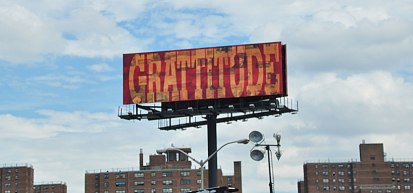
Billboard by Peter Tunney

I saw a sign similar to this from my seat on the train as it rumbled into New York City on Sunday afternoon. It went by so quickly I didn’t process the spelling, just the word. Yes, I thought. That is the perfect word for today.

More than twenty-four hours later, it’s still the perfect word. I am full of gratitude to have the opportunity to attend the Teachers College Reading and Writing Project’s August Reading Institute. After just one day, Lucy Calkins has inspired me to do everything I can to “make reading the best thing it can be” for my students.

In her opening keynote in the soaring nave of Riverside Church, Lucy encouraged the 1300 teachers and administrators present to create classroom and school communities where this can happen. Communities were students feel safe to take risks, where they know their voice will be heard and counted. Communities where they feel connected to something bigger than themselves. These communities are critical, Lucy explained, because “learning to read involves more risk than we often acknowledge.” 

“Embrace the “F” word,” she admonished. We have to be willing to “fail early and fail often.” For it is only through our failures that we grow. “Sharing our work in progress can give us strength.” Lucy continued with Brené Brown‘s wise words: “vulnerability is the birthplace of joy, of creativity, of belonging, of love.” (Which, coincidentally, I wrote about here.)

Lucy went on to share findings that David Brooks reported on his his column in the New York Times a few years ago. Brooks stated that studies done by Google have found the use of words such as patience and compassion in books published over the past fifty years has fallen dramatically. The implications of this are frightening, but sadly are playing out daily on the front pages of newspapers from around the country.

We have the power to change this trend in our classroom communities. Lucy urged us to make our students feel included in this mission by inviting them to “co-create” their classroom. These spaces will be places where students will feel safe “to do their best work” and “role-play their way into being the readers (and people) they want to be.”

Books are tools that help us envision what these communities can look like, Lucy reminded us. Books like The Big Orange Splot, by Daniel Pinkwater and The Hundred Dresses, by Eleanor Estes can help us “teach kids how to empathize and make others feel good.” Books like this year’s Newbery Award winner, Last Stop on Market Street, by Matt de la Peña that help kids sense a “… feeling of magic” in the world around them and gratitude for the communities that nurture them. Books have the power to help us all “grow into the people we want to be.” What a gift. 

I am always grateful to StaceyDanaBetsyBeth, KathleenDeb, Melanie, and Lisa for this space for teachers and others to share their stories each Tuesday. Be sure to visit Two Writing Teachers to read more Slice of Life posts.