Poetry Friday: The Owl and the Pussy-cat

Poetry_Friday_Button-210

Happy Valentine’s Day, everyone! Over the past few days, I considered many favorite love poems to share today. Something from Shakespeare? Maybe a Beatles song, in honor of the 50th anniversary of their first visit to America. In the end, I did stick with a Brit I’ve loved since childhood. Edward Lear’s silliness has always appealed to me, and “The Owl and the Pussy-cat” is one of my all-time favorites.
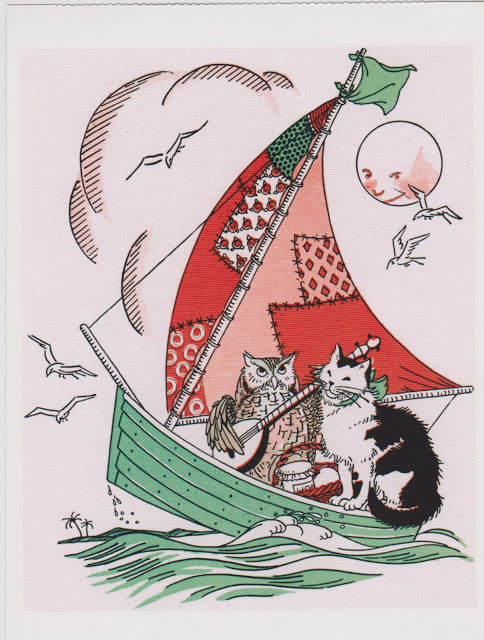
The Owl and The Pussycat, from 1928 Marguerite Davis Sugar and Spice and all that's nice, poem by Edward lear
Marguerite Davis

The Owl and the Pussy-Cat

by Edward Lear

The Owl and the Pussy-cat went to sea

In a beautiful pea-green boat,

They took some honey, and plenty of money,

Wrapped up in a five-pound note.

The Owl looked up to the stars above,

And sang to a small guitar,

“O lovely Pussy! O Pussy, my love,

What a beautiful Pussy you are.

You are,

You are!

What a beautiful Pussy you are!”

Pussy said to the Owl, “You elegant fowl!”

How charmingly sweet you sing!

O let us be married! too long we have tarried:

But what shall we do for a ring?”

They sailed away, for a year and a day,

To the land where the Bong-Tree grows

And there in a wood a Piggy-wig stood

With a ring at the end of his nose,

His nose,

His nose,

With a ring at the end of his nose.

“Dear Pig, are you willing to sell for one shilling

Your ring?” Said the Piggy, “I will.”

So they took it away, and were married next day

By the Turkey who lives on the hill.

They dined on mince, and slices of quince,

Which they ate with a runcible spoon;

And hand in hand, on the edge of the sand,

They danced by the light of the moon,

The moon,

The moon,

They danced by the light of the moon.

When I was little, my mother read this poem to me from a Childcraft book of children’s poems. My own children loved poring over Jan Brett’s richly detailed illustrations for the poem. Do you have a favorite version of Lear’s classic poem?
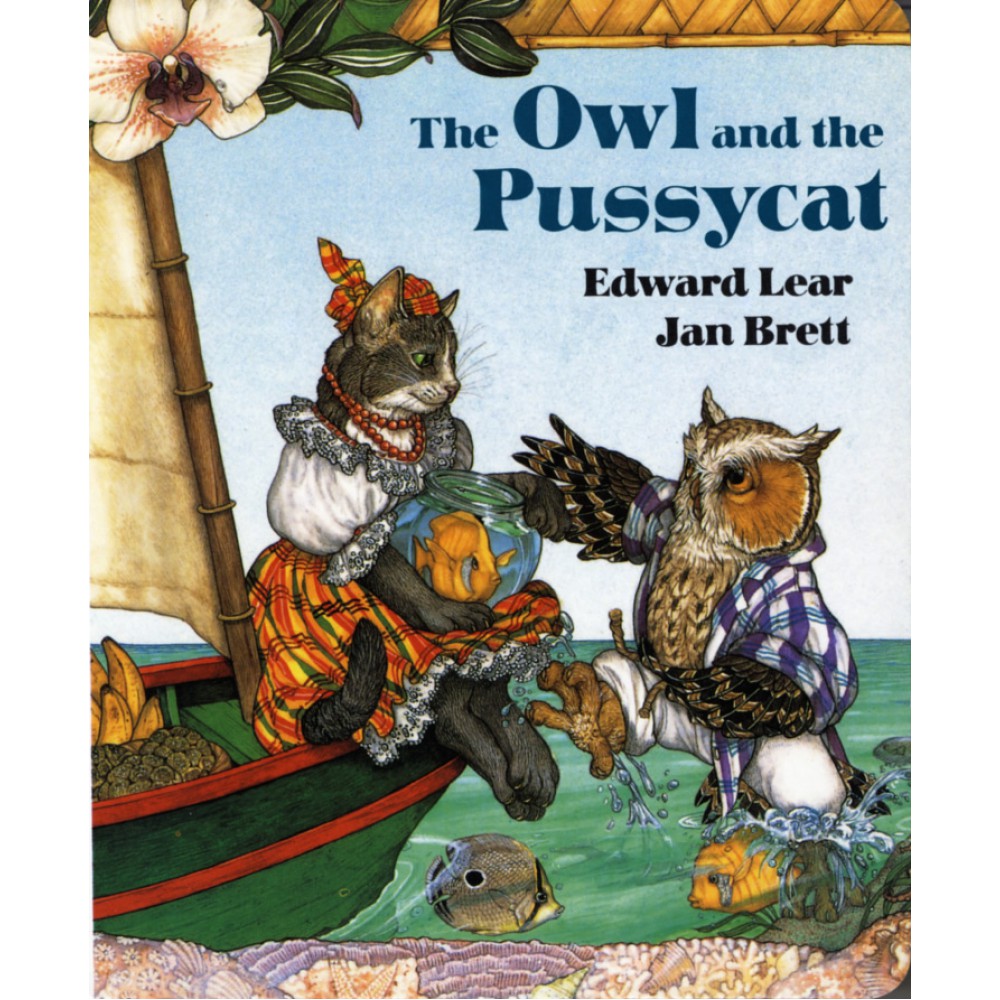
3726-1000x1000

Whether on the edge of the sand or by the light of the moon, be sure to dance on over to Teacher Dance, where Linda has the Poetry Friday Round Up. Wishing you joy this Valentine’s Day!
Poetry Friday: A Poem of Apology

Poetry_Friday_Button-210

To My Grilled Cheese Sandwich

~ A Poem of Apology ~

Forgive me.

I did not mean to burn you,

to char you till your crust was black.

But there was a word, a line I was pursuing,

like the birds, outside the kitchen window

searching for seeds in the snow

on this brilliant, sun-filled afternoon.

I hope the birds had more success.

I didn’t find the word;

the line is lost.

Literally up in smoke:

smoke that invaded my thoughts

as it drifted in

from the other side of the kitchen.

Don’t worry, though. I won’t abandon you.

I’ll eat you anyway.

After all, I forgot to buy bread.

© Catherine Flynn, 2014

Merriam-Webster defines “apology” as “an expression of regret for having done or said something wrong.” I truly did regret burning my sandwich. And although I wasn’t thinking about “This is Just to Say,” at the time, some part of my brain made the connection to William Carlos Williams’ famous poem of apology. You can read more about poems of apology at Joyce Sidman’s website, where she talks about the origins of her book, This is Just to Say: Poems of Apology and Forgiveness (Houghton Mifflin, 2007). For apology poems with a lighter touch, don’t miss Gail Carson Levine’s Forgive Me, I Meant to Do It (HarperCollins, 2012).

Please be sure to visit Renée LaTulippe at No Water River for the Poetry Friday Round Up.

Slice of Life: Pickles, Owl Moon, and the Hard Work of Revision

sols_6Last spring, during a poetry writing unit, a 5th grade student asked me to read a poem she had written. “I’d love to,” I told her as she handed me her notebook with pride. I knew this girl to be a good student and a strong reader, so I was quite surprised to read what she had written.  It was mostly about pickles, but her poem was full of forced rhymes and then no rhymes. I told her that her love of pickles was coming through loud and clear. Then I asked her about some of the more questionable rhymes.

“What do smelly feet have to do with sweet pickles?” I wondered

“Nothing, but sweet and feet rhyme,” she said matter-of-factly.

“I wonder if  there are any other words that rhyme with sweet that have more to do with pickles than feet.”

“Probably, but today I just feel silly and want to write a silly poem.”

“Fair enough. Let’s look at it again tomorrow and see if you still feel that way. Writers often see their work differently after a day or two,” I said.

She wasn’t convinced, and she didn’t change the poem.

Over the years, I’ve had plenty of students who were unwilling to revise their writing. It seems as if getting anything down on paper is torture enough. Then to have to make changes is just insulting. Part of me empathizes with them. I know it’s hard to get our thoughts down in the first place. But I also know how much better writing can be after the second or third revision.

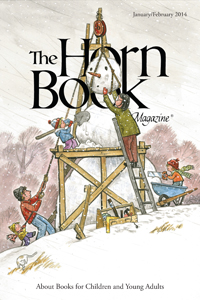
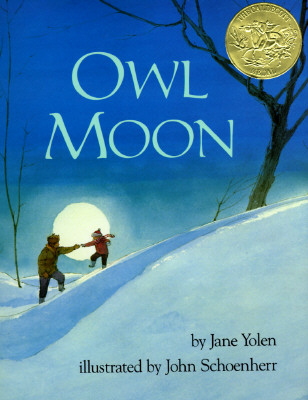
january2014cover_FAKE_200x300I wish I’d had Jane Yolen’s article from the current issue of The Horn Book to share with my reluctant reviser. In it, Yolen muses over different forms her Caldecott-Award winning picture book, Owl Moon, might have taken. A sonnet? No, too short. What about as a rap? Definitely not. She states that “a writer has to make choices [about] how to tell a story. But when a writer finds the right voice, everything comes together.” (pg. 46)

OwlMoon1

Writers do make choices. But I feel that our students don’t really understand that this means more that just thinking of words that rhyme. As Yolen goes on to say, finding this voice for our writing takes “hard work, inspiration, even perspiration.” (pg. 50)

So why did my young poet short-change herself and her poem? In this case, I think she just needed more time. Time to build the habit of writing every day so being asked to write didn’t feel like punishment. Time to experience the joy of finding just the right word, the perfect expression of her feeling. Time to play with different versions of her poem to find out if silly really was the right tone. Sometimes we may get lucky and stumble onto the right form on our first try, as Yolen feels she did with Owl Moon. But in most cases, we need to sweat over our writing before sharing it. Only then can we sit back and have a pickle.

Thank you to everyone at Two Writing Teachers for hosting the Slice of Life every Tuesday. Be sure to stop by to read the hard work of many devoted writers.

Poetry Friday: Aurora Borealis

Yesterday, I was thrilled at the possibility of northern lights being visible in Connecticut. I have vivid memories of the handful of times I have witnessed this display of dancing light, but it’s been ages since I saw them last. These mysterious lights must have been terrifying to people throughout history without our knowledge of solar flares and ions bumping into Earth’s atmosphere. Fortunately, knowing this doesn’t diminish their beauty or their ability to inspire.

I don’t share my own poetry very often, but I couldn’t find a poem that matched my memories or feelings about the auroras I’ve seen. So here is a very rough draft of a poem inspired by watching northern lights with my boys in March of 1989.

By Xander [CC-BY-2.0 (http://creativecommons.org/licenses/by/2.0)], via Wikimedia Commons
By Xander [CC-BY-2.0 (http://creativecommons.org/licenses/by/2.0)%5D, via Wikimedia Commons
“Aurora Borealis”

Do you remember

that spring night, long ago,

when we stood on the lawn,

transfixed?

We gazed up in awe

as curtains of shimmering light

danced across the sky,

wrapping the big dipper

in veils of glowing green.

Your eyes grew wide

when a burst of red

flared and rippled,

casting an eerie glow

over the countryside.

“What is it, Mommy?”

you wanted to know.

“Magic,” I replied.

© Catherine Flynn, 2014

Gaze at the world through the eyes of a four-year old today and be amazed. And, for plenty of amazing poetry, be sure to stop by Mainely Write, where Donna has the Poetry Friday roundup.

Poetry Friday: This Moment

Poetry_Friday_Button-210

This Moment

by Eavan Boland

A neighborhood.

At dusk.

Things are getting ready

to happen

out of sight.

Stars and moths.

And rinds slanting round fruit.

But not yet.

Read the rest of the poem here.

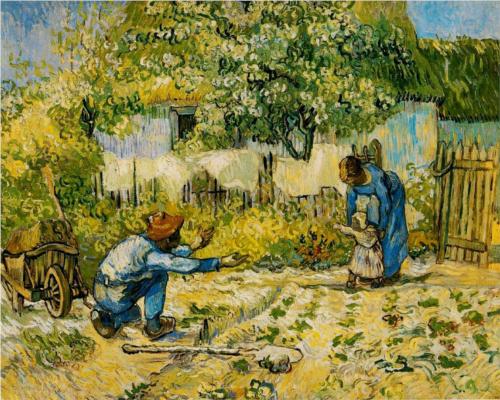
"First Steps (after Millet)" Vincent Van Gogh, 1890 Metropolitan Museum of Art, via wikipaintings.org
“First Steps (after Millet)” Vincent Van Gogh, 1890 Metropolitan Museum of Art, via wikipaintings.org

Eavan Boland is one of “the foremost female voices in Irish literature.” (Boland’s biography can be found at The Poetry Foundation) I wasn’t familiar with her or her work, but was struck by the imagery in “This Moment.” I can’t decide if Boland’s tone is meant to be ominous or just full of expectation. Either way, the anticipation of the unknown seemed appropriate for the New Year.

Wishing you all a happy and healthy New Year! Be sure to visit Betsy at I Think in Poems for the Poetry Friday Round Up.

Poetry Friday: “O Holy Night”

Poetry_Friday_Button-210

‘Tis the season for traditions. Every family celebrates the season in their own way, and singing Christmas carols has always been part of Christmas at our house. Beloved carols and songs fill the air as we decorate the tree, bake cookies and wrap gifts. One of my favorite carols is “O Holy Night.” The music was composed in 1847 by Adolphe Adam for Placide Cappeau’s poem “Minuit, chrétiens.”  In 1855, John Sullivan Dwight adapted the the poem and created the lyrics we sing today.

“O Holy Night”

O holy night! The stars are brightly shining,

It is the night of our dear Savior’s birth.

Long lay the world in sin and error pining,

‘Till he appeared and the soul felt its worth.

A thrill of hope the weary world rejoices,

For yonder breaks a new and glorious morn.

Fall on you knees! O hear the angel voices!

O night divine, O night, when Christ was born;

O night divine, O night, O night Divine.

(read the rest of the lyrics, as well as the original French poem, here)

Wishing you all a holiday filled with love and joy!

Be sure to visit Buffy Silverman at Buffy’s Blog for the Poetry Friday Round Up.

Poetry Friday: What the Heart Cannot Forget

Poetry_Friday_Button-210

My head is still full of wisdom and inspiration from NCTE, but thoughts of Christmas are starting to push them away. As I pondered what to share today, my mind kept returning to my family’s Christmas traditions. My search for a poem that matched my thinking led me to this lovely work by Joyce Sutphen, Minnesota’s Poet Laureate.

 What the Heart Cannot Forget

by Joyce Sutphen

Everything remembers something. The rock, its firey bed,

cooling and fissuring into cracked pieces, the rub

of watery fingers along its edge.

The cloud remembers being elephant, camel, giraffe,

remembers being a veil over the face of the sun,

gathering itself together for the fall.

The turtle remembers the sea, sliding over and under

its belly, remembers legs like wings, escaping down

the sand under the beaks of savage birds.

Read the rest of the poem here.

Wildlifeppl at en.wikipedia via Wikimedia Commons

Once I found “What the Heart Cannot Forget” I copied it into my notebook. I suddenly realized I was doing exactly what Linda Rief described during her session with Georgia Heard and Tom Romano at NCTE. Taking Georgia’s “heart maps” a step further, Linda has her students create “heart books.” These books are collections of poems that reflect a topic on their heart maps. (Vicki Vinton describes Linda’s process beautifully at her blog, To Make a Prairie. Linda Baie also wrote about using heart maps with her students at Teacher Dance.)

Maureen Barbieri introduced Linda as a teacher who “encourages her students to share their voices so readers will see the world in new ways.” Joyce Sutphen’s words made me see the world in a new way. More importantly, they spoke to my heart.

Please visit Robyn at Life on the Deckle Edge for the Poetry Friday Round Up.

Poetry Friday: Georgia Heard, Roque Dalton, and Unlocking the Door to Poetry

Poetry_Friday_Button-210

Poetry filled the air last weekend at the NCTE Convention in Boston. One of the highlights for me was hearing Georgia Heard, Tom Romano, and Linda Rief speak about the importance of “Keeping Poetry at Our Core.”

georgiaheard

Georgia Heard began the session by pointing out that “poetry is in every single strand of the CCSS.” She urged us to grow poetry slowly, not to wait until April, but to make a place for poetry in our classrooms every day. “Poetry changes us,” she said, “it changes our writing and our living.”

With these thoughts about the importance of poetry in mind, Heard went on to give us steps to guide our work. The first step is to “choose poems that are accessible, non-threatening, and relevant” to our students. Once we’ve done this, the next crucial step is to help students connect with a poem by guiding them “toward finding themselves and their lives inside the poem.”

Heard also shared that we have to give our students the tools they need to analyze and interpret poetry. Through close reading and asking questions such as “How does this poem relate to your life?” and “What is the impact of this poem on your life?” students can “unlock the door of a poem.” Then they will be able to analyze the meaning and craft of a poem for other layers of meaning.

Heard inspired me to be even more mindful about helping my colleagues share poetry with students when she closed her part of the session with the wisdom of Matthew Fox:

“The Celtic peoples…insisted that only the poets could be teachers. Why? I think it is because knowledge that is not passed through the heart is dangerous.”

This quote can also be found in Georgia’s book, Awakening the Heart (Heinemann, 1999, pg. 118). As I revisited my copy of this classic, I rediscovered this poem by Roque Dalton, another reminder that poetry is for everyone.

“Like You ”

Like you I

love love, life, the sweet smell

of things, the sky-blue

landscape of January days.

And my blood boils up

and I laugh through eyes

that have known the buds of tears.

I believe the world is beautiful

and that poetry, like bread, is for everyone.

And that my veins don’t end in me

but in the unanimous blood

of those who struggle for life,

love,

little things,

landscape and bread,

the poetry of everyone.

(translated by Jack Hirschman)

Tom Romano and Linda Rief were just as eloquent and inspiring, so, in the weeks to come, they will each have their own well-deserved post. For more inspiring poetry posts, NCTE-related and otherwise, be sure to visit Carol’s Corner, for the Poetry Friday Round Up.

Poetry Friday: Hurry

Poetry_Friday_Button-210

When I was in college, one of the required classes for English majors was “Introduction to Poetry.” One assignment was to write a sonnet, a challenging form under the best of circumstances. At the time, I had two small children and was working part-time in addition to taking classes. It seemed like there was never a moment to take a deep breath, let alone write a sonnet. The busyness of my life was my muse, and I ended up with a poem that included ringing telephones, crying children, and burnt food. (The poem itself is buried somewhere in my attic; count yourself as lucky that I didn’t have time dig it out of its cardboard sarcophagus.)

I thought about this poem last night while trying to decide what to share for Poetry Friday. Somehow, twenty-five years later, I’m as busy as ever. Last week, we were on our way to Pennsylvania for my niece’s wedding, and although I had an idea of what I wanted to share, I ran out of time and posted nothing. The same thing happened earlier in the week when it was time for It’s Monday! What Are You Reading? and Tuesday’s Slice of Life.

By Aldaron — Aldaron, a.k.a. Aldaron (Flickr) [CC-BY-SA-2.0 (http://creativecommons.org/licenses/by-sa/2.0)], via Wikimedia Commons
By Aldaron — Aldaron, a.k.a. Aldaron (Flickr) [CC-BY-SA-2.0 (http://creativecommons.org/licenses/by-sa/2.0)%5D, via Wikimedia Commons
This morning, I woke up determined to share a poem. I googled “poems about being busy” and found I’m not alone in my feelings of frustration at all there is to do. In “Notes on Distraction,” a wonderful post on The New Yorker blog, Giles Harvey writes about noticing a man glance at his watch during a performance of “Einstein on the Beach” as a “vignette of our contemporary busyness.”

Poet Marie Howe has captured this “contemporary busyness” in her poem, “Hurry.”

We stop at the dry cleaners and the grocery store

and the gas station and the green market and

Hurry up honey, I say, hurry, hurry,

as she runs along two or three steps behind me

her blue jacket unzipped and her socks rolled down.

Where do I want her to hurry to?

read the rest of the poem here

This morning, I stood at my kitchen window for what seemed like minutes, just looking at a maple tree covered with yellow leaves glowing in the morning sun. It was lovely not to feel busy or rushed at that moment, even if it was just for a minute or two. I thought back to  the closing lines of Harvey’s essay:

“In a world of speed and distraction, the slow, demanding art work is more indispensable than ever, for it holds out the possibility of those elusive commodities: stillness, clarity, and peace.”

Be sure to visit Diane at Random Noodling for today’s Poetry Round Up. You’ll be sure to find a moment of “stillness, clarity, and peace.”

Poetry Friday: Puzzling Through the Possibilities

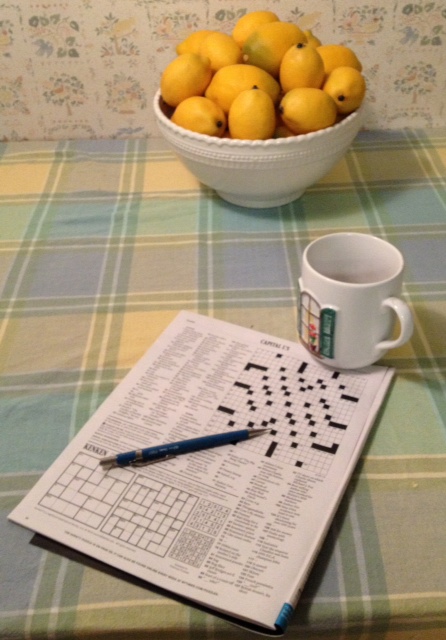
Image

Puzzling Through the Possibilities

The clue seemed so simple:

“Rossini’s William Tell and others”

Overtures even fit.

But the crosses didn’t work.

What word meaning “unprepared” begins with “nu?”

As I puzzled through the possibilities,

it occurred to me that

a writer feels this same frustration

as she reaches for the right word,

the clearest meaning,

so often just beyond her grasp.

Aren’t we all really just searching for that missing piece?

The one that clicks into place?

When we find it, it’s often a surprise.

And better than we ever dreamt.

© Catherine Flynn, 2013

Poetry_Friday_Button-210

The idea for this poem came from a journal entry I wrote in response to one of Corbett Harrison’s “Sacred Writing Time” prompts. When my colleagues and I were working on our writing curriculum, we began each day by writing for ten minutes. On this particular day, the slide stated that “dreamt” is the only word in the English language that ends with “mt.” As a Scrabble player and crossword puzzle lover, this intrigued me. So I wrote about filing this tidbit away, thinking it would come in handy as I was “puzzling through the possibilities” when solving a puzzle. Right away, I noticed this phrase. I loved the alliteration and the potential it contained. So I began playing with ideas. I’m still puzzling over this draft; I’m not sure the middle flows as well as it could, but I’ve had fun working on it.

By the way, the Rossini clue is from the New York Times Sunday puzzle from August 25, 2013, constructed by Victor Barocas.

Be sure to visit Laura at Author Amok for the Poetry Friday Round Up.