Poetry Friday: “I Am Poetry”

poetry-friday-1-1

I have spent the past week at the Teachers College Reading and Writing Project’s Summer Reading Institute. My brain is bursting with all I have learned from my amazing section leaders and the keynote speakers. My senses are overwhelmed by the sights and sounds of New York City in August. My life is richer because of people I have met and friends I have made. It has been a glorious week.

How could I possibly choose a poem to share today that reflects my week? By focusing on one small piece of my experience.

Each teacher was given a book at the beginning of the week to use as a mentor text for the work of the Institue. I received Becoming Naomi León (Scholastic Press, 2004) by Pam Muñoz Ryan. I have loved every book I’ve read by Ryan, but somehow, I had missed this beautiful story about a young girl finding her true self. Pam Muñoz Ryan’s writing is so lyrical, I wondered if she’d written any poetry. A quick search reminded me about The Dreamer, Ryan’s lovely book about the young Pablo Neruda and led me to this poem:

“I Am Poetry”

by Pam Muñoz Ryan

I am poetry,

waiting to seize the poet.

I ask the questions

for which all answers

exist.

I choose no one.

I choose every one.

Come closer…

…if you dare.

I am poetry,

lurking in dappled shadow.

I am the confusion

of root

and gnarled branch.

I am the symmetry

of insect,

leaf,

and a bird’s outstretched wings.

Read the rest of the poem here.

If you haven’t read Becoming Naomi León, The Dreamer, or any of Ryan’s other novels for children, read one today. You’ll be glad you did. 

Please be sure to visit Heidi at My Juicy Little Universe for the Poetry Friday Round Up.
Poetry Friday: “The Picnic”

poetry-friday-1-1

“The Picnic”

We brought a rug for sitting on,

Our lunch was in a box.

The sand was warm. We didn’t wear

Hats or shoes or socks.

Waves came curling up the beach.

We waded. It was fun.

Our sandwiches were different kinds.

I dropped my jelly one.

by Dorothy Aldis

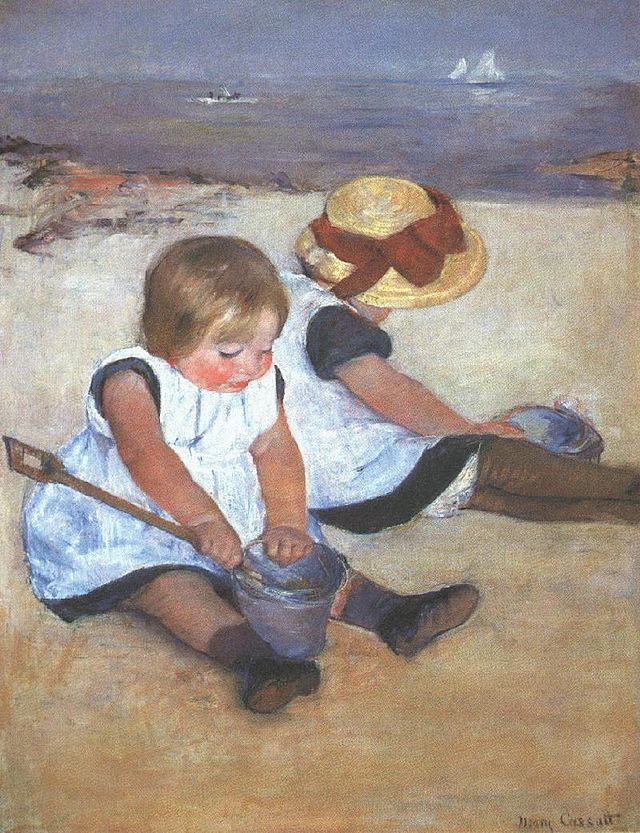
I discovered this poem years ago in Jack Prelutsky’s wonderful anthology, Read-Aloud Rhymes for the Very Young. (Knopf, 1986) And although Dorothy Aldis wrote it almost 100 years ago, children can relate to this simple depiction of a picnic at the beach just as easily today as they did then. First graders love this poem, and the concrete details help those kids who don’t automatically visualize learn to create images from a poet’s words.

"Cassatt Mary Children on the Beach 1884". Licensed under Public domain via Wikimedia Commons - http://commons.wikimedia.org/wiki/File:Cassatt_Mary_Children_on_the_Beach_1884.jpg#mediaviewer/File:Cassatt_Mary_Children_on_the_Beach_1884.jpg
“Cassatt Mary Children on the Beach 1884”. Licensed under Public domain via Wikimedia Commons

Hope you all have time for one more picnic at the beach before summer ends! Please be sure to visit Mary Lee at A Year of Reading for the Poetry Friday Round Up.

Poetry Friday: Flowers of the Ocean

poetry-friday-1-1

When I was a kid, my family always spent a week camping in Rhode Island. We spent many days at the beach, but we also spent time at Beavertail State Park in Jamestown. My parents loved to sit and watch the waves crashing over the rocks and the ships in the bay. My favorite part of being at Beavertail was examining the many tide pools that dotted the rocks when the tide was out. I imagined that I was a marine biologist, studying the seaweed and mollusks that braved the harsh conditions of these rocky oases.

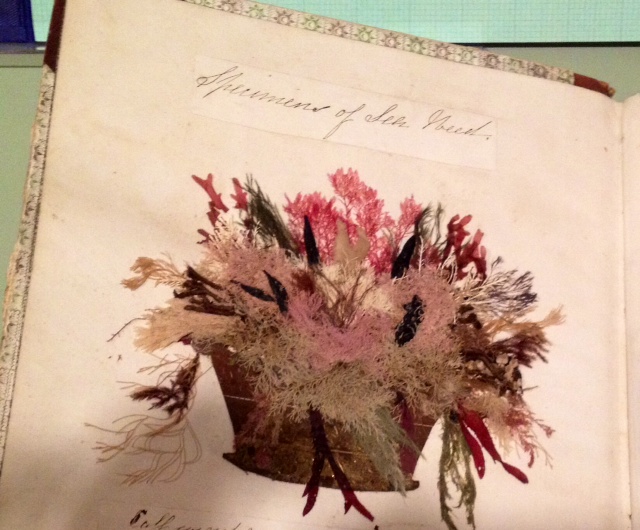
I was reminded of these tide pools last week when a friend and I visited the Yale Center for British Art to see “‘Of Green Leaf, Bird, and Flower’: Artists’ Books and the Natural World,” an exhibit which celebrates the work of “self-taught naturalists and artists [who] recorded and observed the natural world around them from the sixteenth century to the present.” The variety of artistic responses and creativity on display was stunning. In addition to traditional sketches and watercolors, there were collages, works of cut paper, dioramas, and mixed media.

Specimens of Sea Weed, ca. 1840 Yale Center for British Art
Specimens of Sea Weed, ca. 1840
Yale Center for British Art

I found this collage of sea weed specimens especially charming. Apparently creating this kind of sea weed collage was a popular activity in the 19th century, and E.L. Aveline’s poem, “Flowers of the Ocean, often accompanies such pieces. The poem appeared in The Mother’s Fables, in Verse, Designed, Through the Medium of Amusement, to Convey to the Minds of Children Some Useful Precepts of Virtute and Benevolence in 1812. The title page of this volume urges readers to “Find tongues in trees, books in running brooks/Sermons in stones, and good in every thing.” Not bad advice, and the artwork in this exhibit demonstrates that many people followed it faithfully.

Flowers of the Ocean

Call us not weeds—we are flowers of the sea;

For lovely, and bright, and gay-tinted are we,

Our blush is as deep as the rose of thy bowers;

Then call us not weeds—we are Ocean’s gay flowers.

Not nursed like the plants of a summer parterre,

When gales are but sighs of an evening air;

Our exquisite, fragile, and delicate forms

Are nursed by the ocean, and rocked by its storms.

by E.L. Aveline

“Of Green Leaf, Bird, and Flower” is on display until August 10. If you’re near New Haven, it’s worth the trip. Please be sure to visit Janet and Sylvia at Poetry for Children for the Poetry Friday Roundup.

Poetry Friday: Dirge Without Music

poetry-friday-1-1

Dirge Without Music

by Edna St. Vincent Millay

I am not resigned to the shutting away of loving hearts in the hard ground.

So it is, and so it will be, for so it has been, time out of mind:

Into the darkness they go, the wise and the lovely. Crowned

With lilies and with laurel they go; but I am not resigned.

Lovers and thinkers, into the earth with you.

Be one with the dull, the indiscriminate dust.

A fragment of what you felt, of what you knew,

A formula, a phrase remains, –but the best is lost.

The answers quick and keen, the honest look, the laughter, the love–

They are gone. They are gone to feed the roses. Elegant and curled

Is the blossom. Fragrant is the blossom. I know. But I do not approve.

More precious was the light in your eyes than all the roses in the world.

Down, down, down into the darkness of the grave

Gently they go, the beautiful, the tender, the kind;

Quietly they go, the intelligent, the witty, the brave.

I know. But I do not approve. And I am not resigned.

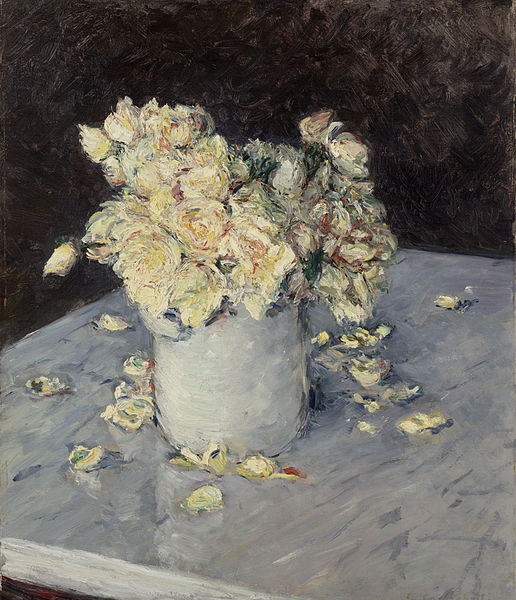
Yellow Roses in a Vase, 1882 Gustave Caillebotte Dallas Museum of Art, The Eugene and Margaret McDermott Art Fund, Inc., via Wikimedia
Yellow Roses in a Vase, 1882
Gustave Caillebotte
Dallas Museum of Art, The Eugene and Margaret McDermott Art Fund, Inc., via Wikimedia

Please be sure to visit Linda at Write Time for the Poetry Friday Round Up.


Poetry Friday: Walt Whitman’s “Miracles”

poetry-friday-1-1

Before I began student teaching, my cooperating teacher invited me to the class Christmas party so I could meet the kids. One boy wanted to know what was my favorite holiday. I didn’t hesitate a minute. “Summer,” I replied.

So even though the solstice isn’t until tomorrow, here’s to the miracle that is summer!

Miracles

by Walt Whitman

Why, who makes much of a miracle?

As to me I know of nothing else but miracles,

Whether I walk the streets of Manhattan,

Or dart my sight over the roofs of houses toward the sky,

Or wade with naked feet along the beach just in the edge of

   the water,

Or stand under trees in the woods,

Or talk by day with any one I love, or sleep in the bed at night

   with any one I love,

Or sit at table at dinner with the rest,

Or look at strangers opposite me riding in the car,

Or watch honey-bees busy around the hive of a summer 

   forenoon,

Or animals feeding in the fields,

Or birds, or the wonderfulness of insects in the air,

Or the wonderfulness of the sundown, or of stars shining so

   quiet and bright,

Or the exquisite delicate thin curve of the new moon in spring;

These with the rest, one and all, are to me miracles,

The whole referring, yet each distinct and in its place.

To me every hour of the light and dark is a miracle,

Every cubic inch of space is a miracle,

Every square yard of the surface of the earth is spread with 

   the same,

Every foot of the interior swarms with the same.

To me the sea is a continual miracle,

The fishes that swim—the rocks—the motion of the waves—

   the ships with men in them,

What stranger miracles are there?

Don’t miss this gorgeous video inspired by Whitman’s words:

Be sure to visit Jone at Check It Out for the Poetry Friday Round Up. Happy summer, everyone!

Poetry Friday: A Spicing of Birds

poetry-friday-1-1

One of my earliest memories is finding the remnants of a robin’s egg under a tree in my grandmother’s front yard. When I showed her my treasure, she “oohed” and “ahhed” and told me all kinds of interesting things about robins. 

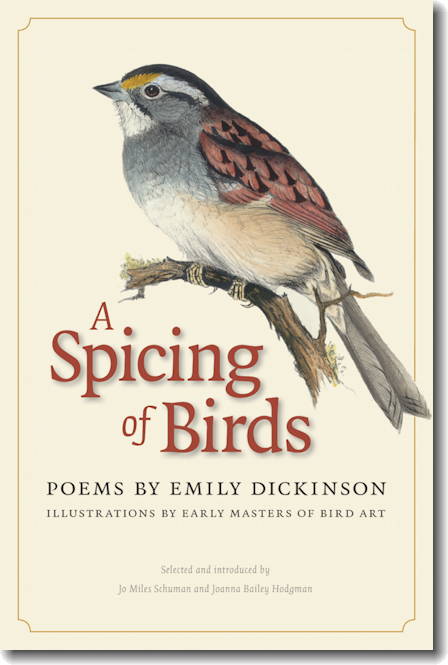
I’ve been thinking about birds a lot these past few days. Now that spring is finally here, birds start singing in the tree outside my window before my alarm goes off. I don’t know as much about birds as my grandmother did, but they still fascinate me. So yesterday, when I stopped in at the library, my eye was immediately drawn to this book on the new book display shelf:

Schuman comp_final.indd A Spicing of Birds (Wesleyan University Press, 2010) is a gorgeous book. Jo Miles Schuman and Joanna Bailey Hodgman have selected thirty-seven of Emily Dickinson’s poems about birds and paired them with illustrations “by late eighteenth century to early twentieth century artists/ornithologists.” An introduction describes Dickinson as an “intimate of birds;” someone who “observed them closely and knew intimately their songs, habits, and characteristics.” Her poetry is filled with the fruits of her noticings. Here is one of my favorite poems from this lovely collection.

The Robin is the One

That interrupt the Morn

With hurried—few—express Reports

When March is scarcely on—

The Robin is the One

That overflow the Noon

With her cherubic quantity—

An April but begun—

The Robin is the One

That speechless from her Next

Submit that Home—and Certainty

And Sanctity, are best.

Please be sure to visit Jama at Jama’s Alphabet Soup for the Poetry Friday Round Up.

Poetry Friday: “Do You Have Any Advice For Those of Us Just Starting Out?”

poetry-friday-1-1

Although National Poetry Month has officially ended, poetry continues, always waiting for us to pay close attention and find it. For those of us still honing our craft, Ron Koertge has this advice.

“Do You Have Any Advice For Those of Us Just Starting Out?”

by Ron Koertge

Give up sitting dutifully at your desk. Leave

your house or apartment. Go out into the world.

It’s all right to carry a notebook but a cheap

one is best, with pages the color of weak tea

and on the front a kitten or a space ship.

Read the rest of the poem here.

Image by David Castillo Dominici via freedigitalphotos.net

Thanks to Katya at Write. Sketch. Repeat. for hosting the Poetry Friday Round Up. Be sure to stop by to read more poetry posts.


Poetry Friday: Louise Erdrich’s “Advice to Myself”

poetry-friday-1-1

I’ve been captivated by Louise Erdrich’s writing for many years, since I first read her middle grade novel, The Birchbark House. This book was a favorite read aloud when I taught third grade.  Since then, I’ve read all of her children’s novels and most of her adult novels. For the past several days, I’ve been reading Erdrich’s National Book Award winning adult novel, The Round House (Harper, 2012).

Often called a “Native American Faulkner”, Erdrich has created in her fiction what Maria Russo calls an “indelible Yoknapatawpha, a fictional North Dakota Indian reservation and its surrounding towns, with their intricately interconnected populations” (New York Times Book Review, Oct. 14, 2012)

Erdrich uses the tools of a poet to tell these finely spun tales. Metaphor, imagery, repetition, and more are skillfully woven together to create passages like this one from The Round House:

“I lay down on the warm wood and the sun went right into my bones. I saw no herons at first. Then I realized the piece of reedy shore I was staring at had a heron hidden in its pattern. I watched that bird stand. Motionless. Then, quick as genius, it had a small fish, which it carefully snapped down its gullet.”

Such craftsmanship isn’t surprising, considering the fact that Erdrich began her writing career as a poet. Many of her poems can be read online, but “Advice to Myself” resonated with me in way the others didn’t after a week of attempting to clear away the clutter of winter.

Advice to Myself

by Louise Erdrich

Leave the dishes.

Let the celery rot in the bottom drawer of the refrigerator

and an earthen scum harden on the kitchen floor.

Leave the black crumbs in the bottom of the toaster.

Throw the cracked bowl out and don’t patch the cup.

Don’t patch anything. Don’t mend. Buy safety pins.

Don’t even sew on a button.

read the rest here

Be sure to stop by Life on the Deckle Edge, where Robyn Hood Black has the Poetry Friday Round Up.

Poetry Friday: “I Wandered Lonely As a Cloud”

poetry-friday-1-1

Signs of spring are finally showing up here in my corner of Connecticut, and spring break begins TODAY! In honor of the season, I’m sharing “I Wandered Lonely As a Cloud” by William Wordsworth. This is one of the first “adult” poems I remember reading in high school that I really liked. Who wouldn’t want to be dancing with daffodils?

I wandered lonely as a cloud
That floats on high o’er vales and hills,
When all at once I saw a crowd,
A host, of golden daffodils;
Beside the lake, beneath the trees,
Fluttering and dancing in the breeze.


Continuous as the stars that shine
And twinkle on the milky way,
They stretched in never-ending line
Along the margin of a bay:
Ten thousand saw I at a glance,
Tossing their heads in sprightly dance.


The waves beside them danced; but they
Out-did the sparkling waves in glee:
A poet could not but be gay,
In such a jocund company:
I gazed—and gazed—but little thought
What wealth the show to me had brought:


For oft, when on my couch I lie
In vacant or in pensive mood,
They flash upon that inward eye
Which is the bliss of solitude;
And then my heart with pleasure fills,
And dances with the daffodils.
By Myrabella (Own work) [CC-BY-SA-3.0 (http://creativecommons.org/licenses/by-sa/3.0)], via Wikimedia Commons
Parc de Bagatelle, Paris By Myrabella, via Wikimedia Commons
Happy Blog Birthday to Michelle at Today’s Little Ditty! Be sure to visit and help her celebrate and to read the Poetry Friday round up.

SOLC 2014/Poetry Friday: The Reward

poetry-friday-1-1    11454297503_e27946e4ff_h

“Sometimes it seems the universe wants to be noticed.”

~ John Green, from The Fault in Our Stars ~

Photo by Wally Pacholka, http://apod.nasa.gov/
Photo by Wally Pacholka,
http://apod.nasa.gov/

The Reward

A sign at the bottom of the trail

promised a view,

so we trudged up the slope

of bare, black rock.

We reached the top and gasped

at the vista suddenly revealed:

soft pillows of fog

filled the crater below.

Ribbons of pink and orange, yellow and green,

arced over the mist.

A fog bow; a bridge to fairyland.

A trillion stars carpeted the sky above,

Mars dazzled, outshone them all.

Such beauty’s otherworldly,

the cosmos puts on quite a show.

© Catherine Flynn, 2014

Be sure to stop by A Year of Reading, where Mary Lee Hahn has the Poetry Friday Round Up.

Thank you, as always, to StaceyTaraDanaBetsyAnna, and Beth for hosting the Slice of Life Challenge. Be sure to visit Two Writing Teachers to read more Slice of Life posts.