It’s Monday! What Are You Reading? Marilyn’s Monster

IMWAYR

When I was a kid, my imaginary friend was nameless and unacknowledged. Sure that others, including my parents, would think I was weird, I never mentioned my imaginary friend to anyone.

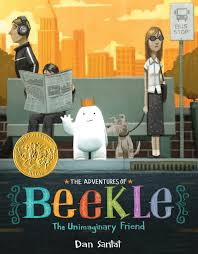
How times have changed! Not only are there plenty of picture books about imaginary friends, Dan Santat’s The Adventures of Beekle: The Unimaginary Friend (Little, Brown, 2014) won this year’s Caldecott Medal. So much for weird.
                         imgres     51MDBfXWDGL._SX258_BO1,204,203,200_

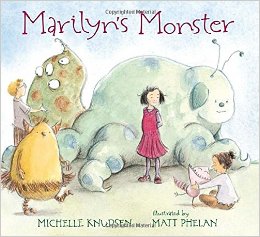
Marilyn’s Monster (Candlewick Press, 2015), by Michelle Knudsen, with illustrations by Matt Phelan is a variation on having an imaginary friend. Knudsen’s heart-felt storytelling and Phelan’s expressive illustrations work together to create a satisfying emotional journey all children will recognize.

Having a monster is “the latest thing,” but Marilyn doesn’t have one yet. “Your monster has to find you.” Soon, Marilyn is “the only one left without a monster.” At first she’s sad, and “tried to be the kind of girl no monster could resist.” Then she gets mad and tries to convince herself she doesn’t need a monster. Deep in her heart, though, Marilyn knows she wants a monster “more than she could say.” She defies the rules and takes matters into her own hands. She follows her instinct, faces her fears, and sets off in search of her monster. Along the way she discovers, like Beekle, that sometimes it’s necessary to push back against conventional wisdom to achieve your goal.

Marilyn’s happiness at the end of the book is more than just satisfaction at having found her monster. It’s far deeper than that. It’s happiness that comes from the confidence gained by overcoming her fears and accomplishing her goal by herself.

Marilyn’s Monster is an endearing book that young audiences will love, but I would share it with second and third graders, too. Not only will they enjoy the story, they will learn much about word choice, tension, and character growth from Knudsen’s masterful writing. In addition, Marilyn’s Monster and The Adventures of Beekle: The Unimaginary Friend are a perfect pairing for comparing and contrasting point of view and setting. Most importantly, though, the theme that when you follow your heart, anything is possible is one worth sharing again and again.

Candlewick has an interview with Michelle Knudsen and Matt Phelan here, and an activity guide here.

Don’t forget to visit Jen at Teach Mentor Texts and Kellee at Unleashing Readers to find out what other people have been reading lately. Thanks, Jen and Kellee, for hosting!
It’s Monday! What Are You Reading?

IMWAYR

My colleagues and I have been busy teaching and revising informational writing units of study. We’ve been concerned, though, about having enough good mentor texts for our Kindergarten through second grade students to emulate. A traditional five-paragraph essay is NOT our goal, yet an organizational structure is needed so they don’t write pages and pages of random facts. This week I found two informational texts with unique structures that will be inspiring mentor texts for young writers.

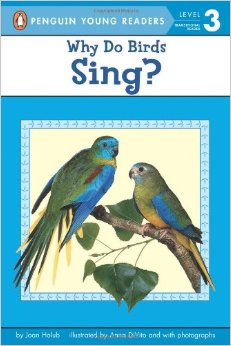
Why Do Birds Sing? (Penguin Young Readers, 2004) by Joan Holub and illustrated by Anna DiVito is a question-and-answer book. Holub anticipates any question kids might have about birds, then responds with brief, informative answers. DiVito’s cartoon-like illustrations are paired with color photos that provide close up views of many familiar species.

51ghouWrrrL._SY344_BO1,204,203,200_

This book is a terrific mentor text. Children have many questions about subjects they’re interested in, and this question-and-answer structure is a perfect way for them to organize their research findings. Text features in Why Do Birds Sing? are limited to photographs and labels, but the photos have been thoughtfully chosen to illustrate and/or support the information being presented.

Holub and DiVito have also teamed up to create Why Do Dogs Bark?, Why Do Cats Meow?, and others that answer these urgent questions that all kids ask.

51zj0DcTTBL._SX258_BO1,204,203,200_

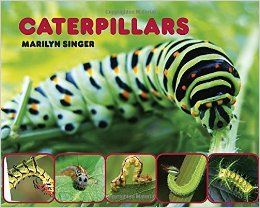
Caterpillars, by Marilyn Singer (EarlyLight Books, 2011) is a fact-filled book lavishly illustrated with close-up color photographs of both familiar and unfamiliar caterpillars. What I really love about this book, though, is its unique structure. Poet Singer (who was recently awarded the National Council of Teachers of English Award for Excellence in Poetry for Children) begins the book with a poem introducing caterpillars. Here is the first stanza:

Caterpillars smooth,

Caterpillars hairy.

Munching in a giant bunch,

Lunching solitary.

The poem is followed by a page devoted to elaborating each line, providing young readers with all sorts of interesting facts. Each page is also filled with gorgeous color photographs showing examples of the species or behavior described in the text. There is also a quiz, a matching game (caterpillar-to-moth/butterfly), glossary, resource list, index, and more.

Caterpillars, which was named a National Science Teachers Association Outstanding Trade Book for Science in 2012, is listed by the publisher as being appropriate for K-2 students. But I think older students would also enjoy Singer’s informative, accessible writing style and have fun creating their own poem to organize their informational writing.

Both of these books are excellent mentors for a whole class book on a single topic, or for individuals writing about a topic of their choice. Best of all, they are engaging nonfiction texts that can be enjoyed as read-alouds or as independent reading by all elementary age students.

Don’t forget to visit Jen at Teach Mentor Texts and Kellee at Unleashing Readers to find out what other people have been reading lately. Thanks, Jen and Kellee, for hosting!
It’s Monday! What Are You Reading?

IMWAYR

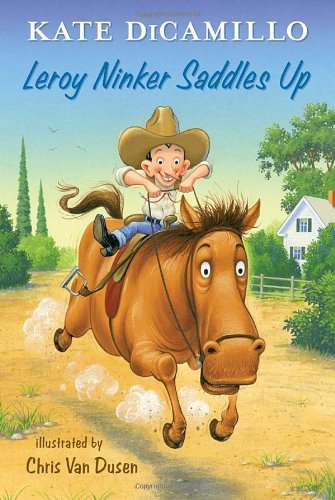
Leroy Ninker Saddles Up (Candlewick Press, 2014) by Kate DiCamillo

Mercy Watson was a staple in my first grade classroom, so I was excited to learn that Leroy Ninker was back with his own adventure. Leroy has repented his thieving ways is now a man with a dream. Inspired by the westerns he watches while working at the Bijou Drive-In Theater, he dreams of being a cowboy. The Bijou’s ticket seller, Beatrice Leapaleoni, encourages Leroy to follow that dream. She urges him to wrestle fate to the ground and get himself a horse.

Leroy does just that. He meets Maybelline, a big horse with a loud whinny, and it’s love at first sight. Silliness ensues, but as in all Kate DiCamillo stories, love overcomes all obstacles. Leroy and Maybelline even end up on Deckawoo Drive for breakfast with Mercy Watson. On the menu? Hot buttered toast, of course.

Leroy Ninker Saddles Up is a perfect read aloud for first or second grade. Mercy Watson fans will enjoy reading Leroy’s adventure with Maybelline on their own. This book is filled with sage advice (“Be a straightforward communicator,” Patty LeMarque tells Leroy.) and self-discovery (Leroy “never imagined he could string so many words together at once.”) But most of all it is a book filled with love, “word after beautiful word…”  

 0763663395.01.LZZZZZZZ  513Q6i-sQFL._SX258_BO1,204,203,200_

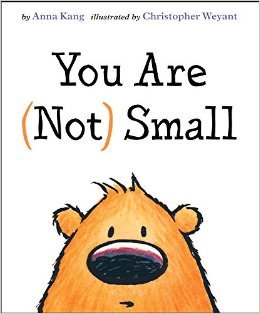
Somehow I missed the debut of You Are (Not) Small (Two Lions, 2014) by Anna Kang and illustrated by Christopher Weyant, last summer. Thankfully, it won the Geisel Award last Monday, so when I saw it at the library over the weekend, I recognized it and brought it home.

Using just a handful of words, Kang’s text and Weyant’s illustrations work together to convey important lessons on differences and perspective. These concepts work on many levels, giving this book wide appeal. Younger readers will easily understand the literal meaning of these differences, and older readers will be able to infer a deeper meaning. Everyone will love that when the characters finally do find common ground, they celebrate by sharing a meal. After all, everyone loves to eat!

In classic picture book fashion, the final page presents a new possibility, opening the door for children to create their own You Are (Not)… story.

Don’t forget to visit Jen at Teach Mentor Texts and Kellee at Unleashing Readers to find out what other people have been reading lately. Thanks, Jen and Kellee, for hosting!
It’s Monday! What Are You Reading?

IMWAYR

Why do we love fantasies? Psychologists have all sorts of explanations about confronting our fears safely, etc., But sometimes it’s simply that a story comes along that just pulls us in and we escape into that world.

9781770495913_p0_v1_s260x420

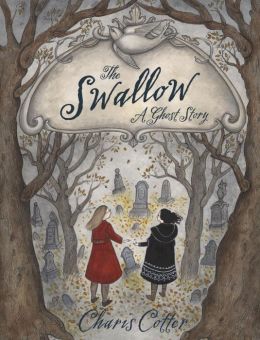
The ability to write such a story is a true gift, a form of magic itself. Charis Cotter has this gift. Her latest book, The Swallow: A Ghost Story (Tundra Books: 2014), is the story of two lonely girls, both of whom introduce themselves by saying they don’t fit in. Polly is eager to be friends with Rose, the new girl next door. Rose, on the other hand, is reluctant to get involved with “one of the dreadful Lacey children who live next door.”

Polly and Rose each narrate their own version of events, and as the book opens, their stories parallel each other. Polly hates having so many brothers and sisters and having to “share everything until there’s nothing left for me. Rose feels she’s “bewitched” because no one, not her parents, teachers or classmates, pays any attention to her. But as Polly and Rose’s friendship deepens, their stories, and their mysteries, become intertwined. Ultimately, they both learn that it’s much easier to face our fears with a friend at our side.

I don’t want to give anything away about the ghost in the title. What I do want to tell you is that this is a beautifully written testament to the power of love and friendship.

21469109

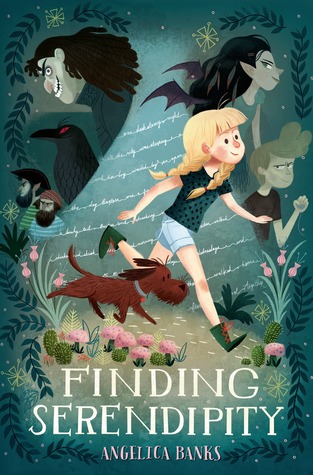
Love and friendship are also at the heart of Angelica Banks new book, Finding Serendipity. (Henry Holt, 2015; Review copy from NetGalley, available February 3, 2015) Summer vacation is just beginning, and Tuesday McGillicuddy is can’t wait for her mother, world-famous author Serendipity Smith, to finish the final adventure of Vivienne Small, a fairy-like creature who lives in the Peppermint Forest and plots “ingenious ways [to] outsmart her archrival, the monstrous Carsten Mothwood.”

Tuesday is worried, though when her mother doesn’t come home for dinner. When she wakes up late at night and realizes Serendipity still isn’t home, she resolves to find her mother. Sitting at her mother’s typewriter trying to find the end of Vivienne’s story, Tuesday begins to write. As she writes her story, a mysterious silver thread begins to spool itself out from the words and wraps itself around Tuesday. Soon, she and her dog, Baxterr, are swept out the window and up into the sky.

Middle grade readers will be swept right along with them. The adventure that follows includes a mysterious fog-filled land, a wise Librarian, near-drownings, and pirates. Along the way, Tuesday learns about being brave and staying true to her friends and herself.

Finding Serendipity is really a love letter to the magic of writing. Angelica Banks (aka Australian authors Heather Rose and Danielle Wood) has created a world where “stories have a power of their own” that take readers and writers on amazing adventures. Readers will discover that writing “might appear to be magical, but the magic comes from nowhere but within you.”

Both of these books do what fantasy does best: expand our horizons and help us see the world in a new way. Both are terrific choices for read-alouds or indpendent reading.

Don’t forget to visit Jen at Teach Mentor Texts and Kellee at Unleashing Readers to find out what other people have been reading lately. Thanks, Jen and Kellee, for hosting!
IMWAYR: One Plastic Bag & The Red Bicycle

IMWAYR

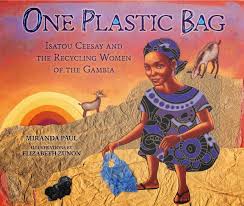
One Plastic Bag: Isatou Ceesay and the Recycling Women of the Gambia (Millbrook Press, 2015; available February 1st) Review copy provided by NetGalley

imgres

Plastic bags are ubiquitous the world over, but in Isatou Ceesay’s village in Gambia they are causing serious problems. Goats eat them, then become ill when they can’t digest them. Water collects in the piles of discarded bags, giving mosquitoes pools for breeding. Isatou comes up with a plan to recycle the bags by crocheting them into purses. Not only is the village clean again, but the purses provide income for the villagers.

Isatou Ceesay is an inspiring role model, and Miranda Paul has done an excellent job making her story accessible to young readers. One Plastic Bag clearly explains the problems caused by discarded plastic bags. Not only will children everywhere be motivated to recycle bags, they’ll be inspired to think outside the box when searching for solutions to problems. Elizabeth Zunon’s collage illustrations, which include pieces of plastic bags, complement the text perfectly.  An Author’s Note includes how Paul came to write One Plastic Bag, as well as a map, timeline, pronunciation guide, and a list of books for further reading.

One Plastic Bag has its own website where you can meet Isatou Ceesay, Miranda Paul, Elizabeth Zunon, and others. You can also learn more at Julie Danielson’s lovely blog, Seven Impossible Things Before Breakfast, which featured an extensive selection of Elizabeth Zunon’s artwork for One Plastic Bag back in November.

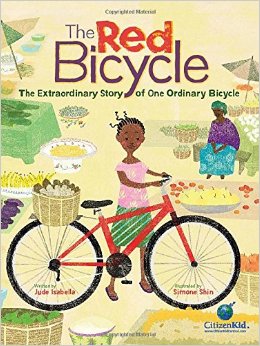
The Red Bicycle: The Extraordinary Story of One Ordinary Bicycle (CitizenKid, division of Kids Can Press, 2015; available March 1st) Review copy provided by NetGalley

6185Q9gFiOL._SY344_BO1,204,203,200_

Jude Isabella and Simone Shin’s “extraordinary story of one ordinary bicycle”  is a perfect book to pair with One Plastic Bag. Young Leo has worked hard and saved his money to buy a bicycle. He rides “Big Red” everywhere and takes such good care of it that even after a few years, it “looks almost brand new.” The problem is that Leo has outgrown his beloved bike, and wants to make sure its new owner will love it as much as he has. The owner of the local bike shop tells Leo about an organization that is collecting bicycles to ship to villages in Africa. Leo gets Big Red ready for its trip across the ocean, shown on a map by a dotted red line. When Big Red arrives in Burkina Faso, Alisetta is excited to get such a beautiful bike. The whole village cheers her on as she joyously learns to ride her new bicycle. Big Red makes life easier for Alisetta and her family by helping them get their sorghum crop to market. After Big Red is damaged in an accident, it’s recycled again. Now an ambulance, Big Red gets health workers to remote villages and sick patients to clinics where they get the care they need.

Readers will be inspired to help get bicycles to African villagers, and information about organizations that collect bicycles or money to transport them is included at the end of the book. Ideas for follow-up activities and facts about Burkina Faso are also included.

Both of these books will be great additions to any K-5 unit on recycling and can be used to inspire opinion writing about the importance of recycling. They will provide children with a look at daily life in Western Africa, increase their  awareness of the importance of recycling, and show them realistic ways they can get involved in these important efforts. 

Don’t forget to visit Jen at Teach Mentor Texts and Kellee at Unleashing Readers to find out what other people have been reading lately. Thanks, Jen and Kellee, for hosting!
It’s Monday! What Are You Reading?

IMWAYR

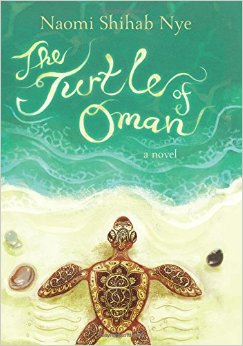
The Turtle of Oman, by poet Naomi Shihab Nye is a beautiful, quiet book about a young Omani boy and his family as they prepare to move to the United States, where his parents will attend graduate school.

516M4hIB1eL._SY344_BO1,204,203,200_
The Turtle of Oman by Naomi Shihab Nye (Greenwillow, 2014)

Aref is bereft at the thought of leaving his home, his friends, and most of all, his grandfather, Sidi. Aref and Sidi are “a Team of Two,” who, “even when they weren’t doing anything special… pretended they were.”

As Aref’s mother is busy packing and preparing their house for cousins to live in for the three years they’ll be gone, she has little time to comfort Aref, who puts off packing and frets about life in the United States. But Sidi, who “always had time for Aref,” takes him on several adventures. These outings distract Aref from his sadness over leaving his “only, number, one, super-duper, authentic, absolutely personal place.”

Aref and his family have a tradition of playing “Discovering Something New Everyday.” They make lists, recording their discoveries: “In your notebook, you wrote down new ideas or even scraps of new information. Nothing was too small.” Each family member constructs lists in their own way, and about topics that interest them. Sidi (who doesn’t make lists; Aref writes down his lists) specializes in geographic information, Aref’s “specialized in animals, his favorite topic.”

Through these lists and Sidi’s and Aref’s adventures, readers learn much about daily life in Oman. Nye’s ability to depict Aref, an ordinary boy, in this exotic location where life is familiar yet so different, seems effortless. Her prose is lyrical throughout, and lines like “your thoughts made falcon moves, dipping and rippling, swooping back into your brain to land,” add depth to Aref’s personality.

In an interview with Roger Sutton, Nye explains that she became interested in Oman as a child after seeing a National Geographic story about the country. She also talks about her longing for a time when people had “less stuff, less clutter, less things in a day, but better relationships with those things. I wanted there to be some sense of that with Aref and Sidi.”

The slow art of The Turtle of Oman is a lovely addition to realistic middle grade fiction. It is an ideal read aloud and will introduce students to a part of the world and a culture they may know little about through the story of a boy they will instantly recognize.

Don’t forget to visit Jen at Teach Mentor Texts and Kellee at Unleashing Readers to find out what other people have been reading lately. Thanks, Jen and Kellee, for hosting!
It’s Monday! What Are You Reading?

IMWAYR

I haven’t written an IMWAYR post in months, but one of my goals for the new year is to blog more often, so I’m starting early with this post.

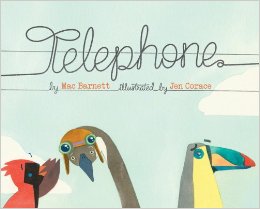
Telephone (Chronicle Books, 2014) by Mac Barnett, illustrated by Jen Corace

I was a little late to the Mac Barnett party, but I’ve been a devoted fan ever since I discovered Extra Yarn (Blazer + Bray, 2012). Having been on something of a bird kick this year, when I saw Telephone at my local bookstore, I grabbed it.

Barnett’s simple text and Corace’s illustrations work together to evoke a bygone era when kids played outside until it was time for dinner. The avian world on the telephone wire above echoes the human world below where kids are outside reading, running, and climbing. The story begins with Peter’s mother’s simple request, “Tell Peter: Fly home for dinner.” The young cardinal she asks is toting a baseball bat and hears what he wants to hear— “Tell Peter: Hit pop flies and homers.”  The birds along the wire continue to mangle this message until it is unrecognizable. Meanwhile, back in the human neighborhood, kids are waving goodbye as they get called inside. Finally, a zany, high-strung bird turns to an unflappable owl and tells him an outrageous mishmash of all the previous messages. The owl gives the other bird a sidelong glance, then calmly turns to Peter and tells him to “fly home for dinner.”

Corace’s illustrations are full of fine comic touches that add depth to the birds’ personalities: a distressed looking turkey is “too high on this wire,” and a rock-loving wren is decked out with star-shaped glasses and electric guitar.

Kids will love this book just for the pure silliness of it, but they’ll also love playing their own game of telephone. The witty word play also makes Telephone a terrific mentor text. Kids could have fun playing with rhymes, near rhymes, and synonyms to create their own version of Telephone. 

Don’t forget to visit Jen at Teach Mentor Texts and Kellee at Unleashing Readers to find out what other people have been reading lately. Thanks, Jen and Kellee, for hosting!
It’s Monday! What Are You Reading? Summer Reading Edition

IMWAYR

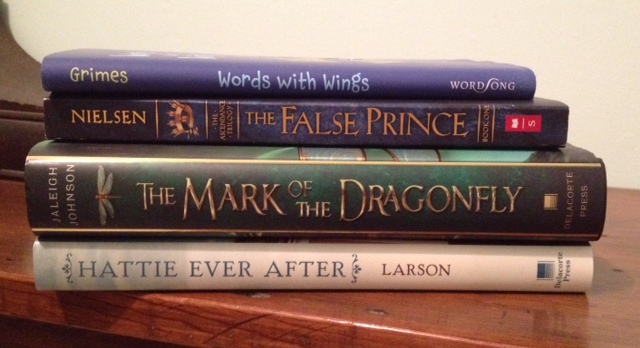
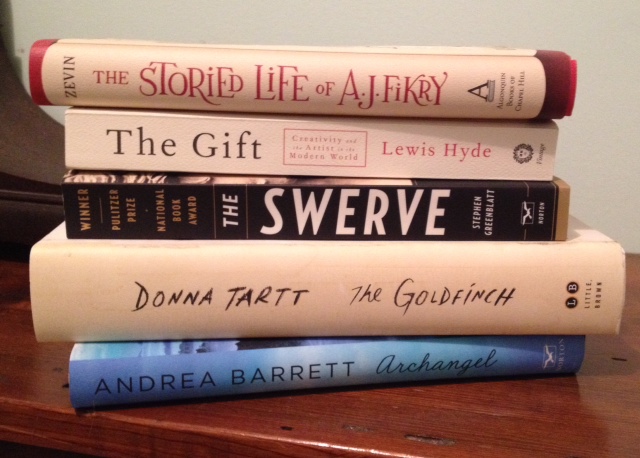
Every teacher knows that the last weeks of school are the most hectic of the year. I haven’t been very successful carving out time for reading anything other than the newspaper and a few blogs lately, but I have been thinking about summer reading. So in lieu of writing about what I have been reading, here are stacks of what I plan to read over the next few months.

photo 1
Professional books
photo 2
Middle grade & YA books
photo 3
Adult books

What’s in your summer reading stack? Happy reading!

Don’t forget to visit Jen at Teach Mentor Texts and Kellee at Unleashing Readers to find out what other people have been reading lately. Thanks, Jen and Kellee, for hosting!
It’s Monday! What Are You Reading? Bird Books

IMWAYR

One of the few memories I have of 2nd grade is learning about birds. My teacher, Mrs. Wheaton, must have been a bird-watcher, because she taught us about the song birds native to our area. I  don’t remember what specific facts about birds I learned from her, but I have clear memories of coloring pictures of the Baltimore oriole, red-wing blackbird, goldfinch, and more. The pages  had the purple ink and intoxicating smell of a mimeograph machine, and I loved them. At the end of the unit, all the pages were stapled together into a little book. 

9780763645618_p0_v1_s260x420I was reminded of this project recently when I read Look Up! Bird Watching in Your Own Backyard. (Candlewick Press, 2013) This book is filled to the brim with fascinating details about bird species, habitats, flight behavior, wing shape, beak shape, songs and more. Author and illustrator Annette LeBlanc Cate tells readers at the start that she is not a scientist; she just really loves birds. Her love shines through on every page of this fact-filled, engaging book.

One of my favorite things about Look Up! Bird Watching in Your Own, which won a Robert F. Sibert Honor, is that it encourages children to hone their powers of observation. Cate urges readers to go outside and “be amazed at just how thrilling it can be to see new birds, find out about them and learn their names.” Tips for successful birdwatching, as well as a bibliography for budding birders are included. Cate also recommends that readers visit the Cornell Lab of Ornithology’s website. This is an extensive resource, where you can search for information about almost any North American bird, hear its song and watch several species in the wild via their Bird Cam.

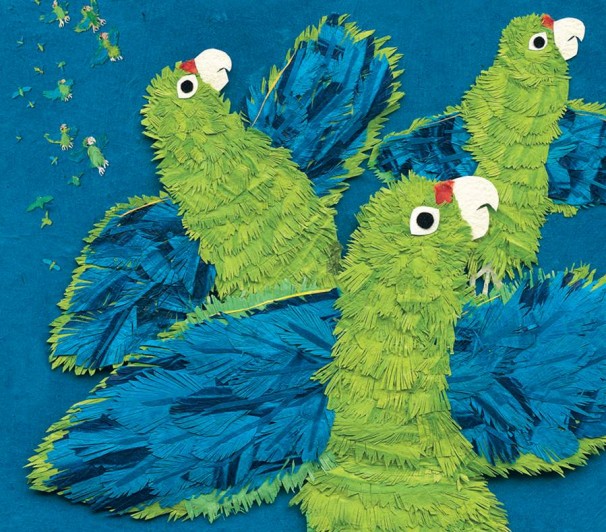
Parrots-over-Puerto-Rico1Parrots Over Puerto Rico (Lee & Low Books, 2013) by Susan L. Roth and Cindy Trumbore is a gorgeous book that tells the story of the Puerto Rican parrot. Called iguaca by the Tainos who arrived on the island over a thousand years ago, “hundreds of thousands of parrots flew over the island” before Puerto Rico was settled by humans. Roth and Trumbore’s description of this paradise is brought to life in Roth’s stunning collages. Using paper and fabric, she creates scenes that have such depth and texture you wouldn’t be surprised if the birds flew off the page.

By weaving the history of Puerto Rico together with the fate of these now extremely rare parrots,  Roth and Trumbore make it clear that humans have been the primary culprits in the birds decline. But they also devote almost half of the book to the efforts humans have taken since the late 1960s to save the Puerto Rican parrot. They describe the setbacks as well as the successes scientists have had as they fight to save the Puerto Rican parrot.

Winner of the 2014 Robert F. Siebert Medal for Most Distinguished Informational Book for Children, Parrots Over Puerto Rico has a lengthy afterword that describes the work of the Puerto Rican Parrot Recovery Program in greater detail and includes photographs of the birds in the aviaries and in the wild. There is also a timeline of events described in the book, as well as a list of sources.

mama-built-a-little-nest-9781442421165_lg

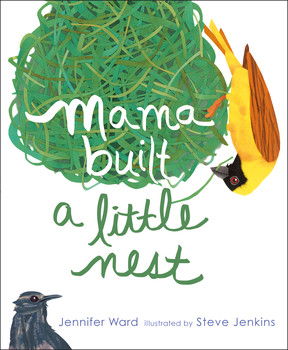
For younger bird lovers, Jennifer Ward has created the lovely Mama Build a Little Nest (Beach Lane Books, 2014). This rhyming book describes how many different species of birds build their nests. Some, like the hummingbird, are “wee and snug,” while others, such as the falcon, scrape “a simple nest/upon a craggy ledge.” Steve Jenkins’ beautiful collages are just right for Ward’s simple, straightforward text. Each page also includes an additional fact about the birds and their habits and a short author’s note provides additional information about nest construction and a list of websites to explore.

If you or your students weren’t bird watchers before, you definitely will be after reading these books. Mrs. Wheaton would have loved them!

Don’t forget to visit Jen at Teach Mentor Texts and Kellee at Unleashing Readers to find out what other people have been reading lately. Thanks, Jen and Kellee, for hosting!
It’s Monday! What Are You Reading?

IMWAYR

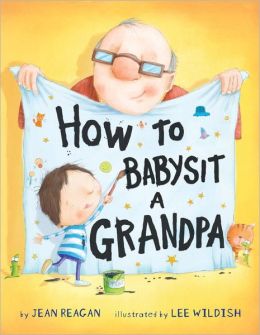
How to Babysit a Grandpa (Alfred Knopf, 2012), by Jean Reagan, with illustrations by Lee Wildish, is a charming story. The book opens with these words of wisdom from a little boy who is about to spend the day with his grandpa.

“Babysitting a grandpa is fun–if you know how.”

Our nameless hero goes on to explain all the highlights of a five-year old’s day: snacks, going outside, playing games, and more. He even suggests “bouncy music” to make clean up easier. Every other page or so provides additional tips for would-be grandpa-sitters, such as snack suggestions and ideas for lots of creative play. (I love that there is a T.V in one illustration, but it is never mentioned, let alone turned on.)

Adding to the appeal of Reagan’s text are Lee Wildish’s digital illustrations. His characters remind me of Melissa Sweet’s non-collage work–imbued with love and a sense of humor about the realities of life as a child. There are crumbs all over the table, and the boy’s tongue is set firmly in the corner of his mouth as he draws a picture for grandpa.

     9780375867132_p0_v1_s260x420   9780385753845_p0_v2_s260x420

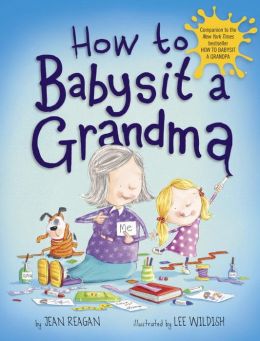
Reagan and Wildish have teamed up again for How to Babysit a Grandma (Alfred Knopf, 2014), and it is every bit as engaging as How to Babysit a Grandpa. The style and tone are the same (the boy and his grandpa even make a cameo appearance at the park), but our heroine has her own ideas for activities to “keep a grandma busy.”

Both of these books are perfect mentor texts for Kindergarteners and first graders learning to write how-to books. Children could also come up with their own versions of the lists Reagan has included, or add their ideas to hers. These books could just as easily be enjoyed as read-alouds, or shared in September in honor of Grandparents Day. The possibilities are endless. One thing is certain, though. If you have a 4-6 year old, know one, or teach them, these books should be on your list of How to Entertain a Child.

Don’t forget to visit Jen at Teach Mentor Texts and Kellee at Unleashing Readers to find out what other people have been reading lately. Thanks, Jen and Kellee, for hosting!