Mary Oliver’s “Instructions for Living a Life” advises that we should “Pay attention. Be astonished. Tell about it.”
I thought of this when I read today’s quick-write on Kate Messner’s Teacher’s Write blog post. I’m often astonished by the beauty of the fields around my house, especially in summer. I’ve written about this in my journals over the years, and Kate’s post inspired me to turn these observations into a poem.
Sometimes, on a summer morning
Grandpa Stuart’s fields are touched
by the rays of the rising sun
so just the top of the grasses
glow in the yellow light.
Goldfinches perch on purple thistles,
breakfasting on seeds.
Sometimes, a deer wanders into the field,
interrupting their feast.
Startled, they rise as one
into the air, darting and diving,
chittering as they fly
before settling down
to the business at hand:
harvesting the glorious sunshine
captured in those thistles.
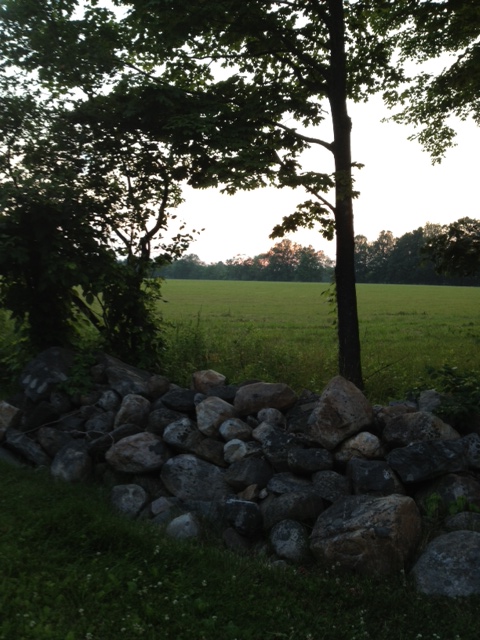
One of Grandpa Stuart’s fields at sunset. It was hayed this week, so there are no thistles.
What astonished you today?
This post is doing double duty for today’s Slice of Life Challenge at Two Writing Teachers. Thank you, as always, to Stacey and Ruth for hosting!
I’ve been largely absent from Twitter and blogging for the past week or so. The swirl of end-of-the-year activities and responsibilities, plus helping my niece get ready for a bridal shower she hosted on Saturday, demanded my full attention. But today is the last official teacher day (kids finished last Friday) and it’s the first day of Teachers Write, a fabulous online summer writing camp for teachers and librarians hosted by Kate Messner and friends. So it seems appropriate to kick off this summer of writing by setting some goals. Goals and objectives are nothing new in education, but lately it seems like they’re the new black.
Last summer I followed the posts and prompts at Teachers Write and I did a fair amount of writing in my journals. But I didn’t share a lot online. This year, I hope to share more of my writing here. Notice I said hope. I am my own worst critic. I want my writing to be perfect the first time I write it. I know this never happens. I’ve read countless writing books and interviews with authors reassuring fledgling writers that first drafts are always terrible. I also know that I am not the only person who feels this way, as many of the comments on the Teachers Write Facebook page say pretty much the same thing. Allowing myself to just write is something I’ve gotten better at, but I still have a long way to go.
While I’m posting some of this writing, I’d like to improve my blogging skills. After a year and a half, there are still some technical details related to my blog that I’d like to master. A friend told me to move my picture to the top of the page, but I have no idea how to do this. Sometimes a picture stays where it landed because I can’t figure out how to move it.
Another goal I have is to keep a regular writing schedule. This has gotten easier for me over the past few months. Participating in the March Slice of Life Challenge at Two Writing Teachers really helped me with this. There are days, however, when life intervenes and not a word is written.
And that brings me to my final goal: Not to worry. If I don’t I polish up that picture book draft from 2004 or turn it into an early chapter book, it will be waiting for me next year. If I don’t post some writing one day, I will the next. Any writing I do is an accomplishment. Going through this process helps me clarify my thinking. It also provides me with tips and tools to share with my students when they are stuck. Most importantly, being a writer makes me more empathetic to my students as they struggle to find an idea, a word, a voice.
Dr. Thomas McMorran, Connecticut’s Principal of the Year for 2012, was the speaker at my school’s Eighth Grade Graduation last Friday evening. His speech was witty, down-to-earth, and full of wisdom. He stressed the importance of caring for one another and being fully present in our daily lives. McMorran urged everyone to “Be here, right now.” This summer, I hope to do just that: to be here, with all of you, writing and learning together.
A huge thank you to Kate and all the authors who will be participating in Teachers Write this summer!
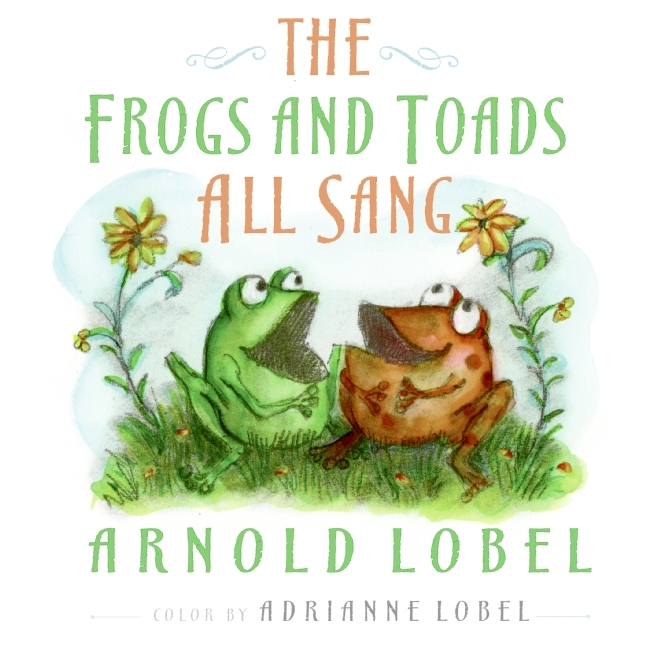
As the literacy specialist in a K-8 school, I have many roles and responsibilities on any given day. For the most part I enjoy them all. But hands down, the best part of my day is working with students. I work with first grade students through our RTI process (known as SRBI, Scientifically Research Based Instruction, in Connecticut). We begin each lesson with a poem to “warm up our ears.” The students choose one or two previously read poems to read to themselves, and then we read a new one together. Over the years, I’ve noticed particular poems that all the children seem to love. Many of these favorites come from The Frogs and Toads All Sang (HarperCollins, 2009), by Arnold Lobel.
These poems were written and illustrated as a gift to writer Crosby Bonsall and her husband. Decades later, they were discovered at Bonsall’s estate auction and brought to the attention of Adrianne Lobel, Arnold’s stage-designing daughter. She added color to her father’s illustrations and this wonderful book was born. You can listen to Adrianne Lobel describe the process here:
By June, my first grade students are well on their way as readers. Lobel’s poems provide just the right balance of familiar and challenging words, not to mention the fact that the poems are about frogs and toads. (Not the Frog and Toad, but I haven’t met too many first graders who don’t love these charming amphibians.) In addition, these poems are silly. See for yourself.
There Was a Frog
by Arnold Lobel
There was a frog
Who had a car.
He drove it fast.
He drove it far.
He traveled
Fifty days and nights
And never
Looked at traffic lights.
“I learned to drive
Quite easily,
But I never learned
To stop,” said he.
What’s not to love about that? If you’re looking for the perfect summer read for any frog and toad loving first grader (or any primary grader, for that matter), this book is it.
The last day of school is June 21st for students; the last day for teachers is the 24th. After that, I’ll be working with middle school English/Language Arts teachers to align our curriculum to the CCSS. As everyone knows, this is an incredibly busy time of year. A former principal once compared the end of the school year to water draining out of a tub. At first the swirl is manageable, but the closer it gets to the final day, ready or not, you are sucked into that swirling vortex. I’m trying to keep my head above water while I get orders completed, assessment data entered, and on and on. So what am I doing this evening? Reading.
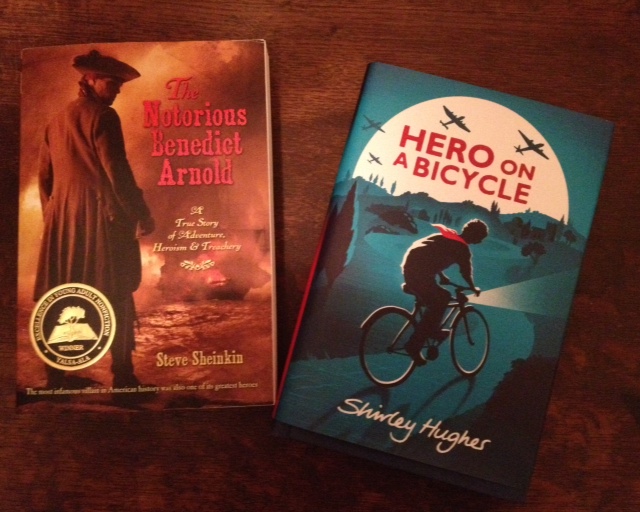
I ordered these books on Sunday, thinking it would take at least a week for them to arrive. Imagine my surprise when they were waiting for me on my porch this afternoon! Hero on a Bicycle, (Candlewick Press, 2013) by Shirley Hughes, has gotten lots of praise this spring. Stories of the citizens of Europe resisting and rebelling against the terrors of the Nazis have always fascinated me, so this book caught my attention right away.
The American Revolution has long been the subject of much historical fiction. I recently finished listening to Sophia’s War (Beach Lane Books, 2012) Avi’s recent addition to this tradition. The fictional heroine, Sophia Calderwood, becomes involved in the historical treachery of Benedict Arnold. I know very little about Arnold and his plans to turn West Point over to the British, and Sophia’s War piqued my curiosity. Having recently read Bomb: The Race to Build–and Steal–the World’s Most Dangerous Weapon, Steve Sheinkin’s excellent account of the Manhattan Project and the people involved, I knew Sheinkin’s The Notorious Benedict Arnold: A True Story of Adventure, Heroism & Treachery (Flash Point, 2010) would answer all my questions about this infamous figure from our history.
Who can resist the allure of brand new books? Not me! Everything I have to do for school will be waiting for me in the morning. You’ll forgive me if I say goodnight. I have some books to read.
A few months ago, Betsy Bird had a post on her inimitable blog, A Fuse 8 Production about unreliable narrators in picture books. This post intrigued me, especially the inclusion of I Want My Hat Back and This Is Not My Hat, both by Jon Klassen. To me, these books are better examples of situational irony. Defined in my trusty Benet’s Readers Encyclopedia as when “there is a discrepancy between what might reasonably be expected and what actually occurs–between the appearance of a situation and it’s reality.”
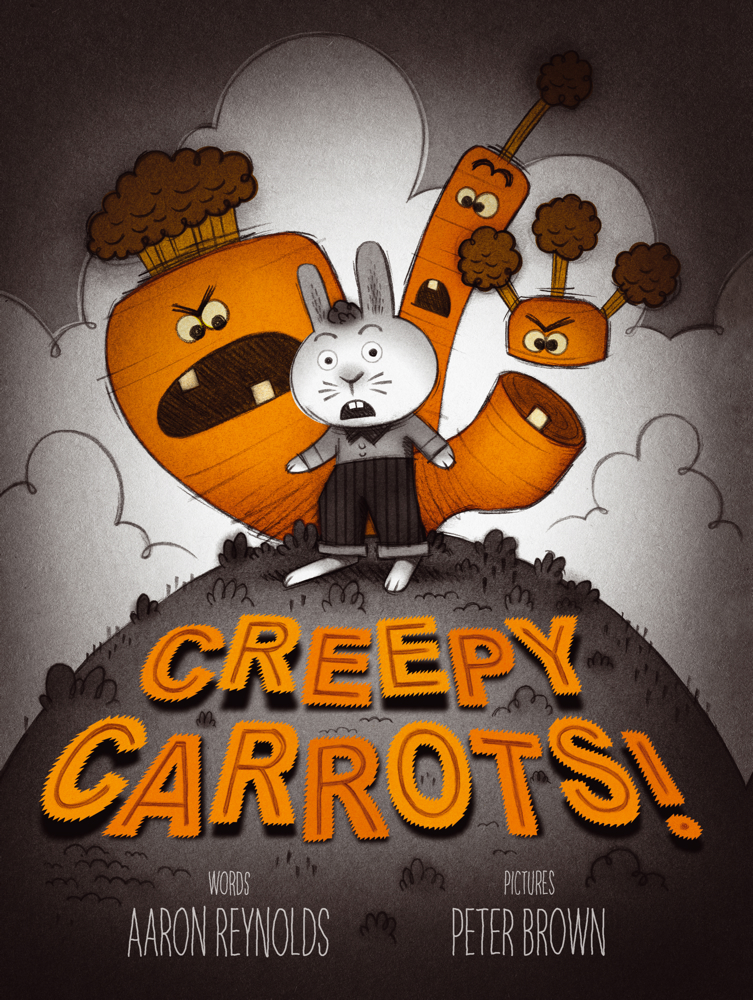
I was reminded of this post over the weekend when I read Creepy Carrots (Simon & Schuster, 2012), by Aaron Reynolds and illustrated by Peter Brown. If ever there was an example of situational irony, this is it! It’s also a great example of how authors build suspense. Peter Brown received a Caldecott Honor for his illustrations. Brown describes how he created his incredible artwork and his inspirations here:
That Is Not a Good Idea! (Blazer + Bray, 2013)by Mo Willems is another picture book with situational irony that will have children on the edge of their seats until the very end. Then they’ll be squealing with delight!
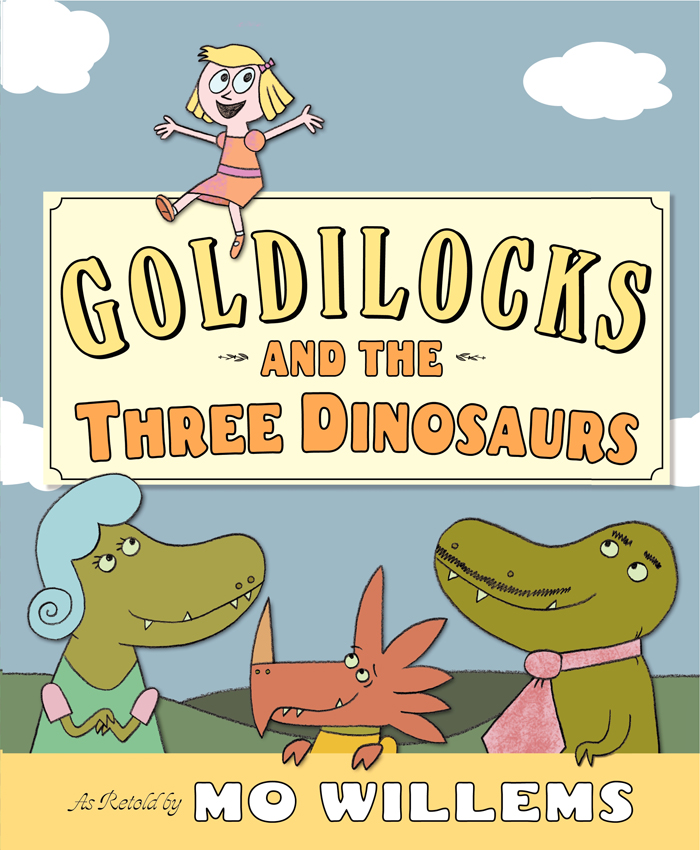
Another recent Mo Willems book, Goldilocks and the Three Dinosaurs (Blazer + Bray, 2012), has lots of verbal irony. Lines like “I SURE HOPE NO INNOCENT LITTLE SUCCULENT CHILD HAPPENS BY OUR UNLOCKED HOME WHILE WE ARE…uhhh….SOMEPLACE ELSE!” leave little doubt about the dinosaurs’ true intentions for Goldilocks.
According to the CCSS, irony is introduced in 8th grade (which is when we introduce it now). The standard (RL.8.6) states that students will “Analyze how differences in the points of view of the characters and the audience or reader (e.g., created through the use of dramatic irony) create such effects as suspense or humor.” Our students typically need lots of scaffolding to understand the subtleties of irony in 8th grade texts. But introducing the concept with these picture books makes it much more accessible, not to mention more fun!
Whether you share these books with middle school students to introduce the concept of irony or as a read aloud with five and six year olds, it really doesn’t matter. Just share them. Everyone will be glad that you did.
Be sure to visit Jen and Kellee at Teach Mentor Texts to find out what others are reading today.
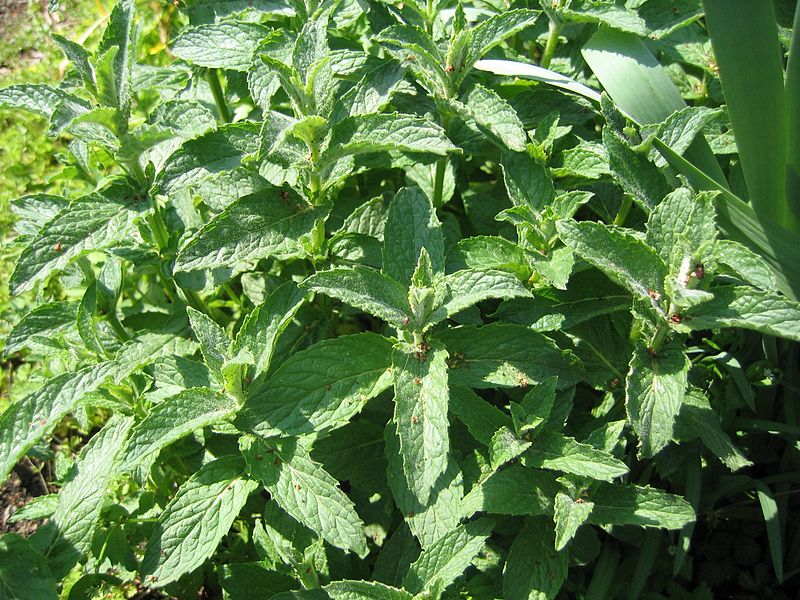
This morning as I was weeding my garden, it occurred to me that the mint that had overrun my herb garden was like standardized test prep. As schools across the country do their best to prepare students for the new CCSS-aligned assessments, test prep is running rampant. Just as the mint in my garden has choked out the basil and parsley, test prep, and the tests themselves, threaten to take over the school day, leaving no time to savor novels, delve into a character’s motivation, or write a deeply personal narrative.
I grow a variety of herbs in my garden because each herb has its own distinct flavor and use. The amount of the herb I use depends on what I’m cooking. The same is true for teaching. We have a wide variety of instructional resources and strategies available. As professionals, we take great care to make thoughtful decisions about which resource or strategy will best meet the needs of our students.
We have to nurture our students so they’ll become independent thinkers and problem solvers. If they are going “build strong content knowledge,” “comprehend as well as critique,” and “value evidence,” all specific goals named in the Common Core State Standards, they have to read and write all kinds of literature and informational texts. As Grant Wiggins wisely points out, “the test is not what you should be practicing; meeting the standards is what you should be practicing.” Providing students with a steady diet of random passages and multiple-choice questions, like those shared by Vicki Vinton on her blog, To Make a Prairie, will do nothing to encourage a student’s curiosity or creativity. We can only do that by providing our students with the rich, robust learning opportunities they deserve.
The mint from my garden adds wonderful notes of flavor to many dishes when I use it appropriately and judiciously. But a steady diet of mint where it doesn’t belong will turn anyone off to its delights. Let’s not turn our students off to the joys of a literate life by overwhelming them with test prep.
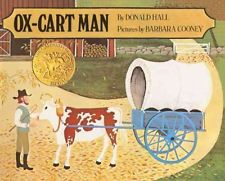
Donald Hall’s “Ox Cart Man” first appeared in The New Yorker on October 3, 1977. Two years later, Hall revised and expanded it into a picture book. Barbara Cooney’s primitive folk art paintings perfectly match the tone of this tale of a self-sufficient farmer and his family. Winner of the 1980 Caldecott Award, the book portrays 19th century farm life and its close ties to the seasons. The Horn Book described it as a “pastoral symphony translated into picture book format.”
Be sure to visit Tabatha Yeatts at her lovely blog, The Opposite of Indifference for the Poetry Friday Round Up.
I discovered this poem on a bookmark in a book that someone at school was weeding out of their collection. I knew Margaret Wise Brown from her classics Goodnight Moon, The Runaway Bunny, and The Important Book, but I wasn’t familiar with this poem. It first appeared in Nibble, Nibble, a collection of 25 poems which was first published in 1959 with illustrations by Leonard Weisgard. Wendell Minor created new illustrations for “Cadence” and four other poems from the original collection in 2007.
Brown was a pioneer in children’s literature and wrote hundreds of books. You can learn more about her life and work here. Leonard S. Marcus published a biography, Margaret Wise Brown: Awakened by the Moon (HarperCollins), in 1999 and Over the Moon: An Imaginary Interview with Margaret Wise Brown in the May/June 2010 of The Horn Book.
My favorite quote from this interview reveals Brown’s prescient wisdom about the lives of children.
“In this modern world where activity is stressed almost to the point of mania, quietness as a childhood need is too often overlooked. Yet a child’s need for quietness is the same today as it has always been–it may even be greater–for quietness is an essential part of all awareness. In quiet times and sleepy times a child can dwell in thoughts of his own, and in songs and stories of his own.”
We all need time to be lost in our thoughts, time to listen for those words “Not spoken yet/And not yet heard.”
Be sure to stop by Teaching Young Writers for today’s round up. Thank you, Betsy, for hosting!
As the school year comes to an end, I’ve been gathering resources to share with my colleagues that they can read and explore over the summer. Our district is very small, with only one school and two or three sections of each grade level. Blogs and Twitter are crucial for us so we can stay […]
Last week my school held its spring book fair. I have loved book fairs for as long as I can remember. All those new books, beckoning, begging to be picked up and read. This year I found some real treasures.
Three Hens and a Peacock (Peachtree, 2011) by Lester Laminack and illustrated by Henry Cole, was the first to catch my eye. This is the story of an interloper in the hen house and how he upsets the routines of life on Tuckers’ farm. By the end, life is back to normal, and the everyone has learned a lesson about not trying to change who they are.
This book reminded me of Just Plain Fancy (Bantam Books, 1990), by Patricia Polacco. Polacco’s story is set on an Amish farm, where the unexpected guest arrives in the form of an egg. Two little girls have the responsibility for caring for the hens, and when they find the unusual egg, they add it to one of the nests in the hen house. Imagine their surprise when they realize that this bird is no hen!
Pairing these books would be a good way to address CCSS Anchor Standard 9: “Analyze how two or more texts address similar themes or topics in order to build knowledge or to compare the approaches the authors take.” This work begins in Kindergarten by having children “compare and contrast the adventures and experiences of characters in familiar stories” with prompting and support.
Actually, all of the books I found at the book fair could be used to meet this standard. How Do You Hug a Porcupine? (Simon & Schuster, 2011) by Laurie Isop and illustrated by Gwen Millward, answers this very prickly question. The boy who wants to attempt this, shown scratching his head on the cover, tries several very creative ways to protect himself from the porcupine’s quills. This book is a perfect mentor text for young writers. They could come up with their own solutions to this problem, or they could pose a similar question to answer.
This book initially got my attention because several of my students had just finished reading The Hug, by Sharon Fear. This book is part of the Fountas & Pinnell Leveled Literacy Intervention series and is published by Heinemann. There are several stories about the main character, Moosling, in this series. Moosling is a loveable moose who gets himself into one predicament after another. In The Hug, Little Pins needs a hug so his good friend Moosling figures out how to give him one.
Speaking of moose, Kelly Bingham’s Z is for Moose (Greenwillow, 2012) has gotten all kinds of good press, but somehow I hadn’t read it yet. Hilariously illustrated by Paul O. Zelinsky, this book is a must-read. The book trailer is just as funny as the book.
I would pair this book with Q is for Duck: An Alphabet Guessing Game (Clarion Books, 2005) by Mary Elting & Michael Folsom with pictures by Jack Kent, for more mixed up alphabet fun.
What treasures did you find at the book fair this year?
Be sure to visit Jen and Kellee at Teach Mentor Texts to find out what others are reading today.