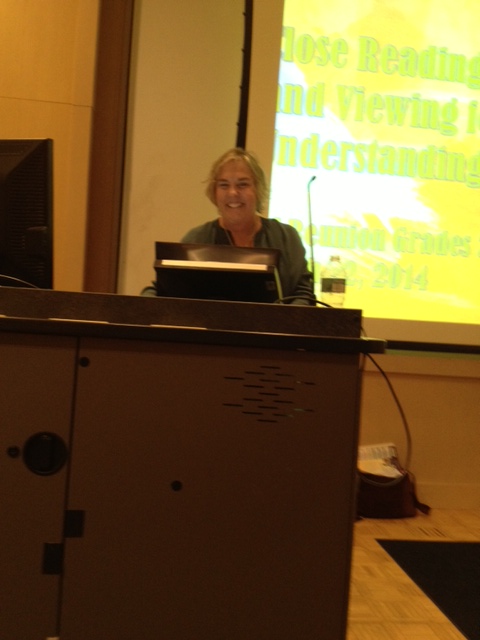
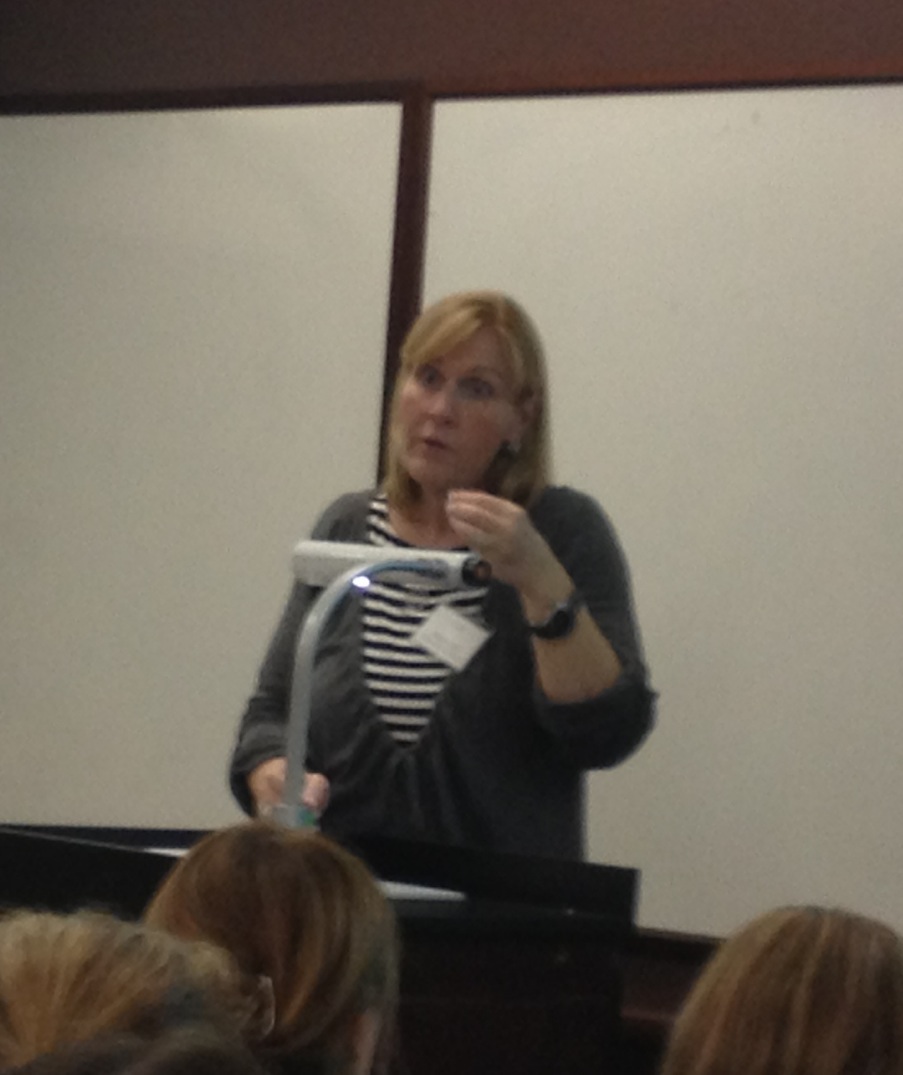
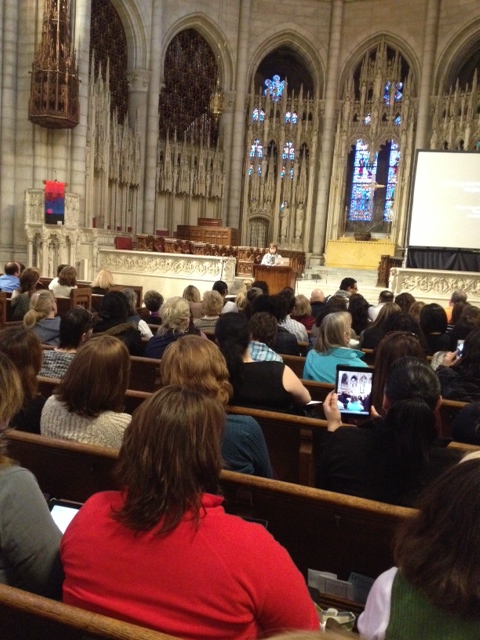
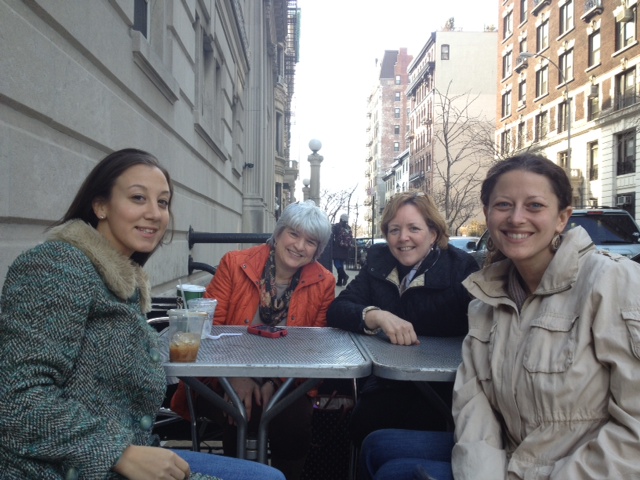
This morning, I left my house at 6:30 and drove to Teachers College at Columbia University for their spring Reading and Writing Project Saturday Reunion. I spent the day with thousands of dedicated teachers soaking up the wisdom of the amazing presenters. Because I am now quite tired, here is my day in pictures.
Diane Ravitch delivering the opening keynote.
Diane Ravitch’s keynote was a call to arms. Lucy Calkins, in her introduction, described Ravitch as “the single most important defender of public education” and “our hero, inspiring all of us to speak out and tell the truth.
Fellow Slicer Anna Gratz Cockerille sharing strategies to help children improve their informational writing.Cynthia Satterlee had great advice for helping kids craft personal opinion essays.Stephanie Harvey reminding teachers that “there’s a difference between thinking and knowledge. We have to teach kids to think so they can acquire and use knowledge.”Kathleen Tolan describing how to “take an ordinary idea about a character and make it extraordinary.”The wisdom of Kathy Collins: “Children should believe that when they give something to texts, they will get something back from the text.”Having coffee with friends and talking about our wonderful day.On my way to Brooklyn, my first view of the Freedom Tower.The view from Brooklyn.Dinner with my son and his girlfriend.
What an amazing day, filled with learning, laughter, family, and friends. Thank to everyone at Teachers College for hosting this amazing event!
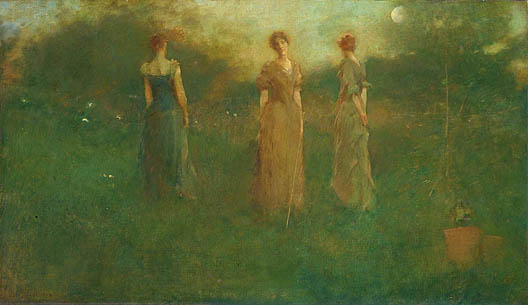
Several years ago, I visited the Smithsonian American Art Museum in Washington, D.C. with a friend. At the time, a room was devoted to the work of the American Impressionist Thomas Wilmer Dewing. I was captivated by the ethereal quality and soft colors of Dewing’s canvases. I bought a calendar that included several of his paintings, thinking I might frame them. Not long after this, my artist son asked if there was anything in particular I wanted for Christmas. I asked him to paint me a version of this painting:
Thomas Wilmer Dewing In the Garden 1892–94 oil 20 5/8 x 35 in. Smithsonian American Art Museum, Gift of John Gellatly
Michael’s version has hung over my bed ever since. I’ve often thought these women, my own graces, deserved a poem, but I never got around to writing one for them.
I was inspired to finally pick up my pen last month when Laura Shovan announced her Pantone® Poetry Project. Laura shared two or three colors each day, and challenged poets to write poems inspired by the colors. Day 10 featured Amberglow and Golden Glow, and although these aren’t the colors in Dewing’s painting, they are similar to Michael’s colors.
Yesterday I contemplated the life story of a man I know only because I often pass him on my way to work. Today, I’m still thinking about life stories, and this made me think of Jennifer Allen, a literacy specialist in Waterville, Maine, and the author of Becoming a Literacy Leader: Supporting Learning and Change (Stenhouse, 2006)and A Sense of Belonging: Sustaining and Retaining New Teachers (Stenhouse, 2009). I read Becoming a Literacy Leader when I began working as a literacy specialist and found Allen’s advice both thoughtful and practical.
Early in Allen’s career as a literacy leader, she was frustrated by the lack of buy-in from her colleagues. In an effort to break the cycle of PD sessions where she did most of the talking, Allen posed this question: “If you had only seven stories to tell of your life, what would they be?” Allen states that “the attention and interest of the staff was captured immediately” and that “teachers were eager to share their stories.” (No surprise here, right, Slicers?)
I intended to share what my seven stories would be, even though I’ve shared some of them with you already. But when I looked up Allen’s current biographical information, I found a “What Do You Know?” interview. Thisseems much more manageable at this late hour.
Books Next to My Bed: The Round House, by Louise Erdrich; Words in the Dust, by Trent Reedy; The Arden Shakespeare: Book of Quotations from Songs and Sonnets; What the Heart Knows: Chants, Charms & Blessings, by Joyce Sidman, illustrated by Pamela Zagarenski; A Tree Grows in Brooklyn, by Betty Smith
Favorite Destressing Activity: Going for a walk
Pets: Lucy, a beagle, and Noodles, a fluffy orange kitty
Hobbies: Knitting and gardening
Inspiration: Nature, art, and interesting people
Favorite Place to Visit: Northern Virginia, where my son and his wife live, and New York City, where my younger son lives (Also home to the Metropolitan Museum of Art, my favorite museum.)
Guilty Pleasure: Peanut M&Ms
Item on My Bucket List: Traveling to Florence, Italy
Music on My iPod: (Very eclectic and not too up-to-date) the Beatles, Broadway shows, Mozart
Proud Accomplishment: Raising two sons
What Makes Me Laugh: My husband, The Big Bang Theory
A Few Favorite Movies: Some Like it Hot, The Shawshank Redemption,White Christmas
I’ve been haunted by Tara Smith’s moving, beautifully written post since I read it on Sunday. Tara spoke eloquently about the importance of compassion, empathy, and recognizing our “fellow human being(s).”
These words flew into my thoughts as I drove home this afternoon. Winter has just started to loosen its grip in my corner of Connecticut, and a cold rain was falling when I passed him. I have no idea who he is, and yet he is a fixture of my commute. I don’t see him every day. Sometimes I pass him in the morning; sometimes it’s afternoon. He walks with a slight limp and it’s impossible to guess his age. He could be 40 or 60.
Now in many places around the world, this gentleman would be just another busy person on his way to or from work. But in this case, he stands out. There are no other people walking on this road; there are no sidewalks, for that matter. It’s rumored, though, that there’s a small settlement of homeless people not far from where I usually see him. Does he live there? To assume he’s fallen on hard times seems to judge him unfairly.
And yet. What is this man’s story? He usually has a plastic grocery bag with him. His hair is always neatly combed and he’s clean-shaven. A small smile gives him a cheerful air. But why does he trudge back and forth on this busy road in all kinds of weather? I marvel at his fortitude at the same time I’m ashamed of myself for making an assumption about someone I know nothing about.
So I make another. This man, for whatever reason, walks each day, probably to the bus stop that’s at least half a mile from the spot where I saw him today. I’ve seen him in the morning and in the evening, coming and going, so he probably has a job that he cares about.
Ultimately, it doesn’t matter if I ever know the particulars of his story. What matters is that when I see him, I look at him. I recognize him as a fellow human being who has a story, a fellow human being who deserves my compassion.
This day got away from me. You know those days. You wake up with plans and a list. And then one thing, probably some minor mishap, happens, and your day is now a day full of falling dominoes. There are no true disasters on days like this; they are mostly just full of frustration.
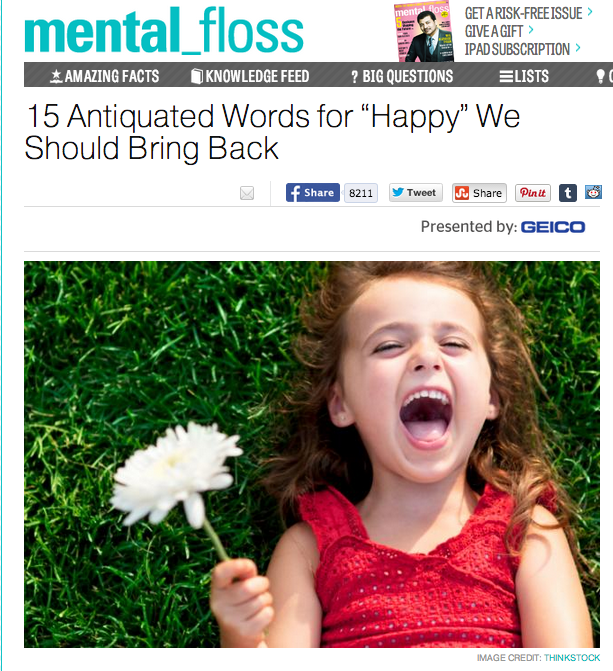
So rather than bore you with the details of this frustrating day, I want to share this post I stumbled across on Facebook over the weekend:
See that picture of me on the lower left corner of this page? That is me being “over the moon” when my son got engaged. (My daughter-in-law is a real gem.) My grandmothers both said “tickled” often, and Stacey used “kvelling” in today’s introduction.
So find a word that puts you “in high snuff” and work it into your writing. I’m going to go write about all those “chirky” robins who were in my yard this afternoon.
Another double-duty Slice for It’s Monday! What Are You Reading?
Coral Reefs, by Seymour Simon (Harper, 2013)
This is a gorgeous book, filled with stunning photographs of one of the earth’s most fragile ecosystems. Coral Reefs gives young readers a thorough overview of the “gigantic communities of living things.” (pg. 6) Simon describes the different types of coral, what they eat, and where they’re found in the world. The “many different kinds of citizens” of a coral reef are also described.
The close-up photographs are captivating and kids will want to pore over them for hours. An index is included, as are a glossary and links to websites with additional information. This book would make a nice companion to the more fanciful but just as informative Coral Reefs by Jason Chin.
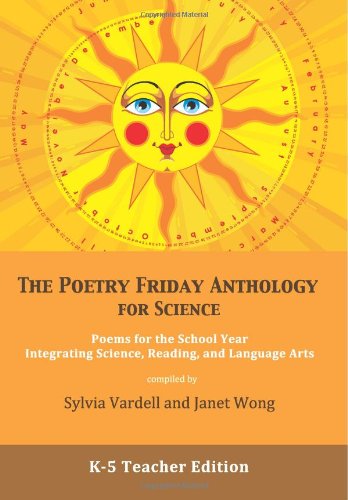
I’ve also been enjoying the poems collected by Sylvia Vardell and Janet Wong in The Poetry Friday Anthology for Science (Pomelo Books, 2014). Dozens of the best poets writing for children today have contributed to this volume. The poems cover a broad range of scientific topics, from scientific practices and lab safety to famous scientists and future challenges, and everything in between. (Although there wasn’t one specifically about a coral reef.)
Wong and Vardell begin their informative introduction with the question “Why poetry with science?” To make their case, they quote legendary author and educator Bernice Cullinan:
“Scientists observe with a clear eye, record their observations in precise, descriptive language, and craft their expressions. Poets do the same thing.”
Also included are tips for sharing the poems and connections to the Next Generation Science Standards. In addition, the following resources are included:
a bibliography of poetry books for science
links to websites and blogs, for both poetry and science
a list of professional resources
a “mini-glossary of science terms”
title, poet, and subject indexes
This book is a must-have resource elementary teachers working to integrate literacy into their science instruction. Student editions are available by grade level and include bonus poems.
Several poems from the anthology have been shared on blogs over the past week. Jone at Check It Out has “Sound Waves” by Amy Ludwig VanDerwater:
You can also read poems from each grade level at Irene Latham’s blog, Live Your Poem…
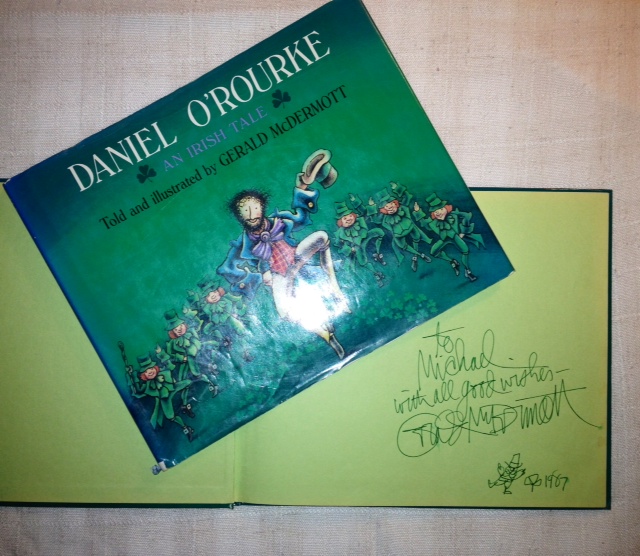
Finally, because it’s St. Patrick’s Day, I have to give a shout-out to my favorite book to share on this day, Daniel O’Rourke (Viking Kestrel, 1986), by Gerald McDermott. Sadly, it seems that this tale of Daniel O’Rourke’s misadventures at the hands of three mischievous leprechauns is out of print. My own children loved this story when they were small, and dozens of my classes over the years have laughed along as Daniel is taken on a wild ride by the legendary pooka.
Our copy, signed by the author to my youngest son.
Don’t forget to visit Jen at Teach Mentor Texts and Kellee at Unleashing Readers to find out what other people have been reading lately. Thanks, Jen and Kellee, for hosting!
Last week, I mentioned sharingKing Midas and the Golden Touch with the fourth grade students at my school. They all enjoyed the story, and because of our rich discussion, had a good understanding of the theme. They were also able to write about this understanding, but incorporating evidence from the story into their writing was more of a challenge.
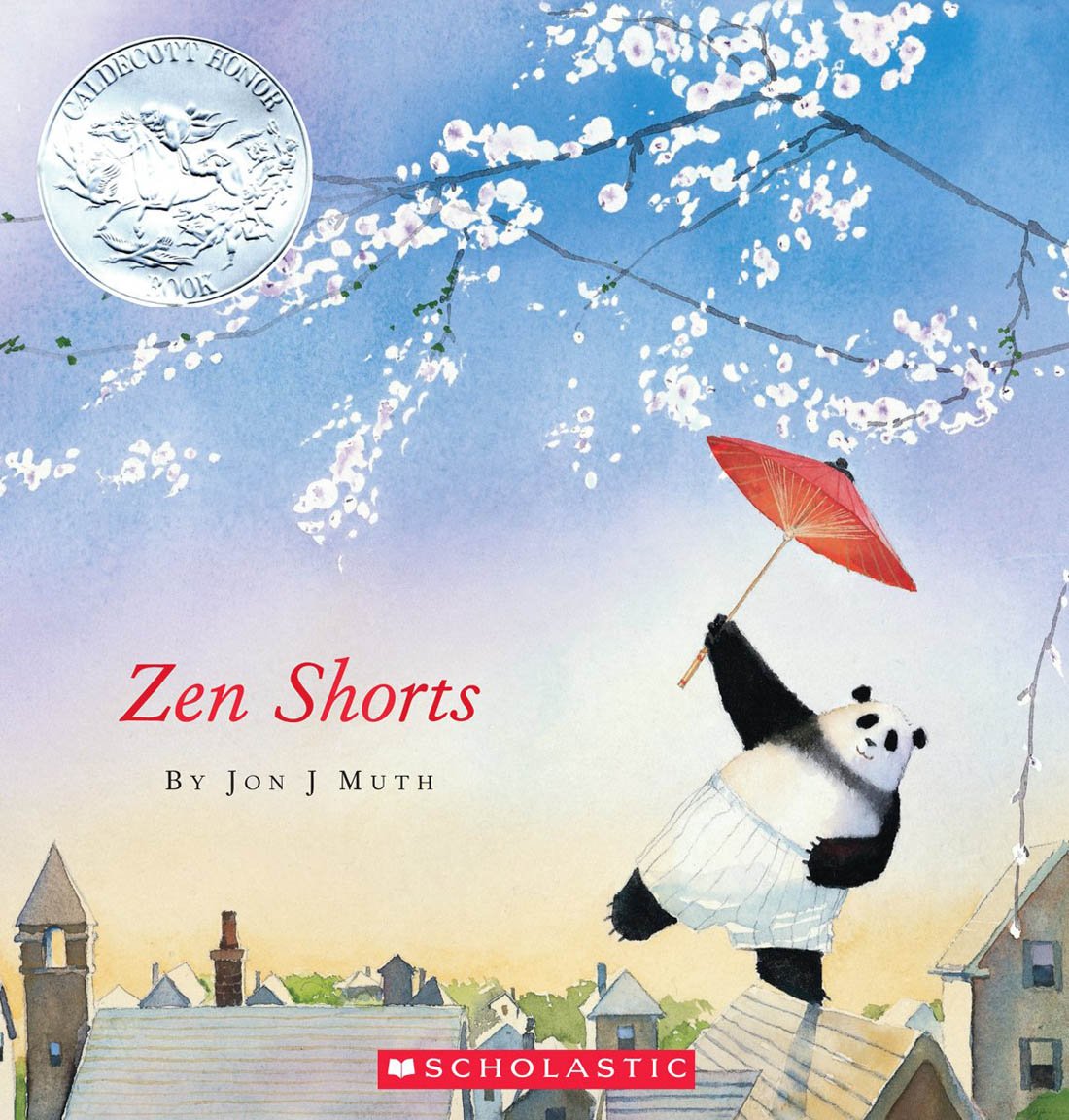
Their teachers and I knew from the start that this wasn’t going to be a “one-shot deal.” We knew there would be many more lessons, including guided and independent practice, as well as feedback, to get our students to be able to do this kind of work well. So on Friday, I was back in their classrooms with a very short excerpt from Jon J. Muth’s Zen Shorts, “Uncle Ry and the Moon.” I love sharing this deceptively simple story with students, and have done so many times. Muth’s book is quiet and unassuming, but it contains a powerful message.
Following the same routine we had used with King Midas, I read the story through once. The kids followed along on a typed version of the text. When I finished reading, I was met with a roomful of puzzled faces. I asked the kids to write what they had noticed and what they were wondering (We used a modified version on Vicki Vinton’s “Know/Wonder” chart for this.) Once they had their thoughts written down, they shared. All of the students were confused by Uncle Ry’s attitude toward the intruder. This clearly conflicted with the action they would take, or expect anyone to take, under similar circumstances. I complimented them for noticing this important contradiction, and explained to them the importance of this kind of observation. When an author includes those contradictions, he’s doing it for a reason. (Notice & Note, pg. 71)
Our next step was to reread the story, more carefully this time, and we stopped along the way to discuss what we were noticing now, and trying to sort out our confusion and begin to answer some of our questions. As we read, some students made thoughtful observations or raised interesting questions. Others asked questions to clarify a simpler element of the story, but these were important, too. I let them discuss these with their partners before sharing with the whole class.
It was during this conversation that one boy tentatively raised his hand. I have known and worked with this student since he was in first grade. His thinking is often perceptive, but can sometimes be muddled. I paused before calling on him to give him time to organize his thinking. Then I nodded to him and he said, “It’s like he’s the opposite of King Midas. Uncle Ry gives things away because he doesn’t mind being poor, and Midas wanted to have as much gold as he could get.”
I was speechless. I hadn’t thought of that myself. His teacher and I exchanged a look of joy. Of course, we let him know how impressed we were with his thinking and the he had made such a meaningful connection to King Midas. Then, another student started to raise her hand, and again, I could see the wheels still turning. She proceeded to tell us that another reason Uncle Ry was different from Midas is that Midas was blinded by greed, but Uncle Ry was blinded by his kind nature, and that was why he saw the intruder as a visitor.
I have shared this story with students many times before, but they have never come to these deep and thoughtful conclusions or level of understanding. So what was different? I hadn’t read the story right after King Midas before, but I wasn’t consciously thinking of a thematic connection between the two. Just as before, I had a plan when I began the lesson, but it was more open-ended. In the past, we were usually focusing specifically on character traits or summarizing. I firmly believe that the kids were able to achieve this level of understanding because I followed their lead. I let them develop the questions they had about the story. I let them go back and locate significant passages in the text. We do our students a huge disservice when we teach from a script and ask only preplanned, canned questions.
Are we finished with this work? Absolutely not. But we are laying a solid foundation for the kind of close reading and thinking skills our students will need to be thoughtful, caring human beings. And that, my friends, is worth all the gold in the world.
We are halfway through March, which means we’re also halfway through the daily Slice of Life Challenge. Like many of you, I questioned the wisdom of committing to a daily blog post. Writing in my journal regularly is one thing. Composing a piece worthy of other people’s valuable time on a daily basis is another.
One reason I worried is that, since September, I’ve gotten out of the habit of writing every day. I made dozens of excuses for not writing more often, most of them pretty weak. But after writing daily for two weeks, I’ve noticed a shift in my brain. My thinking is clearer and I’m more observant because I’m writing every day.
Early last week, when I was working on the haiku I shared yesterday, I went through an old journal looking for the entry where I first wrote about the snow being the field’s counterpane. Instead, I found this, from February 2000: “I think I’m too afraid to find out how awful a story I would write, so I don’t write one.”
Fourteen years later, I’m not afraid anymore. Thanks to many people, I “have the spirit to try.” I know that writing something bad isn’t the end of the world. It’s only the beginning.
Thank you to Stacey, Tara, Dana, Betsy, Anna, and Beth for hosting the Slice of Life Challenge and helping me have the courage to write. Be sure to visit Two Writing Teachers to read more Slice of Life posts.
The month-long Slice of Life Challenge, hosted at Two Writing Teachers, is almost at the half-way point. Because this is a writing challenge, I’ve decided to share original poems for Poetry Friday during the month. What poetic form is better suited to capture Slices of Life than haiku?
1.
Slices of life–
Pieces of hearts on the page.
Stories connect us.
The weather has been extreme in Connecticut this week. Early in the week, the temperature soared, the sky was bright blue, and spring filled the air.
2.
Coming untucked,
the deep counterpane of snow
hides spring underneath.
But on Wednesday, the weather changed. Apparently, winter isn’t through with us, although we have had enough of him.
Kate DiCamillo, the National Ambassador for Young People’s Literature, claims
“When we read together…we are taken out of our aloneness. Together, we see the world. Together, we see one another. We connect.”
We typically think of stories being in the pages of a book. But they also come in the form of letters. One of my aunts was a great letter writer. This, of course, was pre-email and texting, even before free long distance was ubiquitous. My grandmother always looked forward to her sister’s letters, and she loved sharing them with my mother as soon as they arrived. Thinking of her now, sitting at her kitchen table, reading and commenting on my aunt’s news, has suddenly overwhelmed me with longing.
Charlotte May Pierstorff also longed for her grandmother, who lived “a million miles away through the rough old Idaho mountains.” Her parents had promised her a visit, but when the time came, there was no money for a train ticket.
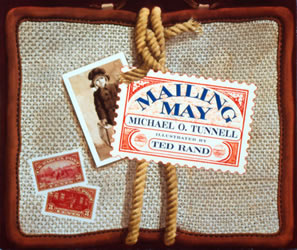
The solution to May’s problem is told in the 1997 book, Mailing May (Greenwillow), by Michael O. Tunnell and illustrated by Ted Rand. With the help of a cousin who works for the railroad, May’s parents decide to mail her to her grandmother via parcel post. After having fifty-three cents worth of stamps and a mailing label attached to the back of her coat, May boards the train for Lewiston and is off on her adventure.
Tunnell lets May tell her own story, which really conveys May’s excitement about her trip. She describes hanging “on the edge of mountainsides” and crawling “through tunnels.” The story ends with May’s joyous reunion with her grandmother, “with a little help from the U.S. Post Office!”
I knew the minute I read Mailing May that it was perfect for my third grade students. May’s experience was so far removed from anything they could imagine, I wanted to immerse them in this book. We turned it into a springboard for a day’s worth of learning. We discussed the theme of the book, and made personal connections about visiting grandparents far away.
But we also wrote letters to grandparents, even if they lived down the street. We studied a map of Idaho and learned about its geography. In the book, Tunnell describes how the postmaster weighs May, then calculates the cost of mailing her. We were piloting a new math program at the time, and there was a lesson about calculating shipping costs for packages. So I brought in my bathroom scale and weighed each child so they could calculate how much it would cost to ship themselves to Florida (where many grandparents did indeed live).
Each year I looked forward to our Mailing May day. The kids were amazed by May’s story and loved her sense of adventure. And while I can’t say they all loved writing the letters, they all had a new appreciation for our quick and easy communication abilities. More importantly, they also gained an understanding and appreciation of how stories, whether in books or letters, connect us all across distances of space and time.
Thank you, as always, to Stacey, Tara, Dana, Betsy, Anna, and Beth for hosting the Slice of Life Challenge and creating this space for us to share our stories. Be sure to visit Two Writing Teachers to read more Slice of Life posts.






 Reading to the Core