Poetry Friday: Laughter Across the Years

poetry-friday-1-1

Hats off to all of you who’ve been writing a poem each day in celebration of National Poetry Month. I have been working on a couple of long-term projects that have made it impossible to keep up with all the inspiring projects people have going. I admire your fortitude and creativity.

Today’s poem was initially inspired by Mary Lee Hahn‘s project, Bygones. When I started writing, though, I soon saw how this could work for Marilyn Singer’s April ditty challenge at Michelle Heidenrich Barnes’s blog to write a “poem inspired by the word ‘echo.'”

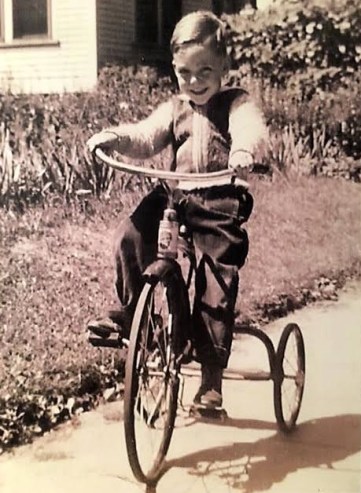
My father, Tom Wallian, circa 1941

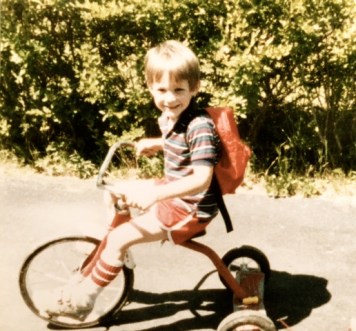
Laughter from two little boys
echoes across the years:

On your first set of wheels
you pedal down the garden path,
feet pumping
hands gripping
heart soaring

A glint of mischief in your eyes
An impish grin across your face

your heart soaring
hands gripping
feet pumping
as you pedal down the garden path
on your first set of wheels

your laughter echoing across the years.

My son, Brian, circa 1985

Please be sure to visit Laura Purdie Salas at Writing the World for Kids for the Poetry Friday Roundup.

Large-Blue-RGB-National-Poetry-Month-Logo

Slice of Life: PD in My PJs

11454297503_e27946e4ff_h

“I have no special talents, I am only passionately curious”
~ Albert Einstein ~

Last Saturday, I took advantage of a great day of professional development available FREE and ONLINE. The Educator’s Collaborative, founded by Chris Lehman, sponsored a day full of inspiration for educators. More than forty educators and writers were on hand to share their ideas and insights. During her presentation, Linda Hoyt talked about ways to help kids see how ideas go together, to see the relationships between seemingly diverse topics. Over the course of the day, it was hard to miss the relationship between all the sessions. The ideas delivered by so many wise presenters went together like pieces of a giant jigsaw puzzle, and the finished puzzle spelled out: STUDENT ENGAGEMENT = STUDENT LEARNING

In one way or another, each session I watched stressed the importance of inspiring our students, sparking their curiosity, and encouraging them to ask questions. These steps will lead them to make new discoveries, discoveries about the world around them, but more importantly, discoveries about themselves. These discoveries, in turn, will help them dream and discover their passions.

It would be impossible to choose the best session, or the most inspiring idea, for they were all fantastic and full of inspiring ideas. I did love that all the presenters shared the research base and philosophy behind their ideas, then provided practical strategies that we could infuse into our lessons on Monday.

You really should just stop reading and go to The Educator’s Collaborative website and start watching. But in case you’re not convinced yet, here are a few examples of all the wisdom you’ll find there.

Harvey Daniels explained that Curiosity is a better motivator than grit. Working from the positive is always so much better.”

Amy Ludwig VanDerwater reminded us that “Each of has something only we can say” and we should “say it through poetry!”

Rebekah O’Dell and Allison Marchetti gave us ideas for including “notebook time” in our classrooms and explained that this time “is an invitation and a place to play.”

Dr. Mary Howard urged us to build our classroom libraries to ensure that “students have books that will make their hearts sing!”

Linda Hoyt pointed out that we can “ignite a sense of wonder with kids through visuals in nonfiction read-alouds.”

“It’s about generating and creating pathways for thinking. It’s about giving kids new opportunities,” Kristin Ziemke explained.

Maggie Beattie Roberts told us that “tools help us do more, become more, reach dreams we have for ourselves, & make things easier.”

I could keep going, but seriously, just go watch the sessions for yourself. You’ll be so glad you did.

You’ll also find a session I wasn’t able to see because of satellite interference by four of Two Writing Teachers fearless leaders, Stacey Schubitz, Dana Murphy, Betsey Hubbard, and Deb Frazier on “Maximizing Independent Writing Time by Creating Conferring Tool Kits.” I’m looking forward to watching their session later this evening. 

Thank you to StaceyTaraDanaBetsyAnnaBeth, Kathleen, and Deb for this space for teachers and others to share their stories each Tuesday. Be sure to visit Two Writing Teachers to read more Slice of Life posts.

Another Small Object Poem

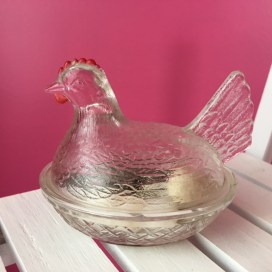
Large-Blue-RGB-National-Poetry-Month-LogoEarly in March, Amy Ludwig VanDerwater challenged the readers of Today’s Little Ditty, Michelle Heidenrich Barnes’s blog, to write a poem about a small object. I immediately thought of this little hen that had sat on my grandmother’s what-not for years.

IMG_0108

Then I tried to write a poem about it. That turned out not to be so easy. Throughout the month I wrote other small object poems, but kept thinking about this one. This morning I finally wrestled it into something I’m mostly satisfied with. In the spirit of all the poets who are writing a poem a day this month, I’m sharing draft number twenty-one.

Unlike the biddies nesting
out in our chicken coop,
you roost upon a bed of glass
instead of sweet, fresh hay.

You’re always poised and calm,
never cluck-cluck-clucking
or ruff-ruff-ruffling
your milky white feathers
when I lift you off your nest.

For it isn’t speckled eggs
you’re keeping safe and warm.
The eggs I find rainbow-hued.
You’re hatching jelly beans!

© Catherine Flynn, 2016

These pressed glass hens were also made of white milk glass, so I took some poetic license with my model so the surprise made more sense.

My friend Margaret Simon challenged me to write a poem each day in April with her. She has written and shared her poems at her blog, Reflections on the Teche. Be sure to visit her to read her inspiring words.

Poetry Friday: A Day Full of Poetry

poetry-friday-1-1

“The best-laid schemes o’ mice an ‘men
Gang aft agley”
~ Robert Burns ~

I started working on the poem I planned to share today on Monday. I drafted two versions and played with them both throughout the week. I recorded different lines on my phone on the way to work. But when I sat down last night, nothing worked. The poem just wouldn’t come together and it’s still a muddled mess.

My day was filled with poetry, though. I shared Amy Ludwig VanDerwater’s poem, “Wonder,” with teachers at our Language Arts Committee meeting this morning:

“Wonder”

Water the wonder
that lives in your brain.

Water your wonder
with questions like rain.

Read the rest of the poem, and more about Amy’s 2016 poetry project, here.

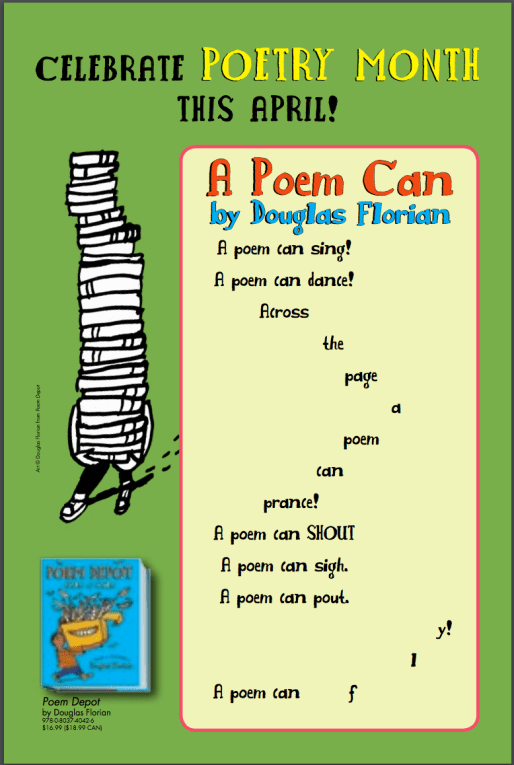
Then the principal and I read this Douglas Florian poem during morning announcements:

Find this poem and more poetry ideas in Penguin's Guide to Poetry in the Classroom here.
Find this poem and more poetry ideas in Penguin’s Guide to Poetry in the Classroom here.

I shared many poems with my students throughout the day, but didn’t have a minute to think about my own poem. By the time I left work, my prime writing hours were long gone. The weather was writing it’s own poem, though. Dark gray clouds piled up in the northwest, while the sky was still bright blue in to the south. Impatient rain drops were falling and the wind was picking up. It was a gorgeous sight that made me think of this Emily Dickinson poem:

“A Drop fell on the Apple Tree” (794)

A Drop fell on the Apple Tree –
Another – on the Roof –
A Half a Dozen kissed the Eaves –
And made the Gables laugh –

A few went out to help the Brook
That went to help the Sea –
Myself Conjectured were they Pearls –
What Necklaces could be –

The Dust replaced, in Hoisted Roads –
The Birds jocoser sung –
The Sunshine threw his Hat away –
The Bushes – spangles flung –

The Breezes brought dejected Lutes –
And bathed them in the Glee –
The Orient showed a single Flag,
And signed the fête away –

Emily Dickinson

Please be sure to visit Amy Ludwig VanDerwater at her lovely blog, The Poem Farm, for the Poetry Friday Roundup.

Large-Blue-RGB-National-Poetry-Month-Logo


Slice of Life: A Month of Learning

11454297503_e27946e4ff_h

“With words at your disposal, you can see more clearly.”
Robin Wall Kimmerer 

Last week, We Are Teachers shared this on Twitter:

CeHxWtsUIAAmgks

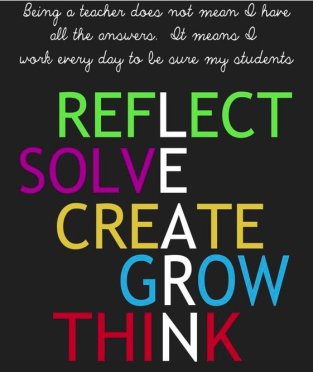
I printed it out to share with teachers right away. I love the visual message that learning is so much more than memorizing facts or formulas. As I considered how to write my final post for this month-long challenge, it occurred to me that these words were a perfect way to organize my thoughts about the experience of blogging every day.

Reflecting has the double benefit of giving me insights into my writing, but also processing and learning from whatever event I’m writing about. The frustrating part about reflecting is that you think of a better way to handle a situation after the event. Of course, this learning can be tucked away for the next time a similar situation arises. Similarly, with writing, a better word or sentence construction occurs to me after I hit “publish.” Still, I’ve become more aware of words and sentence structures I overuse. In my never-ending effort to improve my writing, I’ve tried to use them less often.

Writing daily has made me more attentive to the world in general. This has helped me solve some problems I’ve been struggling with in a story I’ve been working on for the past year.

Creating is the whole purpose of this challenge. Each day has brought forth a new piece of writing. Some posts have been more successful than others, but the very act of creating them has helped me become a more confident writer.

Which brings me to the word grow. Over the past month, I’ve tried writing in new ways, ways that haven’t always been comfortable. In the words of Elizabeth Gilbert, I’m pushing myself out of “the suffocating insulation of personal safety and into the frontiers of the beautiful and the unexpected.”

Finally, this has been a month filled with thinking. Thinking of a topic to write about. Thinking about just the right word or phrase for a poem. Thinking about all the beautiful, heart-felt writing I’ve read on other blogs.  Thinking about how lucky I am to be part of this inspiring, nurturing community.  Thank you for helping me see things more clearly.

And a very special thank you to StaceyTaraDanaBetsyAnnaBeth, Kathleen, and Deb for their Herculean effort to provide this space for teachers and others to share their every day during this month. Your hard work is truly appreciated! Be sure to visit Two Writing Teachers to read more Slice of Life posts.

Slice of Life: An Unobserved Slice

11454297503_e27946e4ff_h

Three hours are left before the last day of March, and I still don’t know what to write about today. Was there a slice hidden somewhere in my day? If there was, I didn’t notice it, maybe because I was preoccupied by something.

Was it that moment when a third grade student came up with the perfect metaphor for a poem she’s writing?

It could have been when a first grade student sat up a little straighter after figuring out a word he didn’t know.

Was it hiding in the emails I wrote?

Maybe it was when a kindergarten student hugged me in the hallway just because she felt like it.

Did I miss it while I was planning for tomorrow?

Or was it when I got home after a late meeting and my husband had dinner ready and waiting?

Whenever it happened, it went by unobserved. Some days are like this.

Thank you to StaceyTaraDanaBetsyAnnaBeth, Kathleen, and Deb for this space for teachers and others to share their stories each Tuesday throughout the year and every day during the month of March. Be sure to visit Two Writing Teachers to read more Slice of Life posts.

Slice of Life: Playing with Haiku

11454297503_e27946e4ff_h

“Attentiveness is your main tool in life.”
~ Jim Harrison ~

There is a kaleidoscope sitting on my desk this afternoon. When I saw it in the store, it reminded   me of one my grandmother had at her house when I was little. So I bought it. I also thought my nephews would have fun with it when they visit.

When I got it home, I held it up to the light to watch the colorful patterns unfold. The plastic beads reminded me of snowflakes, but because they’re colorful, they also reminded me of flowers. This seemed like the spark of a poem to me.

I wrote several drafts, but wasn’t happy with them. Sometimes when I’m stuck, I read a few poems or flip through books about writing to clarify my thoughts. In her book Writing Toward Home: Tales and Lessons to Find Your Way (Heinemann, 1995), Georgia Heard writes “the beauty of haiku is its brevity; it teaches you to use words more clearly and truthfully.

Here is my attempt to “spin [my] observations…as quickly and accurately as possible.”

Colorful snowflakes
blossom like flowers inside
my kaleidoscope.

This does capture my impression pretty accurately. Haiku isn’t my favorite form, but once I start thinking about them, they pop into my head. Here are a few more:

White birds swoop and swerve
over the river at dawn,
eyes peeled for a meal.

Warmed by bright sunshine
lilac buds grow fat and green,
chasing gray away.

By photo taken by H. Pellikka (Own work) [GFDL (http://www.gnu.org/copyleft/fdl.html), CC-BY-SA-3.0 (http://creativecommons.org/licenses/by-sa/3.0/) or CC BY-SA 2.0 (http://creativecommons.org/licenses/by-sa/2.0)], via Wikimedia Commons
By photo taken by H. Pellikka (Own work) [GFDL (http://www.gnu.org/copyleft/fdl.html), CC BY-SA 2.0 (http://creativecommons.org/licenses/by-sa/2.0)%5D, via Wikimedia Commons
I originally wrote this final haiku two years ago, but I wanted to share it again:

Slices of life:
Pieces of hearts on the page.
Stories connect us.

Thank you to StaceyTaraDanaBetsyAnnaBeth, Kathleen, and Deb for this space for teachers and others to share their stories each Tuesday throughout the year and every day during the month of March. Be sure to visit Two Writing Teachers to read more Slice of Life posts.
Slice of Life: Broken Glasses

11454297503_e27946e4ff_h

Have you seen those videos of babies hearing their mother’s voice for the first time? Imagine what it must be like to have the mute button turned off and all of a sudden hearing the soothing sound of a human voice.

I experienced this in reverse after I broke my glasses yesterday. I wore them gingerly until my husband took them to try to fix them. It was astonishing to me how utterly dependent I am on them. I could navigate my house, and thanks to 40 years of typing, was able to write this and have it be relatively error free, but not much else. I could listen to a podcast because I knew the icon’s  color and general design. But I couldn’t stop typing in the middle of a sentence, because I couldn’t go back and reread. If I lost my train of thought, well, it’s lost. (It wouldn’t be the first time!) 

As I typed these words I realized what it must be like for students in our classrooms with learning differences that aren’t being addressed. When we don’t differentiate for these children, we’re essentially asking them to work without their glasses.

We insist that they read this book, do this math, write this story.

And, oh by the way, do it with one sense missing and hardly any experience to fall back on to help you.

Then we’re back in five minutes and wonder why they haven’t gotten more done.

Now we’re exasperated because they don’t know who the main character is because, well, it’s right there in front of them! How do they not see that?

My husband had my glasses for about fifteen minutes. I quickly became bored and frustrated. I was ready to go find something, anything, I could do without my glasses, even if it was only folding clothes.

I can’t imagine how I would feel after six hours of this. I also had a splitting headache, not because I was trying to read this, but because it was impossible not to look at the screen while I typed.

Learning to see by losing one’s sight is a literary device as old as literature itself. I’ve always thought I did my best to differentiate and make accommodations and modifications so students will be able to learn. After this experience, though, I wonder if I’m doing enough. From now on I’ll be much more aware of ensuring that every student can see (and hear!) exactly what they need to. I want to see that smile of joy and understanding spread across the faces of all my students.

 Thank you to StaceyTaraDanaBetsyAnnaBeth, Kathleen, and Deb for this space for teachers and others to share their stories each Tuesday throughout the year and every day during the month of March. Be sure to visit Two Writing Teachers to read more Slice of Life posts.
Slice of Life: Poetry Collections I Love

11454297503_e27946e4ff_h

“Poetry reaffirms our common humanity by revealing to us that individuals, everywhere in the world, share the same questions and feelings.”
United Nations website
World Poetry Day announcement

Last week I shared a list of my favorite read-alouds. I realized, though, that there was no poetry on that list! Because poetry is meant to be read aloud, and because National Poetry Month is right around the corner, I decided poetry deserved its own list.

Early in my teaching career, my poetry collection consisted of Shel Silverstein’s Where the Sidewalk Ends, Jack Prelutsky’s The New Kid on the Block, and The Random House Book of Poetry. Thanks to the Scholastic book order, my collection started expanding to include collections by individual poets. My choices tended toward poetry about animals and nature, and Kristine O’Connell George and Marilyn Singer quickly became favorites.

Today my poetry collection takes up two long shelves in my bookcase. Here are a few of my favorites, both old and new.

Edited anthologies with selections by many poets:

Piping Down the Valleys Wild, edited by Nancy Larrick
Read-Aloud Rhymes for the Very Young, edited by Jack Prelutsky
National Geographic Book of Animal Poetry, edited by J. Patrick Lewis
National Geographic Book of Nature Poetry, edited by J. Patrick Lewis
Another Jar of Tiny Stars: Poems by More NCTE Award Winning Poets, edited by Beatrice Cullinan & Deborah Wooten
Knock at a Star: A Child’s Introduction to Poetry, edited by X.J. Kennedy
A Kick in the Head: An Everyday Guide to Poetic Forms, edited by Paul B. Janeczko
The Tree That Time Built: A Celebration of Nature, Science, and Imagination, edited by Mary Ann Hoberman
A Pet for Me: Poems, edited by Lee Bennett Hopkins (any collection edited by Hopkins is a treasure; Don’t miss Renée LaTulippe’s wonderful spotlight on him here.)
Any of the Poetry Friday Anthologies, edited by Sylvia Vardell and Janet Wong

Collections by individual poets:

A Writing Kind of Day, by Ralph Fletcher
Joyful Noise: Poems for Two Voices, by Paul Fleischman
Hailstones and Halibut Bones, by Mary O’Neill
A Stick is an Excellent Thing: Poems Celebrating Outdoor Play, by Marilyn Singer (Marilyn’s collections of reversos are also not to be missed!)
A Maze Me: Poems for Girls, by Naomi Shihab Nye
An Egret’s Day, by Jane Yolen
In the Spin of Things: Poetry of Motion, by Rebecca Kai Dotlich
You Read to Me, I’ll Read to You, by Mary Ann Hoberman (any book in this series)
Everything is a Poem: The Best of J. Patrick Lewis, by J. Patrick Lewis
Handsprings, by Douglas Florian
When the Sun Shines of Antarctica, by Irene Latham

This list just scratches the surface of the multitudes of wonderful poetry collections available from these poets and more. My 2015 Picture Book 10 for 10 post features more of my favorites.

Books for teachers and students about poetry:

Awakening the Heart: Exploring Poetry in Elementary and Middle School, by Georgia Heard
For the Good of the Sun and the Earth: Teaching Poetry, by Georgia Heard
Poetry Matters, by Ralph Fletcher
Seeing the Blue Between: Advice and Inspiration for Young Poets, edited by Paul B. Janeczko
Pass the Poetry, Please!, by Lee Bennett Hopkins 

There are also many websites that feature poets, poetry, and ideas for teaching poetry. A Year of Reading, Mary Lee Hahn and Franki Sibberson’s must-read blog, lists links to the weekly Poetry Friday Roundup. This is a great place to begin learning more about all things poetic.

(Edited to add) Here’s another great resource from Amy Ludwig VanDerwater’s top-notch blog, The Poem Farm: NCTE’s 2016 Notable Poetry List

What are your favorite poetry collections and resources?

 Thank you to StaceyTaraDanaBetsyAnnaBeth, Kathleen, and Deb for this space for teachers and others to share their stories each Tuesday throughout the year and every day during the month of March. Be sure to visit Two Writing Teachers to read more Slice of Life posts.
Slice of Life: Paying Attention

11454297503_e27946e4ff_h

“To pay attention, this is our endless and proper work.”
~ Mary Oliver ~

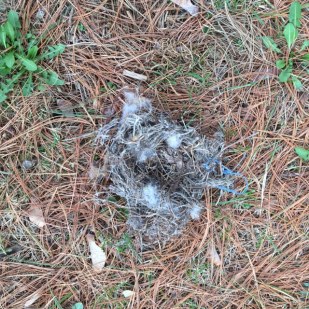
Yesterday while I was out walking, I came across a fallen bird nest. It’s been pretty windy lately, so it must have been blown out of the tree. It looked forlorn and out of place on the ground. There were no signs of any eggs, but I wondered if there were any in it when it fell. Maybe a hungry fox or raccoon stumbled upon it at just the right moment and gobbled up the feast waiting at their feet.

I wanted to take the nest. My students would love looking at the odd collection of material the mother used to build a home for her babies. The nest was made mostly of dried grass, with a few dead leaves and twigs. She’d also tucked in a fair amount of what at first I thought were feathers, but after looking more closely, I saw was fiberfill from a coat or a sleeping bag. A strip of blue plastic, maybe from a shopping bag, was also woven in.

IMG_0080

Then I began to wonder about this mama bird. What went through her mind when she discovered her nest was missing? Did she look for it? Did she grieve for her hard work and her missing eggs?

I left the nest undisturbed. While I realize the bird can’t pick the nest up and put it back, she might be able to reassemble it bit by bit. I hope she will and that it will soon be filled with new eggs.

I’ve spent a fair amount of time writing and thinking about this nest in the past twenty-four hours. Many people would say that surely I have better things to do with my time. But I don’t think so. I’m working on two projects where these thoughts and observations might be useful. So I’ll tuck these thoughts away. I’ll know when the time is right to take them out again and weave them into a story or poem.

 Thank you to StaceyTaraDanaBetsyAnnaBeth, Kathleen, and Deb for this space for teachers and others to share their stories each Tuesday throughout the year and every day during the month of March. Be sure to visit Two Writing Teachers to read more Slice of Life posts.