Some weeks I have my Poetry Friday poems picked out early in the week, especially if I’m sharing an original poem. Other weeks, when work and life in general threaten to get the best of me, as this one has, I’m scrambling to find a poem that speaks to me. But when I saw this on a friend’s Facebook page today, I knew instantly this was the right poem for this week.
“The Arrow and the Song”
by Henry Wadsworth Longfellow
I shot an arrow into the air,
It fell to earth, I knew not where;
For, so swiftly it flew, the sight
Could not follow it in its flight.
I breathed a song into the air,
It fell to earth, I knew not where;
For who has sight so keen and strong,
That it can follow the flight of song?
Long, long afterward, in an oak
I found the arrow, still unbroke;
And the song, from beginning to end,
I found again in the heart of a friend.
Be sure to visit Jone MacCulloch at Check It Out for the Poetry Friday Roundup!
“Not everything that counts can be counted, and not everything that can be counted counts.”
Albert Einstein
After hours of collecting and analyzing data, looking for reading behaviors used or not, identifying vowel patterns known and unknown, after hours of planning lessons, carefully choosing books and poems to support student needs AND spark their interest, after hours of instruction, coaching and supporting strategies or sounds they’re using but confusing, after phone calls and parent meetings about how students are or aren’t progressing, we’ve arrived at the last week of school, and the last lessons with my students for this year.
And the question on everyone’s mind? Did they meet the goal? Not did they meet their personal goal, but did they meet the goal for first grade? In the case of the students I work with, intervention students who came into first grade below the grade level goal, the answer is no.
And yet, they have made tremendous personal progress. They are all confident readers. They read books at their independent level fluently and with expression. They understand what they’ve read and have ideas about why characters act the way they do. They read nonfiction with curiosity and enthusiasm.
Do I feel like I have failed these students? Yes and no. I know their classroom teacher and I did everything we could to support their progress. I know they worked hard when they were with me and made incremental gains on most days. But teachers are always second-guessing themselves. We feel like there must be something else we could have done. But very often, our best truly is enough. These five- and six-year olds just need more time to learn those diphthongs and -r controlled vowels. They need more time to remember to try a different vowel sound if they one they used doesn’t make sense.
I’m willing to give them that time, as long as they’re making progress along the way AND they are falling in love with reading. If both of those things aren’t happening, then something needs to change. If the teaching techniques I’ve been using aren’t meeting their needs, then it’s my responsibility to find a new strategy or technique that does meet their needs. Have I done this? Yes. So back to the original question: Did these students meet the goal?
In my mind, yes. They are readers who can problem-solve to read unknown words, they make meaning from the texts they read, and most importantly, they enjoy reading and are proud of their accomplishments. And isn’t that our goal for all our students?
This post is part of “DigiLit Sunday,” hosted by Margaret Simon at Reflections on the Teche. This week’s topic is PERSPECTIVE.
“Sympathy as a desirable quality is something more than mere feeling;
it is the cultivated imagination for what men have in common and a rebellion at whatever unnecessarily divides them.” ~ Thomas Dewey ~
It’s often said that history is written by the victors. This implies, of course, that only one side of a story gets told. What happens to the stories of the vanquished? Isn’t their perspective of events just as valuable? What truths are hidden within the stories that don’t get told?
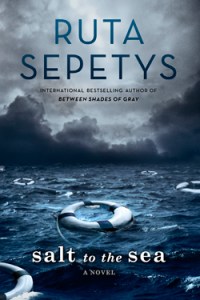
In Salt to the Sea (Philomel Books, 2016), Ruta Sepetys tells the “hidden history” of the sinking of the Wilhelm Gustloffby a Soviet submarine in January of 1945. An estimated 9,000 people lost their lives in the icy waters of the Baltic Sea as a result. By giving voice to four teens fleeing East Prussia at the end of World War II, Sepetys masterfully weaves the story of the Wilhelm Gustloff together with their stories.
Three of the four narrators, Joana, Florian, and Emelia, tells the story their journey toward safety from their perspective. The fourth narrator, Alfred, is a German sailor aboard theWilhelm Gustloff. Each chapter reveals a bit of the character’s history. But the bigger picture also begins to come into focus. The brutality of the Soviet Army as it advanced toward Germany. The selfishness of the Nazi leadership and their pernicious xenophobia. The sacrifices ordinary people from every country made for those they loved.
The tapestry that emerges gives readers a much deeper understanding of the events than any one of the narrators would have created individually. It also builds our sympathy for each of the narrators and their traveling companions.As we get to know them, we realize that each of them carries a secret that haunts them. Just like every other human on the planet.
On this Memorial Day weekend, let’s resolve to find and share these untold stories with our students. It seems to me that the political hyperbole in the U.S. today makes it even more urgent that stories like Salt to the Sea be shared. These are stories that will broaden our perspective, and help us develop the imagination needed to see something of ourselves in the stories of others.
Listen to Ruta Sepetys discuss Salt to the Sea on NPR’s Morning Edition here.
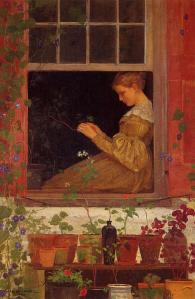
Today I’m sharing the latest draft of the persona poem I’ve been working on for Laura’sDitty Challenge over at Michelle’s blog, Today’s Little Ditty. I’ve loved this painting for years, so it wasn’t hard to decided to write a persona poem for this young woman. The more I studied the painting though, the more contradictions I saw and the more questions I had. This draft answers some of them, but not all.
“Morning Glories” Winslow Homer 1873
Through an open window, the wide world beckons me.
I toss my crewel work aside, its neat silk stitches no match for the ropes of green twining up outside the sill, toward the sky, where a menagerie of clouds is parading by.
I watch them skitter and shift, morphing into fantastic creatures.
I wish I could transform into a hummingbird. I’d dart and hover among the morning glories and geraniums, sipping their summer sweetness.
But like this philodendron, I’m trapped inside, bound to this place, never allowed to roam free, never allowed to touch the sky.
“The purpose of grammar is to enhance writing. Writing is ALWAYS the goal,” Jeff Anderson told a packed conference room last Saturday. Spending an hour and half with Anderson at the New England Reading Association Conference gave me new insights into how engaging grammar instruction can be.
Photo by Aaron Burden via unsplash.com
Anderson began the session by reading a section of his book, Zack Delacruz: Me and My Big Mouth. He correctly pointed out that there are often times when kids (and adults) need to be “juiced up” for writing. Reading a snippet of a book, poem, or article can “inspire great writing.”
After hearing about Zack and his school’s anti-bullying assembly, we had at least four topics to choose from for a free write:
assemblies
being/feeling different
picked on/bullied
teachers
I wrote a stream-of-consciousness riff on watching middle school kids at my school, which took me back to my own middle and high school days.
Anderson then explained that grammar “rules aren’t hard; it’s applying them that’s hard.”
So how can we make our grammar instruction effective? By focusing on function and practical application.
Why does this matter? Because grammar “helps writing come alive.”
Anderson urged us to abandon our practice of putting up sentences with errors, a la Daily Oral Language, for correction. Rather, we should display correctsentences, then study these mentor sentences to figure out why they’re effective. In this way, we “merge craft and grammar” instruction.
“Every choice a writer makes has an effect,” Anderson pointed out. By studying models, we can begin to “view grammar with a sense of possibility.” We can begin to imagine how we can use grammar to “help our writing come alive.”
“All grammar decisions add elaboration,” Jeff explained. This seems so obvious, but I had never thought about it that way. He went on to say that “commas act like a zoom lens—going from the big picture to close details.”
Using the first line of Ali Benjamin’s book, The Thing About Jellyfish, Jeff modeled exactly what he meant by this, and how to design a cycle of instruction to “immerse kids in the power of grammar and editing.”
The first step is to display a sentence, then invite kids to NOTICE what the comma is doing when they read it out loud. Then have them read it again and think about what the comma does when they read with their eyes.
Once kids have noticed something and thought about how a comma is used, they begin to see it everywhere, thanks to our reticular activating system. (Thank you, Jeff, for naming this phenomenon.) Once they’re aware of this pattern, the “more likely they are to try it in their own writing.”
Now invite students to COMPARE & CONTRAST the mentor sentence with a teacher-written model. Discuss how the construction of the two sentences is similar and/or different. Then talk about the impact of the two sentences. Is one more intriguing? Why? What grammar decisions (which are really CRAFT decisions) did the author make to create a powerful sentence?
Then collaborate to write a similar sentence together. (We didn’t have time for this in our session, but it’s the logical next step in a gradual-release model. You can view Anderson’s presentation slides here).
Invite students to IMITATE the mentor sentences. By trying it on their own, students will be able to see and understand the “possibilities of grammar acrobatics.” Inviting kids to imitate also gives them choice. Choice of what to write about, but also choices about how to imitate the mentor sentence.
Finally, invite students to REVISE. Have them revisit a piece of writing and “find a place where you can sharpen an image.” Have them imitate the model again, whatever it was. On Saturday we were using “the right-branching closer.”
Here is my revision from the free write we did at the beginning of the session:
Original:
What an act of bravery it is, though, to come to school in middle school with the new shoes or new pants that you think are like everyone else’s, but something isn’t quite right. Now, instead of feeling cool and fitting in, you feel like even more of an outsider. The Levi’s tab isn’t red.
Revision:
I strode into school, feeling cool in my brand new Levis with the red tab waving from the back pocket.
I know I never would have written this sentence without Anderson’s “invitation to play” with my writing. By inviting our students to do this work, not worksheets, we invite them to see what’s possible, and in so doing, invite them do their best work.
Functional application at its finest!
Thank you to Stacey, Dana, Betsy, Beth, Kathleen, and Deb for this space for teachers and others to share their stories each Tuesday. Be sure to visit Two Writing Teachers to read more Slice of Life posts.
I want to be a teacher who grows passionate, joyful, independent learners. A teacher who, in the words of Thomas Dewey, gives students “something to do, not something to learn; and when the doing is of such a nature as to demand thinking; learning naturally results…”
I want to my students to be curious and observant.
I want them to be thoughtful readers who understand that reading is about more than answering questions about the main character and his problem. I want them to understand that when we read, we learn about ourselves, our lives, the lives of others, and the world around us.
I want to be a teacher who gives my students time to think and write about what they want to think and write about. I want to give them the time and tools they need to follow their thinking wherever it leads them.
I want my classroom to be a greenhouse where students thrive and see possibilities in themselves they hadn’t ever imagined.
I also want to be a teacher who can rise above the day-to-day frustrations that could distract me from this goal.
I want to be a teacher who doesn’t let demands and pressures of the inevitable changes in standards, assessments, etc., deter or sway me from this vision. In the words of Katie Wood Ray, I want to make myself “as smart as I can be about my work so that I can articulate” my beliefs.
This vision is one I’ve strived to fulfill through all my years of teaching. Thank you to all the wise, passionate educators at NERA whose words helped me express these ideas. Thanks to them for also showing me how this vision can become a reality.
Maybe it’s because I recently spent a day at the Metropolitan Museum of Art, soaking in the beauty of two millennia worth of collected treasures. Or maybe it’s because of Laura Shovan’s ditty challenge to write a persona poem. Whatever the reason, I’ve been thinking about art a lot lately. But because of the nature of teaching, life hasn’t allowed me more than snatches of stolen time to write.
I’ve also been reading in those stolen moments, and found this lovely little poem in Art and Artists: Poems (edited by Emily Fragos; Everyman’s Library Pocket Poems).
“A Flower-Piece by Fantin” by Algernon Charles Swinburne
Heart’s ease or pansy, pleasure or thought, Which would the picture give us of these? Surely the heart that conceived it sought Heart’s ease.
Surely be glad and divine degrees The heart impelling the hand that wrought Wrought comfort here for a soul’s disease.
Deep flowers, with lustre and darkness fraught, From glass that gleams as the chill still seas Lean and lend for a heart distraught Heart’s ease.
Henri Fantin-Latour [Public domain], via Wikimedia CommonsPlease be sure to visit Margaret at Reflections on the Teche for the Poetry Friday Roundup.
This post is part of “DigiLit Sunday,” hosted by Margaret Simon at Reflections on the Teche. This week’s topic is REFRESH.
By Winslow Homer (Memphis Brooks Museum of Art) [Public domain], via Wikimedia Commons
Teachers often have a long list of projects they want to work on, both personal and professional, that we’ve either put off or just haven’t had time for during the school year. And while I love finishing these tasks and the sense of accomplishment they bring, I don’t really find them refreshing. For me, being refreshed means having time to enjoy long, lazy afternoons reading and dozing.
Making plans for summer reading is one of my favorite activities. In January, I talked with fifth grade students about Reading Resolutions. This is the perfect time to revisit those resolutions, and, if necessary, make some new ones. I finished the Very Famous Children’s book back in February. Lately I’ve been thinking about Virginia Wolf’s To the Lighthouse. This is a book that has intimidated me as an adult, and I feel now’s the time to give it another try.
I have a long list of professional books I’m planning to read this summer. These books are currently at the top of the stack:
I’m also planning on getting caught up on journal articles I haven’t had a chance to read.
I’ll also be reading many picture books and middle grade novels, but I don’t have a specific list. I would love to get my hands on an ARC of Melissa Sweet’s upcoming book about E.B. White. (Hint, hint, ARC gods!) Louise Erdrich is one of my favorite authors, both for children and adults, and she has two new books out this year. Makoons is the fifth book in the series that began with The Birchbark House, one of my all-time favorites, so I’m excited to read this book, too.
There are many books on my shelves that I haven’t read, and sometimes I’ll just browse and see what strikes my fancy. I also like to visit the library and find new books there.
Last year’s shelfie.
Having plans for summer reading is great, but discovering new books along the way and having time to read them is another reason summer reading is such a gift. What are your summer reading plans?
“Alertness is the hidden discipline of familiarity” ~ David White ~
Krista Tippet’s show “On Being” is one of my favorite podcasts. Recently, Krista interviewed poet David Whyte. I was only vaguely familiar with Whyte’s name, but in the days since I listened to this interview, I’ve been seeking out more of this wise man’s poetry.
Here is one of my favorites:
“The Lightest Touch”
by David Whyte
Good poetry begins with the lightest touch, a breeze arriving from nowhere, a whispered healing arrival, a word in you ear, a settling into things, then like a hand in the dark it arrests your whole body, steeling you for revelation.
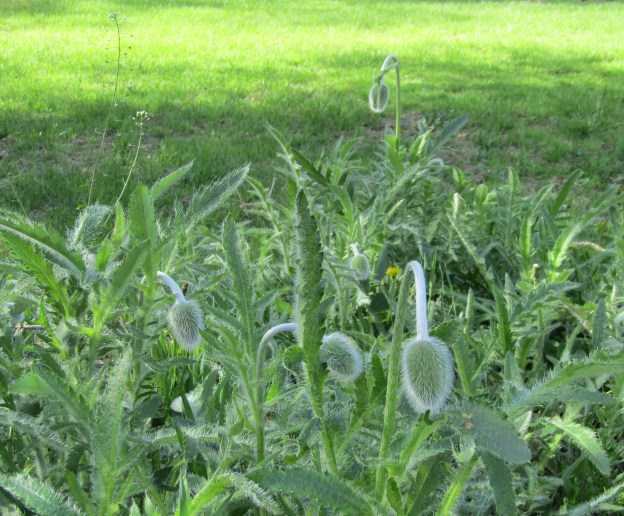
The rain has finally stopped and my flower gardens are ready to burst. It won’t be long before the papery orange blooms of these poppies are dancing in the breeze.
They inspired this poem:
Patient poppies bow their heads like dancers offstage waiting to make their entrance, waiting their turn to shine in the spotlight.




![Henri Fantin-Latour [Public domain], via Wikimedia Commons](https://readingtothecore.com/wp-content/uploads/2016/05/henri_fantin-latour_-_vase_of_flowers_-_google_art_project.jpg?w=293&h=369)
![By Winslow Homer (Memphis Brooks Museum of Art) [Public domain], via Wikimedia Commons](https://readingtothecore.com/wp-content/uploads/2016/05/winslow_homer_reading_by_the_brook_1879-_oil_on_canvas-_memphis_brooks_museum_of_art_memphis.jpg?w=496&h=359)

 Reading to the Core