March SLO: The Breathings of My Heart

My father and grandfather built the house I grew up in when I was two years old. The house wasn’t completely finished when we moved in, and the closet in my bedroom remained unpainted for several years. That vast, empty expanse of sheetrock became my own personal graffiti wall. I can barely remember what I drew on those walls. If I wrote anything, it was the scribbles and loops of an emergent writer. Of course this drove my mother crazy, but I wouldn’t stop. I had a story to tell!

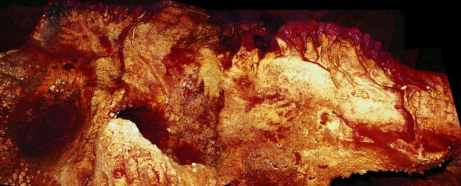
Humans have always been compelled to tell their story. Recently discovered cave paintings in Spain were made by Neaderthals, our close ancestor, at least 65,000 years ago! In his novel Waterland, Graham Swift writes, “Man—let me offer you a definition—is a storytelling animal. Wherever he goes he wants to leave behind not a chaotic wake, not an empty space, but the comforting marker buoys and trail signs of stories.” Those handprints deep inside caves around the world are the ancient equivalent of “Kilroy was here.”

Hand stencils in Maltravieso Cave in Spain made at least 66,000 years ago. (H. Dollado)

I stopped scribbling on my closet wall once my father painted it, but I’ve always filled notebooks with what Wadsworth calls “the breathings of my heart.” I love the joy I feel when I uncover a forgotten memory or make some other discovery about myself when I write. I love the clarity writing brings to my thinking about relationships, work, and the world around me. For the next month, I’ll be joining hundreds of writers and teachers around the world delve into the mysteries that writing uncovers as well tell our stories, one slice at a time. I hope you’ll join us.

Thank you to StaceyBetsyBeth, KathleenDeb, Melanie, and Lanny for creating this community and providing this space for teachers and others to share their stories every day in March and each Tuesday throughout the year. Be sure to visit Two Writing Teachers to read more Slice of Life posts.

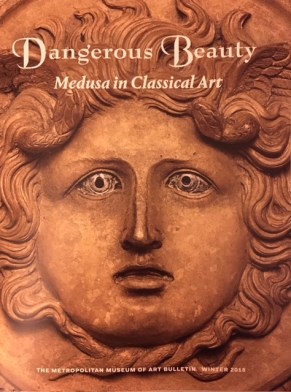
Poetry Friday: An Epitaph for Medusa

Every month I look forward the Ditty Challenge that Michelle Heidenrich Barnes shares on her blog. In February, to celebrate their new book, Last Laughs: Prehistoric Epitaphs (Charlesbridge, 2017), J. Patrick Lewis and Jane Yolen challenged Michelle’s readers  to write an epitaph poem. All month I’ve been at a loss for a topic. Then, yesterday, inspiration arrived in the mail:

“An Epitaph for Medusa”

With slithering, serpentine hair
and a cold, penetrating stare,
you turned men into statues of stone,
so most mortals left you alone.

But while you slumbered in bed,
Perseus chopped of your head.
Now, instead of resting in Elysian’s field,
you’re entombed on Athena’s bronze shield.

 © Catherine Flynn, 2018

Please be sure to visit Elizabeth Steinglass for the Poetry Friday Roundup, and then stop by Michelle’s blog to read more epitaphs.

SOL: Focus

After eight weeks of trying it on for size, I’ve decided “focus” is the right OLW for me in 2018. We develop our own understanding of words throughout our life, so I was curious about what the dictionary had to say about my word. The first definition listed in my old Merriam Webster states that focus is “the point where rays of light, heat, etc, or waves of sound come together, or from which they spread.” Although my original thinking had more to do with “to concentrate, as to focus one’s attention,” I love the image of rays of light coming together or spreading out as I pour my energy into two projects, one personal, the other work-related, that are the real impetus for me choosing this word.

In a recent blog post, Vicki Vinton, author of Dynamic Teaching for Deeper Reading, invited her readers to become “protagonists in their own learning” by adopting an inquiry based approach to a problem or question. Over the past few months, my colleagues and I have been focused on cultivating a growth mindset in our students. This is challenging, ongoing work that easily lends itself the kind of action-research Vicki advocates.

Following Vicki’s model, we have our question: How can we cultivate a growth mindset in our students? We have done research, although this is really ongoing process, and have a hypothesis: Modeling growth mindset behavior and embedding growth mindset stance vocabulary into our daily interactions with children will cultivate their own growth mindset.

Our research began by reading Carol Dweck’s foundational book on the subject, Mindset: The New Psychology of Success (Random House: 2006). Two books are guiding us as we move forward. Learning and Leading with Habits of Mind: 16 Essential Characteristics for Success, (ASCD, 2008) edited by Arthur L. Costa and Bena Kallick is an incredible resource, filled with suggestions for creating “thought-full” environments, assessing students’ (and our own!) attitudes and ideas about mindset, as well as lists of additional resources. Kristine Mraz and Christine Hertz’s A Mindset for Learning: Teaching the Traits of Joyful, Independent Growth (Heinemann, 2015) has guided our K-3 teachers in making the stances of mindset accessible to our youngest learners.

Through surveys, we gathered information regarding how students perceive their current mindset. To encourage reflective thinking about these stances, we asked them to include specific examples of when they engage in a particular behavior. The results were a mixture of brutal honesty (I am not persistent when my math homework is hard.) and responses that need a bit more reflection. (I am always persistent.)

Read-alouds are one way we are embedding the vocabulary of growth mindset into our day. Children’s literature is filled with determined, resilient, flexible characters who overcome incredible odds to achieve their goals. My personal favorite is Brave Irene by William Steig, which has been my go-to book for teaching character traits since it was published, but there are hundreds of worthy titles to choose from. Nonfiction is also full of inspiring stories of people who didn’t give up on their dreams. (This post from 2013 has a short list of a few of my favorites.)

We are still in the process of testing our hypothesis, and will be for months to come. As Costa and Kallick point out, “we never fully master the Habits of Mind…we continue to develop and improve them throughout our lives.”

I’ll let you know how well I’m doing staying focused and share any glimmers of light spreading out from our work.

Thank you also to StaceyBetsyBeth, KathleenDeb, Melanie, and Lanny for creating this community and providing this space for teachers and others to share their stories each Tuesday. Be sure to visit Two Writing Teachers to read more Slice of Life posts.
IMWAYR: THE GIRL WHO DREW BUTTERFLIES: HOW MARIA MERIAN’S ART CHANGED SCIENCE

“You can develop this ability to see. You just have to know what to look for…and where to look.”
Erlin Olafsson *

It seems astonishing to us in the modern age, when microscopes and telescopes have revealed so many wonders, that not that long ago, people didn’t know where butterflies came from. When Maria Merian was born in 1647, a majority of people still believe Aristotle’s theory of “spontaneous generation…that insects did not come from other insects, but from dew, dung, dead animals, or mud.” Growing up “in a household filled with growing things,” Maria became curious and “from youth on [she was] occupied with the investigation of insects.”

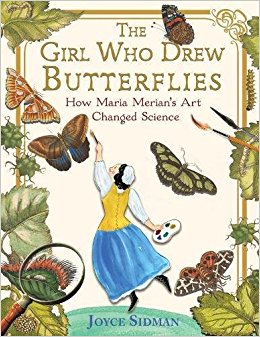
Joyce Sidman’s engaging and colorful biography of Maria Merian, The Girl Who Drew Butterflies: How Maria Merian’s Art Changed Science (Houghton Mifflin Harcourt, 2018), is itself a wonder. Each chapter opens with a poem chronicling the lifecycle of a butterfly. These poems, told from the insect’s perspective, mirror Merian’s own transformation from a curious girl helping in her stepfather’s art studio to a pioneering thinker who lead the way for future scientists. As Sidman writes, “she saw nature as an ever-transforming web of connections—and changed our view of it forever.”

Sidman’s clear, poetic prose, interspersed with Merian’s own words from her field notes, brings Maria and her world to life. The book is lavishly illustrated with Merian’s intricately detailed paintings and Sidman’s own photographs of the metamorphosis cycle. Maps and period paintings of daily life in Germany and the Netherlands provide young readers with clear images of 17th century Europe. Additional information about aspects of daily life at the time, including “Women: Unsung Heroes of the Workforce,” “Science Before Photography,” and “Slavery in Surinam,” among others, place Maria’s life and accomplishments in a broader context. A glossary, timeline, and suggestions for future reading are also included.

At one point, Sidman explains that “Maria had decided that insects belonged to plants and plants to insects. Together, they formed a community of living things that nurtured one another.” In this book, Sidman has woven together many strands from art and science that enhance each other to create a stellar example of what is possible in nonfiction for young readers.

The Girl Who Drew Butterflies is a true gift to readers. Maria Merian was a remarkable woman who overcame the constrictions of society to achieve her dreams, dreams that have left a legacy still with us today. She deserves this book and our children need to hear her story. They need to know that miracles and mysteries are all around them, just waiting to be discovered.

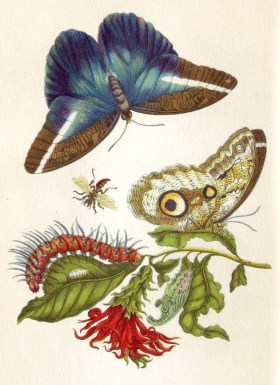
Maria Sibylla Merian [Public domain], via Wikimedia Commons

Teachers can download a study guide here. After students finish The Girl Who Drew Butterflies, be sure to direct them to Jeannine Atkins’s gorgeous novel in verse, Finding Wonders: Three Girls Who Changed Science.

Please be sure to visit Jen Vincent at Teach Mentor Texts and Kellee Moye of Unleashing Readers for more book recommendations.

(quoted in Life on Surtsey: Iceland’s Upstart Island, by Loree Griffin Burns)

Poetry Friday: The Maiden and the Dove

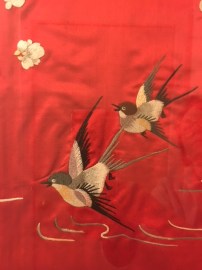
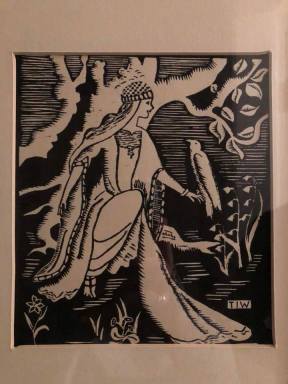
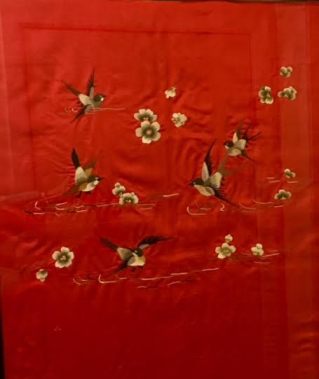
Like many Poetry Friday friends, I’m participating in Laura Shovan‘s 6th Annual February Daily Poem Project. This year’s theme is ekphrasis. Each day, a group member posts a photo of a work of art in his or her home. The variety of works shared during the past week alone has been astounding. I haven’t been able to keep up and write a poem every day, but I’m trying. This daily writing is stretching my poetry muscles in different ways and has yielded many surprises. Almost accidentally, I’ve also been playing with new and different forms. Last week, I shared an abecedarian. This week, Heather Meloche shared a block print created by her grandmother, Thelma Wilson Brain.


Troubadours and courtly love immediately came to mind, so I decide to tried my had at a lai. In The Essential Poet’s Glossary, Edward Hirsch writes that “in Old French Poetry, a lai is a short lyrical or narrative poem…usually written in octosyllabic verse.” Sticking to a strict syllable count and rhyme scheme was quite a challenge. I tried not to sacrifice sense while maintaining both, but don’t think I completely succeeded. In any case, this draft was fun to write, and brought back many fond memories of a favorite English professor who specialized in the lais of Marie de France.

The Maiden and the Dove

When troubadours in days of old
Sang songs of maids with hair of gold,
Sweet lady Jane traversed a wood
To where the sacred hazel stood.
Beneath its boughs she met a dove
Who trilled the promise of true love.
“Gather rosebuds of red and white.
Present them to a gallant knight.
For you he will forego all strife,
Preferring an idyllic life.”     

No damsel in distress was she,
Jane soon was down upon one knee.
“Dear dove, thank you for these wise words
But taking such advice from birds
Seems like a foolish plan to make
And sure would bring me much heartache.
Don’t fill my head with fluff and froth.
I’ll only ever pledge my troth
To one who’s loyal and steadfast,
Whose bravery is unsurpassed.
On such a man I will bestow
My tender love, then all will know.”

To her word, gracious Jane was true,
Tales of her love and kindness grew,
Throughout the land her story was told,
By troubadours in days of old.

© Catherine Flynn, 2018

Please be sure to visit Sally Murphy’s blog for the Poetry Friday Roundup.

Poetry Friday: An Abecedarian

The first few lines of this poem, inspired by the first prompt of Laura Shovan’s 6th Annual February Daily Poem Project, came to me in alphabetical order. I’ve been working on an abecedarian for my WIP, so I decided to go with my instinct and get some practice with the form.

According to the Academy of American Poets, an abecedarian is 

an ancient poetic form guided by alphabetical order. Generally each line or stanza begins with the first letter of the alphabet and is followed by the successive letter, until the final letter is reached.

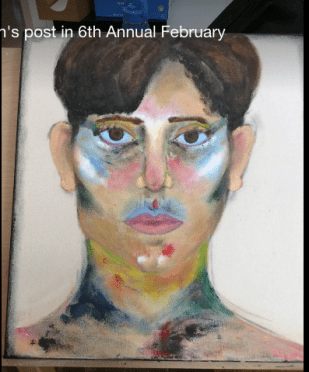
Unfinished self-portrait by Jay Shovan

To me, the pain in this painting is palpable, but Jay’s eyes are strong and steady. It felt necessary to acknowledge a possible source of what look like bruises (Real? Metaphorical? Does it matter?), yet see into the fulfilling future those piercing eyes are looking toward.

A
Bully’s words,
Calculated for maximum
Damage,
Echo through my brain
Forever,
Grow softer, but never fully
Heal.
I want to scream, “Who are you to
Judge me?  Because I
Know
Lurking behind your
Malicious mask is a
Neglected soul.
On my neck, this
Patchwork
Quilt of colors will fade,
Recede from sight and I will
Stitch my soul back
Together
Until
Vibrant
White sails unfurl. I’ll become a
Xebec,* sail to far away shores, leaving
Your taunts behind, reaching my
Zenith despite you.

* “a small, three-masted ship with overhanging bow and stern, once common in the Mediterranean.” (Webster’s New World Dictionary)

© Catherine Flynn, 2018

Don’t forget to visit Donna Smith at Mainely Write for the Poetry Friday Roundup. Also, please stop by my friend and critique group partner Linda Mitchell’s blog, A Word Edgewise. Linda invited me to answer a few questions about poetry and writing. It was revealing process to reflect on Linda’s questions, and I thank her for the opportunity. As usually happens, when I read my responses, I realized I neglected to mention all my poetry mentors, especially Laura Purdie Salas and Mary Lee Hahn. Forgive my addled brain!

Slice of Life: Catalog Nerd

Each autumn when I was a kid, I looked forward to the arrival of the Sears Wish Book. Within this catalog were the items I needed to ensure a perfect life. Barbie dolls I dreamt of, a dollhouse I coveted, and more. There were matching skirts and sweaters and perfectly appointed bedrooms. (I confess, though, the white French Provincial furniture never appealed to me.) I pored over the pages, carefully considering each item before adding it to my letter to Santa.

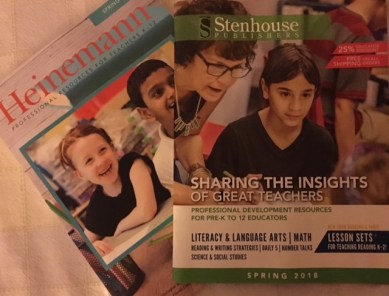
Of course the Sears Christmas catalog, and others like it, have gone the way of the dodo. But over the course of my teaching career, I’ve discovered two catalogs that fill me with as much excitement as the Wish Book did so many years ago. The Heinemann and Stenhouse spring catalogs arrived today, and I swear I did a little happy dance. Filled with professional books by educators I trust and admire, I now study the pages of these two catalogs with more intensity that I ever invested in the Sears catalog. Because, although I won’t ever have time to read all the smart, inspirational books offered by Heinemann and Stenhouse, I am certain that the three or four books that I do purchase will make me a better teacher. They won’t ensure a perfect life (I gave up that wild goose chase long ago), but they will provide me with ideas, tools, and strategies that I can use to do the best work I can for my students. And while that won’t give them a perfect life either, it will go a long way toward instilling in them the passions and skills they’ll need to create their own best possible life.

Thank you also to StaceyBetsyBeth, KathleenDeb, Melanie, and Lanny for creating this community and providing this space for teachers and others to share their stories each Tuesday. Be sure to visit Two Writing Teachers to read more Slice of Life posts.
Poetry Friday: Maya Angelou’s “I Love the Look of Words”

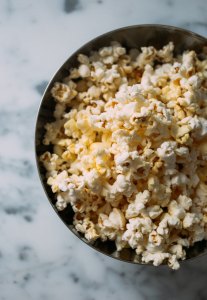
Did you know today is National Popcorn Day? It is also one of those days when I was at a bit of a loss about what to share for Poetry Friday. So I casually Googled “popcorn poems.” Maya Angelou’s “I Love the Look of Words” was one of the results. The title sounded vaguely familiar, and as I started reading it, I realized this poem is one I shared with my third graders for many years.

Angelou’s poem is a celebration of words and ideas, bouncing around in our brains like popcorn. I’m sorry this poem lay tucked away in my memory for so long. I’m happy National Popcorn Day brought it back up to the surface.

“I Love the Look of Words”

Popcorn leaps, popping from the floor
of a hot black skillet
and into my mouth.
Black words leap,
snapping from the white
page. Rushing into my eyes. Sliding
into my brain which gobbles them
the way my tongue and teeth
chomp the buttered popcorn.

When I have stopped reading,
ideas from the words stay stuck
in my mind, like the sweet
smell of butter perfuming my
fingers long after the popcorn
is finished.

I love the book and the look of words
the weight of ideas that popped into my mind
I love the tracks
of new thinking in my mind.

by Maya Angelou

Photo by Charles Deluvio via Unsplash

Grab a bowl of popcorn and visit Kay McGriff at A Journey Through The Pages for the feast of poetry served in the PF Roundup.


Poetry Friday: Jacqueline Woodson’s “on paper”

“I believe in one day and someday and this perfect moment called Now.”
Jacqueline Woodson

I was lucky enough to be in the audience at NCTE’s Annual Convention last November when Jacqueline Woodson read this passage from Brown Girl Dreaming, her award-winning memoir in verse. Woodson’s work has always had a place in my classroom, and I am thrilled that she has been named the next National Ambassador for Young People’s Literature This role will allow her to travel around the country sharing her message that “books can drive change and instill hope in young readers.” She summed up her vision as ambassador as “Reading = Hope x Change.” You can hear Woodson talk more about this vision in this NPR interview

During her speech at NCTE, students from around the country asked questions via pre-recorded video. One student wondered why Woodson chose to write Brown Girl Dreaming and her recent novel Another Brooklyn in verse. Woodson’s brilliant response? “I wrote it in verse because that’s how memory comes to us.”

In “on paper,” from Brown Girl Dreaming, Woodson shares this memory:

The first time I write my full name

Jacqueline Amanda Woodson

without anybody’s help

on a clean white page in my composition notebook,

    I know

if I wanted to

I could write anything.

Read the rest of the poem here.

Woodson reminded the teachers at NCTE that “everybody has a story, and everyone has a right to tell that story. Encourage students to tell their stories.” It’s clear that Woodson’s work springs from her own story, her own memories. But her writing also shines with her love for her fellow humans. She urged her NCTE audience to remember that community is so important. We need to know who we are going to walk through the world with.” I am happy I’m walking through the world with Jacqueline Woodson.

Please be sure to visit Jan Godown Annino at Bookseedstudio for the Poetry Friday Roundup.

Poetry Friday Roundup and Can I Touch Your Hair: Poems of Race, Mistakes, and Friendship

Happy New Year! Welcome to the first Poetry Friday Roundup of 2018! If you’re new to Poetry Friday, you can learn more from Renée LaTulippe at No Water River.

Today I’m proud to feature a brave and beautiful new book by two dear poetry friends, Irene Latham and Charles Waters, Can I Touch Your Hair? Poems of Race, Mistakes, and Friendship, published by Carolrhoda Books on January 1, 2018. With starred reviews from Kirkus  and Publisher’s Weekly, this book deserves a place in every classroom. (A Teacher’s Guide is available here.)

Assigned to work together on a poetry project, Irene and Charles are ambivalent. Irene articulates this with the frank honesty of childhood: “Charles is black/and I am white.”

Overcoming their misgivings, they find common ground in the everyday worries of all kids, and begin by writing about shoes and hair. These subjects soon give way to more serious topics such as saying the wrong thing, racial tensions, police brutality, and fear of others because they look different.

They walk the tightrope of adolescent friendships when Irene’s request to join “the black girls/ play[ing] freeze dance” and Charles’s friends “play me dirty.” The poems reveal an unfolding friendship, which Sean Qualls and Selina Alko capture in their sensitive illustrations as heart-shaped flourishes erupting from their pens, mouths, and minds.

Throughout the collection, Irene and Charles make their alter egos come alive by honestly revealing pieces of vulnerability, as when Charles realizes he’s “a few shades too dark/to be allowed to call [a new classmate] by his nickname.” This is balanced by their courage to face fear and shame, as Irene does in “Apology.” When an African-American classmate’s family tree is “draped in chains,” she realizes that the words “I’m sorry…are so small/ for something/so big.”

Both poets use figurative language to bring a depth of feeling and wisdom that amplifies the emotional impact of their writing. We feel the “fury rising inside” Charles, as if he’s “a tidal wave about to crash on land,” as well as the joy they each feel as they “stand in line, cradling our books like newborn kittens,” as they wait to meet author Nikki Grimes. 

With Charles and Irene at NCTE in St. Louis last November.

Irene and Charles generously allowed me to share two of their poems with you today. Thank you so much!

“The Poem Project”

When our teacher says,
Pick your partner,
my body freezes
like a ship in ice.

I want Patty Jean,
but Madison
has already looped
arms with her.

Within seconds,
you-never-know-what-
he’s-going-to-say-Charles
is the only one left.

How many poems?
someone asks.
About what?
Do they have to be true?

Mrs. Vandenberg
holds up her hand.
Write about anything!
It’s not black and white.

But it is.
Charles is black,
and I’m white.

© Irene Latham, 2018

“Writing Partner”

Mrs. Vandenberg wants us to write poems?
Finally, an easy project. Words fly off my pen
onto the paper, like writing is my superpower.
The rest of the time, my words are a curse. I open my mouth,
and people run away. Now I’m stuck with Irene?
She hardly says anything. Plus she’s white.
Her stringy, dishwater blond hair waves
back and forth as she stutter-steps toward me.
My stomach bottoms out. “Hello,” I say. “Hi,” she says.
I surprise myself by smiling at her–she smells like
a mix of perfume and soap. We stare at our sneakers
before I ask, “So, what do you want to
write about?” She shrugs. I say, “How about our shoes, hair?
Then we can write about school and church?”
She takes a deep breath. “Okay.”
I match it. “Let’s start there.”

© Charles Waters, 2018

In an interview with Megan Labrise on the podcast Fully Booked by Kirkus Reviews (starting at 32:40), Charles and Irene share the origin of Can I Touch Your Hair, as well as their hopes for their book. Irene states their wish is that “it will make it easier to have these really difficult conversations about race” and as we “talk about it, listen to each other, [we’ll] realize that we’re all human people, we have more in common than we have separate, different, and that the different parts are beautiful.” Because, as Irene and Charles so wisely point out in the book’s final poem, “Dear Mrs. Vandenberg”: “We are so much more than black and white!”

And now for the Roundup! Please join today’s celebration of poetry by sharing your link.