The scene outside is all too familiar: fine, steady snow being buffeted about a persistent northeast wind. Inside, the scene is a little different: an flower pot filled with potting soil awaits a rooted begonia leaf. To heck with snow. It’s spring, and I’m planting!
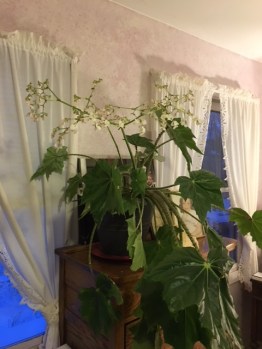
This cutting is descended from a plant that originally belonged to my great-great grandmother and was kept alive for the better part of the twentieth century by my great-aunt. After she passed away, my mother inherited the plant. Now, my sister and I are keepers of this hardy, giant-leafed plant. Starting a new plant is as simple as cutting off a leaf and plopping it into a jar of water. It doesn’t take long for roots to erupt from the bottom of the stem. Once they’ve appeared, the leaf can be planted. Today’s plant is for my son and his fiancé’s new apartment.
The parent plant has taken over this part of my bedroom!
I’m not ordinarily a rebellious person. But planting this next generation begonia today was my act of defiance against all this snow. Happy spring, everyone!
Thank you to Stacey, Betsy, Beth, Kathleen, Deb, Melanie, and Lanny for creating this community and providing this space for teachers and others to share their stories every day in March and each Tuesday throughout the year. Be sure to visit Two Writing Teachers to read more Slice of Life posts.
“Every family’s different–each family is just right!”
Laura Purdie Salas
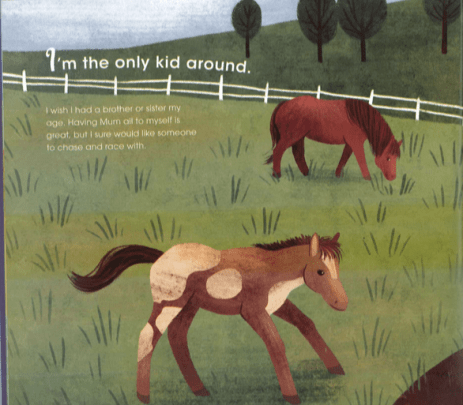
Welcome to the latest stop on the Blog Tour for Laura Purdie Salas’s beautiful new book, Meet My Family: Animal Babies and Their Families (Millbrook Press, 2018). When I first read Laura’s heartfelt words and saw Stephanie Fizer Coleman‘s lively illustrations, I knew this book was a perfect mentor text for student writing.
Laura was inspired to write Meet My Family by feelings she had about her own family growing up. In her interview with Kirby Larson (the link is listed below), Laura says that “my family felt very different from other families.” She hopes “this book might erase some of the shame so many kids feel about their families.”
One of my colleagues is the most amazing Kindergarten teacher on the planet, and she welcomed me into her classroom to share Laura’s book with her students and work on this writing project with them. After reading Meet My Family to the children, we talked about all the different kinds of animal families in the book. Then we talked about all the ways our own families are different. After brainstorming together, the kids wrote a sentence about their own family.
The next day, we reread the book, this time looking closely at the subtext on each page. Again, using Laura’s text as a mentor, the students added details to their writing about their family. Some chose to write about activities they do together, others wrote about favorite foods. Everyone gained an appreciation for all the different kinds of families we have!
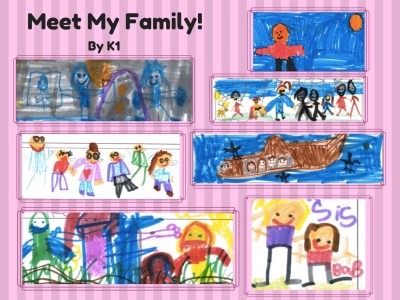
Illustrations are a very big deal for Kindergarteners, and they couldn’t wait to start drawing their families. We even used the cover layout as a model for the cover of the book we created.
Here is their work:
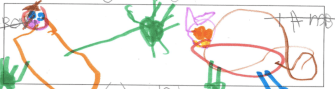
I live with my mom and dad in my house. We love to babysit my baby cousin.
by R.
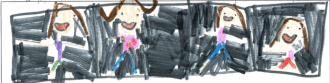
I am the only child. And sometimes I go out to walk with my family.
by R.
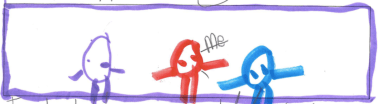
I have three sisters. I watch TV with my sisters.
by S.
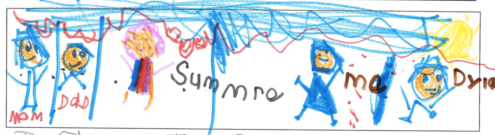
I moved across the country. Sometimes we go on hikes!
by J.
I live with my family. We go to Five Guys for burgers.
by L.
I am the smallest in my family! My family likes to bike together! I like my family!
by K.
I am the youngest in my family. I went with my family in the forest. We had fun.
by A.
I live with my brothers and my baby sister. My family likes to go to the beach.
by I.
I live with my mimi and poppy. We like to go out to dinner.
by Z.
I have one sister. After school we go to gymnastics. It is tiring and it is fun.
by B.
I live with my mom and my brothers. We play Manhunt outside. I am fast.
by L.
My brother is eight and I am five. My baby sister is two. I live with my Nana and my PopPop, my puppy and cats.
by E.
I live with my mommy and dad and my baby sister, too. After school I help mom and dad make chicken for dinner.
by L.
These Kindergarten students are very proud to share their work today, and are already busy planning their next writing project. Thank you, Laura, for writing this informative, inspiring book!
Thanks to Laura’s generosity, one lucky reader will win a copy of Meet MyFamily!Just leave a comment before midnight, Thursday, March 22nd, to be entered in the drawing.
To find out more about Laura and this wonderful book, be sure to visit the other stops on the Meet My Family Blog Tour:
Thank you to Stacey, Betsy, Beth, Kathleen, Deb, Melanie, and Lanny for creating this community and providing this space for teachers and others to share their stories every day in March and each Tuesday throughout the year. Be sure to visit Two Writing Teachers to read more Slice of Life posts.
I have lived in New England my entire life. Certain snowstorms are vivid in my memory. In the late 60s, a drift the size of a dump truck blocked our street for what seemed like days and we had to get fresh milk straight from the farm across the street. When we returned to school after the blizzard of ’78, the snow was drifted to the roof of our sprawling, one-story school in some spots. I even remember one winter when we didn’t have a single snow day until March. Then we had one every week.
But I can’t remember any winter that compares to the weather we’ve had in the past two weeks. Three nor’easters since the beginning of March have dumped almost two feet of snow at my house, and we’re on the lower end of the snow totals! Even though it’s still winter, the days are getting longer and snow melts quickly at this time of year. There was even a tiny hint spring in the air last week.
So when I reread the poems Nikki Grimes and Michelle Heidenrich Barnes shared for this month’s ditty challenge, this line, from Nikki’s poem, “Truth, by Tyrone Bittings,” shone out like a beacon:
a reason for a song
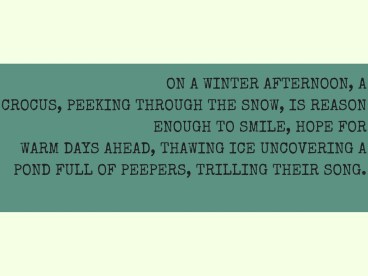
It made me think of a photo of crocuses blooming in the snow I’d seen recently and inspired this Golden Shovel:
By Meneerke bloem (Own work), via Wikimedia Commons
Please be sure to visit Linda Baie at TeacherDance for the Poetry Friday Roundup. And thank you to Stacey, Betsy, Beth, Kathleen, Deb, Melanie, and Lanny for creating this community and providing this space for teachers and others to share their stories every day in March and each Tuesday throughout the year. Be sure to visit Two Writing Teachers to read more Slice of Life posts.
This conversation reminded me that for the past few years, I’ve celebrated Pi Day with a Pie poem. This year, I used 3.14159 syllables to structure my poem.
Blueberry, Peach, Lemon meringue. Sweet fruit wrapped in flaky crust. Every care melts away with one bite.
Thank you to Stacey, Betsy, Beth, Kathleen, Deb, Melanie, and Lanny for creating this community and providing this space for teachers and others to share their stories every day in March and each Tuesday throughout the year. Be sure to visit Two Writing Teachers to read more Slice of Life posts.
We’ve all been there, so you understand that priorities have to be made. This is my story for now. I’ll keep you posted.
Thanks to Fran for reminding me of Six-Word stories!
Thank you to Stacey, Betsy, Beth, Kathleen, Deb, Melanie, and Lanny for creating this community and providing this space for teachers and others to share their stories every day in March and each Tuesday throughout the year. Be sure to visit Two Writing Teachers to read more Slice of Life posts.
Last week, Slicer Christie Wyman of Wondering and Wandering realized she was writing about a topic she’d written about last year. (Another nor’easter; my New England friends don’t even want to think about the new one brewing for next week!) Christie wondered, “do you have a slice from last year’s SOLC you could revisit because some things never change? Or maybe because they have!”
I had already been considering revisiting an exercise from Karen Benke’s Rip the Page: Adventures in Creative Writing. (Read another post inspired by this book here.) Here’s the explanation of “Juxtaposition” (found on page 56) from last year’s post:
This exercise begins by folding a piece of paper in half lengthwise, then choosing ten words from one of the many word lists in the book. Next, add a descriptive word in front of each of the chosen words. Turn the paper over and follow the directions for what to write next. When you unfold the paper, write “Poetry Is” at the top. Try various combinations from the assortment of words and phrases you wrote until you find a “juxtaposition…two unlike things (side by side) to wake up your ears and make your mouth smile.”
In response to last year’s post I wrote, Some of these pairings aren’t really a surprise, but I liked the images they conjured.
I did not reread the last year’s poem before starting this year, but some images appeared again anyway. I guess those words and ideas are deeply ingrained in me. Last year’s poem is structured differently from this year’s poem, and I think I like it a little better, but this year’s poem created some images that deserve a poem of their own.
Poetry hides…
In gentle rains of summers past In rippling, whispering waves In the soft peaks of a lemon meringue pie
Poetry lurks…
under the slow drift of pale sunshine inside the molten silver of Wednesdays behind the secret of cerulean blue
Poetry lives…
inside a cosmic whirl of serenity in the full moon of my imagination within the quickening spark of my heart.
This activity is exactly what Benke’s subtitle promises: an adventure in creative writing. Students love it for many reasons. Some of the combinations turn out to be very funny. It also provides a structure that reluctant writers find comforting and supportive. Confident writers will appreciate the flexibility they have to play with the format of their poem. The possibilities are endless!
Photo by Jeff Golenski via Unsplash
Thank you to Stacey, Betsy, Beth, Kathleen, Deb, Melanie, and Lanny for creating this community and providing this space for teachers and others to share their stories every day in March and each Tuesday throughout the year. Be sure to visit Two Writing Teachers to read more Slice of Life posts.
I took a circuitous route to the classroom. Although I always knew I wanted to be a teacher and writer, I considered other career options along the way, including interior decorator. However, when I graduated with my A.S. in 1980, jobs in this field were few and far between. Desperate for a job, I started working as a receptionist in a doctor’s office. In my mind, this was a temporary situation. I would find my dream job soon.
As the saying goes, everything is temporary. My stint at the doctor’s office only lasted fourteen years. But it turned out to be a good training ground for teaching. Dealing with parents is nothing compared to patients! I also met some pretty interesting people over the years, including William Styron. But one encounter I will never forget was with Ursula Nordstrom.
Ursula Nordstrom was, in the words of Maria Papova, “a fearless custodian of the child’s world and imaginative experience.”An editor at Harper & Row (now HarperCollins) for many years, she edited classics such as Stuart Little, Charlotte’s Web, and Where the Wild Things Are. When Ms. Nordstrom came into our office, I was writing terrible picture book manuscripts on a weekly basis, and for me, it was as if the patron saint of all I aspired to had just walked in the door.
Of course, there are rules of professionalism that have to be followed, so I greeted her calmly and asked her to have a seat. She chose a seat quite close to the window, which was a little unnerving. We were very busy that day: the phone wouldn’t stop ringing, charts had to be typed, (Yes, typed, as on a typewriter. This was in the mid-80s.) and other patients needed attention.
During one lull in the action, she looked over at me and said, “You handle everything very well.” (Or something like that.)
In that brief moment I wanted to say, “I write picture books, too!” But of course I didn’t. I thanked her, and then answered the phone again.
Ms. Nordstrom didn’t return to our office, and passed away soon after this brief encounter. If you’re not familiar with her work, Leonard Marcus gave the world of children’s literature a gift when he published Dear Genius: The Letters of Ursula Nordstrom (HarperCollins, 2000). Included in the book is correspondence between Nordstrom and E.B. White, Laura Ingalls Wilder, and Margaret Wise Brown, among many, many others. I read Dear Genius when it was first published and was inspired by Nordstrom’s wit, intelligence, and compassion. Do yourself a favor and read this book. Spend time with “a deeply lovable spirit” who helped create the world of children’s literature as we know it today.
Thank you to Stacey, Betsy, Beth, Kathleen, Deb, Melanie, and Lanny for creating this community and providing this space for teachers and others to share their stories every day in March and each Tuesday throughout the year. Be sure to visit Two Writing Teachers to read more Slice of Life posts.
I spent much of the evening working on a writing project that I hope to tell you about one day. After playing with one four-line stanza for the better part of an hour, it was time to step away. My brain was too muddled to make any more progress on this day. Then I realized I hadn’t written anything for Poetry Friday! I searched my recent jottings and found the bare bones of this poem hiding in my notebook. Since this is what I’d been doing all evening, it seemed appropriate to polish it up a bit and share it today.
Find a word write it down play with its meaning listen to its sound.
Pick another do the same string them together make it a game.
Soon you will have a new work of art a story or poem straight from your heart.
Please be sure to visit Michelle Heidenrich Barnes at Today’s Little Ditty for the Poetry Friday Roundup. Also, a big thank you to Stacey, Betsy, Beth, Kathleen, Deb, Melanie, and Lanny for creating this community and providing this space for teachers and others to share their stories every day in March and each Tuesday throughout the year. Be sure to visit Two Writing Teachers to read more Slice of Life posts.
My mother is a shadowy mountain. I scale her thick, furry limbs. I ride along on the broad, flat ridge of her back as we roam our rain forest home. I snuggle into the cave of her arms, safe, when we nest each night. The mountain sustains me. My mother.
This poem was inspired by the photo of a carved mountain gorilla mother and child shared by my partner-in-poetry and Slicing, Christie Wyman, for Laura Shovan’s Ekphrastic Poetry Project. For me, the facial expressions of these critically endangered animals brought this carving to life. It appealed to me immediately, and I had a general idea of what I wanted to write. What I needed was a form that suited my ideas.
There are many well known poetic forms that I could have tried, but I wanted something that would ring true to the African roots of this carving. I didn’t find anything suitable in a search through my poetry reference books, so I turned to Google. There I found an form called the “Eintou.” Described as an “African American septet syllabic/word count form consisting of 2 words/syllables in the first line, 4 in the second, 6 the third, 8 the fourth, 6 the fifth, 4 the sixth, and 2 the seventh.” In addition, “Eintou” is from a West African dialect and means “pearl, as in pearls of wisdom.” The structure also reflects the African and African American philosophy that “life is a cycle. Everything returns to that from which it originates.”
An Eintou felt exactly right for this poem. Now my only problem was matching the word count. I drafted several versions that stuck to the structure explained online, but it just wasn’t working. In keeping with my efforts to develop my Habits of Mind, I decided that by “creating, imagining, and innovating,” I could modify the structure and add a 10 word line in the middle and work back to two words from there. (This form has the added, unintentional bonus of being shaped like a mountain!) I think I maintained the spirit of the form. Also, I definitely stayed true to the purpose of Laura’s project, which “is to practice the habit of writing regularly,” the same purpose of the Slice of Life Challenge.
Thank you to Stacey, Betsy, Beth, Kathleen, Deb, Melanie, and Lanny for creating this community and providing this space for teachers and others to share their stories every day in March and each Tuesday throughout the year. Be sure to visit Two Writing Teachers to read more Slice of Life posts.
My One Little Word for 2018 is focus. At school, I’ve been focused on incorporating the growth mindset stances laid out by Kristine Mraz and Christine Hertz in their book, A Mindset for Learning, as well as the habits of mind explained in Learning and Leading with Habits of Mind, by Arthur L. Costa and Bena Kallick. This means I’m constantly on the lookout for opportunities to weave these habits into my lessons.
In Costa and Kallick’s work, this focus would fall under the habit of “creating, imagining, and innovating.” Maybe it’s the poet it me, but I prefer to think of this as “serendipity,” those happy accidents of chance that occur when we’re paying attention. Yesterday, such a moment occurred.
As I was working with a second grader, he noticed The Day the Crayons Quit in a basket on a nearby bookshelf. “Can we read this, too?” L. asked as he pulled the book from the basket. “Mr. M. read it to us in Library and it’s really funny.”
“Absolutely,” I replied. “Let’s finish our other work first.” He agreed, and I presented How Bear Lost His Tail from Fountas & Pinnell’s Leveled Literacy Intervention kit.
He wasted no time in reminding me that he’d already read this book. The advantages of rereading are well-known and many. Among other benefits, rereading increases fluency and deepens comprehension, my goal in this case. I explained to him I knew he’d read the book before, but that readers always find something new when they read a book a second, third, or even fourth time.
He launched into the book, and because it was his second read, he read it fairly fluently and with good expression. When he finished, I asked him if he had an idea about why Fox tricked Bear. He replied, “Maybe Fox was sad.” Seeing an opportunity to develop his vocabulary, I asked him if there were any other words he could use to describe how Fox felt. “Upset?” he said, with a hint of a question.
“Why would he be upset?” I asked him.
“Because Bear’s tail is bushier than his,” he replied, this time with more confidence.
I asked him if he knew the word “jealous.” He said he didn’t. I explained that if someone has something you would like to have, you might be jealous. I asked him if his sister ever had anything he wanted but couldn’t have. He remembered that at her last birthday party, he’d been upset that she was getting so many presents. “That’s what it feels like to be jealous,” I explained.
Seizing the opportunity he’d presented me with when he asked to read The Day the Crayons Quit, I asked, “Do you think any of the crayons were jealous?” He shrugged and said he couldn’t remember. “Let’s find out,” I suggested.
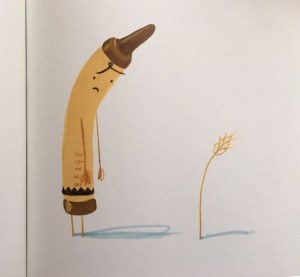
Working together, we reread the first few letters of protest from Duncan’s crayons. Lo and behold, there was Beige, feeling very left out because Brown got to color all the “bears, ponies, and puppies.”
“He’s jealous,” L. announced proudly.
From The Day the Crayons Quit, by Drew Daywalt, pictures by Oliver Jeffers
New learning sticks when learners apply “past knowledge to new situations” (Costa & Kallick, p. 28). Granted, this new situation was within five minutes of L.’s introduction to the word, but he made the connection between the two characters on his own and was articulated his thinking clearly. It’s unlikely that I would have planned this sequence of events ahead of time. But L. is more likely to remember this new vocabulary because a number of conditions were in place that engaged him in a meaningful way. Serendipity at its finest.
Thank you to Stacey, Betsy, Beth, Kathleen, Deb, Melanie, and Lanny for creating this community and providing this space for teachers and others to share their stories every day in March and each Tuesday throughout the year. Be sure to visit Two Writing Teachers to read more Slice of Life posts.














 Reading to the Core