Whenever I’m on the subway, I’m always on the lookout for one of the MTA’s “Poetry in Motion” posters. “Poetry in Motion” is a joint project between the Poetry Society of America and the Metropolitan Transportation Authority. Poetry is placed in “transit systems of cities throughout the country, helping to create a national readership for both emerging and established poets.”
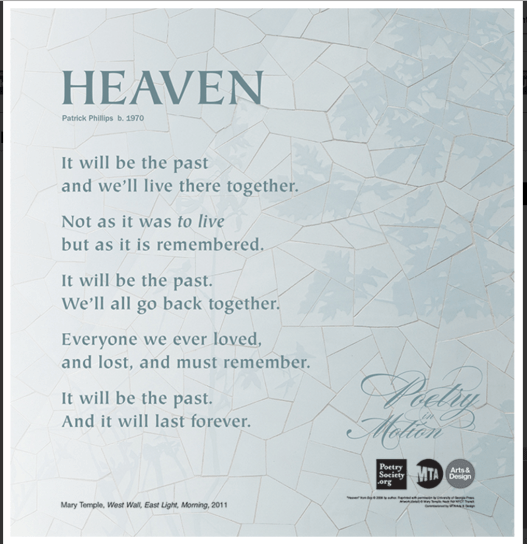
Earlier this week, on my way to hear Colum McCann interview Elizabeth Strout about her new book, My Name is Lucy Barton (Random House, 2016), I was on a packed rush hour train and couldn’t tell if there was a poem in the car or not. However, later in the evening, the train was almost empty and I easily spotted this beauty by Patrick Phillips:
This was a perfect end to a perfect evening. McCann, author of Let the Great World Spin, which won the National Book Award, and the critically acclaimed Thirteen Ways of Looking, and Strout were smart, funny, and insightful. Their conversation revolved around My Name is Lucy Barton in particular and writing in general. And although both Strout and McCann are primarily novelists, their finely observed prose is infused with poetry.
I couldn’t keep up trying to write down all of McCann and Strout’s wise words about writing, but I do remember Strout saying that her eyes and ears are always open, that she loves to listen. I also found this on McCann’s website: “Put your faith in language.” And this “So this, then, is a word, not without love, to a young writer: write.”
Please be sure to visit Keri Collins at Keri Recommends for the Poetry Friday Round Up.
So far I’ve been feeling pretty overwhelmed in 2016. This is my own fault. I am a procrastinator. I make piles of things to do tomorrow. Laundry to put away, magazine articles and books to read stack up until I don’t know where to start. I’m not proud of this, but there it is. I’ve come to realize that this leads me to nothing but regret, particularly about those things I just never do. I do know I can’t think of anything I’ve ever done that I truly regret. So I should just do it, right? But what is the opposite of procrastinate?
Online sources aren’t helpful. Forge, forward, and expedite are all listed, as is proactive. Each one of these is fine as a stance, but none appeal to me as a word to live by.
This morning, even though I was without a word, I decided not to procrastinate any longer and forged ahead with the vacuuming I’d been putting off. Sure enough, as I pushed the beater bar back and forth across the living room rug, the word present popped into my head.
Present. The more I considered this word, the more it appealed to me. It has so many meanings, but two immediately came to mind: The here and now and a gift. It seems to me these are really the same thing. To be present right here, right now, is a gift. To be able to sit in my warm kitchen and write these words is a gift. To look out the window and watch the rain drip off the maple tree’s bare branches is a gift.
I’m not under any illusion that it will be easy to give up my habit of procrastinating, although as I get older, putting things off makes less sense. What am I waiting for, after all? Or, more to the point, what am I afraid of? My yoga teacher always tell us that when we find our mind has wandered, return to the breath. This seems an appropriate response to procrastination as well. When I find myself stewing over where to start, I’ll remember to just breathe, and return to the present. Who knows what gifts I’ll find waiting there.
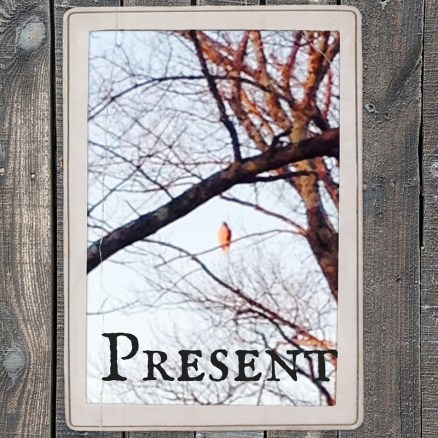
Created in Canva, using a photo of a gorgeous hawk I took while out on a walk last week.
Margaret Simon has invited bloggers to share their OLWs on her DigiLit Sunday Roundup today. Please be sure to visit her there to see her students’ Canva creations.
This is based on a true story, although it didn’t happen to me. When a friend told me she lost her Fitbit at Five Guys, I knew I had to write a poem using that line. I’ve taken a lot of poetic license in this draft, so please don’t judge my friend!
Be sure to visit Mary Lee Hahn at A Year of Reading for the Poetry Friday Roundup. I wish you all a New Year filled with family and friends, happiness and good health, and success with your resolutions!
“Writing is an exploration. You start from nothing and learn as you go.”
E.L. Doctorow
This quote is perfect and true.
Over a year ago, I began writing a story about a girl who falls out of a tree and breaks her arm. When I started writing, I didn’t know much more than that. I didn’t even know why she was in the tree in the first place. But that didn’t stop me. I kept writing and have learned much about this girl.
Then, last spring, I got sidetracked by another idea. All my writing energy went into this new project. However, as it often does, life intervened and both projects have been on the back burner for a few months.
Now, though, I feel ready to move on. I’m curious about what’s going on with this girl. More than a year later, she still has her arm in a cast. Surely that bone must be healed by now!
So yesterday I just started writing. I had no plan, no idea what what was going on with this character. But, true to Doctorow’s words, I figured it out (or at least got a better idea). It turned out that she wanted to make popcorn balls. So we made popcorn balls. This endeavor wasn’t completely successful, as the sugar and molasses tasted slightly burned. But the process of making this old family recipe revealed priceless details that I’d long forgotten.
Who knows what lies ahead for this character, or if this scene will end up as part of her story. I have an idea of how events will go, but I don’t know for sure. And that’s why I love Doctorow’s quote. I don’t have to know. I’ll figure it out. All I have to do is keep writing.
Scrolling through Twitter earlier this week, I came across this:
Sounds intriguing, right? So I checked it out. Susanna Leonard Hill is the author of several picture books, including Punxsutawny Phyllis (Holiday House, 2005). The contest, which ends at midnight, is to:
“Write a children’s story (children here defined as approximately age 12 and under) beginning with any version of ‘Rocking around the Christmas tree at the Christmas party hop.'”
Immediately, the wheels started turning. After several false starts and many revisions, here’s my entry:
“Pouncing Around the Christmas Tree”
Pouncing around the Christmas tree, while the humans are away. Such a happy, joyous spree, It’s a feline holiday.
Pouncing around the Christmas tree, now the garland’s in a heap. Spying an angel on the crown, I can reach her if I leap.
Shiny tinsel dangles, It’s a sight I do adore. Candy canes and twinkling lights. Look at that angel soar!
Pouncing around the Christmas tree, ribbons to frazzle and fling. Batting at ornaments with glee, watching them sway and swing.
No more tinsel dangles, and the ornaments are smashed. All the lights are in a tangle, Oops, the tree toppled and crashed!
Yowling under the Christmas tree, Now my fun is at an end. Through bent branches I try to flee, before they catch me and I’m penned!
There are many things I love about NCTE’s Annual Convention. I love learning from authors, teachers, and researchers I admire. I love meeting friends from blogging and Twitter in real life. And I love all the free or discounted books, posters, and bookmarks being given away by publishers in the Exhibition Hall.
Something else I love are the book recommendations presenters make during their sessions. Teachers are readers, and presentations are always grounded in research. So, in addition to coming home with a suitcase full of books to share with my students, I brought home a list of professional books and other “adult” reading that I’m looking forward to diving into. Here, in no particular order, are some of the titles I’ll be reading in the weeks to come.
During her session, “Tracing the Shape of Human Thinking,” presented with her husband, Randy, Katherine Bomer referred toThe Best American Essays 2015, edited by Ariel Levy. I picked this up over the weekend and have already read Anthony Doerr’s lovely “Thing with Feathers That Perches in the Soul.” Katherine’s presentation was based on her upcoming book, The Journey is Everything. She closed her part of the session by telling us that “the act of writing without boundaries leads kids on a magical journey where they can hear what they think and say what they have to say.” I cannot wait to read more of Katherine’s thinking about changing they way we teach essay writing.
At the Wonderopolois Breakfast (which deserves it’s own post), Georgia Heard talked about Elizabeth Gilbert’s new book, Big Magic:Creative Living Beyond Fear. In this book, Gilbert urges her readers to live “a life that is driven more strongly by curiosity than by fear.” Sounds like good advice.
Amy Benjamin and Barb Golub’s session, “Infusing Grammar Instruction into the Workshop Model” was packed to the rafters and full of practical suggestions for implementing a “concept-based approach to grammar.” Fortunately, Benjamin and Golub have written a book, published by Routledge, to help us implement “activities [that] build language knowledge for ALL learners.”
This list is by no means complete, and doesn’t begin to address all the kids books now piled on my desk. But it perfectly illustrates that the learning from NCTE reaches far beyond the Minneapolis Convention Center.Happy reading, everyone!
A few weeks ago, on her superb blog, Vicki Vinton asked “What are you doing to cultivate passion in readers and writers in your rooms?”
One way I try to cultivate passion is to wear my love for reading and writing on my sleeve. Another is to hold Family Writing Nights. Last winter, inspired by Dana Murphy’s presentation at NCTE, I organized our first writing night, which you can read about here. It was a big success, and many people asked if we could have another FWN. I’d hoped to squeeze it in last spring, but the schedule filled up quickly and there were too many conflicts. So this year I decided to hold our first writing night in the fall, followed by another in February.
The turnout wasn’t quite as high as last year’s event, but we still had an enthusiastic crowd.
Ralph Fletcher says that “memories are like a fountain no writer can live without.” Hoping to spark some summer memories, I began the evening by reading Marla Frazee’s exciting Roller Coaster (HMH Books for Young Readers, 2006). This gem of a small moment story recalls a child’s first time on that amusement park ride that everyone loves or loves to hate. Either perspective makes a good story!
I also shared a tip I learned recently from Shanna Schwartz shared at a TCRWP Writing Units of Study workshop. She suggested encouraging writers to use their body as a kind of memory map. Shanna said to have kids (or adults) start at the top of their head and ask if they have a story about their hair. I know I have my share of disastrous hairstyles! Maybe they have a story about a time they cut their hair, or a time they cut someone else’s hair. Moving down, is there a story about a loose tooth? What about that broken arm? Are they wearing a t-shirt they got on vacation or with the name of their favorite sport team? Once you start asking these questions, the list of possible stories is endless!
At the end of the evening, one dad came up to me to say how much he had enjoyed the evening. He told me he’d had a pretty stressful day, and that sitting down to write had relaxed him and relieved some of his stress. The next day, several students brought their notebooks to school to share what they’d written after they got home.
That’s the kind of enthusiasm we hope for in all of our students. It’s incredibly gratifying to help others find their voice as a writer. That’s why I’ll continue to organize Family Writing Nights, doing everything I can to encourage writers of all ages.
“When we write, we should play with what pleases us,” Lester Laminack advised the audience at the Connecticut Reading Conference earlier this month. These words have been in my head as I’ve thought about what to write for Carol Varsalona’s “Finding Fall” Poetry Gallery. Once again, Carol has invited teachers, writers, and poets to contribute a seasonal poem, which she will assemble into a stunning visual gallery.
Autumn is a perennial favorite for poets, so finding a new angle is quite a challenge. Then, when I was walking my dog last week, I noticed how she sought out the piles of leaves collected along the roadside. She was having just as much fun in the leaves as I used to when I was little. I had found a topic that pleased me, a topic I could play with. Here is the result.
Oceans of Leaves
When autumn leaves transform lawns into orange and yellow oceans, our dog races through the piles swelling and drifting across the yard. Like a dolphin, diving in and out of foamy ocean waves, she plunges into heaps of maple leaves that rustle and crunch under her sagging belly. A smile of joy spreads across her face as she catches the perfect wave and rides the golden surf.
Four days of conferences in three different locations in one week sounds like too much, doesn’t it? But I did it, and survived! From a day at Teachers College with six colleagues for a day-long immersion into the Writing Units of Study to the Connecticut Reading Conference with Peter Johnston, Lester Laminack, Christine Hertz, Mary Howard, and Linda Hoyt, my brain felt like it was ready to explode as I drove home Friday afternoon. But in a good way!
Our day at Teachers College was a huge success. I spent the day with my two first grade colleagues learning more about writing workshop in K-2 from the amazing Shanna Schwartz, while four teachers from our school spent the day learning about 3-5 writing workshop with Lucy Calkins. Needless to say, we had plenty to talk about on the drive home.
3-5 teachers loved meeting Lucy Calkins.
I took nine (!) pages of notes, so I’m not going to attempt to distill them all into one post. Rather, here are a few of my key takeaways.
“Writing Workshop Bill of Writers” “We apprentice children in the life of a writer”
All children have the right to…
Time to write Units based in authentic genres Knowledge of conventions Skills and strategies for writing Understanding of the writing process Collaboration
In other words, our students deserve nothing less than to do “what real writers do in a writing life.”
Shanna stressed the importance of collaboration and feedback, and I love this idea: “Our best writing is the writing we work on on our own and with feedback from others. Feedback is a gift.”
On revision, Shanna had this to say: “Revision is a complement we give our best work.” Isn’t that a wonderful idea?
The importance of read alouds and mentor texts was also emphasized: “A writer can’t write what they haven’t heard or read.” and “Read alouds help readers/writers think about what writing can sound like.”
Shanna also talked about the importance of beginning the year with narrative writing. She explained that narrative is the “first way we exist in the world” and that “when we meet people, we tell them our story.” Shanna reminded us that “story is the first kind of reading we do.” Finally, she pointed out that “story is the building block of every other kind of writing…small stories are often included in informational and opinion writing.”
When conferring with children, Shanna suggested we begin by saying, “Tell me about what your working on in this story.” After listening to the writer’s response, “think about what will make this writer stronger and more independent.” She also urged us to “give compliments that are productive by noticing a behavior and tell them the effect that behavior” has on their writing. This type of praise will “encourage them to do it again,” and thus help them become more independent. Independence is the goal, after all.
If there was any common thread to all I learned last week, the idea of independent learners is it. As Lucy Calkins wrote in A Guide to the Reading Workshop: Primary Grades (Heinemann, 2015), “the goal…is not only to teach kids to read [and write], but to help them grow up to be people who value reading [and writing].
Poets often talk about finding the right form as being the key to unlocking a poem. This is true for this draft. I jotted notes and images for this poem two weeks ago. Since then, I’ve been carrying them around with me, talking myself through different combinations of words and order of lines, but nothing satisfied me. Then, as I was looking for another poem in Mary Ann Hoberman’s outstanding collection, The Tree That Time Built, I came across Eve Merriam’s “Reply to the Question: ‘How Can You Become a Poet?’” I immediately recognized Merriam’s free verse examination of a leaf as a potential model for my campfire images. The original, which you can read on many websites and blogs, is focused on a single object, whereas I’m trying to capture an experience. Here is a link to Heidi Mordhorst’s post about how Merriam’s poem nicely illustrates the connection between poetry and science.