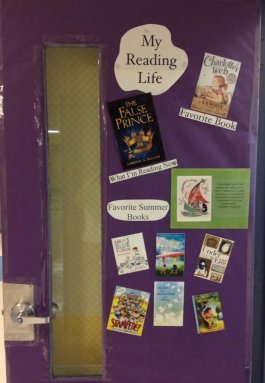
As a literacy specialist, I wear my love of reading on my sleeve for all to see. Or on my door. Donalyn Miller shared her idea for a Reading Life door several years ago, and I’ve been creating them ever since.
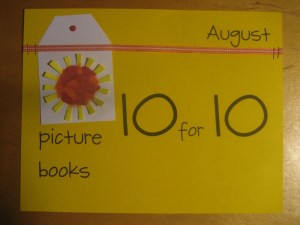
My Reading Life, August, 2014 Edition
Until now. Over the summer, I moved into a new room. My old door was perfectly placed for third, fourth, and fifth graders to see everyday. Kids often stopped to study the book covers or ask me about a title.
Now I have three roommates, so the door isn’t just mine. Also, it faces a wall, so it could only be seen if the door was closed, which it never is.
I’m sure there is another way to create a Reading Life display, but I haven’t figured it out yet. (I’m still unpacking all my books!) In the meantime, here’s a virtual door I created in Canva.
What would be on your Reading Life display?
Thank you to Stacey, Dana, Betsy, Beth, Kathleen, Deb, Melanie, and Lisa for creating this community and providing this space for teachers and others to share their stories each Tuesday. Be sure to visit Two Writing Teachers to read more Slice of Life posts.
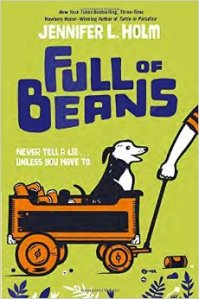
In a note to readers, Jenni Holm explains that when her son was old enough to read Turtle in Paradise (Random House, 2010), “he wanted to know more about Turtle’s sharp-tongued cousin Beans.” He told her, “Beans needs his own story.”
Thankfully, Jenni Holm agreed and has served up Full of Beans (Random House, 2016), a rich, rewarding novel for middle-graders that grapples with hard questions about right and wrong.
Beans Curry’s authentic voice leaps off the page from the first sentence: “Look here, Mac. I’m gonna give it to you straight: grown-ups lie.” It is 1934 and the Depression has hit Key West hard. Work is scarce, and Beans is doing everything he can to help his family survive. After he and his younger brother, Kermit, are cheated out of money for cans they’ve collected, Beans can’t resist the lure of a job from Johnny Cakes, Key West’s resident gangster.
But even though he tries to hide the fact, Beans is really “a good boy.” Whether he’s helping his mother deliver the laundry she takes in or watching his kid brothers, everyone knows they can count on Beans. So when his work for Johnny causes harm to his friend Pork Chop’s family, Beans feels “like a criminal.” Desperate to redeem himself, Beans learns some hard lessons about telling the truth, being a friend, and doing the right thing.
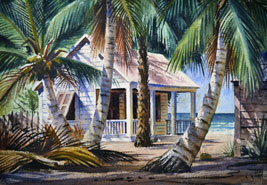
Holm does a masterful job of bring Key West of the 1930s to life. Local and historical details are expertly woven into Full of Beans. There are references to the Depression, WPA artists painting tourism posters, even Key West’s “resident writer.”
Along with Turtle in Paradise, Full of Beans is a great book club choice for 4th, 5th, or 6th graders studying theme, character, or author’s craft. It’s also a great choice to read for fun. And because Full of Beans is a prequel to Turtle in Paradise, you don’t have to read Turtle’s story first.
Full of Beans is full of humor, full of hope, and, most importantly, full of heart. Beans Curry is a character you won’t soon forget. And that’s no lie.
This post is part of “DigiLit Sunday,” hosted by Margaret Simon at Reflections on the Teche. Please be sure to visit her there to read more Digilit Sunday contributions.
When Margaret posted this week’s topic for #DigiLit Sunday, I groaned. Where to begin with the word motivation?
I started jotting my thoughts as they came to me. My list looked something like this:
Love motivates us to do things for others.
A sense of accomplishment can motivate us to do things.
What about desire? What role does this play?
People are motivated to learn about and do things that are interesting to them.
None of this helped me narrow this topic down. I could think of personal examples for each point on this list, but I was curious about how these feelings work in the classroom. I had some examples from my own teaching experience, but I didn’t want to write only about anecdotal evidence.In The Journey is Everything (Heniemann, 2016), Katherine Bomer advises writers to “Read, watch, and listen. All types of texts—books, movies, art, music, Ted Talks—provide inspiration as well as actual content for elaborating essays.”
Sure enough, a quick Google search brought me to Daniel Pink’s Ted Talk on motivation. After about fifteen minutes of describing why carrot and stick approaches to motivation don’t work for “definitional tasks of the 21st century,” Pink went on to explain that intrinsic motivation is the best way to ensure high performance on creative, cognitively demanding tasks. Pink stated that people are motivated when they “desire to do things because they matter, because we like it, because they’re interesting, and because they’re part of something important.”
He went on to list three factors critical to intrinsic motivation:
autonomy—the urge to direct our own lives
mastery—the desire to get better and better at something that matters
purpose—the yearning to do what we do in the service of something larger than ourselves
I was struck by the similarities between what I wrote on my initial list and the three factors Pink describes as necessary for intrinsic motivation. And although Pink was looking at these elements in terms of business, their application to the classroom is obvious.
My students are always more motivated to read a book they have chosen, even if I limit their choice by giving them two or three options. Writing stories and essays about self-chosen topics is a much richer learning experience because the subject is meaningful to the writer.
The importance of students setting their own learning goals is not a new idea. But I know I need to do a better job at facilitating this process with my own students. Again, we can guide students through this process, even if we give them two or three goals to choose from.
Finally, giving our students a sense of purpose, of working toward “something larger than ourselves” is highly motivating. In the weeks after 9/11, I wanted to find some way to involve my 3rd grade students in efforts to help the families of the victims of the attacks. We ultimately designed and created an afghan that was raffled off. We donated the money raised to a fund for victims’ families. The kids were proud of the fact that they were contributing, and many even wanted to learn to knit so they could help with that part of the project.
So much has been written about motivation that it would take a person years to read all the articles and books that have been published recently. But motivating our students is arguably the most important part of our job. So thank you, Margaret, for selectingmotivation as our theme this week. It’s been helpful for me to examine my own thoughts about motivation and do a little research on the subject. I also found at least two books I’ve been meaning to read right on my bookshelf about this very topic. Now I’m motivated to start reading them today!
This post is part of “DigiLit Sunday,” hosted by Margaret Simon at Reflections on the Teche. Please be sure to visit her there to read more Digilit Sunday contributions.
It’s taken me a few weeks to get back into the routine of these Sunday posts. I thought Margaret’s invitation to choose our own topic this week was a good opportunity for me to share my contribution to Carol Varsalona’s “Summerscapes” gallery.
When I was a kid, my family and I spent our summer vacations camping with friends in Saunderstown, Rhode Island. Our daily routine always included a visit to Beavertail Point on Conanicut Island (also known as Jamestown). We explored tide pools, collected shells, and watched ships and airplanes from the nearby Quonset Point Naval Air Station.
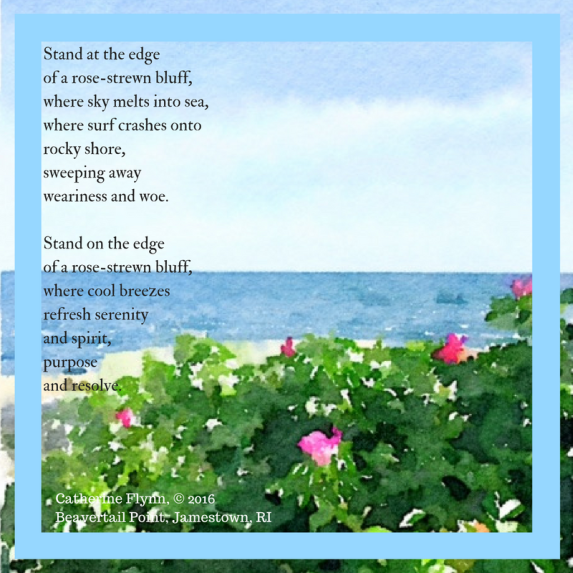
Earlier this summer, my sister and I spent an afternoon at Beavertail, reminiscing about those distant days. Our visit inspired this poem:
I took this photo of the view from the very tip of Beavertail Point, then converted it into a watercolor using the Waterlogue app. The border and text of my poem were added using Canva. I’ve used Canva to create similar combinations of images and poetry, but I’d never used a Waterlogue image. The process was fairly straightforward. Aside from writing the poem, I think my biggest challenge was choosing a color for the border! One of my goals for the coming school year is to have students create similar images, pairing their photos with the poetry they inspired. Stay tuned for more about this!
“Reading became my rocket ship out of the second-floor apartment in the projects. I traveled the world through books.” ~ Sonia Sotomayor ~
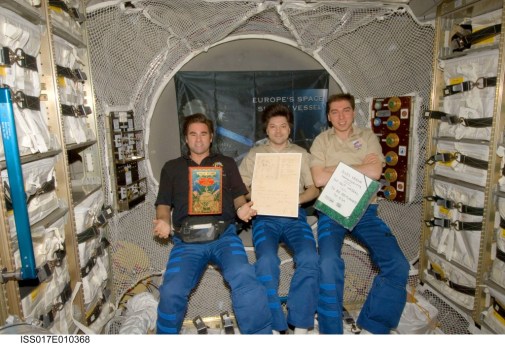
Space Station Expedition 17 crew holding Jules Verne book and manuscript inside ATV Jules Verne. Credits: NASA
There’s a welcome chill in the air this morning, and in just a week, students will be streaming into my school. They’ll be eager to see their friends and meet their teachers. I’m eager to greet them. My summer has been filled with reading and attending conferences that have given me a plethora of ideas about ways to help my students learn and grow as readers, as writers, as people.
As I reflected on all of the professional development I’ve participated in the past few months, one work kept coming up: volume.
Kelly Gallagher talked about the importance of reading volume at ILA in Boston: “If the volume doesn’t happen, it doesn’t matter what standards we cover.”
At TCRWP’s August Reading Institute, Kylene Beers shared that research shows that “reading volume is the single best predictor of how good a reader is.”
She also shared Richard Allington’s finding that “the more minutes of high-success reading completed each day is the best predictor of reading growth.”
How will I translate this into classroom practice? By keeping my minilessons truly MINI. This is a huge challenge for me, but I know it’s critical. It’s critical because the less time spent on a minilesson means more time for students to read and write independently. It means more time for me to confer with individuals and small groups, where powerful learning is more likely to happen.
Kids also need this space to practice the skills they’re learning. Because, as Kathleen Tolan recently reminded teachers, “it’s in the over and over again of trying that you get better at something.” She also pointed out that “it’s not always about moving them higher, but for them to get better at it.” And, according to Mark Overmeyer, in order to be effective and lasting, “practice must be done in context.”
This means that kids are practicing reading in books that they choose. I might guide this choice, but the child should have the final say. In his decades of research, Richard Allington has found that “the best intervention is a good book that a child can and wants to read.”
How will I ensure that kids have books they can and want to read? I’ve read more books this summer than I’ve ever read in a single summer. I’ve done this because I want to be able to say to a student, “I thought of you when I read this book.” In his Newbery Medal Acceptance speech, Matt de la Peña told listeners that he didn’t identify himself as a reader until college, when a professor gave him a copy of Alice Walker’s The Color Purple. “When I finally fell for literature, I fell hard.”
He went on to say, “But what if I can nudge a few…kids toward the magic of books at a younger age?” That is my mission. To know my students well enough that I can read a book and know that it’s a book they might love. A book with a character they can look at and say, “I know how she feels.” Or, “That’s me. I’m not alone.” A book that nudges them toward the magic.
Stephanie Harvey says that when we give them the access, the choice, and the time, the volume will follow naturally. Because when students find that magic, they read more.
And when they know they’re not alone, that we’re there to cheer them on, to lend a hand, an ear, a shoulder, that is when they do their best learning. That is how we, in the words of Kylene Beers, “change tomorrow, each and every day.”
Thank you to Stacey, Dana, Betsy, Beth, Kathleen, Deb, Melanie, and Lisa for creating this community and providing this space for teachers and others to share their stories each Tuesday. Be sure to visit Two Writing Teachers to read more Slice of Life posts.
I saw a meme on Facebook recently that said something like “August is the Sunday night of summer.” And it’s true. Most teachers I know spend August gearing up for the return of our students. But any grumbling from me is really about the loss of summer’s pace and not about returning to work. For me, this poem by Pat Mora explains why we show up, everyday, with a smile for every child we see.
“Ode to Teachers”
by Pat Mora
I remember
the first day,
how I looked down,
hoping you wouldn’t see
me,
and when I glanced up,
I saw your smile
shining like a soft light
from deep inside you.
“I’m listening,” you encourage us.
“Come on!
Join our conversation,
let us hear your neon certainties,
thorny doubts, tangled angers,”
but for weeks I hid inside.
I read and reread your notes
praising
my writing,
and you whispered,
“We need you
and your stories
and questions
that like a fresh path
will take us to new vistas.”
For the past week, I’ve been at the Teachers College Reading and Writing Project August Reading Institute. Every educator deserves to spend a week learning from the passionate, brilliant people here. Each day, keynote speakers share their latest thinking about reading and reading instruction.
The message this week has been loud and clear: WE ARE WHAT WE READ
Matt de la Peña told us on Tuesday that he believes the job of a young person is to “discover the different possibilities that are in front of you.” If a young person is a nonreader those possibilities are very limited.
Stephanie Harvey implored us to “table the labels.” A student is not a number or a letter. A student is a human being with hopes and dreams and desires. When we label them and allow them to read only books that match that label, we are limiting the possibilities they see for themselves. That is unconscionable.
With all this in mind, this poem, by Naomi Shihab Nye, seemed especially appropriate to share and keep in our minds and hearts as we head back to our classrooms.
“The Young Poets of Winnipeg”
by Naomi Shihab Nye
scurried around a classroom papered with poems.
Even the ceiling, pink and orange quilts of phrase…
They introduced one another, perched on a tiny stage
to read their work, blessed their teacher who
encouraged them to stretch, wouldn’t let their parents
attend the reading because parents might criticize,
believed in the third and fourth eyes, the eyes in
the underside of leaves, the polar bears a thousand miles north,
and sprouts of grass under the snow. They knew their poems
were glorious, that second-graders could write better
that third or fourth…
“We believe words can transform the world.” ~ Kwame Alexander ~
Jerry Pinkney, in his acceptance speech for the 2016 Laura Ingalls Wilder Award, proclaimed that he “learned through [his] own creativity that the world was limitless.” The books we share in our classrooms feed the creativity and imagination of children in limitless ways. Here are ten new books filled with beauty and humor that convey the power of observation and imagination.
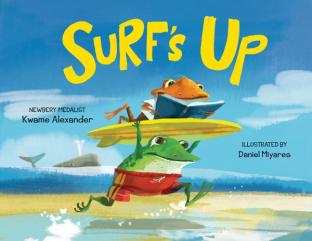
Surf’s Up! by Kwame Alexander, illustrated by Daniel Miyares (North/South Books, 2016) “Books are boring” “DUDE, BOOKS ARE FASCINATING!” So begins this lively back-and-forth between two surfing frogs. Dude is ready to head to the beach, but Bro is engrossed in his book. The story Bro is so engrossed in comes alive through the illustrations, and as he reacts to the action, Dude gets drawn in & wants to know what’s so exciting. Bro won’t tell, so Dude starts reading, abandoning his surf board for a whale of a tale.
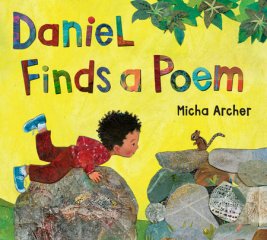
Daniel Finds a Poem, by Micha Archer (Nancy Paulsen Books, 2016)— Curious because of a sign announcing “Poetry in the Park,” Daniel asks all his animal friends, “What is poetry?” Each animal replies with a poetic description of something important in their habitat. Daniel creates his own poem by stringing their lines together, learning in the process that poetry is everywhere.
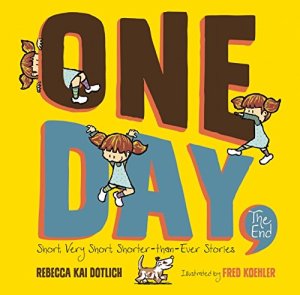
One Day, The End: Short, Very Short, Shorter-Than-Ever Stories, by Rebecca Kai Dotlich, illustrated by Fred Koehler (Boyds Mills Press, 2016). When I was first teaching, a common writing assignment was to write a new ending to a story. In this charming book, Rebecca Kai Dotlich offers a variation: “For every story there is a beginning and an end, but what happens in between makes all the difference.” A series of episodes in a young girl’s life unfolds in Dotlich’s spare text. Fred Koehler’s witty illustrations bring these episodes to life. Together, the offer endless storytelling possibilities.
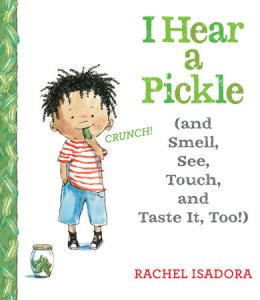
I Hear a Pickle (and Smell, See, Touch, and Taste It, Too!), by Rachel Isadora (Nancy Paulsen Books, 2016) If, as Kwame Alexander tells us, “words can change the world,” we need a whole arsenal of them. This concept book for younger readers is a great introduction to onomatopoeia and what’s all around us to hear (and smell, see, touch and taste) when you open your senses to the world around you.
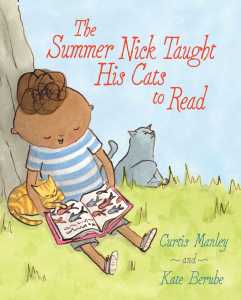
The Summer Nick Taught His Cats to Read, by Curtis Manley, illustrated by Kate Berube (Simon & Schuster Books for Young Readers, 2016) It’s a truth universally acknowledged that cats have a mind of their own. So when Nick decides to teach his cats to read, we aren’t surprised they aren’t too cooperative. But Nick is determined. He makes flash cards in the shape of objects, “and Verne got interested.” and is “soon reading new stories all by himself.” Not so Stevenson, who hides whenever Nick approaches with a book. Lo and behold, Stevenson has his own ideas for a story and has drawn all the pictures. The three friends join forces to create “The Tale of One-Eyed Stevenson and the Pirate Gold,” which turns out to be the first of many adventures. The subtle humor and message of this book make it a must-read.
Yaks Yak: Animal Word Pairs, by Linda Sue Park, illustrated by Jennifer Black Reinhardt. (Clarion Books, 2016) Words are beautiful and have the power transform us, but they are also funny and fun to play with. Clever illustrations contain a subplot and definition for each pair of words, and an afterword lists the origin of each animal name and its matching verb.
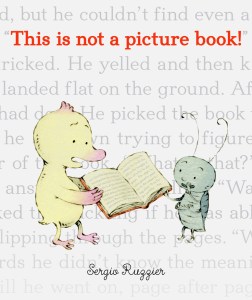
This Is Not a Picture Book, by Sergio Ruzzier (Chronicle Books, 2016) Duck is excited to find a book, but quickly becomes discouraged when he discovers the book has no pictures. Luckily, he has a friend to cheer him on and encourage him to try reading the book anyway. Ruzzier brilliantly illustrates the magic of a book coming to life though his use of color and the gradual introduction of, wait for it, pictures! As Duck discovers he knows some of the words, he realizes that “Some are funny” and “Some are very sad.” The illustrations convey these shifting emotions and moods. A lovely reminder that words are magical, transformative, and “stay with [us] forever.
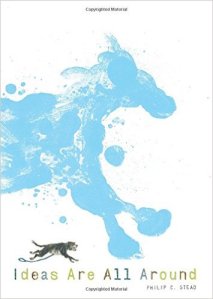
Ideas Are All Around, by Philip C. Stead (Roaring Book Press, 2016) At the opening of this book, an unnamed narrator tells us “I have to write a story today. That is my job. I write stories. But today I don’t have any ideas.” How often have we all heard that? To unlock his stories, Stead takes his narrator (him?) on a walk around his neighborhood where ideas are indeed “all around.” The blend of photographs with “monoprint techniques and collage” add to the child-like quality of this book and make it accessible to kids. A wonderful testament to the fact that ideas for stories don’t have to be fanciful.
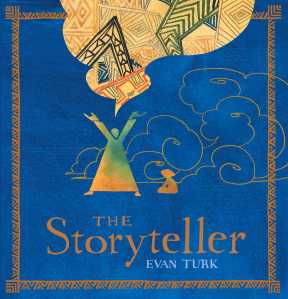
The Storyteller, by Evan Turk (Atheneum Books for Young Readers, 2016) This rich and nuanced book draws on millennia of storytelling traditions, including frame stories and Scheherazade to weave a warning to the modern world of what’s at stake when”One by one, the storytellers were drowned out by noise…” and stopped telling stories. This beautifully illustrated book reminds us that our stories are as vital and nourishing to our lives as water.
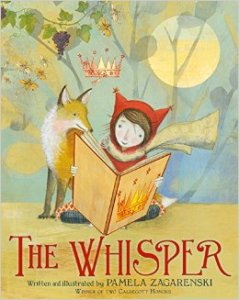
The Whisper, by Pamela Zagarenski (Houghton Mifflin Harcourt, 2015) Pamela Zagarenski is known for her whimsical illustrations full of fanciful crowns, somber tigers, and buzzing bees. These elements are all present and accounted for in The Whisper, as is a clever subplot to the main story. “A little girl who loved stories” is given a “magical book of stories” by her teacher. Excited to read this treasure, the little girl hurries home, not realizing that the words are escaping out of the book as she runs. Bitterly disappointed by “the wordless book,” she soon hears a whisper telling her she “can imagine the words…and stories.” Slowly, the girl’s stories unfold and become more elaborate as she finds her voice and a storyteller is born.
BONUS BOOK
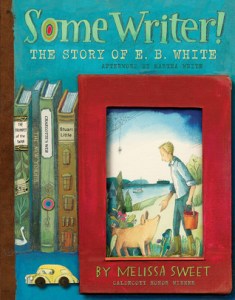
Some Writer!: The Story of E.B. White, by Melissa Sweet (Houghton Mifflin Harcourt, 2016) At 176 pages, this biography is not a picture book, but it is filled with Melissa Sweet’s loving illustrations. It is sure to inspire older readers and writers to “be on the lookout for wonders.” When I was at the International Literacy Association in Boston earlier this summer, I happened upon the Houghton Mifflin Harcourt booth when an author signing was taking place. I wasn’t familiar with the author or the book, but there weren’t too many people in line, so I joined the queue. As I was waiting, one of the sales reps and I started chatting. There was a poster for Melissa Sweet’s new biography of E.B. White, which is coming out in October. I had already scoured the list of author signings to see if Sweet would be at the conference, but alas, she wasn’t on the schedule. So I asked the rep if there were any ARCs of Some Writer! hiding in the booth. To my astonishment and delight, there were! When the rep handed me the book, I felt that I had been given a great treasure, just like the little girl in The Whisper. I promised the rep I would write about the book. I will write a longer review closer to the actual publication date, but felt this list wouldn’t be complete without a mention of this book.
Thank you to Cathy Mere and Mandy Robek for creating and curating this celebration of picture books. You can read all the lists contributed to this labor of love here. It is teachers like them, and others in this community, who will keep the gift of stories alive for years to come.
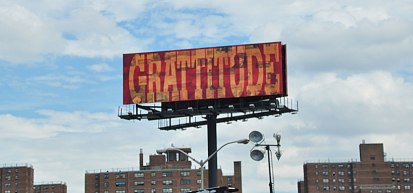
I saw a sign similar to this from my seat on the train as it rumbled into New York City on Sunday afternoon. It went by so quickly I didn’t process the spelling, just the word. Yes, I thought. That is the perfect word for today.
More than twenty-four hours later, it’s still the perfect word. I am full of gratitude to have the opportunity to attend the Teachers College Reading and Writing Project’s August Reading Institute. After just one day, Lucy Calkins has inspired me to do everything I can to “make reading the best thing it can be” for my students.
In her opening keynote in the soaring nave of Riverside Church, Lucy encouraged the 1300 teachers and administrators present to create classroom and school communities where this can happen. Communities were students feel safe to take risks, where they know their voice will be heard and counted. Communities where they feel connected to something bigger than themselves. These communities are critical, Lucy explained, because “learning to read involves more risk than we often acknowledge.”
“Embrace the “F” word,” she admonished. We have to be willing to “fail early and fail often.” For it is only through our failures that we grow. “Sharing our work in progress can give us strength.” Lucy continued with Brené Brown‘s wise words: “vulnerability is the birthplace of joy, of creativity, of belonging, of love.” (Which, coincidentally, I wrote about here.)
Lucy went on to share findings that David Brooks reported on his his column in the New York Times a few years ago. Brooks stated that studies done by Google have found the use of words such as patience and compassion in books published over the past fifty years has fallen dramatically. The implications of this are frightening, but sadly are playing out daily on the front pages of newspapers from around the country.
We have the power to change this trend in our classroom communities. Lucy urged us to make our students feel included in this mission by inviting them to “co-create” their classroom. These spaces will be places where students will feel safe “to do their best work” and “role-play their way into being the readers (and people) they want to be.”
Books are tools that help us envision what these communities can look like, Lucy reminded us. Books like The Big Orange Splot, by Daniel Pinkwater and The Hundred Dresses, by Eleanor Estes can help us “teach kids how to empathize and make others feel good.” Books like this year’s Newbery Award winner, Last Stop on Market Street, by Matt de la Peña that help kids sense a “… feeling of magic” in the world around them and gratitude for the communities that nurture them. Books have the power to help us all “grow into the people we want to be.” What a gift.
As summer winds down, thoughts turn to the start of school. Each new year brings new faces new challenges, new curriculum, but poetry remains a constant. Krista Tippet’s interview with Naomi Shihab Nye on last week’s episode of On Being (a must-listen!) prompted me to revisit “Valentine for Ernest Mann” and think about where poems are hiding in my life.
Here is a draft of one I found outside my kitchen window one morning this week:
Poems hide. They lie crouched in the tall grass at the edge of a thicket where each morning a tawny rabbit emerges to nibble his breakfast of grass and sweet clover. His ears stand at attention, alert for the slightest sound, eyes peeled for the shadow of a hawk, legs coiled in readiness to flee back into the safety of the thorns.






![By M2545 (Own work) [Public domain], via Wikimedia Commons](https://readingtothecore.com/wp-content/uploads/2016/08/rabbit_north_america.jpg?w=368&h=196)
 Reading to the Core