“Kind words do not cost much. Yet they accomplish much.” ~ Blaise Pascal
Last spring, at the Teacher’s College Reading and Writing Project Saturday Reunion, Lucy Calkins urged the thousands of teachers gathered at Riverside Church to be supportive of our colleagues and to treat one another with kindness through this tumultuous time in education.
The importance of maintaining this kind of positive attitude is being felt in schools across the country this fall. In Connecticut, where I teach, the state’s new teacher evaluation system is being rolled out this year. Teacher’s are now required to have five goals: two Student Learning Objectives (SLO’s), one Professional Growth Goal (linked to the Connecticut Common Core of Teaching Rubric), a whole-school goal linked to last year’s state assessment results, and a goal related to feedback from a parent survey. These have to be submitted by October 15. Needless to say, this is causing some stress.
And yet, as I meet with my colleagues each day to work on these goals, we feel a sense of accomplishment. As we read through writing samples, we learn more about our students and our writing goals become clear. We read and reread the standards, and our understanding deepens. Our unit plans begin to take shape, and we realize that we can do this. We are doing it. Together.
My colleagues and I have been thinking about how we are going to adapt our instruction to meet CCSS Reading Literature standard Nine (Analyze how two or more texts address similar themes or topics in order to build knowledge or to compare the approaches authors take.) I have always tried to link texts thematically whenever possible, but in Connecticut, our state test has had an inordinate emphasis on text-to-self connections for years. So this standard is causing us to rethink some of our curriculum.
I think this is a very good thing, as there is plenty of evidence that reading multiple texts on the same topic and pairing fiction and nonfiction texts helps students build a stronger knowledge base. So we’ve been creating text sets to support our reading units of study. For example, we’ve selected a variety of titles around the main theme of each unit so students have an independent reading book of their choice that has a similar theme to the short story or novel being read in class. For the past week or so, I’ve been reading and rereading several books we’re thinking about adding to our collection.
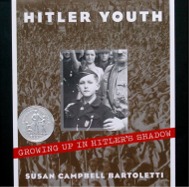
In the spring, the 8th grade will study the Holocaust in social studies and English/language arts. In the past, students have read the play, The Diary of Anne Frank. We haven’t made all of our choices yet, but so far have added The Book Thief to this unit.We want to include nonfiction as well, so last weekend I read Hitler Youth: Growing Up in Hitler’s Shadow, by Susan Campbell Bartoletti. (Scholastic Nonfiction, 2005) This is a powerful book. Parts of it were difficult to read, but Bartoletti does an excellent job of creating a clear picture of how Hitler manipulated the young people of Germany to his purposes. Using extensive primary sources and photographs, readers experience life in Germany from the rise of the Nazis in the early 1930s to the end of the war and beyond. Bartoletti also includes the story of several teens who realized the Nazi leaders were lying to the German people. They tried to warn others, but were arrested and executed. An epilogue tells readers what happened to the young people whose stories are told throughout the book after the war, and there is an extensive bibliography. In 2006, Hitler Youth: Growing Up in Hitler’s Shadow was named a Newbery Honor Book, a Siebert Honor Book, and an Orbis Pictus Honor book for Outstanding Nonfiction for Children.
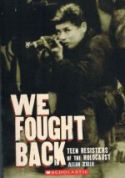
Bands of partisans fought against Hitler throughout Europe, and many of these brave men and women were teenagers. Allan Zullo has collected their stories in We Fought Back: Teen Resisters of the Holocaust. (Scholastic, 2012) This book has many gripping accounts of the harsh conditions the partisans endured, especially during the winter, and the dangerous missions they undertook in their attempts to break the Nazi war machine. There are notes about the lives of these resisters after the war, as well as recommendations for reading more about each individual.
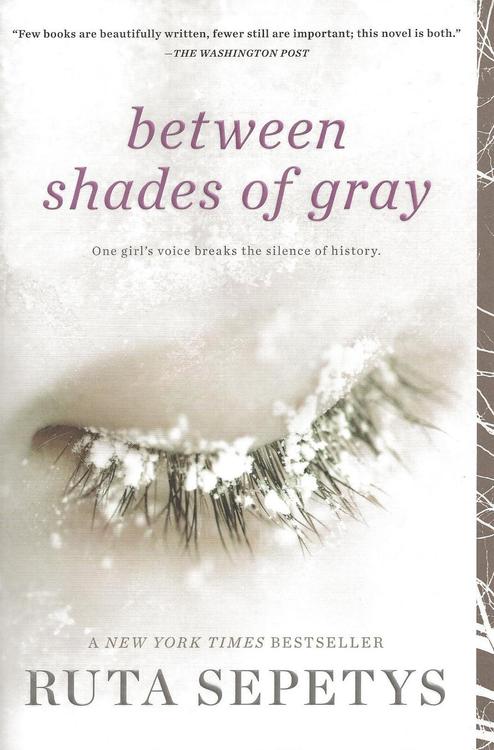
Although it isn’t about the Nazis, we will probably include Ruth Sepetys’s Between Shades of Gray in this unit, as there are so many similarities between Lina’s story of persecution and deportation in Soviet Russia under Stalin during World War II and what was happening in Germany and much of Europe at the time. If you haven’t read this amazing book, add it to your list today. In the meantime, you can learn more about it here.
It’s not easy to have the courage to stand up for what you believe in, for what what you know is right. We Fought Back: Teen Resisters of the Holocaust and Between Shades of Gray offer readers inspiring portraits of young people who fought against governments who denied their basic humanity. Reading these books in conjunction with Hitler Youth will give readers plenty of opportunities to build their knowledge and discuss this terrifying time in world history.
There are many other excellent books that would fit in a unit on the Holocaust. What titles do you include in similar units? How are you addressing standard nine?
Be sure to visit Jen at Teach Mentor Texts and Kellee at Unleashing Readers to find out what other people have been reading lately. Thanks, Jen and Kellee, for hosting!
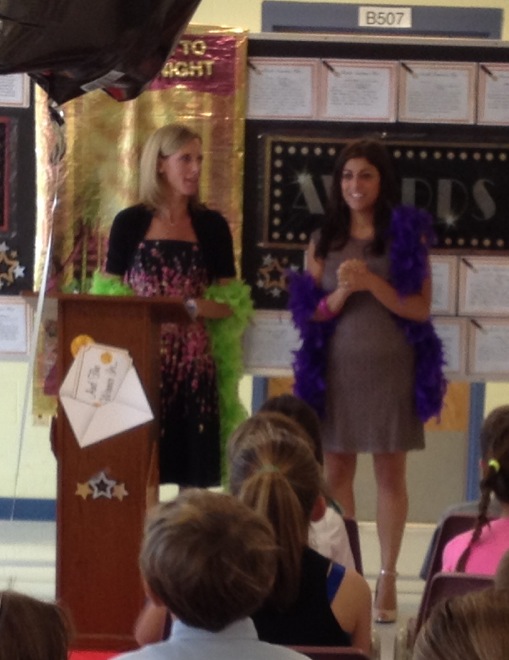
Last week, on the sixth day of school, my fourth grade colleagues kicked off the year in style with their annual “Readers’ Choice Awards.” Wanting to make summer reading assignments more purposeful, Bernadette and Kim came up with a plan that also energized their students about reading.
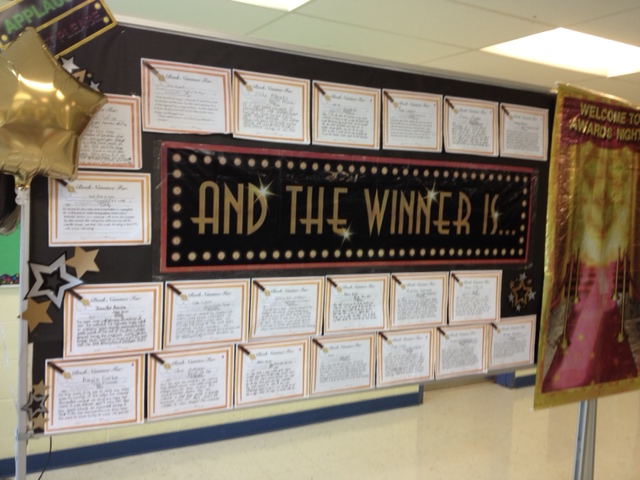
Each student was encouraged to nominate one of their summer reading selections (all chosen from a list of suggested titles, but students could chose a book not on the list) for the best book in one of the following categories: Best Character, Best Setting, and Best Plot. Students wrote their nominations, hoping to persuade their classmates to vote for their book. Once all the nominations were shared, the children voted for a book in each category.
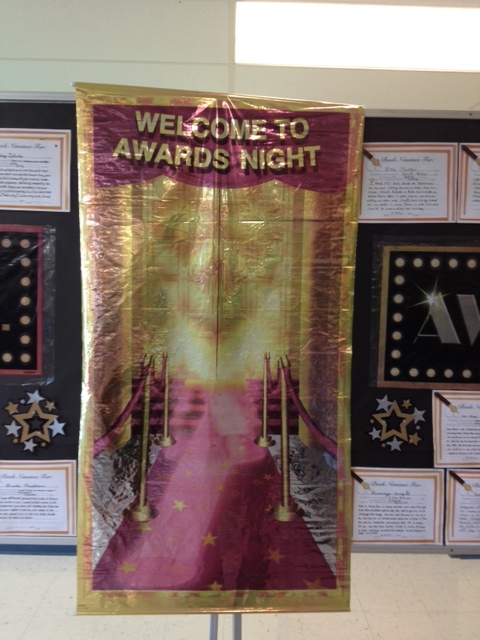
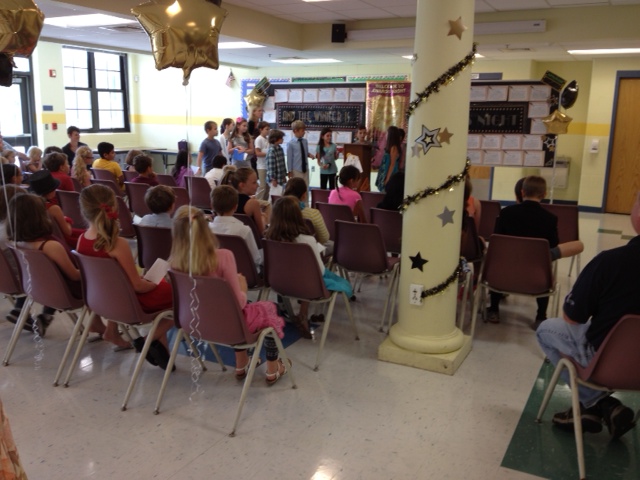
Most fourth-graders arrived at school on Friday dressed to the nines for the awards ceremony, which included a red carpet, golden statues, and lots of applause. After a quick thank-you to the parents from Kim and Bernadette, the Masters of Ceremonies were introduced, and the nominees for the first category were announced. Students were called up to the podium to share the book they nominated, and the runner-up was announced. Then the emcee opened the envelope containing the name of the winner. To heighten the excitement, students in the audience provided a drum-roll on their laps. A statue was presented to the student who nominated the winning book before he or she read a short thank-you speech.
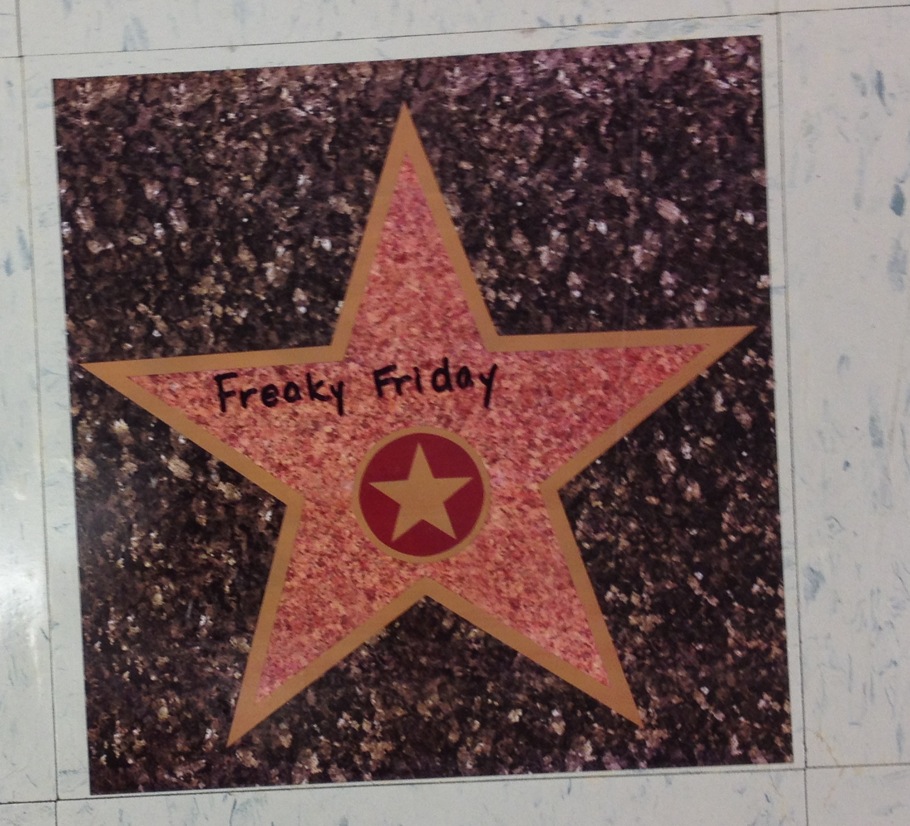
Once all the awards had been handed out, students mingled with their parents and other guests and posed for photos. All the nominations were displayed for visitors to read, and there were even Hollywood-like stars on the floor leading into the cafeteria.
Although this ceremony lasted only half-an-hour, it’s impact will be felt for the rest of the year. By being sensitive to including as many students as possible in the ceremony, Kim and Bernadette created a supportive tone in their classrooms and sense of community that often takes much longer to establish. Even students whose books weren’t chosen had the opportunity to share the title of their book. Parents loved seeing their children celebrate their summer reading in a meaningful way, and the students started the year off with style, excited about reading and sharing books with their friends.
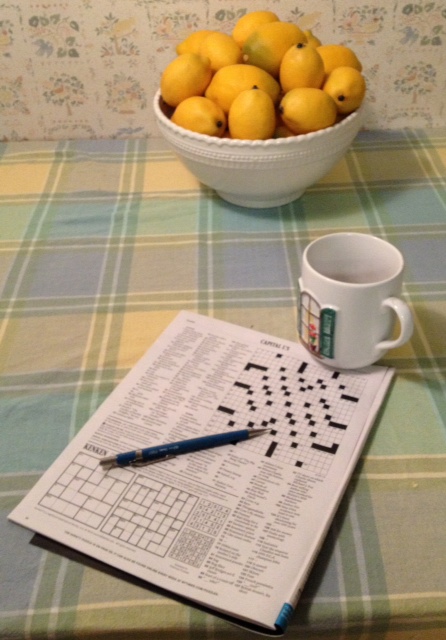
The idea for this poem came from a journal entry I wrote in response to one of Corbett Harrison’s “Sacred Writing Time” prompts. When my colleagues and I were working on our writing curriculum, we began each day by writing for ten minutes. On this particular day, the slide stated that “dreamt” is the only word in the English language that ends with “mt.” As a Scrabble player and crossword puzzle lover, this intrigued me. So I wrote about filing this tidbit away, thinking it would come in handy as I was “puzzling through the possibilities” when solving a puzzle. Right away, I noticed this phrase. I loved the alliteration and the potential it contained. So I began playing with ideas. I’m still puzzling over this draft; I’m not sure the middle flows as well as it could, but I’ve had fun working on it.
By the way, the Rossini clue is from the New York Times Sunday puzzle from August 25, 2013, constructed by Victor Barocas.
Be sure to visit Laura at Author Amok for the Poetry Friday Round Up.
Last week, Sarah Horn’s life was changed “For Good” when Kristen Chenoweth invited her to share the stage to sing a duet of the song from the Broadway show Wicked.
I was deeply moved as I watched the video that has now been viewed by over 2 1/2 million people. I was struck by these lines in particular:
“…I know I’m who I am today
Because I knew you…”
How many people are fortunate enough to be able to say this to one or more individuals who have made a difference in their lives? How often is that individual a special teacher?
Teachers often never know the impact they have on their students. Because this is true, we owe it to every child to help them to be their very best, to help them discover, as Ann Patchett’s characters in Bel Canto only begin to discover, “all the brilliant things we might have done with our lives if only we suspected we knew how.”
As I walked down the hall today, I watched a fourth-grade boy the size of a first-grader, a boy born with multiple disabilities try to jump up and touch the moulding at the top of the door jam as he headed for the bathroom. We usually discourage kids from doing this, but as I watched him I thought, “Go for it. Jump as high as you can. I hope someday you reach the top.”
Thank you, as always, to Stacey and Ruth at Two Writing Teachers for hosting the Slice of Life Challenge and providing a space for us to become better writers by telling our stories.
Nowadays, it seems that Labor Day is more about the last official summer holiday and sales, not about the workers it honors. So today it seems appropriate to share books about the everyday heroes who took tremendous risks and made many sacrifices to help shape the labor laws we have today.
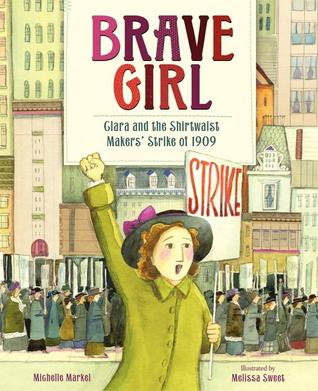
Brave Girl: Clara and the Shirtwaist Maker’s Strike of 1909, by Michelle Markel (Blazer + Bray, 2013; illustrated by Melissa Sweet) tells the true story of Clara Lemlich, who immigrated with her family from the Ukraine when she was 17 years old. Her father was unable to find work, so Clara went to work in one of the many shirtwaist factories on the lower east side of Manhattan in the early 20th century. Clara soon discovers the harsh realities of the garment industry, and helps organize the famous 1909 strike.
Melissa Sweet’s illustrations are always appealing, and here they provide a glimpse into the conditions of the tenements and factories of the time. Using her signature collage, Sweet incorporates fabric, stitching, and patterns to recreate Clara’s world. In an interview with Julie Danielson at Seven Impossible Things Before Breakfast, Sweet explains that this “felt like a fitting way to honor these brave seamstresses.”
The picture book format of Brave Girl shouldn’t discourage teachers of upper elementary grades from sharing this book with their students. In fact, Markel’s text is an ideal introduction to this important chapter of our history. Once students’ curiosity has been piqued, there are many other excellent books available to extend their learning.
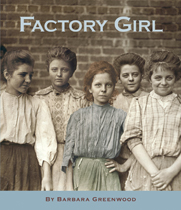
In Factory Girl, by Barbara Greenwood (Kids Can Press, 2007), combines fiction and non-fiction to bring the world of the garment and textile mills of New York and New England at the turn of the 20th century to life. Archival photos, many by Lewis Hine, reveal the terrible working conditions these children endured. This book also includes a timeline of the labor movement in the United States.
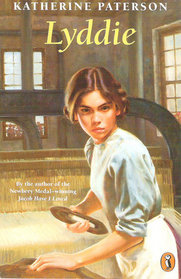
Katherine Patterson has written two novels that vividly depict the experience of young workers in New England textile mills. Lyddie (Dutton, 1991) takes place much earlier than the events in Factory Girl, but the situation is very similar. Lyddie arrives at a textile mill in Lowell, Massachusetts in the 1840s, just as several of the women are organizing to demand 10-hour working days. Patterson expertly weaves other aspects of life for these “factory girls” into the story. Facts like the “company” requirement of regular church attendance and the numerous restrictions on the girls’ after-work activities will be sure to provoke many heated discussions and are natural springboards for opinion and argument writing.
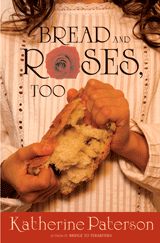
Bread and Roses, Too (Clarion Books, 2006) takes place in Lawrence, Massachusetts during the Bread and Roses strike of 1912. Sadly, the mill workers in this novel are still confronted with many of the issues Lyddie struggles against over half a century before.
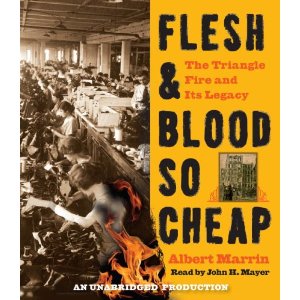
As is often the case, it took a tragedy before these conditions changed in any meaningful way. The 1911 fire at the Triangle Waist Company led to the deaths of 146 workers who were locked into the factory so they couldn’t leave early. Albert Marin has written a riveting account of the tragedy in Flesh and Blood So Cheap: The Triangle Fire and Its Legacy (Alfred A. Knopf, 2011). Marin sets the stage by telling the story of why so many Europeans were desperate to come to America in the first place. Incorporating archival photos and eyewitness accounts, this book is an important resource for students and teachers alike.
While children in the United States today are protected by child labor laws thanks to the efforts of Clara Lemlich and countless others, the same cannot be said for children around the world. These books open the door for students to conduct research and gain new insights into child labor around the world. The New York Times Learning Network has a lesson plan and resources related to the factory collapse in Pakistan earlier this year, and Teachers College Reading and Writing Project has an extensive collection of links to articles and videos available on-line, as well as books that address both the history of child labor and examples of child labor as it exists today.
There are many other fine books about other leaders of the Labor Movement, as well as fictional accounts of its many unsung heroes. I’d love to know which books are your favorites.
Be sure to visit Jen at Teach Mentor Texts and Kellee at Unleashing Readers to find out what other people have been reading lately. Thanks, Jen and Kellee, for hosting!
As this week of commemoration and celebration of the fiftieth anniversary of the March on Washington and Martin Luther King, Jr.’s “I Have a Dream” speech comes to a close, I’d like to share a book of poetry that gives voice to a little-known chapter in the history of segregation and discrimination against African-Americans in the United States.
Dial Books, 2009
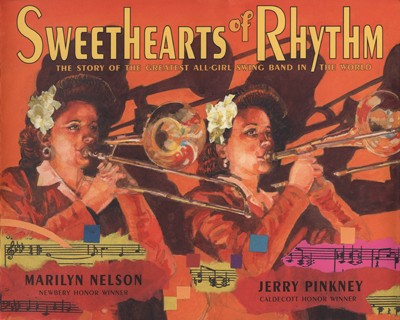
Sweethearts of Rhythm: The Story of the Greatest All-Girl Swing Band in the World, by Marilyn Nelson, is a completely original book. Nelson has created a mosaic of voices which, piece by piece, tells the story of “the first integrated all-women swing band in the world.” (Author’s Note) Rather than have each musician tell her story, Nelson lets the instruments talk. And do they have a tale to tell! Beginning with the band’s roots in the Piney Woods Country Life School, each poem shares details about the musicians and their music, as well as African-American life in the early 20th-century South.
Nelson’s poetry also illuminates the character of each instrument. In “Bugle Call Rag,” the trumpet isn’t shy about it’s status in the band:
“No trumpet has ever been tempted
Not to funambulate
On the filament of a melody.
We’re all stars; we were made for the limelight.”
Events of the wider world are also described in the poems, each one named for a popular song of the period. When war is declared against Japan, the tenor sax tells us that Twin Ione or Irene Gresham
“…bowed her head
Then lifted me and eased me into song…
It was ‘Chattanooga Choo-Choo,’ but it was a prayer for peace.
She was trying to change the world through sound.”
But, in “Jump, Jump, Jump,” the alto sax reminds us that the reality of life is never far away for these musicians.
“From ballroom to ballroom, the unsleeping eye of Jim Crow
Ever upon us, we traveled the United States
of Colored America, bouncing on back-country roads…”
Throughout the text, Jerry Pinkney’s amazing illustrations mix watercolors and collage to enhance the feeling of Nelson’s poems. Sepia tones are used to portray the desolation of the Dust Bowl, the indignity of segregated restrooms, and the injustice of Japanese internment camps. Warm, vibrant colors are used when children are jumping, couples are dancing, and victory is being celebrated.
Appropriately, in “That Man of Mine,” that show-off trumpet shares the news:
“Her pristine technique wove a shimmering texture of sound
That was shot through with joy, on the day the Armistice was declared.”
These lines could also describe Nelson’s crafting of these poems. Their “shimmering texture of sound” isn’t always shot through with joy, but it always contains the truth, a testament to the lives of these brave women and their instruments, who did bring joy to countless Americans despite the prejudices they faced.
Anna Mae Winburn and the International Sweethearts of Rhythm, performing “Jump, Children
Please be sure to visit Tara at A Teaching Life for the Poetry Friday Roundup for more poetry.
“Quantity produces quality. If you only write a few things, you’re doomed.” –Ray Bradbury
via Wikimedia Commons
To say that I have been obsessed with writing lately would be an understatement. The curriculum work I wrote about last week has me very excited about our school year. As I’ve prepared for school over the past week, though, I realized I left out at least one critical element of writing instruction: time.
In his 2008 book Outliers, Malcom Gladwell popularized the idea that it takes 10,000 hours of practice to become a master at any given task. Recently, some have questioned this notion, and Gladwell responded with a clarification on The Atlantic Wireby pointing out that this rule applies to “cognitively demanding activities that need significant thought.” Writing is certainly a cognitively demanding endeavor.
For students to become even proficient writers, they need time every day to write. Students need ample time to generate ideas. They need time to play with language so they develop a richer vocabulary and deeper understanding of language structures. They need time to develop confidence and their writing voice.
Time is a four letter word for most of us. We never have enough, are always running out of it. But time is exactly what our students need if they are to come anywhere close to mastery of writing. We will never make more time, but teachers are creative problem solvers. By closely examining long standing routines and our priorities, we can find more time in our schedule for this skill that is so critical to learning.
At our meeting to kick off the year yesterday, all of the speakers shared a personal story about their experience in education. Our students have their own stories that they want to share. They deserve the opportunity to tell them. After all, caring about each others’ stories is what makes us human.
Thank you, as always, to Stacey and Ruth at Two Writing Teachers for hosting the Slice of Life Challenge and providing a space for us to become better writers by telling our stories.
Without trying to be thematic, I read three books this weekend that all related to taking better care of the Earth and all the creatures we share our planet with.
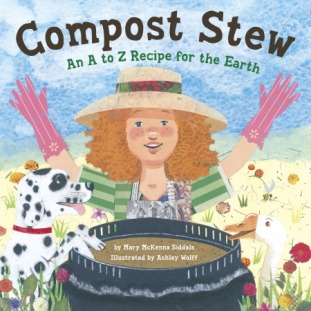
Compost Stew: An A to Z Recipe for the Earth by Mary McKenna Siddals (Tricycle Press, 2010; illustrated by Ashley Wolff) is a clever rhyming alphabet book that explains how and what to compost, as well as why composting is important. Ashley Wolff’s collage illustrations are a study in recycling themselves. The main character’s apron is made out of pages from the Farmer’s Almanac, beautiful papers are used for goose feathers, and found objects add depth to every page.
Years ago, we made composting columns out of soda bottles so kids could observe this process. This was a great project, although some kids were grossed our by the worms! Now, I would add a writing component to this unit, using the experience to model writing a how-to book. Instructions for how to construct these columns can be found here: http://www.learner.org/courses/essential/life/bottlebio/ecocol/build.html Marty McGuire Digs Worms by Kate Messner (Scholastic Press, 2012; illustrated by Brian Floca) is a natural read aloud choice for a unit like this.
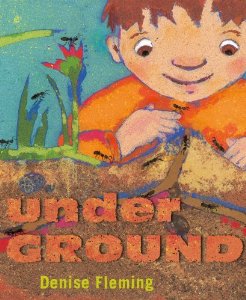
Denise Fleming is a favorite of early-childhood teachers everywhere. In underGround (Beach Lane Books, 2012), Fleming has created cut-away illustrations of the ground beneath our feet using pulp painting, “a papermaking technique using colored cotton fiber poured through hand-cut stencils.” (from a note included on copyright page) Animals, plants, rocks, and minerals are all shown with details sure to fascinate the youngest naturalists. Humorous touches are everywhere, making the book a kind of I-spy of buried treasures. Two pages of facts about the critters who inhabit the book supplement the simple rhyming text.
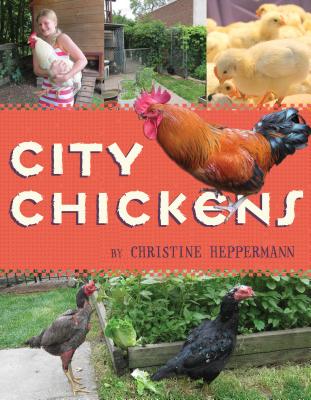
City Chickens (Houghton Mifflin Books for Children, 2012), by Christine Heppermann, is a non-fiction book for kids in second grade and up about Chicken Run Rescue, a shelter for rescued hens and roosters in Minneapolis. Heppermann includes a wealth of information about Mary and Bert Clouse’s efforts to care and find new homes for abandoned chickens. The reasons such a shelter is needed are explained, as is the responsibility of caring for these birds. You will have a different view of them after reading this book and seeing Heppermann’s gorgeous photographs. Notes include information for educators and a source list. This book could be used as a springboard for opinion writing about keeping chickens as pets. Teacher’s College Reading and Writing Project has a digital text set of additional resources on pets in the classroom here. More information about City Chickens is available on this website.
I grew up across the street from a working dairy farm. The rhythms of the farm were the rhythms of life. It makes me sad to know so many children are only able to experience nature from a distance, but these books will ignite the curiosity of children about the wonders that surround them.
Be sure to visit Jen at Teach Mentor Texts and Kellee at Unleashing Readers to find out what other people have been reading lately. Thanks, Jen and Kellee, for hosting!
For the past six days, I’ve worked with an amazing group of teachers making revisions to our writing curriculum. The dedication and passion these men and women brought to this work made my job of facilitating much easier. I feel good about what we accomplished and know that these teachers all feel prepared to launch the writing workshop in their classrooms next week.
We still have so much work to do, but thanks to the Units of Study developed by Lucy Calkins and her colleagues at the Teachers College Reading and Writing Project, we have a good grasp of the process and new expectations. Everyone is excited for school to start so we can begin working with students and help them become capable, confident writers.
Teachers often ask me about the purpose of the writer’s notebook. They are uncomfortable with the idea of letting kids write about a self-selected topic. They want to know what they’re supposed to do with this writing. Do they grade it? Does it have to become a story or some other kind of a polished piece. I always explain that no, this writing is not graded. It doesn’t necessarily have to become something else.
Because of these questions and the discomfort some of them have with writing itself, I began our work days by giving the teachers time to write. Some days I offered a photograph or piece of art; some days I shared one of Corbett Harrison’s Sacred Writing Time slides. It was interesting to watch how the teachers reacted to the prompts and how they worked. (I did write, also.) But the real revelations came when the teachers shared their writing.
Everyone had approached the task from a different angle, an angle that was meaningful to them. Some were surprised by the direction their writing took. Others were grateful for the opportunity to sit quietly and be reflective after a hectic morning trying to get to school by eight o’clock. We talked about the importance of giving our students choices about their writing and about the importance of feeling comfortable enough to share our work. We all agreed that going through this process ourselves would help us as we guide our students in the weeks to come.
The most valuable insight for me came from what I wrote this morning. Harrison’s slides always include whatever “National” day it is. Today happened to be National Radio Day. This made me remember a record album of old time radio programs that my mother used to listen to when I was little. Like links in a chain, this thought led to other ideas, which led me to an insight about a character in a story I’ve been writing this summer. This cascade of memories reminded me of one of my favorite scenes from Ratatouille, when Anton Ego takes his first bite of the dish Remy and Colette have lovingly prepared for him.
Why wouldn’t we want our students to have this same kind of opportunity to see where their writing takes them? Who knows what they might discover about themselves?


 Reading to the Core