Slice of Life: Letting Go of Fear

11454297503_e27946e4ff_h

“There is so much we overlook, while the abundance around us
continues to shimmer, on its own.”
Naomi Shihab Nye

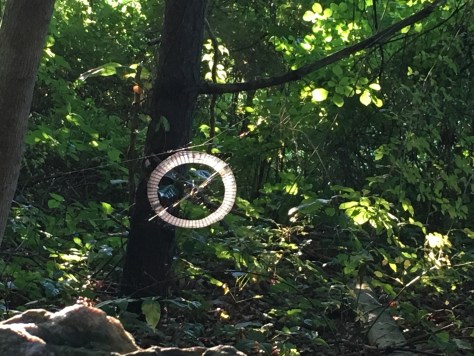
The night’s rain left the earth fresh and smelling of green things growing. The birds, playing hide and seek in the tree tops, called out, “Over here, over here.” And yet I stepped hesitantly into this lush, cool morning. I looked at every spot my foot would land before setting it down because I was afraid. Afraid of stepping on a snake.

My fear of snakes comes from an encounter with a large black snake when I was a child. This fear is totally irrational, since the snake didn’t harm me in any way. And yet, this fear is really the only one I have never outgrown. I know there are snakes in these woods. I’ve seen them. And although I’ve only seen harmless snakes, neighbors have seen copperheads. So despite the fact that my children played in these woods for many years without incident, I rarely venture into them.

Ophidiaphobia, the technical term for fear of snakes, “is among the most common animal phobias,” according to Phobias: The Psychology of Irrational Fear: The Psychology of Irrational Fear, (ABC-CLIO, 2015) edited by Irena Milosevic Ph.D., Randi E. McCabe Ph.D.

Okay, I’m not alone. And, even though, copperheadsnake.net reassures readers that “the chance of a fatal bite and envenomation by a copperhead is probably less than 1 to 5,000,” I’m not sure that makes me feel any better.

But my ophidiaphobia got me thinking about fear in general. Let me be clear, I’m not thinking about fear for our lives when we’re in mortal danger. Being afraid of an approaching hurricane is not the same as being nervous about trying a new teaching method or visiting a new city or country. Rather, I’m wondering about irrational fears and why it’s so hard to let go of them. And, what are we afraid of, really?

My suspicion is that it’s fear of being vulnerable, making a mistake, of looking foolish, or being wrong. So much has been written about this kind of fear lately that it’s hard to distill. TED Talks about vulnerability, failure, and fear are among the most watched, and book shelves bulge with volumes whose goal is to help us overcome our fears.

What exactly is the difference between fear and vulnerability? Psychology Today defines fear as “a vital response to physical and emotional danger,” whereas to be vulnerable is to be “easily hurt or harmed physically, mentally, or emotionally.” And yet Brené Brown has said that “vulnerability is the birthplace of joy, of creativity, of belonging, of love.” Aren’t these the feelings we want to nurture not only in ourselves but in our students?

So the issue isn’t one of not being afraid or vulnerable. As Kathryn Schulz explains in her TED Talk, “our capacity to screw up is not some kind of embarrassing defect in the human system…it’s totally fundamental to who we are.” The issue is to learn how to balance our fear and vulnerability so that we can choose a new or less familiar path. A path where we can see the lushness of the surrounding countryside. A path that can lead us to the delight of discovery.

The world is full of things to be afraid of. But it’s also full of wonder. I don’t want to miss those wonders because I’m so busy looking down, always watchful for a snake.
IMG_0746

 Thank you to StaceyDanaBetsyBeth, KathleenDeb, Melanie, and Lisa for this space for teachers and others to share their stories each Tuesday. Be sure to visit Two Writing Teachers to read more Slice of Life posts.
Slice of Life: A Weekend in Boston

                                          11454297503_e27946e4ff_h         f36176a2c4703110251c9b8c27654e22

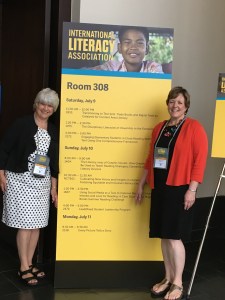
My mind and heart are overflowing with all the passion, knowledge, and energy that was shared by the colleagues I was fortunate enough to learn with and from at the International Literacy Association Conference in Boston. I’ll be reading, digesting and thinking about the sessions for weeks to come. But while the experience is still fresh in my mind, I want to share some key take aways.

“We all have a life worth writing about.” Adora Svitak

“Give your students a little piece of sky; help them soar.” Kwame Alexander

“We get better by doing the best we can” Mark Overmeyer

“Invite students to live writerly lives.” Paula Bourque

“Play opened avenues in my brain that I didn’t know existed.” Jennifer Jacobsen

“Look for the surprises in your writing…that’s where the gold of the story is hiding.” Cynthia Lord

“Let kids know our passion for reading” Penny Kittle & Kelly Gallagher

“Books provide imaginative rehearsals for the real world.” Kelly Gallagher

“Let kids know that “what they have to say matters.” Linda Rief

“We want kids to be responsive to the characters & themselves” Bob Probst

My weekend in Boston was also filled with seeing old friends and meeting online friends in real life.

IMG_0522
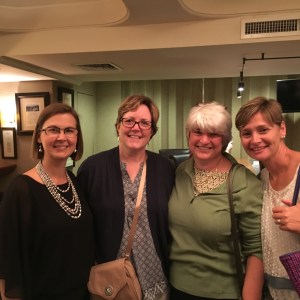
With Colette Bennett, Jan Burkins, and Kim Yaris.
CnAb31AWEAAztcN
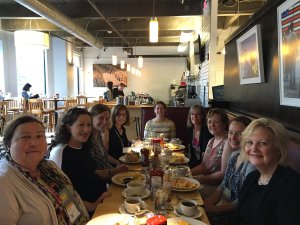
Slicer Breakfast at the Trident Cafe.
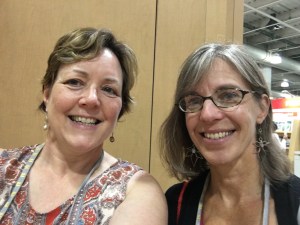
So happy to meet Molly Hogan in real life!
With Colette Bennett before our presentation.

If you’ve never attended a national conference, it’s an experience you’ll never forget. Thank you, ILA, for a wonderful weekend!

Thank you to StaceyDanaBetsyBeth, KathleenDeb, Melanie, and Lisa for this space for teachers and others to share their stories each Tuesday. Be sure to visit Two Writing Teachers to read more Slice of Life posts.
Slice of Life: Summer STEAM

11454297503_e27946e4ff_h

“Wisdom Begins in Wonder”
Socrates

These words are as true today as they were 2500 years ago. I may have heard or read them before, but I was happy to see them painted on the wall of the “Cabinet of Art and Curiosity” installation at the Wadsworth Atheneum in Hartford yesterday. I was there to participate in the museum’s “Summer STEAM” workshop, designed to show teachers “the many ways art can enhance science, technology, engineering, and math” in their classrooms.

Lisa Delissio, a STEM Faculty Fellow at Salem State University, began the day with a talk about the intersection of art and science. She explained that the “perspective and knowledge of artists is essential to scientific approaches to problems.” Specifically, she listed the observational skills artists bring to their work that have been found to have an impact on the skills of her biology students. These include:

  • visual qualities
  • other sensory qualities
  • perspectives
  • materials
  • connecting to meaning: memories and metaphor
  • context, function, and purpose

Dr. Delissio then showed us this image:

By Prosthetic Head (Own work) [CC BY-SA 4.0 (http://creativecommons.org/licenses/by-sa/4.0)], via Wikimedia Commons
By Prosthetic Head (Own work) [CC BY-SA 4.0 (http://creativecommons.org/licenses/by-sa/4.0)%5D, via Wikimedia Commons

She asked us to use the observational skills of an artist and the perspective of a biologist to respond to the image with word and/or  pictures. My sketch was very rudimentary, but my jottings were very much dominated by my poetry brain. I was immediately drawn to the stamens of the large flower in the foreground, which reminded me of sunspots exploding on the sun and the flower in the bottom center waiting to bloom. To me, its folded petals looked like hands folded in prayer.

We were given ten minutes to work on this, which sounds like a long time. But it really wasn’t. I could have easily  spent another half hour working on my observations and the poem I was beginning to formulate. Keeping the STEAM theme of the day in mind, I started a Fib poem, a poem which uses the Fibonacci sequence to determine the number of syllables in each line.

Fat
skink
rests on
bright purple
aster petals, their
stamens exploding like the sun.

The auditorium full of dozens of teachers was absolutely still as people worked. But it didn’t feel like work at all. We were completely engaged in our creativity, our intellectual curiosity sparked by the blending of diverse disciplines. As Dr. Delissio explained, students who pursue double majors in science and the arts are more creative, and exhibit more intellectual curiosity and divergent thinking than students with a single major.

Attending this workshop was a joy for me, not because I needed convincing that the arts should be included in STEM, but because it bolstered my belief in the importance of including the arts in our classrooms. As schools across the country embrace STEM and devote time and resources to integrate STEM into the curriculum, we have to ensure that the arts are always included. As Anne Jolly points out in a recent Education Week article, “The purpose of STEAM should not be so much to teach art but to apply art in real situations. Applied knowledge leads to deeper learning.”

Thank you to StaceyDanaBetsyBeth, KathleenDeb, Melanie, and Lisa for this space for teachers and others to share their stories each Tuesday. Be sure to visit Two Writing Teachers to read more Slice of Life posts.
Slice of Life: Meeting Goals

11454297503_e27946e4ff_h

“Not everything that counts can be counted, and not everything that can be counted counts.”
Albert Einstein

After hours of collecting and analyzing data, looking for reading behaviors used or not, identifying vowel patterns known and unknown, after hours of planning lessons, carefully choosing books and poems to support student needs AND spark their interest, after hours of instruction, coaching and supporting strategies or sounds they’re using but confusing, after phone calls and parent meetings about how students are or aren’t progressing, we’ve arrived at the last week of school, and the last lessons with my students for this year.

And the question on everyone’s mind? Did they meet the goal? Not did they meet their personal goal, but did they meet the goal for first grade? In the case of the students I work with, intervention students who came into first grade below the grade level goal, the answer is no.

And yet, they have made tremendous personal progress. They are all confident readers. They read books at their independent level fluently and with expression. They understand what they’ve read and have ideas about why characters act the way they do. They read nonfiction with curiosity and enthusiasm.

Do I feel like I have failed these students? Yes and no. I know their classroom teacher and I did everything we could to support their progress. I know they worked hard when they were with me and made incremental gains on most days. But teachers are always second-guessing themselves. We feel like there must be something else we could have done. But very often, our best truly is enough. These five- and six-year olds just need more time to learn those diphthongs and -r controlled vowels. They need more time to remember to try a different vowel sound if they one they used doesn’t make sense.

I’m willing to give them that time, as long as they’re making progress along the way AND they are falling in love with reading. If both of those things aren’t happening, then something needs to change. If the teaching techniques I’ve been using aren’t meeting their needs, then it’s my responsibility to find a new strategy or technique that does meet their needs. Have I done this? Yes. So back to the original question: Did these students meet the goal?

In my mind, yes. They are readers who can problem-solve to read unknown words, they make meaning from the texts they read, and most importantly, they enjoy reading and are proud of their accomplishments. And isn’t that our goal for all our students?

Thank you to StaceyDanaBetsyBeth, KathleenDeb, Melanie, and Lisa for this space for teachers and others to share their stories each Tuesday. Be sure to visit Two Writing Teachers to read more Slice of Life posts.
The Perspective of Others: Salt to the Sea

slide11

This post is part of “DigiLit Sunday,” hosted by Margaret Simon at Reflections on the Teche. This week’s topic is PERSPECTIVE.

“Sympathy as a desirable quality is something more than mere feeling;
it is the cultivated imagination for what men have in common and a rebellion at whatever unnecessarily divides them.”
~ Thomas Dewey ~

It’s often said that history is written by the victors. This implies, of course, that only one side of a story gets told. What happens to the stories of the vanquished? Isn’t their perspective of events just as valuable? What truths are hidden within the stories that don’t get told?

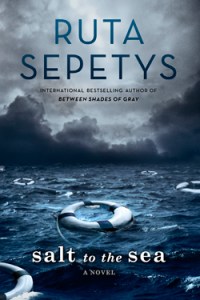
In Salt to the Sea (Philomel Books, 2016), Ruta Sepetys tells the “hidden history” of the sinking of the Wilhelm Gustloff  by a Soviet submarine in January of 1945. An estimated 9,000 people lost their lives in the icy waters of the Baltic Sea as a result. By giving voice to four teens fleeing East Prussia at the end of World War II, Sepetys masterfully weaves the story of the Wilhelm Gustloff together with their stories.

25614492

Three of the four narrators, Joana, Florian, and Emelia, tells the story their journey toward safety from their perspective. The fourth narrator, Alfred, is a German sailor aboard theWilhelm Gustloff.  Each chapter reveals a bit of the character’s history. But the bigger picture also begins to come into focus. The brutality of the Soviet Army as it advanced toward Germany. The selfishness of the Nazi leadership and their pernicious xenophobia. The sacrifices ordinary people from every country made for those they loved.

The tapestry that emerges gives readers a much deeper understanding of the events than any one of the narrators would have created individually. It also builds our sympathy for each of the narrators and their traveling companions.  As we get to know them, we realize that each of them carries a secret that haunts them. Just like every other human on the planet.

On this Memorial Day weekend, let’s resolve to find and share these untold stories with our students. It seems to me that the political hyperbole in the U.S. today makes it even more urgent that stories like Salt to the Sea be shared. These are stories that will broaden our perspective, and help us develop the imagination needed to see something of ourselves in the stories of others.

Listen to Ruta Sepetys discuss Salt to the Sea on NPR’s Morning Edition here.

Slice of Life: Playing With Grammar

11454297503_e27946e4ff_h

“The purpose of grammar is to enhance writing. Writing is ALWAYS the goal,” Jeff Anderson told a packed conference room last Saturday. Spending an hour and half with Anderson at the New England Reading Association Conference gave me new insights into how engaging grammar instruction can be.

Photo by Aaron Burden via unsplash.com

Anderson began the session by reading a section of his book, Zack Delacruz: Me and My Big Mouth. He correctly pointed out that there are often times when kids (and adults) need to be “juiced up” for writing. Reading a snippet of a book, poem, or article can “inspire great writing.”

After hearing about Zack and his school’s anti-bullying assembly, we had at least four topics to choose from for a free write:

  • assemblies
  • being/feeling different
  • picked on/bullied
  • teachers

I wrote a stream-of-consciousness riff on watching middle school kids at my school, which took me back to my own middle and high school days.

Anderson then explained that grammar “rules aren’t hard; it’s applying them that’s hard.”

So how can we make our grammar instruction effective? By focusing on function and practical application.

Why does this matter? Because grammar “helps writing come alive.”

Anderson urged us to abandon our practice of putting up sentences with errors, a la Daily Oral Language, for correction. Rather, we should display correct sentences, then study these mentor sentences to figure out why they’re effective. In this way, we “merge craft and grammar” instruction.

“Every choice a writer makes has an effect,” Anderson pointed out. By studying models, we can begin to “view grammar with a sense of possibility.” We can begin to imagine how we can use grammar to “help our writing come alive.”

“All grammar decisions add elaboration,” Jeff explained. This seems so obvious, but I had never thought about it that way. He went on to say that “commas act like a zoom lens—going from the big picture to close details.”

Using the first line of Ali Benjamin’s book, The Thing About Jellyfish, Jeff modeled exactly what he meant by this, and how to design a cycle of instruction to “immerse kids in the power of grammar and editing.”

The first step is to display a sentence, then invite kids to NOTICE what the comma is doing when they read it out loud. Then have them read it again and think about what the comma does when they read with their eyes.

Once kids have noticed something and thought about how a comma is used, they begin to see it everywhere, thanks to our reticular activating system. (Thank you, Jeff, for naming this phenomenon.) Once they’re aware of this pattern, the “more likely they are to try it in their own writing.”

Now invite students to COMPARE & CONTRAST the mentor sentence with a teacher-written model. Discuss how the construction of the two sentences is similar and/or different. Then talk about the impact of the two sentences. Is one more intriguing? Why? What grammar decisions (which are really CRAFT decisions) did the author make to create a powerful sentence?

Then collaborate to write a similar sentence together. (We didn’t have time for this in our session, but it’s the logical next step in a gradual-release model. You can view Anderson’s presentation slides here).

Invite students to IMITATE the mentor sentences. By trying it on their own, students will be able to see and understand the “possibilities of grammar acrobatics.” Inviting kids to imitate also gives them choice. Choice of what to write about, but also choices about how to imitate the mentor sentence.

Finally, invite students to REVISE. Have them revisit a piece of writing and “find a place where you can sharpen an image.” Have them imitate the model again, whatever it was. On Saturday we were using “the right-branching closer.”

Here is my revision from the free write we did at the beginning of the session:

Original:

What an act of bravery it is, though, to come to school in middle school with the new shoes or new pants that you think are like everyone else’s, but something isn’t quite right. Now, instead of feeling cool and fitting in, you feel like even more of an outsider. The Levi’s tab isn’t red.

Revision:

I strode into school, feeling cool in my brand new Levis with the red tab waving from the back pocket.

I know I never would have written this sentence without Anderson’s “invitation to play” with my writing. By inviting our students to do this work, not worksheets, we invite them to see what’s possible, and in so doing, invite them do their best work.

Functional application at its finest!

Thank you to StaceyDanaBetsyBeth, Kathleen, and Deb for this space for teachers and others to share their stories each Tuesday. Be sure to visit Two Writing Teachers to read more Slice of Life posts.
Intent: The Teacher I Want to Be…

slide11

This post is part of “DigiLit Sunday,” hosted by Margaret Simon at Reflections on the Teche. This week’s topic is INTENT

“What we learn with pleasure we never forget.”
Alfred Mercier

Photo by Tina Floersch, via unsplash.com

Love.
Passion.
Joy.

These words echoed throughout the rooms at the Sable Oaks Marriott in Portland on Saturday. Teachers from around New England and beyond gathered to learn from superstar educators Ralph Fletcher, Tom Newkirk, Vicki Vinton, Kathy Collins, Matt Glover, Jeff Anderson, and Katie Wood Ray, among others.

At the end of a panel discussion about a trip to the Italian school Reggio Emilia and the book which grew out of that trip, The Teacher You Want to Be: Essays about Children, Learning, and Teaching, Kathy Collins invited us to complete this statement: The teacher I want to be…

Here is my response to Kathy’s appeal:

I want to be a teacher who grows passionate, joyful, independent learners. A teacher who, in the words of Thomas Dewey, gives students “something to do, not something to learn; and when the doing is of such a nature as to demand thinking; learning naturally results…”

I want to my students to be curious and observant.

I want them to be thoughtful readers who understand that reading is about more than answering questions about the main character and his problem. I want them to understand that when we read, we learn about ourselves, our lives, the lives of others, and the world around us.

I want to be a teacher who gives my students time to think and write about what they want to think and write about. I want to give them the time and tools they need to follow their thinking wherever it leads them.

I want my classroom to be a greenhouse where students thrive and see possibilities in themselves they hadn’t ever imagined.

I also want to be a teacher who can rise above the day-to-day frustrations that could distract me from this goal.

I want to be a teacher who doesn’t let demands and pressures of the inevitable changes in standards, assessments, etc., deter or sway me from this vision. In the words of Katie Wood Ray, I want to make myself  “as smart as I can be about my work so that I can articulate” my beliefs.

This vision is one I’ve strived to fulfill through all my years of teaching. Thank you to all the wise, passionate educators at NERA whose words helped me express these ideas. Thanks to them for also showing me how this vision can become a reality.

Making Plans for Summer Reading

slide11

This post is part of “DigiLit Sunday,” hosted by Margaret Simon at Reflections on the Teche. This week’s topic is REFRESH.

By Winslow Homer (Memphis Brooks Museum of Art) [Public domain], via Wikimedia Commons

Teachers often have a long list of projects they want to work on, both personal and professional, that we’ve either put off or just haven’t had time for during the school year. And while I love finishing these tasks and the sense of accomplishment they bring, I don’t really find them refreshing. For me, being refreshed means having time to enjoy long, lazy afternoons reading and dozing.

Making plans for summer reading is one of my favorite activities. In January, I talked with fifth grade students about Reading Resolutions. This is the perfect time to revisit those resolutions, and, if necessary, make some new ones. I finished the Very Famous Children’s book back in February. Lately I’ve been thinking about Virginia Wolf’s To the Lighthouse. This is a book that has intimidated me as an adult, and I feel now’s the time to give it another try.

I have a long list of professional books I’m planning to read this summer. These books are currently at the top of the stack:

I’m also planning on getting caught up on journal articles I haven’t had a chance to read.

I’ll also be reading many picture books and middle grade novels, but I don’t have a specific list. I would love to get my hands on an ARC of Melissa Sweet’s upcoming book about E.B. White. (Hint, hint, ARC gods!) Louise Erdrich is one of my favorite authors, both for children and adults, and she has two new books out this year. Makoons is the fifth book in the series that began with The Birchbark House, one of my all-time favorites, so I’m excited to read this book, too.

There are many books on my shelves that I haven’t read, and sometimes I’ll just browse and see what strikes my fancy. I also like to visit the library and find new books there.

FullSizeRender-1
Last year’s shelfie.

Having plans for summer reading is great, but discovering new books along the way and having time to read them is another reason summer reading is such a gift. What are your summer reading plans?

The FUNction of Poetry in the Classroom

slide11

This post is part of “DigiLit Sunday,” hosted by Margaret Simon at Reflections on the Teche. This week’s topic is FUNCTION.

poetry-from-india-talkies-online

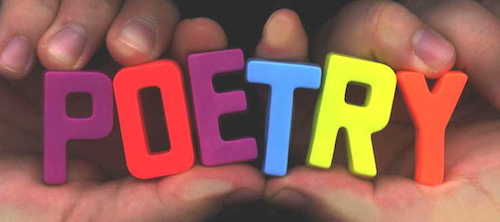
What’s the function of poetry in the classroom? As National Poetry Month comes to an end, this is a good time to to ask this question. Poetry can play many roles and deserves a place in our classrooms every day.

Poetry has always been woven into my instruction, no matter what time of year. When I taught third grade, we began the year studying Mary O’Neill’s Hailstones and Halibut Bones (1961). O’Neill’s “Adventures in Poetry and Color” were perfect for helping my students become more observant and thoughtful about description. Close study of these poems also helped kids solidify their understanding of parts of speech.

Now I work with readers who are considered Tier 3 in the RTI model. They aren’t special ed students, but they also aren’t progressing at a rate that makes it likely they will reach end-of-year benchmarks. Whether we call them struggling readers or striving readers, the bottom line is the same: They need extra help. And I’m lucky to be the person to give them that assistance.

When I was working on my reading specialist certification, one professor urged us to start each lesson with a poem as a way to “warm up our ears.” I didn’t need convincing, but loved the rationale. So each day, my students and I read poems. Poetry is ideal for students who find reading challenging for many reasons. Poetry tends to come as a small packages, which is perfect for beginning readers who get overwhelmed by lots of print.

Another important reason to include poetry that rhymes in lessons with young readers is that these poems give kids a chance to practice phonics patterns in an authentic text. This repetition is key for all learning. Average young readers need “four to fourteen repetitions” in order to “reach a reliable level of word reading accuracy…[but] more than 40 repetitions [are needed] for those with reading difficulties” (Katherine Garnett, “Fluency in Learning to Read: Conceptions, Misconceptions, Learning Disabilities, and Instructional Moves” *) Using poetry ensures these repeated readings will be fun!

I carefully chose poems that are engaging and incorporate the phonics elements we are working on. This allows students experience success with reading right away. Early success not only keeps kids engaged, it increases the likelihood that they’ll want to keep reading. Certain poems quickly become favorites and are soon memorized. These are recited with confidence and pride.

“I See a Cat” by Cindy Chapman (found here) is perfect for beginning readers:

I see a cat.
I see a big cat.
I see a big, fat cat…

You can see the appeal. We also act out the poems, sometimes with props, adding an extra sensory dimension. This increases the likelihood that the students will retain what they’re learning. Copies of poems are always sent home so kids care show off their skills to their families and friends.

Making poetry part of every lesson also helps build vocabulary, science and social studies concepts, and more. The list is really endless, and I haven’t even mentioned comprehension or the emotional impact of poetry. Because we’ve read so much poetry, writing poetry becomes a natural extension (and provides additional authentic practice!).

What is the function of poetry in the classroom? Poetry brings laughter and joy, something we all need, every single day.

Not convinced? Here a few of the hundreds of resources available in print and online:

* Chapter from: Birsch, J. R. (2011). Multisensory Teaching of Basic Language Skills, 3rd Edition. Baltimore: Paul H. Brooks Publishing.

Revision: Finding the Best Words

By Herkulaneischer Meister via Wikimedia Commons

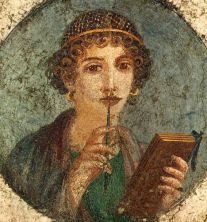
“Poetry: The best words in the best order”
~ Samuel Taylor Coleridge ~

Many writers rank revision right up there with root canals and colonoscopies, especially beginning writers. They’ve struggled to get their words down and now you’re asking them to change them?!? Or maybe they’ve hit upon a rhyme they think is perfect. Until you ask them what it means. Then they have to admit they really don’t know, but they like the way it sounds.

The magic of word processing has made the labor of revision much less overwhelming, but still it’s often hard for writers to let go of their words. (“Kill your darlings,” William Faulkner advised.)

This week I was working with a fifth grade student on a poem that had promise. His opening line had a nice rhythm and the second line had an effective repetition. Then came two lines he was really proud of. They rhymed, but he achieved that rhyme through weak, almost meaningless word choice that would stop readers in their tracks.

I began our conversation by reminding him that poems don’t have to rhyme. We had read many poems over the past week, immersing ourselves in persona poems and poems of address. A few rhymed, but most didn’t. Then I asked him to explain the lines to me, hoping he’d use some more effective vocabulary in his explanation. We spent a few minutes talking about what people often say when they lose things. (His poem was about an explorer searching for, but never finding, gold.) I asked him how he thought the explorer felt after expending all that time and energy for nothing.

Feeling like the explorer, I was getting frustrated trying to uncover a nugget of anything that made sense, but still coming up empty-handed. I tried hard not to put words in his mouth, but it was clear he didn’t have the vocabulary to say what he wanted to say. In the end, with the help of a thesaurus and a rhyming dictionary, he found the words he was looking for, even though I still had to explain some of the meanings to him. Was that cheating? I hope not. Because I think he learned some valuable lessons in the process. Now he has a better understanding of the words “sorrow” and “woe.” More importantly, he recognized how much better his poem sounded after making changes. His hard work of revision paid off.

What lessons were there for me in this whole process? I considered flat out banning rhymes in our next round of poems, but that limits student choice, doesn’t it? Maybe a better approach would be to study poems with rhyme more closely to discover what makes them work. And as always, it comes down to more writing. Because the more we write, the better the chance we’ll find the best word, and have the skills to put them in the best order.

Every Sunday, Margaret Simon of Reflections on the Teche invites teachers and writers to reflect on digital literacy, teaching, and writing. Please visit her there to read more about revision.

slide11
DigiLit Sunday