Picture Book 10 for 10: Poetry Picture Books

pb 10 for 10 015

Children’s first reading experiences are usually through picture books, and for this reason, people have fond memories of them and are passionate about their favorites. Because of the role picture books play in introducing the magic of reading to children, they are worth celebrating. 

Picture Book 10 for 10 is the brainchild of Cathy Mere of Reflect & Refine: Building a Learning Community and Mandy Robeck of Enjoy and Embrace Learning. During this annual event, now in its sixth year, teachers, librarians, and book lovers create lists of 10 essential picture books. Cathy and Mandy collect and share these lists, and everyone is richer because of their efforts. Be sure to visit their blogs to see their lists, and check out dozens of Picture Book 10 for 10 lists here. Thank you, Cathy and Mandy, for organizing this celebration of picture book love. 

Many children are introduced to picture books through collections of nursery rhymes. The rhythm of poetry is soothing and the rhymes give kids the foundation they need to become independent readers. But most importantly, reading nursery rhymes and poetry to children is fun.

Creating this list was quite a challenge, as there are many, many beautiful poetry picture books available these days. For any one of the poets listed below, there are one or two or ten other books that are just as worthy of inclusion on this list.

1.  Bookspeak: Poems about Books, by Laura Purdie Salas, illustrated by Josée Bisaillon (Clarion Books, 2011)

51No5OmW7oL._SY474_BO1,204,203,200_

What could be better than a collection of poems celebrating books? Laura Purdie Salas gives voice to all parts of books, including the cover, index, and the end. You can watch the trailer for Bookspeak, listen to Laura read two poems, and read the teacher’s guide here.

2. Red Sings From the Treetops: A Year in Colors by Joyce Sidman, illustrated by Pamela Zagarenski (Houghton Mifflin Books for Children, 2009)
Image

Joyce Sidman is one of my favorite poets, and I love Pamela Zagarenski’s whimsical style, so this book was a shoe-in for this list. I have written about it before here.

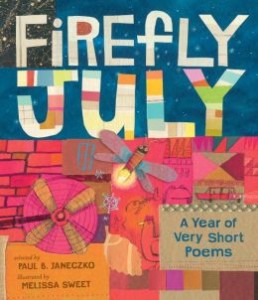
3. Firefly July: A Year of Very Short Poems, selected by Paul B. Janeczko, illustrated by Melissa Sweet (Candlewick Press, 2014)
janeczko_firefly-july2

This award-winning anthology, illustrated with whimsical perfection by Melissa Sweet, includes poems celebrating each season and is not to be missed.  Julie Roach, writing in School Library Journal described Sweet’s illustrations this way: “Colors and shapes with willowy details expertly blur or bring bits of the images into focus to create a magical sense of place, time, and beauty.”

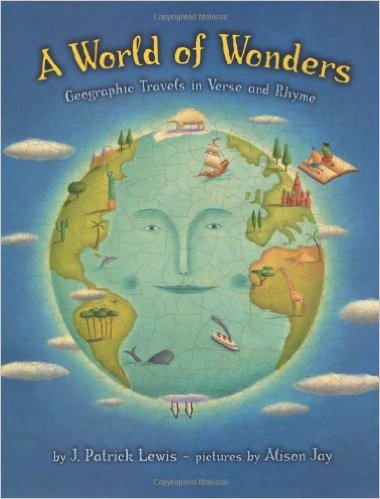
4. A World of Wonders: Geographic Travels in Verse and Rhyme, by J. Patrick Lewis, pictures by Alison Jay (Dial Books for Young Readers, 2002)
5131m598s2L._SX378_BO1,204,203,200_

Lewis brings his signature blend of humor and interesting facts to the world of geography in this collection. Allison Jay’s muted colors and craquelure,“a cracking or network of fine cracks in the paint, enamel, or varnish of a painting,” illustrations evoke maps from the age of exploration.

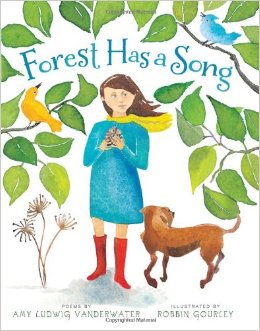
5.  Forest Has a Song, by Amy Ludwig VanDerwater, illustrated by Robbin Gourley (Clarion Books, 2013)
51UrEYN7JYL._SX258_BO1,204,203,200_

Amy Ludwig VanDerwater turns her keen poet’s eye to the forest landscape throughout the year. Gourley’s delicate watercolors are the perfect complement to VanDerwater’s evocative poems.

6. On the Wing: Bird Poems and Paintings by Douglas Florian (Harcourt, 1996)

51-L+7QsU7L._SY498_BO1,204,203,200_

Douglas Florian’s sophisticated humor and word play make his poetry perfect choices for any elementary classroom. Find out more about Florian and his other poetry collections here.

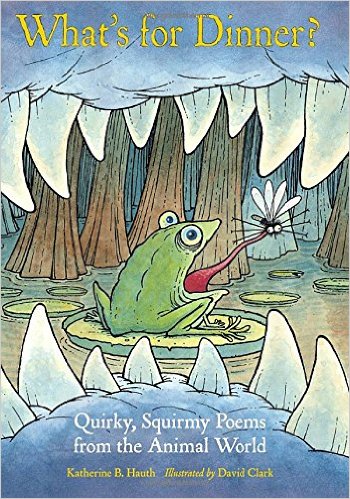
7. What’s for Dinner? Quirky, Squirmy Poems from the Animal World, by Katherine B. Hauth, illustrated by David Clark (Charlesbridge, 2011)
61TNs2UmDBL._SX348_BO1,204,203,200_

This NSTA/CBC Outstanding Science Trade Book is chock-full of hilarious poems about the very serious subject of how animals capture their prey. Hauth includes factual information about each animal, as well as a list of suggested reading. David Clark’s cartoon-like illustrations add to the humor.

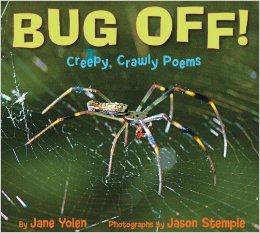
8.  Bug Off! Creepy, Crawly Poems, by Jane Yolen, photographs by Jason Stemple (WordSong, 2012)
51rgQzM7S1L._SX258_BO1,204,203,200_

Jane Yolen is one of my favorite authors of all time. In fact, my 2013 Picture Book 10 for 10 post was devoted to her work. Yolen has published many volumes of poetry, but her collaborations with her photographer son, Jason Stemple, are my favorites. Stemple’s photographs are full of incredible details, and Yolen’s poetry captures the “beauty and mystery” of “these tiny living beings.” (From Yolen’s author’s note.)

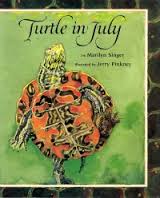
9.  Turtle in July, by Marilyn Singer, illustrated by Jerry Pinkney (Macmillan, 1989)
imgres-2

Marilyn Singer is the 2015 winner of the NCTE Award for Excellence in Poetry for Children and has long been one of my favorite poets. You can read a previous post about Marilyn’s poetry here. This collection, filled with Jerry Pinkney’s stunning illustrations, is a must-have for any elementary classroom.

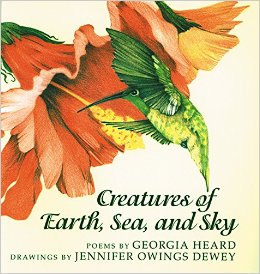
10. Creatures of the Earth, Sea, and Sky, by Georgia Heard, drawings by Jennifer Owings Dewey (WordSong, 1992)
61If8BIUfPL._SX258_BO1,204,203,200_

 Georgia Heard has written that “poets find poems in hundreds of different places” (Awakening the Heart: Exploring Poetry in Elementary and Middle School, Heinemann: 1999), and in this wonderful collection, which has long been a staple in my classroom, she has found poems throughout the animal kingdom. Dewey’s detailed, realistic drawings add to the beauty of this book.

My previous Picture Book 10 for 10 lists:

2014: Friendship Favorites
2013: Jane Yolen Picture Books
2012: Wordless Picture Books

Slice of Life: Summer Reading Plans

11454297503_e27946e4ff_h

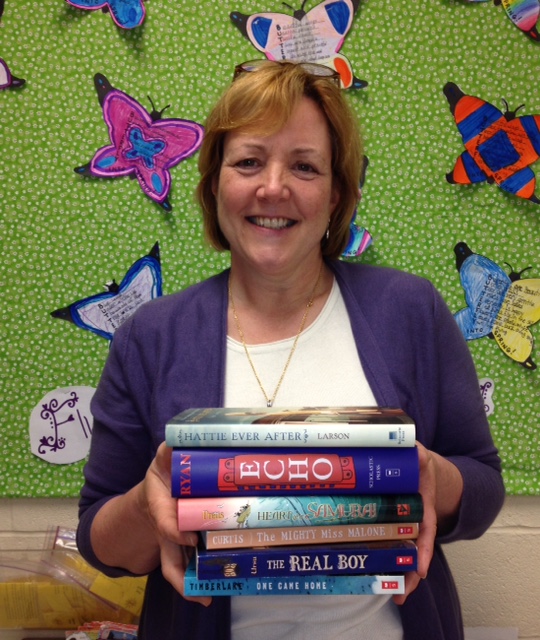
Summer. The very word conjures images of long afternoons with a book. Whether at the beach or stretched out in hammock under a tree, I’m looking forward to reading. A lot. Except for Pam Muñoz Ryan’s Echo, my stack of middle-grade novels is embarrassingly out of date. I’ll be making regular trips to the library to find more recent titles, including The War that Saved My Life by Kimberly Brubaker Bradley and picture books like Yard Sale by Eve Bunting and Julia Sarcone Roach’s The Bear Ate Your Sandwich.

FullSizeRender-1
A small portion of my TBR stack. This was taken last week, and I finished Hattie Ever After over the weekend. I loved it!

imgres   imgres-1

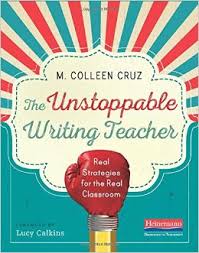
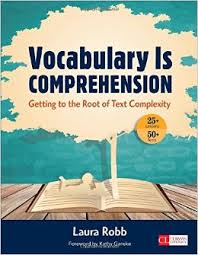
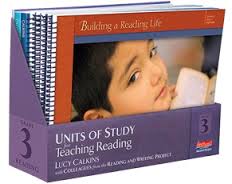
I also have a pile of professional books that includes Colleen Cruz’s The Unstoppable Writing Teacher and Vocabulary Is Comprehension, by Laura Robb. I’m looking forward to having the new Units of Study for Teaching Reading, by Lucy Calkins and her colleagues at the Teachers College Reading and Writing Project sometime in early July.

images-1

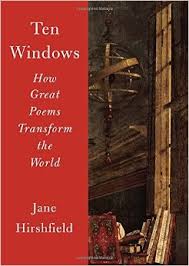
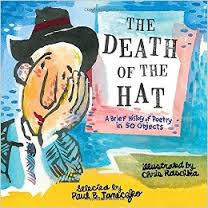
Finally, there are several poetry books I’m looking forward to reading, including Jane Hirshfield’s Ten Windows: How Great Poems Transform the World and The Death of the Hat: A Brief History of Poetry in 50 Objects, selected by Paul B. Janeczko.

imgres-2     imgres-3

This list may change over the weeks ahead. Another joy of summer reading is having time to browse the library stacks or tables at the bookstore and find an undiscovered gem. What will you be reading?

Thank you to StaceyTaraDanaBetsyAnna, and Beth for this space for teachers and others to share their stories each Tuesday. Be sure to visit Two Writing Teachers to read more Slice of Life posts.

Slice of Life: The Art of Leonard Weisgard

11454297503_e27946e4ff_h

In Minders of Make: Idealists, Entrepreneurs, and the Shaping of American Children’s Literature (Houghton Mifflin, 2008), Leonard Marcus writes, “To those who worked in the children’s book industry of the early 1940’s, New York could seem as small as a fairy-tale village.” By the 1950’s and early 1960’s, many writers, illustrators, and editors of the children’s book world had moved to my corner of Connecticut, trading one fairy-tale setting for another. Renowned illustrator Leonard Weisgard was among them.  Although I didn’t know until Saturday that he had lived nearby, Weisgard’s books were a staple of my childhood.

51YWWHu6C5L._SX258_BO1,204,203,200_  1947_The_Little_Island

Weisgard illustrated classics such as The Golden Egg Book and The Golden Bunny. My sister and I loved Pussy Willow so much we wore out several copies. Weisgard won the Caldecott Medal in 1947 for The Little Island, written by Golden MacDonald, a pseudonym for Margaret Wise Brown. 

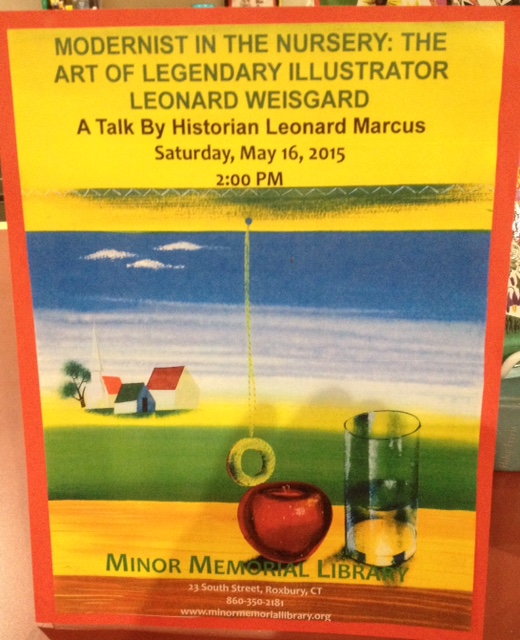
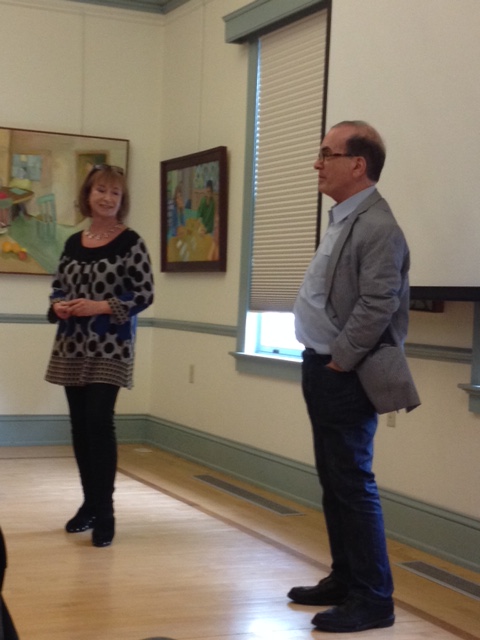
Last Saturday, neighbors, friends, and family gathered for “Modernist in the Nursery: The Art FullSizeRender-2of Legendary Illustrator Leonard Weisgard, a talk by children’s literature historian Leonard Marcus. (Connecticut is still a mecca for the children’s book world; I sat next to Lane Smith!) Marcus talked about Weisgard’s love of color and nature. He discussed Weisgard’s many collaborations with Margaret Wise Brown and how her work at the Bank Street Writers Laboratory influenced his art. Weisgard loved folk art, and Marcus shared several examples of how that love influenced his art.

Weisgard's daughter, Abby, with Leonard Marcus
Weisgard’s daughter, Abby, with Leonard Marcus

 When Marcus concluded his remarks, Weisgard’s  daughter, Abby, answered questions and shared  memories of her father. Neighbors and friends   shared recollections of Weisgard’s generosity and humility, then told stories of  wonderful meals with Weisgard and his family.

 Throughout the afternoon, it was clear from both his art and everyone’s  memories that Weisgard respected children and trusted their ability to “see  and hear and feel with simple intensity.” In his Caldecott Medal Acceptance  Speech, Weisgard said that “books…have always been a source of real magic in  this wildly confusing world.” Thank you, Leonard Weisgard, for sharing your singular magic with the world.

 Thank you to StaceyTaraDanaBetsyAnna, and Beth for this space for teachers and others to share their stories each Tuesday. Be sure to visit Two Writing Teachers to read more Slice of Life posts.

It’s Monday! What Are You Reading? Marilyn’s Monster

IMWAYR

When I was a kid, my imaginary friend was nameless and unacknowledged. Sure that others, including my parents, would think I was weird, I never mentioned my imaginary friend to anyone.

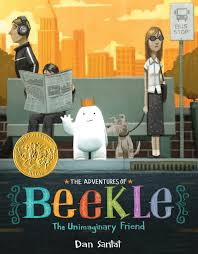
How times have changed! Not only are there plenty of picture books about imaginary friends, Dan Santat’s The Adventures of Beekle: The Unimaginary Friend (Little, Brown, 2014) won this year’s Caldecott Medal. So much for weird.

                         imgres     51MDBfXWDGL._SX258_BO1,204,203,200_

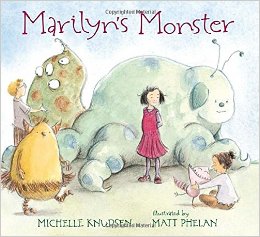
Marilyn’s Monster (Candlewick Press, 2015), by Michelle Knudsen, with illustrations by Matt Phelan is a variation on having an imaginary friend. Knudsen’s heart-felt storytelling and Phelan’s expressive illustrations work together to create a satisfying emotional journey all children will recognize.

Having a monster is “the latest thing,” but Marilyn doesn’t have one yet. “Your monster has to find you.” Soon, Marilyn is “the only one left without a monster.” At first she’s sad, and “tried to be the kind of girl no monster could resist.” Then she gets mad and tries to convince herself she doesn’t need a monster. Deep in her heart, though, Marilyn knows she wants a monster “more than she could say.” She defies the rules and takes matters into her own hands. She follows her instinct, faces her fears, and sets off in search of her monster. Along the way she discovers, like Beekle, that sometimes it’s necessary to push back against conventional wisdom to achieve your goal.

Marilyn’s happiness at the end of the book is more than just satisfaction at having found her monster. It’s far deeper than that. It’s happiness that comes from the confidence gained by overcoming her fears and accomplishing her goal by herself.

Marilyn’s Monster is an endearing book that young audiences will love, but I would share it with second and third graders, too. Not only will they enjoy the story, they will learn much about word choice, tension, and character growth from Knudsen’s masterful writing. In addition, Marilyn’s Monster and The Adventures of Beekle: The Unimaginary Friend are a perfect pairing for comparing and contrasting point of view and setting. Most importantly, though, the theme that when you follow your heart, anything is possible is one worth sharing again and again.

Candlewick has an interview with Michelle Knudsen and Matt Phelan here, and an activity guide here.

Don’t forget to visit Jen at Teach Mentor Texts and Kellee at Unleashing Readers to find out what other people have been reading lately. Thanks, Jen and Kellee, for hosting!

Slice of Life: My Pro Tool

11454297503_e27946e4ff_h

This morning there was a story on Marketplace called “Pro Tool.” Host David Brancaccio caught my attention when he referred to a pair of scissors as “dear.” This usage of the word, meaning “high or exorbitant in price” is uncommon these days. As I continued to listen, though, Brancaccio’s use of the word made perfect sense. Hairdresser Lauren Popper was clear that these shears, as calls them, were indeed “highly valued, precious” to her. After all, without the right tools, this hairdresser wouldn’t be able to do her job effectively. My husband, a toolmaker, and my son, a cabinetmaker, both have favorite tools that they would feel lost without. And I have my favorite bowl, knife, etc. in the kitchen. But what about my job? Do I have a tool without which I couldn’t teach?

In fact, I do. I can’t imagine teaching without books. The books I read as a kid instilled a sense of curiosity in me and made me want to learn more. Books have pushed me to be a more compassionate and empathetic person. Then there are books I have depended on to learn this craft of teaching.

Books have helped me be an effective teacher in another way. They’ve helped me build relationships with students and colleagues. Reading a book with a group of students is one of the best ways I know to build a community. Sharing the experiences of characters we come to love brings us together. After crying together when Charlotte dies, or cheering for Auggie during his standing ovation, we are a team. Without the healthy, trusting relationships that books help us forge with our students, we wouldn’t accomplish much.

Some may argue that computers are indispensable to teaching. They do make life much easier (most of the time), and I love how technology has broadened my horizons. But I love the people next to me everyday more. I love that my first grade students are taking off as readers and that the seventh grade writers met their writing goals. I love that when children see me in the hallway, they tell me what book they’re reading. These people and moments are all precious to me. They, and the books we share, are dear.

Thank you to StaceyTaraDanaBetsyAnna, and Beth for this space for teachers and others to share their stories each Tuesday. Be sure to visit Two Writing Teachers to read more Slice of Life posts.

Poetry Friday: Eileen Spinelli & Another Day As Emily

poetry-friday-1-1

I can’t believe how quickly April flew by. Because today is Friday, I feel like we have a bonus day of National Poetry Month!

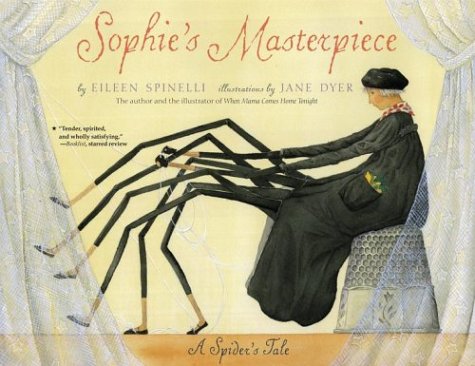
On her webpage, Eileen Spinelli has a list of tips for young writers. Her number one piece of advice? “Keep your eyes and ears and heart open.” There is no doubt that this is what drives Eileen’s writing as well. I first encountered Eileen’s writing in Sophie’s Masterpiece (Simon & Schuster, 2001). Sophie, the heroine of  this tale, is one of the most thoughtful and caring spiders this side of Charlotte. Sophie’s kindness and generosity inspired my third grade students to learn how to knit after 9/11 and, ultimately, create an afghan that we raffled to raise money for charity.

                     51X5BZ62W9L    519wFzxAgWL._SY344_BO1,204,203,200_

So when I wasn’t surprised when I saw that Eileen and her husband, Jerry Spinelli, would be part of a panel hosted by Janet Wong and Sylvia Vardell titled “Sharing Random Books of Kindness: The Power of Story” at NCTE last November. (Read Eileen’s heartbreaking “Poem for a Bully” in this post by Mary Lee Hahn & Janet Wong about the role of poetry in literacy learning here.) The next day, I waited in line to meet Eileen at a book signing and got a copy of her latest book, Another Day As Emily (Random House, 2014).

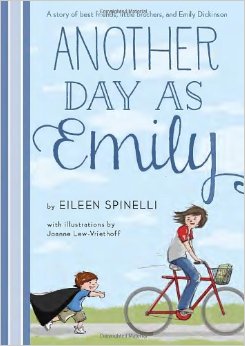
I finally found time recently to read this charming verse novel, and I’m so happy I did. Suzy Quinn is almost twelve. She collects rocks and loves the Philadelphia Phillies. She also has a pesky little brother named Parker, who saved their neighbor’s life and is now an official hero. Feeling left out because of all the attention Parker’s getting, Suzy plunges into a project for her library’s summer program and learns all she can about Emily Dickinson. At the same time, Suzy is trying to navigate the challenges of friendship. Overwhelmed when she isn’t chosen for a part in a play and devastated when her birthday trip to a Phillies game is cancelled, she retreats to her room “…to be left alone…Forever. Like Emily Dickinson.” Suzy dresses in white, bakes gingerbread, even renames her goldfish Carlo, after Emily Dickinson’s dog.

Spinelli spins a story full of realistic details about the trials and tribulations of adolescence. Suzy’s family and neighbors remain loving and supportive, even as Suzy pushes the limits of their patience. Eventually, Suzy decides there’s more to life “than being a twelve-year old hermit.” In the process, she discovers that she “missed herself,” even though the self she missed is forever changed.

One of the magical things about books is that they let you try on different personas. Lucky readers of Another Day As Emily get to try on two through the “eyes and ears and heart” of Eileen Spinelli. What a gift!

Here is another gift from the pen of Eileen Spinelli:

“The Month of May”

May is a merry month
a flower-into-berry month,
the month to skip outdoors to play,
to tuck your winter boots away,
to honor moms and aunties too
with cards and hugs for all they do.

Read the rest of the poem here.

Mary Lee at A Reading Year and Ellen at Elementary Dear Reader  have The Poetry Friday Round Up. Be sure to stop by for more poetic gifts.

Poetry Friday: An Egret’s Day

poetry-friday-1-1

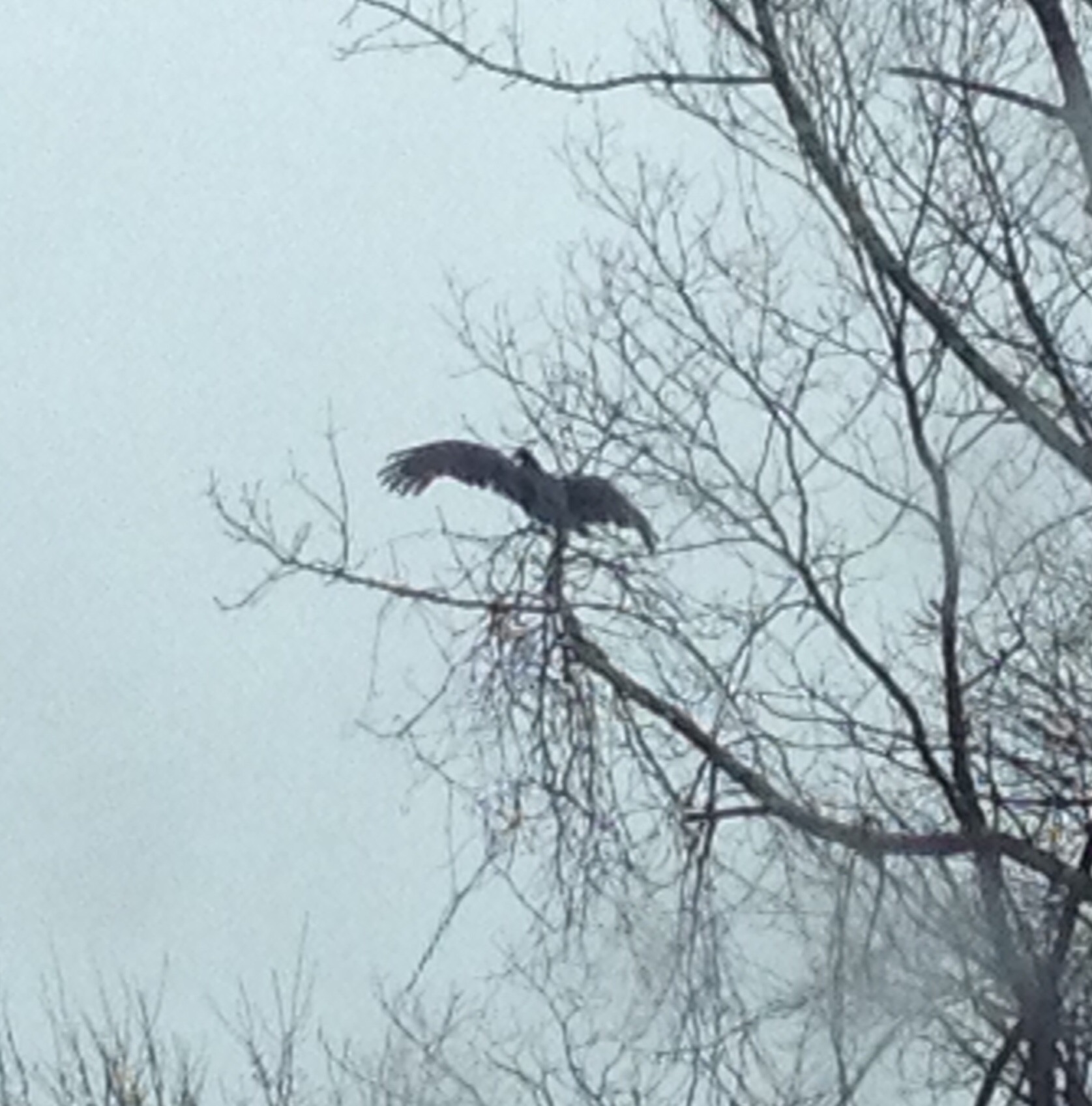
I’ve had birds on my mind this week because of an idea I hatched at the Highlights Foundation last week. One of Rebecca Kai Dotlich’s many wise pieces of advice was to research your topic. So I’ve been reading about birds, listening to birds, and watching for them whenever I’m outside. In fact, I almost drove off the road on Monday because of this bird:

FullSizeRender

I’m pretty sure this is a vulture, which are quite common where I live, but I have never seen one poised like this. After I pulled over to take this picture, I sat and watched this display. The bird stayed poised on this branch for at least five more minutes. Unfortunately, I had an appointment, so I couldn’t watch any longer.

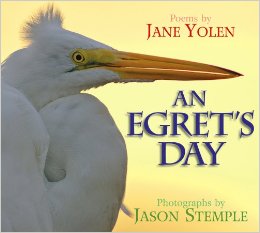
Rebecca also suggested reading poems about the topic you’re writing about, so I’ve been reading as many bird poems as I can find. One of my favorite collections is Jane Yolen and Jason Stemple’s gorgeous book, An Egret’s Day (WordSong, 2010). Yolen’s poetry follows egrets through their day and is accompanied by factual paragraphs about the poem’s topic. Stunning photographs by Jason Stemple, Yolen’s son, accompanies each poem, and gives readers a chance to observe these graceful birds up close.

511Ck0+HkZL._SX258_BO1,204,203,200_

Here’s a poem from this beautiful book:

“Egret in Flight”
by Jane Yolen

She’s an arrow
From a bow.
We watch in wonder
From below.

Origami
neck is folded.
All that we can do?
Behold it.

Read the rest of the poem here (It’s about 1/3 of the way down the page).

Small-Blue-RGB-National-Poetry-Month-Logo_0

I hope you have a chance to behold a beautiful bird or two today. There is always beautiful poetry to behold on Poetry Friday, so be sure to head over to Renee LaTulippe’s blog, No Water River, for the Poetry Friday Round Up.

SOL: Finding Ourselves in Others

11454297503_e27946e4ff_h

I think the first Patricia Polacco book I ever read was Pink and Say (1994), but I can’t be certain. I do know that Chicken Sunday was in the literature anthology my school adopted in 1996.  At once I knew Patricia Polacco was a master storyteller whose books conveyed important themes through stories of intergenerational and multicultural friendship and caring. These themes evoked compassion and allowed readers to see “the other” in themselves.

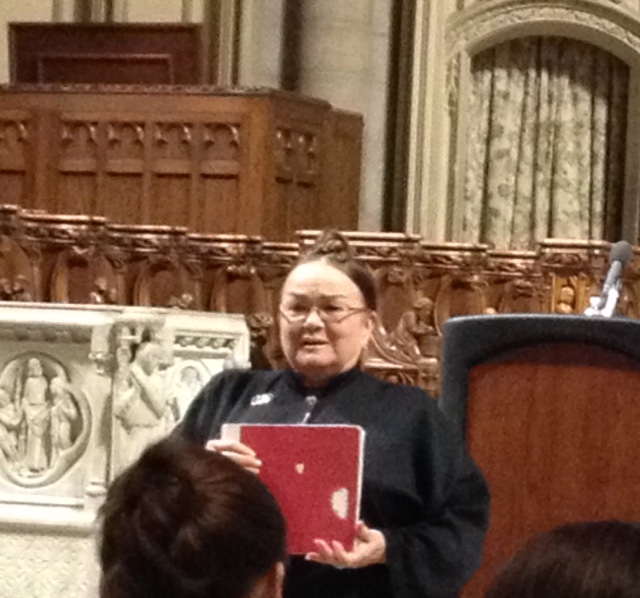
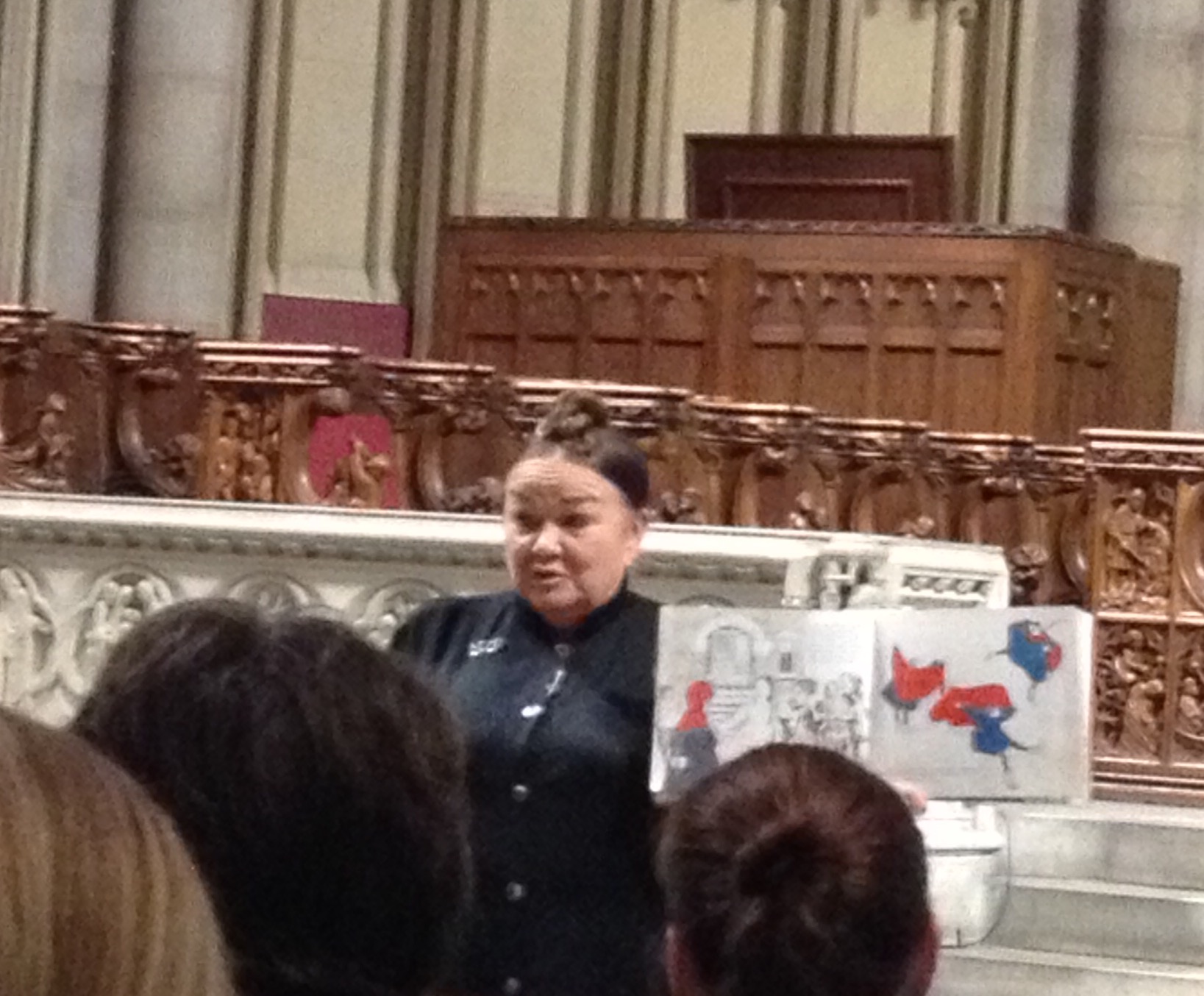
FullSizeRenderAt the 88th Teachers College Reading and Writing Project Saturday Reunion, held yesterday, teachers from across the country braved swirling snow and freezing temperatures to hear Patricia Polacco deliver the opening keynote. She told us that “the greatest heroes in our counry are classroom teachers.” She shared the story of her hero, George Felker, the real Mr. Falker. Mr. Felker was the first teacher to recognize Patricia’s dyslexia and was instrumental in getting her the help she needed to learn to read. Polacco described him as a man who was “beautiful in his heart.”

FullSizeRender-1

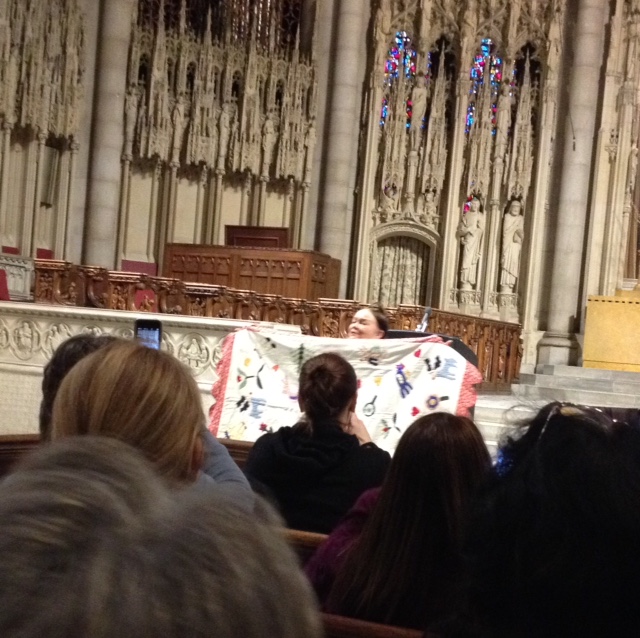
Polacco also shared the story of The Keeping Quilt. I know I wasn’t the only member of the audience moved to tears as Patricia told of her great-grandmother, Anna, who left the Ukraine as a small child. The dress and headscarf, or babushka, she wore eventually became part of the keeping quilt. Anna’s mother sewed the quilt so that when Anna felt homesick she could “just touch the quilt, and you’ll keep home” in your heart.

FullSizeRender-2

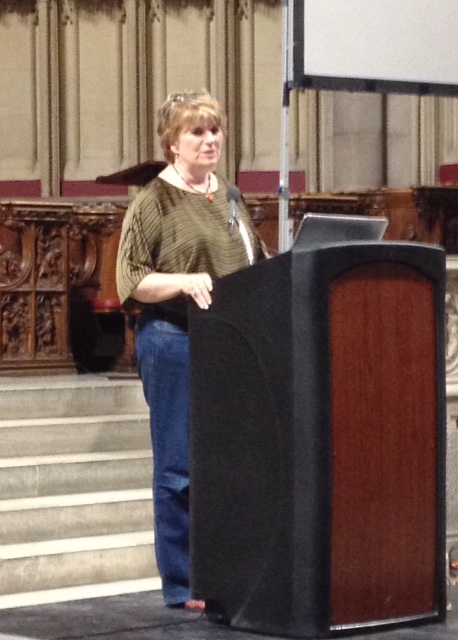
Hearts were the thread running through Polacco’s speech. She thanked the thousands of teachers filling Riverside Church for devoting “our lives to educating the minds and hearts of others.” In closing, Polacco told us that she was proud to “walk this earth” with us, and that she holds our hearts in her good keeping. 

Kylene Beers’s closing keynote, “What Matters Most,” was the perfect bookend to Polacco’s opening address. Kylene began by talking about how literacy is about power and privilege. She went on to say that “power is the ability to reach someone with your message” and that “power is about being connected.” What connects us better than stories? Stories like The Keeping Quilt and Dear Mr. Falker.

Beers also told us that “we must have more compassion” and that we “get to compassion best and easiest through the teaching of literature.” Brain research supports this, as well as the role of literature in creating empathy, something that is sorely lacking in our society today. “The humanities should humanize us,” Beers said, and the best way to achieve this is to read. Children should read widely and read books of their choosing, because “want-ability will always be more important that readability.” Children should read widely because through literature “we learn how to navigate our lives by navigating the lives of others.”

FullSizeRender-3

With characters as diverse as a slave and soldier of the Civil War, Russian immigrants, Holocaust survivors, and everyday African-American kids, Patricia Polacco has given us literature that enables us to, as Kylene Beers put it, “become what we are not.” Great teachers will share these books with their students because they will help children become curious, creative, and compassionate. They will share them because “great teachers are our best hope for a better tomorrow.”

Thank you to Lucy Calkins and everyone at the Teachers College Reading and Writing Project for making the Saturday Reunion possible, and thank you to Patricia Polacco and Kylene Beers for your confidence, faith, and above all, your words of inspiration.

Thank you also to StaceyTaraDanaBetsyAnna, and Beth for this space for teachers and others to share their stories each day during the month of March and on Tuesdays throughout the year. Be sure to visit Two Writing Teachers to read more Slice of Life posts.

SOL: Knowing and Wondering With Fifth Graders

11454297503_e27946e4ff_h

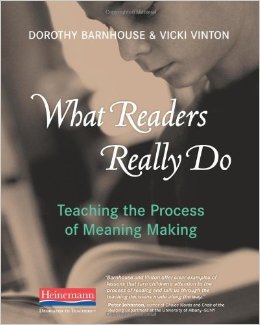
I’ve been a fan of Vicki Vinton and Dorothy Barnhouse’s “Know/Wonder” chart since I first discovered it on Vicki’s blog a few years ago. Since then, I have read and learned much from Vicki and Dorothy’s book, What Readers Really Do: Teaching the Process of Meaning Making (Heinemann, 2012). If you aren’t familiar with Vicki & Dorothy’s book, a Know/Wonder is a simple tool students use to chart their thinking as they read.

A few weeks ago, I was lucky enough to spend the day at the Educator’s Institute in Rhode Island and hear Vicki speak about comprehension. She focused on ways we can help students think deeply about complex texts independently. I always feel like I gain new understanding when Vicki shares her ideas. She articulates her thinking about reading comprehension in such a way that I say, “Of course!”

     51MGRQ28D0L._SX258_BO1,204,203,200_     51TzuMPYTPL

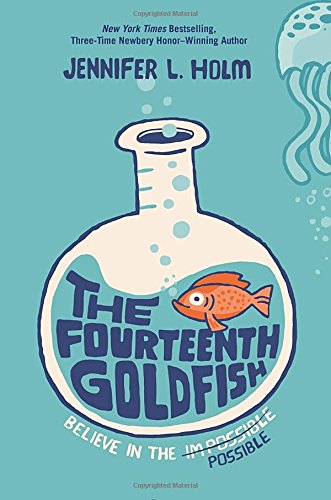
Earlier this week, I took Vicki’s advice and got “kids involved doing the thinking right from the get go.”  After a very brief introduction, I began reading The Fourteenth Goldfish (Random House, 2014), by Jennifer L. Holm, to a group of fifth graders. The first chapter generated a number of unanswered questions. The narrator isn’t named, and there is only one clue as to whether it’s a boy or a girl.  We find out that the goldfish who just died is really goldfish number thirteen. “So why is the book called The Fourteenth Goldfish?they wanted to know. Right away, they were:

  • gathering information
  • asking questions
  • making predictions
  • thinking about the plot—which has to come first in order to be able to problem solve for deeper understanding—both at the inferential level and the thematic level

In Vicki’s words, they were engaged in a “productive struggle” to make sense of this book.

Engagement is key. How often have you shared a book that you absolutely love, only to find that your students don’t love it? We take it personally, right? Vicki reminded us that “kids have to be engaged with their thinking about a book, not our love of it.”

So book choice is important. Vicki suggested that it isn’t Lexile levels that make a text complex; “texts are complex because they interact in unpredictable ways.”

Unpredictable things happen in the first three chapters of The Fourteenth Goldfish, but because students were engaged and were charting their thinking, a chorus of “I KNEW IT” erupted spontaneously at the end of one revealing chapter.

I will be working with these students over the next week or so. We will continue to “pay close attention to the details,” and develop ideas about this book. Once we have done that, we can start the next phase of this work by looking for patterns. Then we can “develop a line of inquiry” from these patterns and follow it as we continue reading.

Vicki ended her talk with a reminder that “kids can notice a lot if we open the door for them to notice.” Who knows where their thinking will lead us?

Thank you to StaceyTaraDanaBetsyAnna, and Beth for this space for teachers and others to share their stories each day during the month of March and on Tuesdays throughout the year. Be sure to visit Two Writing Teachers to read more Slice of Life posts.

SOL: “Live With Your Hands Unfolded”

11454297503_e27946e4ff_h

Like millions of people across the country, I look forward to the StoryCorps segment on NPR each Friday morning. Some of these stories have made me laugh, others have moved me to tears. They are always compelling. Yesterday, nine-year old Aiden Sykes had some questions for his father, Albert Sykes. When Aiden asked “What are your dreams for me?” Mr. Sykes told him

“My dream for you is to live out your dreams. There’s an old proverb that talks about when children are born, children come out with their fists closed because that’s where they keep all their gifts. And as you grow, your hands learn to unfold, because you’re learning to release your gifts to the world…For the rest of your life, I want you to see you live with your hands unfolded.”

Mr. Sykes’s wise words reminded me of Cornelius Minor’s keynote, “The Things that Break Us Don’t Have To,” at last Saturday’s Educator’s Institute in Providence. He urged the teachers in the audience to empower kids to be the superhero of their own lives and “give kids the tools they need to rescue themselves.” In other words, teach them that they have the power to find their gifts, to unfold their hands.

So how can we support our kids, both at home and in the classroom, so they can discover their gifts and passions?

Give them the skills they need to accomplish their goals. Begin with the basics of reading, writing, and math. But go further. Give them resources, both print and digital. Surround them with as many books as possible. Then, as Cornelius encouraged us, teach them “how to acquire their own prior knowledge.” The gift of how to learn is one they will never lose.

We also have to give kids plenty of opportunities to practice whatever it is they want to be good at. This is true for both home and school. My son can play one particular Nirvana song REALLY well because he played it about a gazillion times when he was 14 and 15. I personally don’t like the song, but I listened to it a gazillion times because it was important to him.

But above all, we have to be their champion. We have to, as Cornelius pointed out, give kids the feedback and encouragement that will help them pick themselves up after they fail. Because it is through these failures and missteps that they learn. It is through the advice and guidance of mentors that they gain knowledge. It is through our faith in them that they learn to have faith in themselves and realize their dreams.

 Thank you to StaceyTaraDanaBetsyAnna, and Beth for this space for teachers and others to share their stories each day during the month of March and on Tuesdays throughout the year. Be sure to visit Two Writing Teachers to read more Slice of Life posts.