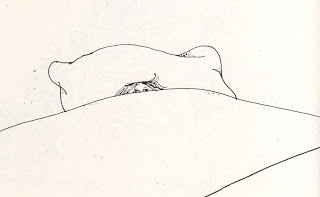
Beloved children’s poet Shel Silverstein would have celebrated his 83rd birthday earlier this week. Born on Sept. 25, 1930, Silverstein is best known for his poetry collections Where the Sidewalk Ends and A Light in the Attic. But did you know he began his career as a cartoonist for Playboy?
I’ve been thinking about my grandmother lately. Born in 1904, she passed away thirteen years ago this week. She grew up on a farm, had a garden until she was in her 70s and a tomato plant by her back door after that. Having lived through the Depression, she saved EVERYTHING. I loved spending time at her house because I never knew what treasure would turn up. Her father’s family emigrated from Scotland in the 1870s, and she was fiercely proud of her Scottish heritage. Robert Burns was one her favorite poets, so I thought it would be fitting today to share one of the “national poet of Scotland’s” most famous poems.
Alexander Nasmyth [Public domain], via Wikimedia CommonsA Red, Red Rose
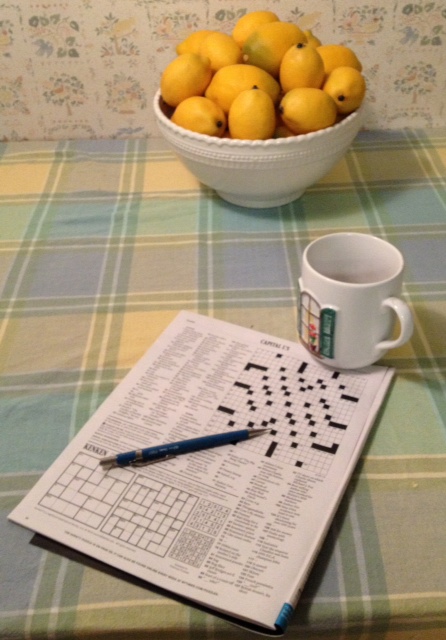
The idea for this poem came from a journal entry I wrote in response to one of Corbett Harrison’s “Sacred Writing Time” prompts. When my colleagues and I were working on our writing curriculum, we began each day by writing for ten minutes. On this particular day, the slide stated that “dreamt” is the only word in the English language that ends with “mt.” As a Scrabble player and crossword puzzle lover, this intrigued me. So I wrote about filing this tidbit away, thinking it would come in handy as I was “puzzling through the possibilities” when solving a puzzle. Right away, I noticed this phrase. I loved the alliteration and the potential it contained. So I began playing with ideas. I’m still puzzling over this draft; I’m not sure the middle flows as well as it could, but I’ve had fun working on it.
By the way, the Rossini clue is from the New York Times Sunday puzzle from August 25, 2013, constructed by Victor Barocas.
Be sure to visit Laura at Author Amok for the Poetry Friday Round Up.
As this week of commemoration and celebration of the fiftieth anniversary of the March on Washington and Martin Luther King, Jr.’s “I Have a Dream” speech comes to a close, I’d like to share a book of poetry that gives voice to a little-known chapter in the history of segregation and discrimination against African-Americans in the United States.
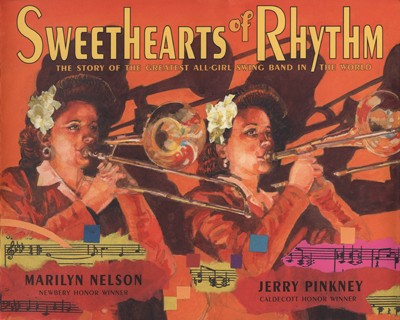
Dial Books, 2009
Sweethearts of Rhythm: The Story of the Greatest All-Girl Swing Band in the World, by Marilyn Nelson, is a completely original book. Nelson has created a mosaic of voices which, piece by piece, tells the story of “the first integrated all-women swing band in the world.” (Author’s Note) Rather than have each musician tell her story, Nelson lets the instruments talk. And do they have a tale to tell! Beginning with the band’s roots in the Piney Woods Country Life School, each poem shares details about the musicians and their music, as well as African-American life in the early 20th-century South.
Nelson’s poetry also illuminates the character of each instrument. In “Bugle Call Rag,” the trumpet isn’t shy about it’s status in the band:
“No trumpet has ever been tempted
Not to funambulate
On the filament of a melody.
We’re all stars; we were made for the limelight.”
Events of the wider world are also described in the poems, each one named for a popular song of the period. When war is declared against Japan, the tenor sax tells us that Twin Ione or Irene Gresham
“…bowed her head
Then lifted me and eased me into song…
It was ‘Chattanooga Choo-Choo,’ but it was a prayer for peace.
She was trying to change the world through sound.”
But, in “Jump, Jump, Jump,” the alto sax reminds us that the reality of life is never far away for these musicians.
“From ballroom to ballroom, the unsleeping eye of Jim Crow
Ever upon us, we traveled the United States
of Colored America, bouncing on back-country roads…”
Throughout the text, Jerry Pinkney’s amazing illustrations mix watercolors and collage to enhance the feeling of Nelson’s poems. Sepia tones are used to portray the desolation of the Dust Bowl, the indignity of segregated restrooms, and the injustice of Japanese internment camps. Warm, vibrant colors are used when children are jumping, couples are dancing, and victory is being celebrated.
Appropriately, in “That Man of Mine,” that show-off trumpet shares the news:
“Her pristine technique wove a shimmering texture of sound
That was shot through with joy, on the day the Armistice was declared.”
These lines could also describe Nelson’s crafting of these poems. Their “shimmering texture of sound” isn’t always shot through with joy, but it always contains the truth, a testament to the lives of these brave women and their instruments, who did bring joy to countless Americans despite the prejudices they faced.
Anna Mae Winburn and the International Sweethearts of Rhythm, performing “Jump, Children
Please be sure to visit Tara at A Teaching Life for the Poetry Friday Roundup for more poetry.
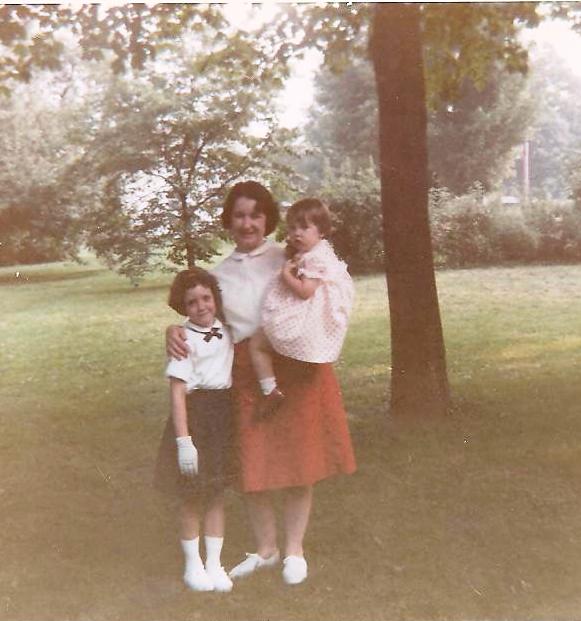
With my mother and sister before I marched in the parade for the first time.
Every August, my town is transformed by the Bridgewater Country Fair. Sponsored by the volunteer fire department, this annual event was one of the highlights of my childhood. The fair was a magical place with a merry-go-round and Ferris wheel, farm animals, flowers, and vegetables. All summer, I looked forward to eating all the food I could only get at the fair.
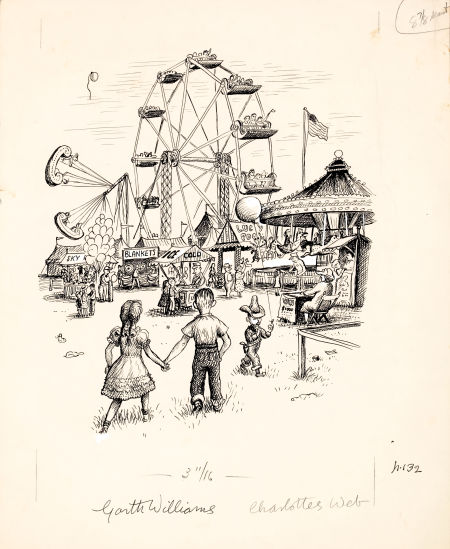
The fair where Wilbur and Charlotte have their final triumph has always reminded me of our fair. As a matter of fact, I think one of the reasons I loved Charlotte’s Web so much the first time I read it was because White’s description of the fair resonated so deeply with me. (I still love it, but for many other reasons.) I’ve often tried to write something about the Bridgewater Fair, but have never been happy with the results. So this year, inspired by Margaret, I decided to create a found poem using White’s own words. Drawn from chapters XVI, XVII, XVIII, and chapter XIX, this poem uses White’s language to capture my memories of the fair of my childhood.
“Off to the Fair”
The Fair only comes once a year.
Balloons aloft.
Clean straw,
new pigpen,
cattle barn,
sheep blatting,
first prize.
“Can I have some money?”
Have some fun on the midway:
Ferris wheel turning,
round and round in the sky.
Music of the merry-go-round,
steer a jet plane.
“Hold on tight!”
Spin a wheel, win a doll.
Many fine smells in the air:
Hamburgers frying,
popcorn,
candied apples,
lollypops.
Wonderful excitement!
Wonderful adventure!
~from the words of Charlotte’s Web, by E.B. White
Happy Friday, everyone! I’m “off to the fair!”
Thank you to Lisa at Steps and Staircases for hosting the Poetry Friday Round Up today. Be sure to head over and read more wonderful poetry!
More Jane Yolen, of course! After highlighting just 10 (well, maybe a few more than 10) picture books by one of the most prolific authors ever for Picture Book 10 for 10, I can’t stop reading (and rereading) books by Yolen.
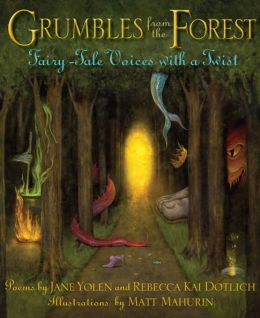
One of her more recent volumes is a book of poetry, co-written with Rebecca Kai Dotlich. In Grumbles from the Forest: Fairy-Tale Voices with a Twist (Wordsong, An Imprint of Highlights, 2013; illustrated by Matt Mahurin), Yolen and Dotlich use fifteen well-known fairy tales as a spring board for pairs of poems that let the characters speak for themselves. Snow White has her say, as do Gretel and Goldilocks. There are also poems that give voice to supporting characters, such as the the Wicked Fairy from Sleeping Beauty, who admits she “should’ve read/that page on tips.” While some of the poems do have a humorous tone, others reveal the dark side of the fairy tale. Beauty’s isolation is tinged with sadness as she wonders “what sounds children/might have made/running across the marble halls…”
These poems are naturals for reading after reading the original tale. Anchor Standard 9 of the CCSS states that students will “analyze how two or more texts address similar themes or topics in order to compare the approaches the authors take.” At many grade levels, students are expected to use fairy tales, myths, and legends for this purpose.
In a note to their readers, Yolen and Dotlich also urge their audience to “try writing a fairy tale poem yourself [and] make a little magic.” By “juggling different perspectives,” students will develop a deeper understanding of characters who, in many retellings, are often no more than stereotypes.
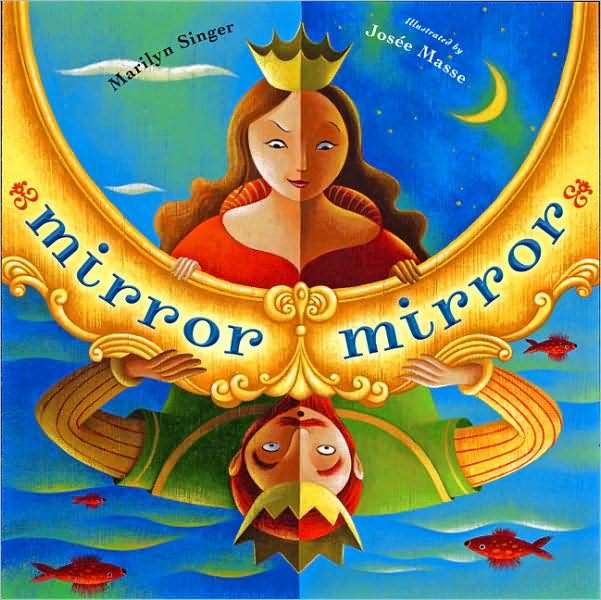
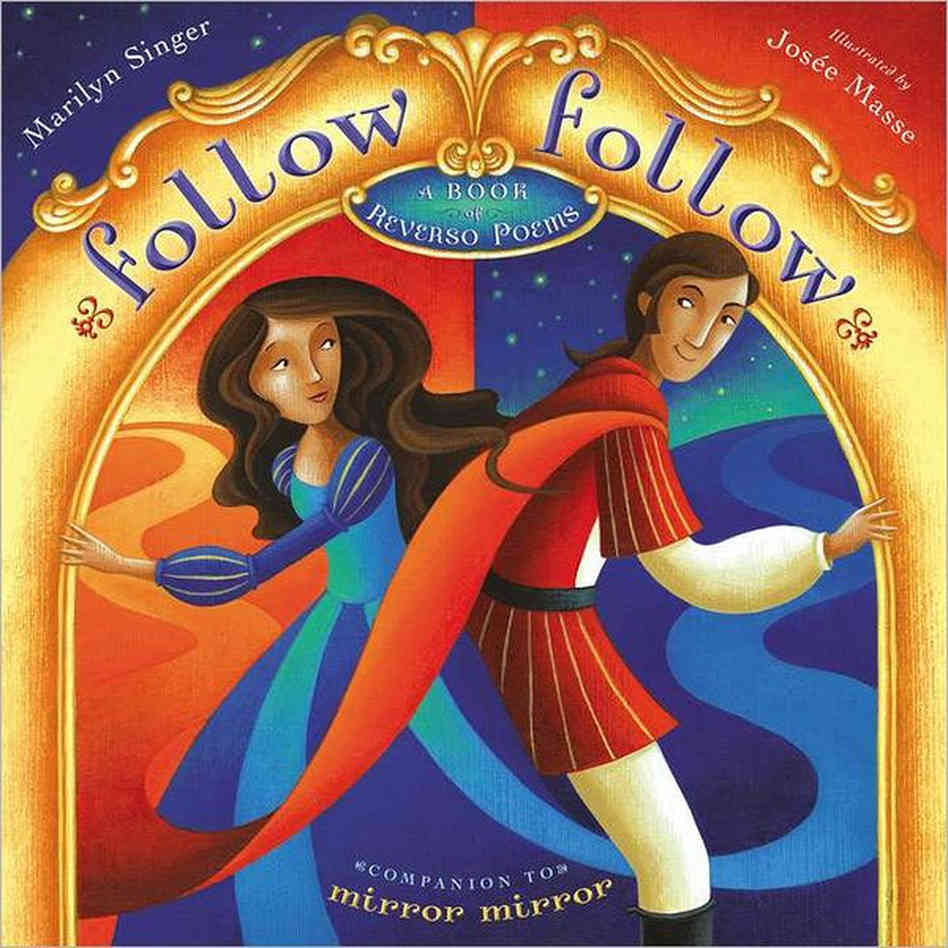
Of course, there are numerous versions of these tales that do adopt the point of view of a character who doesn’t usually have a voice. Since the huge success of The True Story of the Three Little Pigs, by Jon Scieszka (Viking Press, 1989; illustrated by Lane Smith) these “fractured fairy-tales” have become their own sub-genre. There are also other poets who have given a voice to favorite fairy tale characters. Marilyn Singer has written two books of reversos, pairs of poems which use the same words in reversed order to present the perspective of two different characters. Singer’s poems in Mirror, Mirror (Duttons Children’s Books, 2010; illustrated by Josee Masse) and Follow, Follow (Dial Books, 2013; also illustrated by Josee Masse) are similar to Yolen and Dotlich’s as they have humor but don’t shy away from the hard lessons these characters have learned. Masse amazingly repeats this feat in her illustrations.
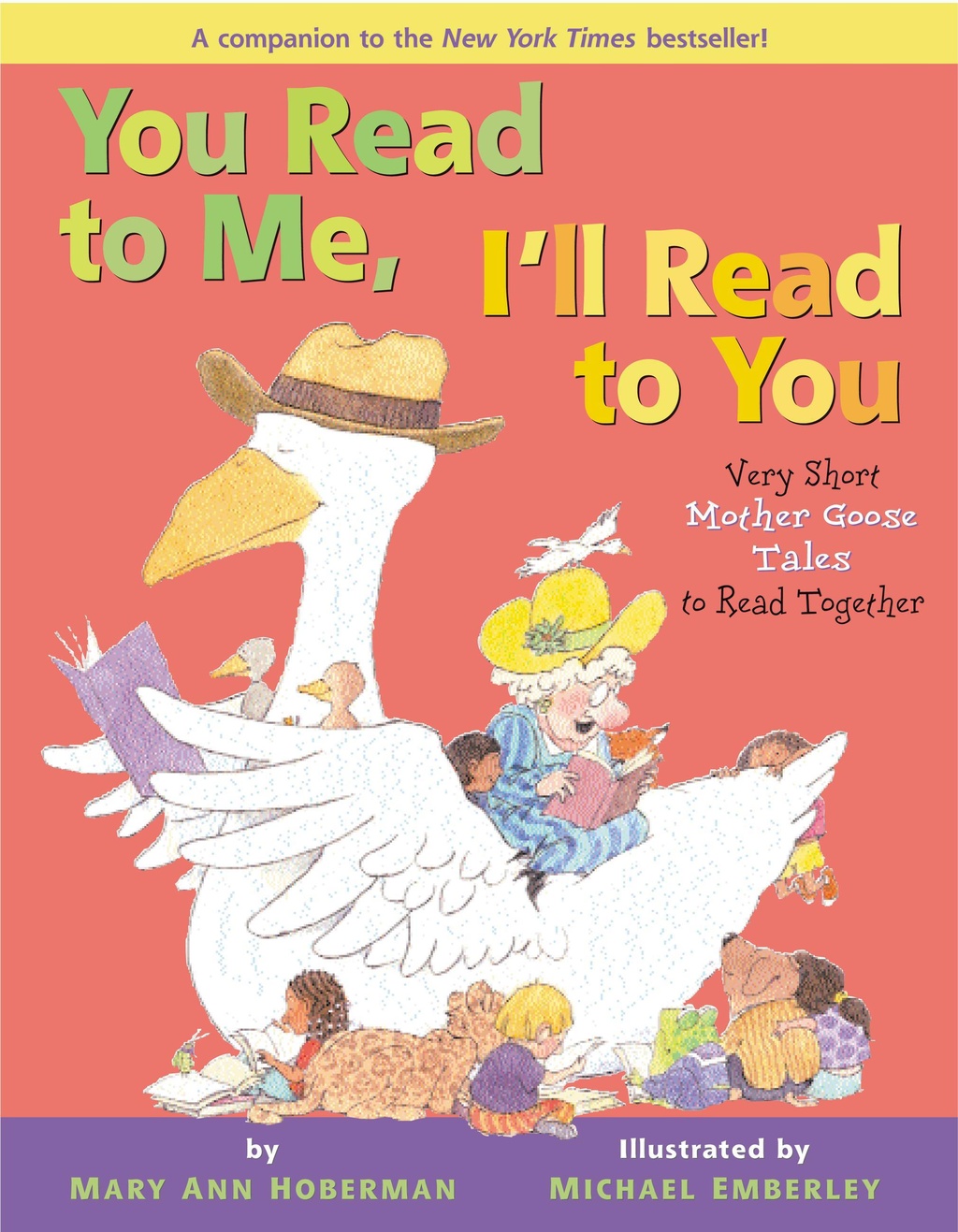
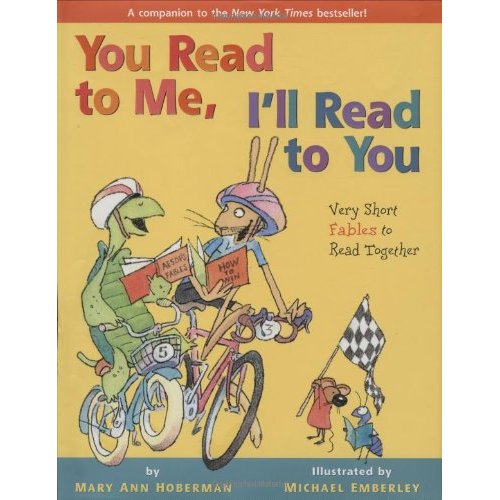
Grumbles from the Forest and both of Singer’s books will be best understood by students in third grade and up. Why should they have all the fun? Mary Ann Hoberman’s You Read to Me, I’ll Read to You series has a collection devoted to fairly tales, Mother Goose, and Aesop’s fables that are perfect for sharing with younger readers.
Sadly, I’m no longer surprised when students arrive at school not knowing these classic stories. My library, though, is well-stocked with classic versions of these stories, as well as many of the fractured variety. I share them with students every chance I get. I believe Yolen is absolutely correct when she wrote in Touch Magic: Fantasy, Faerie and Folklore in the Literature of Childhood, (August House, 2000) “that culture begins in the cradle…to do without tales and stories and books is to lose humanity’s past, is to have no map for our future.”
Be sure to visit Jen at Teach Mentor Texts and Kellee at Unleashing Readers to find out what other people have been reading lately. Thanks, Jen and Kellee, for hosting!
Picture Book 10 for 10 is the brainchild of Cathy Mere of Reflect & Refine: Building a Learning Community and Mandy Robeck of Enjoy and Embrace Learning. During this annual event, now in its fourth year, teachers, librarians, and book lovers create lists of 10 essential picture books. Cathy and Mandy collect and share these lists, and everyone is richer because of their efforts. Be sure to visit their blogs to see their lists, and check out links to other lists. Thank you, Cathy and Mandy, for organizing this celebration of children’s literature!
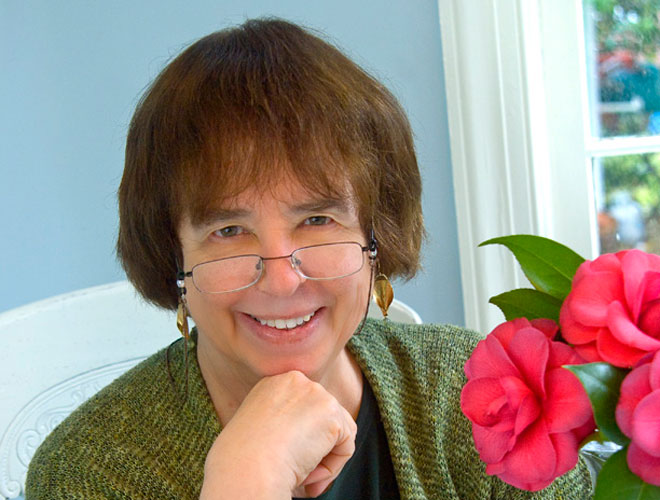
Jane Yolen, who has been called the Hans Christian Anderson of our time, is one of my favorite authors and I’ve always used her books in my classroom. Her books are filled with humor, compassion, and a deep desire to ensure that children continue to have quality literature that preserves our cultural heritage. She has written over 300 books, including fantasy and fairy tales, historical fiction, poetry, rhyming picture books, non-fiction picture books, novels and more. Needless to say, trying to choose just ten of her books turned out to be quite a challenge! I tried to include one book from each genre Yolen has written in and I admit my choices are very subjective. Many of these are older works that I read to my children when they were small. These, of course, are my favorites.
Photo by Jason Stemple, via wired.com
One of the most generous and inspiring writers working today, Yolen speaks at conferences of teachers and writers often, sharing her wisdom about books and writing. I have been fortunate to hear her speak twice, and a smarter, funnier, kinder advocate for children’s literature is not to be found. Yolen’s website is a treasure-trove of information about anything to do with her life and work.
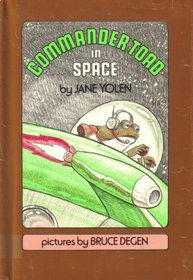
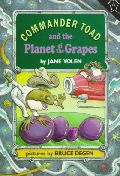
Commander Toad in Space (CowardMcCann, 1980; illustrated by Bruce Degen) On her website, Jane explains that she got the idea for this series (which are really early readers) when she read an article in her local newspaper about a boy whose frog, “Star Warts”… “had just won a jumping frog contest.” Yolen goes on to point out that “every book is riddled with puns,” which today’s beginning readers are certain to understand, given the popularity of Star Wars. Not all the puns are related to Star Wars, though. Commander Toad and the Planet of the Grapes (CowardMcCann, 1982) gives a nod to another Hollywood classic, and Mr. Hop is suspiciously Spock-like. Even if they don’t get all the allusions, these books (there are seven titles altogether) are tried and true favorites of first and second grade readers.
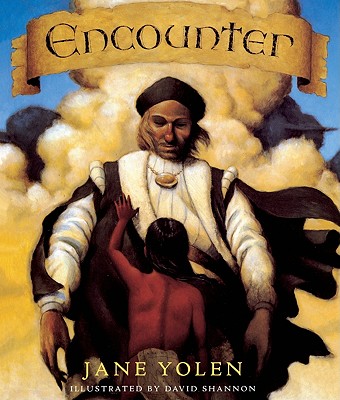
Encounter (Harcourt Brace, 1992; illustrated by David Shannon) Kirkus described this book as “a poignent account of Columbus’s landfall in the Americas, from a Taino’s point of view.” An important counterpoint to “In 1492, Columbus sailed the ocean blue…” this book belongs in every classroom. Yolen’s subtle prose and Shannon’s luminous illustrations ensure that this vanished culture won’t be forgotten.
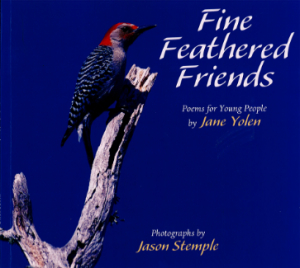
I love of all of Jane’s poetry, so it was difficult to choose a single book. She and her son, Jason Stemple, have teamed up to create a number of books like Fine Feathered Friends (Boyds Mills, 2004). Yolen uses Stemple’s stunning “photographs as a jumping off place for poetry.” (About.com interview) A masterful poet, Yolen’s poems are full of imagery, humor, and facts about each bird. Haikus, quatrains, and other forms are paired with facts about each bird, including its genus, species, and habitat.
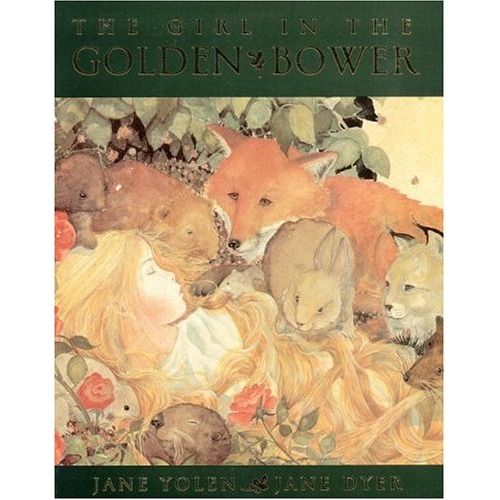
The Girl in the Golden Bower (Little Brown, 1994; illustrated by Jane Dyer) is an original fairy tale that my third graders always loved. Indeed, Book List states that “the lyrical language Yolen employs makes this an excellent choice for reading aloud.” The story contains many elements for the genre, including an evil sorceress, magical objects, spells, and people who are who are transformed into animals.
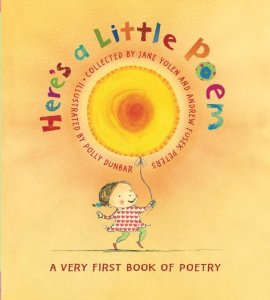
Here’s a Little Poem: A Very First Book of Poetry (Candlewick and Walker UK; with Andrew Fusek Peters; illustrated by Polly Dunbar) Jane edited this anthology with British author Andrew Fusek Peters. It is one of my favorite collections, full of poems about the everyday lives of young children. My favorite poem in this collection will always and forever be “The No-No Bird,” by Peters. It begins “I’m the no-no bird/that’s right, that’s me/I live up in/the Tantrum Tree.” One year I had a student who said no to everything I tried to read with him until we got to this. I think he suddenly realized that he wasn’t alone in his negativity! He still remembers this poem, and he’s now a passionate reader who’s about to start fifth grade.
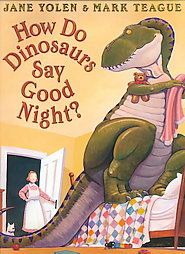
How Do Dinosaurs Say Good Night? (Scholastic, 2000; illustrated by Mark Teague) This rhyming picture book is probably one of Ms. Yolen’s best known recent works. It has won numerous awards and is the first book in a series which now includes seven titles. These dinosaurs have daily lives exactly like those of their young fans. And while not always the models of appropriate behavior, in the end, they do what’s right and turn out the light. (Sorry, I’ve read this too many times today!)
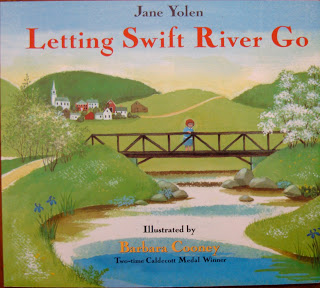
Letting Swift River Go (Little Brown, 1992; illustrated by Barbara Cooney) My grandmother grew up in Athol, one of the towns near the Quabbin Reservoir, so I was immediately drawn to this book when it was published. It tells the story of how four towns along the Swift River in central Massachusetts were flooded to create a source of drinking water for Boston. Yolen’s text explains this process in a child-friendly way. Indeed, the Los Angeles Times Book Review wrote that “…the words convey the poignancy of change, as well as the healing effects of accepting change and moving on.” Both the town where I live and the town where I teach are bordered by lakes that were created by flooding sections of our river communities. I have shared this book with students many times to give them a better understanding of our towns’ history.
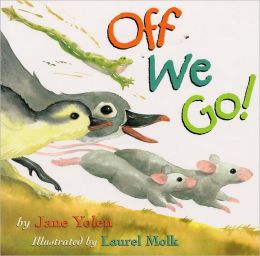
Off We Go! (Little Brown, 2000; illustrated by Laurel Molk) In this rhyming picture book for the preschool set, all the animals are off to Grandma’s house. Told in quatrains, each animal’s stanza begins with an action: the mouse goes “tip-toe, tippity toe,” while the frog goes “hip-hop, hippity hop.” I can envision students acting out these stanzas as the story is read.
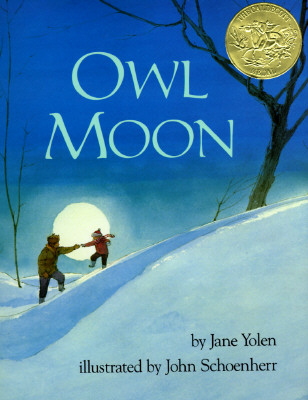
Perhaps Ms. Yolen’s best known book, Owl Moon (Philomel, 1987) was awarded the Caldecott Medal for John Schoenherr’s gorgeous illustrations. This story of a little girl going owling with her father was a particular favorite of my adventurous boys when they were little. They took great delight in finding the woodland animals Schoenherr hid in the shadows of his woodland scenes. The Horn Book called the text “quiet and reflective,” (Vol. 62, No. 6, p. 790) and Yolen herself considers the text “an unrhymed picture book poem.”
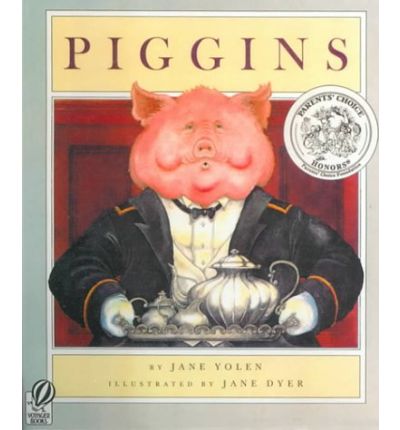
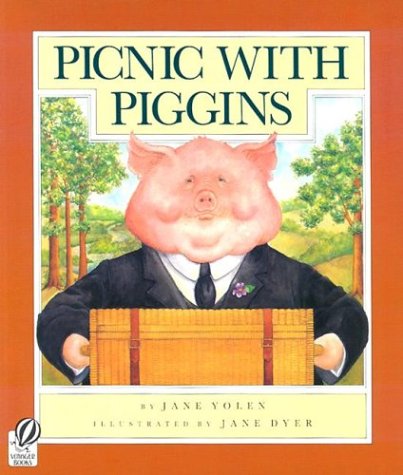
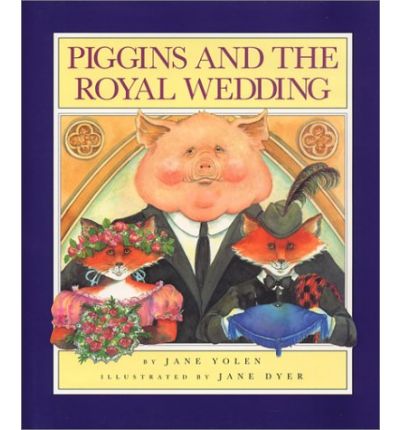
Piggins (Harcourt, 1987; illustrated by Jane Dyer) is the story of Piggins, a very proper British butler, who keeps everything running smoothly at 47 The Meadows, the very proper Edwardian home of Mr. and Mrs. Reynard. Small mishaps have happened around the house, and Mrs. Reynard’s cursed diamond lavalier is blamed. The Reynards invite their close friends to a dinner party, hoping that they will be able to sell the necklace. A mystery ensues and Piggins saves the day. Humorous allusions abound and although the original readers (i.e. parents) found similarities to Upstairs, Downstairs, today’s parents are more likely to be reminded of Gosford Park. The fun continues in Picnic with Piggins (Harcourt Brace, 1988) and Piggins and the Royal Wedding (Harcourt Brace, 1988). Both are also illustrated with Jane Dyer’s charming watercolors.
I could go on and on, and shudder to think of some of the books I left off this list. What is your favorite Jane Yolen picture book?
Thank you, Ms. Yolen, for your tireless efforts to create this wonderful body of work that will continue to enrich the lives of children and adults alike for years to come.
TeachersWrite, the summer writing camp for teachers organized by Kate Messner, Gae Polisner, Jo Knowles, and Jen Vincent, ends Monday. While I’m sad that the structured lessons, quick-writes, and feedback opportunities will be ending, I’m very excited about the writing I’ve done this summer. I’ve learned so much and can’t wait to get back to school to share these insights with my colleagues and students.
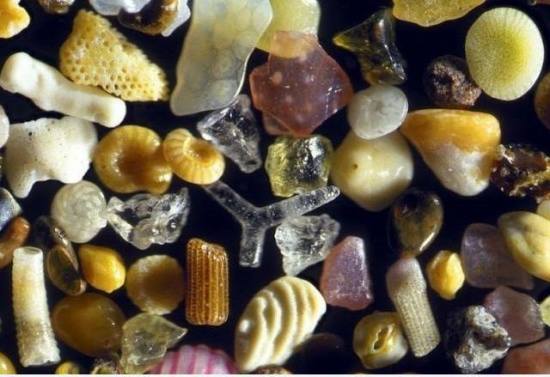
Today’s poem was inspired by this photo, which a friend shared on Facebook a few weeks ago. I was amazed by the uniqueness of each individual grain, and it got me thinking. This is the current draft of the resulting poem:
Sometimes in our busy lives,
we brush others aside
as carelessly as we brush
the sand off our feet
after a day at the beach.
But what if we stopped,
took a moment
for a closer look?
What wonders might be revealed to us?
The geologist, turning
her microscope to those few
grains of sand,
is rewarded with
an astonishing menagerie:
a crystal jack, broken in half
translucent beads, flecked with whirls of milky white
Many, many thanks to Kate, Gae, Jo, and Jen, for a wonderful, rewarding summer of writing. I’m looking forward to being back next summer! (And maybe meeting some of you at NCTE in Boston?)
There are more incredible photos of magnified sand at InspirationGreen. I think this would be a perfect quick-write to share with students of any age.
Thanks also to Renee at No Water River for hosting the Poetry Friday Round Up. Be sure to visit her and all the other Poetry Friday folks.
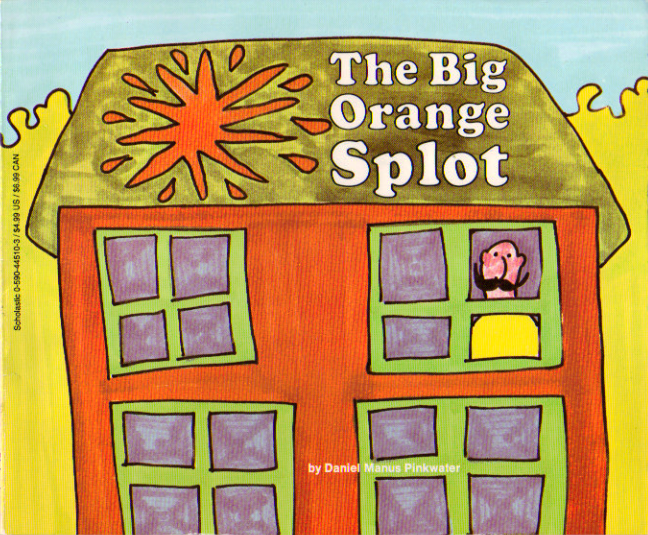
When I taught third grade, The Big Orange Splot, by Daniel Pinkwater, was always a favorite. This is the improbable story of what happens after an errant seagull flies over Mr. Plumbean’s house and drops a can of orange paint on the roof. Because “all the houses were the same” on their “neat street,” the neighbors assume that Mr. Plumbean will get right to work repainting his house. But he waits a little while. He thinks about the splot. When he finally does paint his house, it’s not at all what the neighbors had in mind. When asked what he has done, Mr. Plumbean simply replies, “My house is me and I am it. It looks like all my dreams.” At first the neighborhood thinks he’s nuts, but after a while they start to see the wisdom of Mr. Plumbean’s mantra. Eventually the houses aren’t the same at all and Mr. Plumbean’s neighbors dreams are revealed through their houses.
Kids loved the wackiness of Mr. Plumbean and his house, and were intrigued by the other houses in the neighborhood. I began collecting photos of unusual houses and buildings to display on a bulletin board when we read this story. Then I found this poem, the perfect complement to the pictures.
Buildings
by Myra Cohn Livingston
Buildings are a great surprise,
Everyone’s a different size
Offices grow long and high
Tall enough to touch the sky.
Houses seem more like a box
Made of glue and building blocks
Every time you look, you see
Buildings shaped quite differently
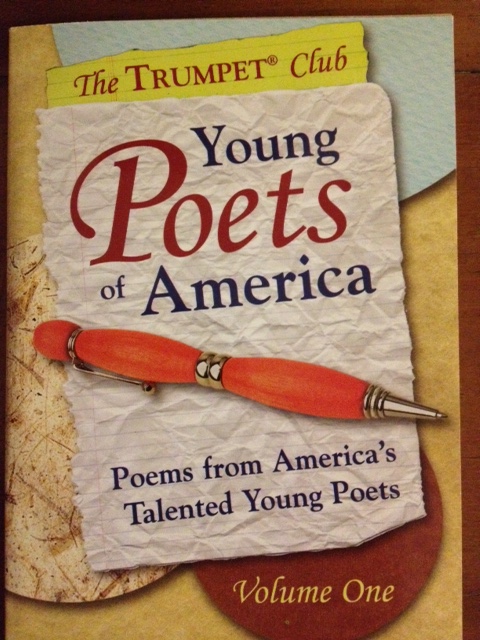
One year during this unit, a poetry contest was announced in the Trumpet Book Club order. (Trumpet either was or became part of Scholastic.) We had been reading and writing poetry since the start of school, so I shared this with my students and encouraged them to enter. I don’t remember specifically telling anyone to write a poem about a building, but the bulletin board did inspire some of them. Several students did submit poems to the contest and we were all thrilled when Allie’s poem was chosen to be included in this anthology:
A Windmill
by Allie Mandeville
Windmill dancing in the breeze,
With a swift, turning ease.
The windmill makes a squeaky sound
As it’s turning round and round.
Spinning once, spinning twice,
The sound of spinning
Sounds so nice.
And as the wind makes it turn,
The windmill looks so very stern.
The windmill looks so beautiful.
The windmill looks so nice.
But don’t you think
It must be full of mice?
(Thank you, Allie, for permission to share your poem.)
The picture that inspired Allie’s poem. Photo by Brad Stanton
I was reminded of all this recently when I found a copy of the anthology at a local book sale. I’m sure that if I were teaching third grade today I would still put up bulletin boards of interesting photos related to what we were reading and learning about. I know I would still be teaching writing using a workshop model. I would allow students to choose topics and subjects that interested them, not limit them to prompts provided by the state or some other distant textbook publisher.
I would do all this and more to help them understand that the world is full of possibilities. I would do this so they could write poems that are full of all their dreams.


![Alexander Nasmyth [Public domain], via Wikimedia Commons](https://readingtothecore.com/wp-content/uploads/2013/09/pg_1063burns_naysmithcrop.jpg)

 Reading to the Core
